
A new paper dealing with solar phenomena catches my eye this morning. Based on work performed at the University of Michigan, it applies computer modeling to delve into what we can call ‘structures’ in the solar wind, which basically means large-scale phenomena like coronal mass ejections (CMEs) and powerful magnetic flux ‘ropes’ that are spawned by the interaction of a CME and solar wind plasma. What particularly intrigues me is a mission concept that the authors put to work here, creating virtual probes to show how our questions about these structures can be resolved if the mission is eventually funded.
More on that paper in a minute, but first let me dig into the mission’s background. It has been dubbed Space Weather Investigation Frontier, or SWIFT. Originally proposed in 2023 in Frontiers in Astronomy and Space Sciences and with a follow-up in 2025 in Acta Astronautica (citations below), the mission is the work of Mojtaba Akhavan-Tafti and collaborators at the University of Michigan, Les Johnson (NASA MSFC) and Adam Szabo (NASA GSFC). The latter is a co-author on today’s paper., which studies the use of the SWIFT probes to study large-scale solar activity.
What SWIFT would offer is the ability to monitor solar activity at a new level of detail through multiple space weather stations. A solar sail is crucial to the concept, for one payload must be placed closer to the Sun than the L1 Lagrange point, where gravitational equilibrium keeps a satellite in a fixed position relative to Sun and Earth. Operating closer to the Sun than L1 requires a solar sail that can exactly balance the momentum of solar photons and the gravitational force pulling it inward. If this ‘statite’ idea sounds familiar, it’s because the work grows out of NASA’s Solar Cruiser sail, a quadrant of which was successfully deployed last year on Earth. We’ve discussed Solar Cruiser in relation to the study of the Sun’s high latitudes using non-Keplerian orbits.
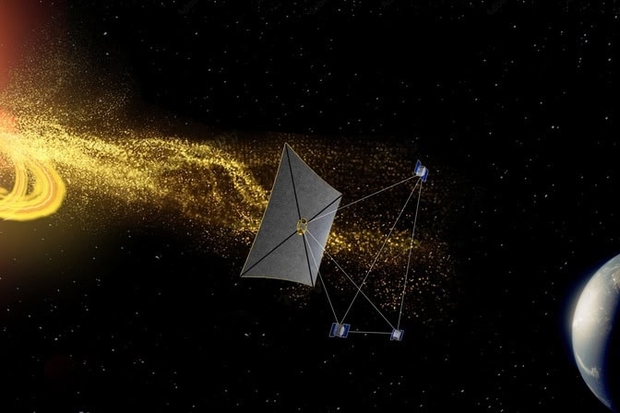
Image: An artist’s rendering of the spacecraft in the SWIFT constellation stationed in a triangular pyramid formation between the sun and Earth. A solar sail allows the spacecraft at the pyramid’s tip to hold station beyond L1 without conventional fuel. Credit: Steve Alvey, University of Michigan.
The SWIFT mission, unlike Solar Cruiser, would consist of four satellites – one of them using a large sail, and the other three equipped for chemical propulsion. Think of a triangular pyramid, with the sail-equipped probe at the top and the other three probes at each corner of the base in a plane around L1. Most satellites tracking Solar activity are either in low-Earth orbit or geosynchronous orbit, while current assets at the L1 point (WIND, ACE, DSCOVR, and IMAP) can offer up to 40 minutes of advance warning for dangerous solar events.
SWIFT would buy us more time, which could be used to raise satellite orbits that would be compromised by the increased drag caused by atmospheric heating during a geomagnetic storm. Astronauts likewise would receive earlier warning to take cover. But the benefits of this mission design go beyond small increases in alert time. With an approximate separation of up to 1 solar radius, the SWIFT probes would be able to extract data from four distinct vantage points.
Designed to fit the parameters of a Medium-Class Explorer mission, SWIFT is described in the Johnson et al. paper in Acta Astronautica as a ‘hub’ spacecraft (sail-equipped) with three ‘node’ spacecraft, all to be launched aboard a Falcon 9. The craft will fly “in an optimized tetrahedron constellation, covering scales between 10 and 100s of Earth radii.” A bit more from the paper:
This viewing geometry will enable scientists to distinguish between local and global processes driving space weather by revealing the spatial characteristics, temporal evolution, and geo-effectiveness of small-to meso-scale solar wind structures and substructures of macro-scale structures, such as interplanetary coronal mass ejections (ICMEs) and stream interaction regions (SIRs). In addition, real time measurements of earth-bound heliospheric structures from sub-L1 will improve our current forecasting lead-times by up to 35 percent.
Looking now at the paper “High-resolution Simulation of Coronal Mass Ejection–Corotating Interaction Region Interactions: Mesoscale Solar Wind Structure Formation Observable by the SWIFT Constellation,” with lead author W. B. Manchester, the scale of the potential SWIFT contribution becomes clear::
The radial and longitudinal spacecraft separations afforded by the SWIFT constellation enable analyses of the magnetic coherence and dynamics of meso- to large-scale solar wind structures… The main advantage of the tetrahedral constellation is its ability to distinguish between a structure’s spatial and temporal variations, as well as their orientations.
Coronal mass ejections are huge outbursts of plasma whose injections into the solar wind form mesoscale structures with profound implications for Earth. Magnetic field interactions can produce geomagnetic storms that play havoc with communications and navigation systems. The effects show up in unusual places. Sudden changes in Earth’s atmosphere can affect satellite orbits. On the ground, this particular study, out of the University of Michigan, cites a 2024 geomagnetic event that created large financial losses in agricultural areas in the US Midwest by crippling navigation systems on farm-belt tractors.
Mojtaba Akhavan-Tafti, co-author of the paper, notes the need for more precise detection of this phenomenon:
“If there are hazards forming out in space between the sun and Earth, we can’t just look at the sun. This is a matter of national security. We need to proactively find structures like these Earth-bound flux ropes and predict what they will look like at Earth to make reliable space weather warnings for electric grid planners, airline dispatchers and farmers.”
Flux ropes, between 3,000 and 6 million miles wide, are hard to recreate in current CME simulations and prove too large for existing modeling of magnetic field interactions with plasma. The new study produces a simulation that probes the phenomenon, showing that these ‘ropes’ are produced as the coronal mass ejection moves outward through solar wind plasma, and can form vortices interacting with different streams of solar wind. The authors compare them to tornadoes, noting that existing space weather-monitoring spacecraft are not always able to detect their formation. SWIFT will be able to spot them.
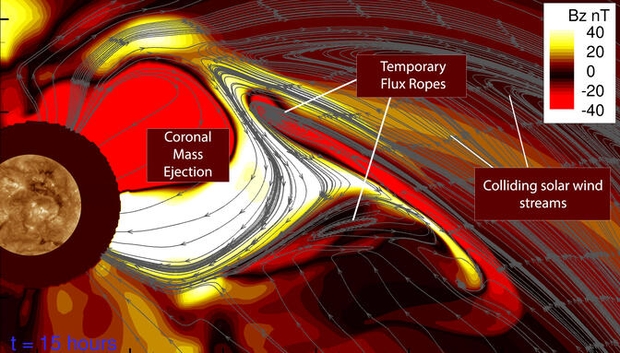
Image: A computer-generated image shows where rotating magnetic fields form at the edges of a coronal mass ejection 15 hours after a solar eruption. The coronal mass ejection is the large bubble extending from the sun at the left edge of the image. Two streams of plasma extend from the edge of the coronal mass ejection as it hits neighboring streams of fast and slow solar wind. Shades of red and yellow depict the strength and orientation of the plasma’s magnetic field (labeled “Bz” in the figure legend). Shades of red represent plasma that could trigger geomagnetic storms if it hits Earth, while shades of yellow represent plasma with a strong, positive orientation. The red-brown circle around the sun shows the area not covered by the simulation, about ten million miles wide. ILLUSTRATION: Chip Manchester, University of Michigan.
This is fascinating research into a topic with near-term ramifications, a matter of planetary defense that we can take steps to resolve soon, although as always we await funding decisions. In the larger perspective, here is another way sails can be employed for purposes no other propulsion method could achieve. Future sails could use these methods to ‘hover’ over the Sun’s polar regions. Moreover, close observation of space weather changes near the Earth has much to tell us about future mission concepts that would harness solar wind plasma to drive a magsail or enable an electric sail to reach high velocities.
ADDENDUM: Alex Tolley tracked down a paper I hadn’t seen on SWIFT, available here. This may be helpful in understanding the full mission concept.
The 2023 paper on SWIFT is Akhavan-Tafti et al., “Space weather investigation Frontier (SWIFT),” Frontiers in Astronomy and Space Sciences Vol 10 (2023), 1185603 (abstract). The 2025 paper is Johnson et al., “Space Weather Investigation Frontier (SWIFT) mission concept: Continuous, distributed observations of heliospheric structures from the vantage points of Sun-Earth L1 and sub-L1,” Acta Astronautica Vol. 236 (November 2025), 684=691 (abstract). The paper on solar activity as a target for SWIFT is Manchester et al., “High-resolution simulation of CME-CIR interactions: small- to mesoscale solar wind structure formation observable by the SWIFT constellation,” The Astrophysical Journal Vol. 992 No. 1 (2025), 51 (full text).
I am confused by the description of SWIFT.
This implies 4 separate satellites, one with a solar sail, and 3 using conventional rocket engines.
But the image shows a single solar sail and at least 3 instruments hanging off it in a tetrahedral arrangement, implying this is the SWIFT configuration.
Then later:
and,
This implies that this is a constellation of spacecraft, with a wide separation to be able to map the structure of the solar flares in 3D.
Is the image just showing the relationship, but not the scale of the probes, and the lines of the tetrahedron just indicative of their arrangement, when the probes are actually “free-flying” and widely separated (although how can they stay in alignment when the sail is a statite?).
With only abstracts to work with, the SWIFT configuration is unclear to me.
Yes, the image isn’t a good one. It’s almost a schematic of the idea rather than an illustration, and it’s grossly out of scale. The probes are free-flying and widely separated. I don’t have anything further (yet) on maintaining the orientation of this constellation of craft.
There is now a better way fold structures:
https://techxplore.com/news/2025-11-interlaced-origami-enables-compact-storage.html
Aluminum advancement:
https://techxplore.com/news/2025-11-ultra-strong-lightweight-metal-composite.html
Diamond coatings
https://phys.org/news/2025-11-lab-grown-diamond-coatings-shown.html
Given the current regime’s attitude to space science (especially weather, terrestrial or otherwise), and the currently reduced NASA budget focused on the Artemis lunar mission[s], I doubt this proposal will fly.
On a related note, while the Venus missions VERITAS and DAVINCI are being canceled, the privately funded Morning Star missions to Venus to do the first experiment to look for life in the temperate atmosphere zone is due to launch next year. The kit is now delivered and waiting to be integrated and mated with the rocket.
Seeking Signs of Life on Venus
I can only hope that Chinese (and Indian) missions, both crewed and robotic, will shake up the US with a new “Sputnik moment” and revive the need to fund science and engineering in space to prevent being left behind as observers only.
Alex, since you brought up Venus and the search for life there, what are your thoughts on this recent relevant discovery concerning brown dwarfs…
https://www.space.com/astronomy/james-webb-space-telescope/the-search-for-life-on-venus-just-took-another-turn-thanks-to-jwsts-brown-dwarf-discovery
To quote from the opening of the above article…
The James Webb Space Telescope (JWST) has discovered phosphine in the atmosphere of a brown dwarf — the same chemical that stoked controversy following claims that it had been detected on Venus and could be coming from life.
This new detection on a brown dwarf is predicted by models that simulate alien atmospheres and is a reminder that phosphine is not necessarily a biosignature. However, astronomers remain puzzled about why some objects contain phosphine and others do not, even though theory says it should be there.
The phosphine was identified in the cold atmosphere of a brown dwarf called Wolf 1130C, which exists in a triple system along with a low-mass red dwarf star and a white dwarf. The phosphine exists with an abundance of 0.1 parts per million, which matches what models of the atmosphere of gas giant planets and brown dwarfs predict. Indeed, both Jupiter and Saturn contain a similar abundance of phosphine to Wolf 1130C.
@LJK
The best response is from Natalie Chabrol.
Wolf 1130C: Phosphine, Evidence, and an Exercise in Scientific Restraint
Magnetic ‘switchback’ detected near Earth for the first time.
by Sarah Stanley, Eos
The findings suggest that switchbacks can occur not only close to the sun, but also where the solar wind collides with a planetary magnetic field. This could have key implications for space weather, as the mixing of solar wind plasma with plasma already present in Earth’s magnetosphere can trigger potentially harmful geomagnetic storms and auroras.
The study also raises the possibility of getting to know switchbacks better by studying them close to home, without sending probes into the sun’s corona.
https://phys.org/news/2025-10-magnetic-switchback-earth.html
Seems similar activity is happening near Earth also…
What a remarkable sentence this is!
“…the privately funded Morning Star missions to Venus…”
Agreed. Imagine reading this back in the Apollo era.
They might be even more shocked that humans would stop sending representatives of themselves to the Moon after 1972 and that no astronauts or cosmonauts have set foot on Mars by now.
Yes, automated probes are more efficient and cheaper, but they expected people exploring and settling those worlds by now back in 1969. I know I certainly did.
Just a few examples…
https://www.youtube.com/watch?v=onoibcAedmY
https://www.youtube.com/watch?v=WFXza9RH7-E
https://www.youtube.com/watch?v=3wIXZsbjIxA
And yet Clarke, as ever, presaged this robotic future in 2001:ASO. Recall that while the USS Discovery was crewed by humans, 2 awake, 3 in hibernation, the ship’s AI, HAL 9000, stated that in the event of an incapacitated crew, it could manage the mission objectives at Saturn (Jupiter in the movie) on its own.
Apollo was less than 20 years after Alan Turing wrote about AI and suggested a way to determine if a computer was intelligent with his now famous Turing Test. Now, 75 years later, we know computers can easily pass the Turing Test with chat using a clever “imitation game”, but is not truly intelligent. Whether a neural network system, like LLMs, allied with symbolic logic, like HAL 9000, can fully replace humans in space, we don’t yet know, but I wouldn’t bet against it. Since we cannot hibernate humans for really deep space exploration, and humans could not approach Europa as in the movie 2001 and subsequent novels of that universe, machine explorers will be the best way to explore beyond the inner solar system. Unless all our efforts to make thinking machines hit a real barrier in the near future, 50 years from now, there could be “intelligent” machine explorers all over our system, perhaps out to the Kuiper belt and interstellar space, able to operate with minimal management feedback from humans. No Discovery class spaceships needed with complex life support. The intelligences will be both spaceships and smaller probes.
I think this article did a good job of explaining the concept, but here’s some more info. Disturbingly, I did not find an arxiv preprint for the 2025 paper, thought there is a slide show about the concept at https://ntrs.nasa.gov/api/citations/20240010921/downloads/SWIFT%20presentation.pdf
Note that this idea “descopes to” (centers around) a single statite probe displaced outward from L1. The probe is expected to increase the warning for space weather by 35%. Since L1 is 1.5 Gm (‘million km’) from the Earth, a simple-minded assumption would place the probe 0.53 Gm closer to the Sun than the L1 point. Presumably this is as far as the probe can venture from Earth orbit and use solar wind and solar sail to remain in synch with Earth’s orbit.
The additional probes require only chemical rockets as they are in halo orbits, approximately in the plane of L1. L1 has a region of influence of roughly 0.1 Gm (100,000 km), and the small sats could cover a scale of “10s to 100s of earth radii” >= 0.06 to 0.6 Gm or “1 solar radius” = 0.7 Gm. For comparison, SOHO’s orbit is 0.65 Gm.
The slide presentation describes an average tetrahedron quality factor of 0.605, where 1 is a perfect tetrahedron, and implies they want to maximize it. According to a simple-minded calculation, that could be done with less separation of the probes than this. But halo orbits are a bit complicated… https://www.scirp.org/pdf/IJAA_2016091415093705.pdf
The artistic drawing has good excuse to be unclear. The satellites are minute and separated by distances much larger than the Earth, so to scale they would only be dots. Perhaps doing it as a diagram of L1 and the orbits, with a magnifying-glass symbol around the drawing of each satellite would have made it clearer?
Totally agree. That may also be why Artilects (AI) will be the ones who find and communicate with similar entities, rather than our current SETI and METI methods.
Read the following from this link of an interview with Dr. Sara Seager, an astrophysicist and planetary scientist at the Massachusetts Institute of Technology (MIT), discussing who, what, and how a suitably advanced species would best move through interstellar space:
https://thereader.mitpress.mit.edu/exoplanets-sara-seager-interview/
“My personal opinion about life that could traverse the galaxy, if we are now talking about life that could come to Earth, or in the future, if we’re able to travel to a distant star system, is that it probably has to be nonbiological because space is very harmful for people. We can barely survive on Earth, if you think about it, and Earth is a very safe, well-designed place for us, or rather we are adapted to our environment. So I think for us initially as human beings to find life elsewhere, it’s bound to be biological, since that’s all we can see; it’s all we know how to do. But if we ever think of traveling through the galaxy or of alien life coming here, then I believe on a personal level that it will be nonbiological.”
@LJK
Nice to read that Sara Seager has joined the list of those who realize that non-biological intelligence will be the explorers of interstellar space.
Clarke was the first I ever read who thought that advanced intelligence would likely be non-biological. This was said in a Playboy interview after the release of the Kubrick movie of the novel.
More recently, Sir Martin Rees made a similar claim, but with regard to deep space exploration. The late James Lovelock argued that non-biological intelligence was his most likely scenario for the future of intelligence, in his book, Novacene.
I am sure there are many others, but outside of my reading. SciFi was the venue for these speculations, but it is a different matter when this is stated in non-fiction and interviews.
Now that LLM technology has given everyone a taste of communicating with an artificial “intelligence”, it is probably easier for the general public to contemplate the possibility of true machine intelligence sometime in the future and probably within their own lifetimes.
Britain’s Royal Society recently celebrated its “75th anniversary of the Turing Test“, watchable as a 5-hour recording of the event.
Speaking of a space vessel that requires sails, it looks like Breakthrough Starshot is in deep trouble before anything is even built, let alone launched…
https://www.youtube.com/watch?v=HwPTF_TZvWY
https://www.youtube.com/watch?v=FRHaMOR0dJ0
The finances and politics of this plan were far more of my concern than any technical or physics issues. Sadly they are now turning concern into reality. I also have had issues with the means for powering the mission that also involved politics and funding, along with such a powerful laser being used as a weapon.
Maybe those who want to see a real starship happen should start with solving the above issues first. Otherwise, we won’t be reaching any stars no matter how otherwise advanced we become on paper.
Update: I learned that the reason Breakthrough Starshot will not be heading to Proxima Centauri is because no one wants to pay the 100-billion-dollar price tag for such a mission, especially the megalaser.
I was told that someone has come up with an alternate plan at the very recent Interstellar Research Group (IRG) conference that will not require a laser but function more like the Parker Solar Probe using the Sun as a gravity assist to boost speed, much like the Voyager probes did with the outer planets, only a wee bit faster. I am hoping to find either the video lecture or the paper on this, or both, or if someone here can come to the rescue.
I will say once again that we could have had relatively fast interstellar travel decades ago with the Orion nuclear pulse vessel…
https://www.centauri-dreams.org/2016/09/16/project-orion-a-nuclear-bomb-and-rocket-all-in-one/
What about the BIS Daedalus probe, you say, which could have made it to Alpha Centauri in 36 years as opposed to one century for Orion? Well, for one, it required fusion propulsion, and we are still waiting for anything practical in that regard outside of the hydrogen bomb.
The BIS folks who designed Daedalus also thought the helium-3 required to fuel their interstellar probe would come from mining the atmosphere of Jupiter. I am still shocked that in the 1970s, when Daedalus was first thought up, that educated folks would seriously think we would have aerial mining operations floating in the Jovian atmosphere by the middle of the 21st Century. We may be able to get our helium-3 from the Moon, but we are at least a decade or more away from even setting up an initial crewed lunar base, let alone any mining operations.
Then there is the item I once read that Daedalus’ propulsion system might not actually work as conceived after all: The engines would actually burn themselves up in operation, which would be counter to the mission goals. Perhaps we will have the multiple fusion problems solved in the coming decades, but then we will still need to somehow get a working fusion engine into space and have it function for decades or more.
The BIS folks also assumed the computer brain of Daedalus would be semi-intelligent, which I presume means aware. We may be able to make an AI that can act and function like a conscious entity without requiring actual sentience, but my question is, what if true consciousness is required for this interstellar mission?
And worse, the BIS planners had Daedalus drifting off into deep space after plunging through the Barnard’s Star system as originally planned (they thought there were two gas giants circling that sun at the time – now we know there are at least four exoworlds there), leaving the probe’s main mind with nowhere else to go but to drift endlessly until it runs out of power. I recall reading in their accompanying book on the project that they gave no considering to the fate of this AI after it had served its initial purpose.
Maybe they didn’t know or care about such things in the 1970s, but maybe we can learn from this mistake and ensure such minds are not abandoned by us, should we ever finally get an interstellar mission off the ground.
And of course, as usual, so far as I can recall, no one mentioned where all the money would come from to build Daedalus: That it would have to be constructed in space would naturally add a few dollars to the project funding efforts.
So it would seem once again the biggest stumbling block to humanity reaching the stars is humanity itself. I wonder and hope other intelligences in the galaxy are more advanced in all aspects of their existence and have crossed any related cultural barriers by now.
Oh yes, decades later someone else came up with a follow-up plan called Icarus – after the son of Daedalus who flew too close to the Sun (Sol) and ended up plunging to his death in the sea. They at least admitted that there are many aspects of their project that are still insurmountable, with funding being among them.
https://interstellarresearchcentre.org/projecticarus
@LJK
The 1960s were a heady time for technology, boosted by the Apollo program and the space race. Clarke’s fiction had deep space missions. Poul Anderson had mining operations in the gas giant atmospheres. I thought we would have a Moonbase by the end of the century, even if it wasn’t so grand as 2001’s “Clavius”. Just look at the many books written about space hardware from the late 1940s onward. All assumed rapid development, perhaps inspired by the rapid advances in technology driven by WWII. Slightly more prosaically, we had Gerry O’Neill’s ideas for space colonies at L5, and vast space solar power satellites providing energy to Earth.
Space has proven far more hazardous than we once thought, and the costs of exploration, even robotic, are quite enormous. Coupled with the slowing of economic growth in the USA and Europe, and the increasing levels of national debt in most advanced nations, is it any wonder that populations wanted less “Buck Rogers” and more spending on domestic needs?
$100bn for a probe to Proxima? We cannot even fulfill that annual commitment to helping nations that are suffering from the effects of global heating. Elon Musk could foot that bill himself if he wanted to, dwarfing Milner’s $100m for Breakthrough projects.
A robotic probe to Proxima using gravity assists is not going to generate enough delta V to make the mission possible within the lifetime of any of the current nations. Either no one will even remember we sent a probe or be able to do anything about any signal that arrives back, or we will be so advanced that a later probe will have passed it en route. Maybe there will be a [human/robot] welcoming committee at Proxima when it finally arrives.
Interestingly, at a recent Royal Society meeting on AI and the Turing Test, one researcher stated that we should not make AIs conscious beings, for all the moral issues that would entail. An interesting goal, as consciousness may be an emergent feature of intelligence.
As for sending out a conscious intelligence, it may be fine. There is no reason to have its consciousness operate at the rate ours does. It could have a reduced clock speed to make even 1000 years seem to pass quite quickly. It could also live in a virtual world during the trip, emerging only for handling problems and the various flybys. It is no different than contemplating a trip circumnavigating the cosmos as nearly the speed of light and experiencing the flight over a human lifetime via relativistic time dilation.
Quoting Alex Tolley from above:
“As for sending out a conscious intelligence, it may be fine. There is no reason to have its consciousness operate at the rate ours does. It could have a reduced clock speed to make even 1000 years seem to pass quite quickly. It could also live in a virtual world during the trip, emerging only for handling problems and the various flybys. It is no different than contemplating a trip circumnavigating the cosmos as nearly the speed of light and experiencing the flight over a human lifetime via relativistic time dilation.”
You are likely – and hopefully – right about this. I was just bothered that the BIS team who put Daedalus together said so little about the AI system that would run the mission, and how when Daedalus had zipped through whatever star system was chosen to explore, the probe would be left to drift through interstellar space indefinitely, with no further mission plans or destinations.
Although I cannot recall if the BIS team said anything about this, one would assume if the probe were still functioning after its main mission, that they would utilize it to keep studying interstellar space and observe other celestial objects remotely from its vantage point, just as we are doing with the twin Voyager probes. I do know one of the Daedalus designs involved several optical telescopes the size of the one at Hale Observatory.
Their main focus was on the vessel’s propulsion system, I get that.
http://bisbos.com/space_n_daedalus.html
Some interesting bits on Daedalus variants here…
https://en.wikipedia.org/wiki/Project_Daedalus
To quote:
Variants
A quantitative engineering analysis of a self-replicating variation on Project Daedalus was published in 1980 by Robert Freitas.[9] The non-replicating design was modified to include all subsystems necessary for self-replication. Use the probe to deliver a seed factory, with a mass of about 443 metric tons, to a distant site. Have the seed factory replicate many copies of itself on-site, to increase its total manufacturing capacity, then use the resulting automated industrial complex to construct probes, with a seed factory on board, over a 1,000-year period. Each REPRO would weigh over 10 million tons due to the extra fuel needed to decelerate from 12% of lightspeed.
Another possibility is to equip the Daedalus with a magnetic sail similar to the magnetic scoop on a Bussard ramjet to use the destination star heliosphere as a brake, making carrying deceleration fuel unnecessary, allowing a much more in-depth study of the star system chosen.