
Because I’ve been talking about enormous structures lately and describing them as ‘big dumb objects,’ I thought it would be fun to revisit the origin of that term. BDOs emerged in what was intended as an April Fool’s joke by writer and critic Peter Nicholls, famed as editor (with John Clute) of The Encyclopedia of Science Fiction, now online in its fourth edition. He describes the genesis of the term in a well known essay called “Big Dumb Objects and Cosmic Enigmas: The Love Affair between Space Fiction and the Transcendental”:

“All these matters were in the forefront of my mind when I came to revise The Encyclopedia of Science Fiction, a task in which my primary responsibility was to rewrite and rethink all those entries dealing with the themes of science fiction. This brings us to April Fool’s Day, 1992, that being a day in which practical jokes are traditionally carried out. On that day I was exhausted writing theme entries, and my brain was hurting. So I decided to write an April Fool’s entry. I would pretend that a phrase that I’d always liked, originated by the critic Roz Kaveney but not in general use, was actually a known critical term. I would write an entry called “Big Dumb Objects” in a poker-faced style, suggesting an even more absurd critical term to be used in its place, “megalotropic sf…”
Image: The cover of the first edition of Greg Bear’s novel Eon (1985), which describes a huge, terraformed asteroid that enters the Solar System. This is one of the Big Dumb Object novels Nicholls discusses in his formative essay.
Nicholls soon realized that vast structures were symptomatic of what makes the best science fiction operate, and he relates them to the “…tension between the writer’s respect for and understanding of orderly scientific thought (the classical) and his love for the phenomena which do not submit to this order (the romantic).” If that seems a stretch, read the essay, where he points out that ‘hard’ science fiction, with its adherence to the laws of physics, can inspire in its ringworlds and Dyson spheres and Ramas a deep Dionysian mystery, a sense of the sublime that we can easily relate to the familiar ‘sense of wonder.’ I like Nicholls’ reference to the rituals of Dyonisus, with their ecstaties and trances.
In our talk about stability and BDOs, we home in on the practical matter of whether or not they could actually be built, but again, the laws of physics imply this is an engineering problem that an advanced civilization could well master. It could be, of course, that a Big ‘Dumb’ Object isn’t really so dumb if it needs a constant technological assist to survive, but Colin McInnes, whose essay on stellar engines we examined last week, has also produced a paper covering ringworlds and Dyson spheres that finds modes of stability even there. I’ll give that citation below, and thank Dr. McInnes for his kind note with the reference. So maybe we need another term: ‘Big Smart Objects’?
For today, let’s segue to a relatively new entry in the stellar engine portfolio, as developed by Illinois State University’s Matthew Caplan. Unlike a Dyson sphere or swarm, a stellar engine produces a change in its star’s position, small enough that a planetary system is not disrupted, but large enough that over millions of years, the star’s galactic orbit can be modified. Speculating about what alien civilizations might do takes us deep into the weeds of philosophy and epistemology, an exercise best left for future posts. But let’s take one possibility that seems rational, escaping from one or more nearby supernovae. Thus Caplan:
…ozone depletion in the earth’s atmosphere due [to] ultraviolet radiation from a supernova within 10–100 pc may result in a mass extinction event. Amusingly, mounting evidence for one or several nearby supernova (100 pc) approximately 2 million years ago now forms the basis for recent suggestions that nearby supernova caused climatic shifts which directly influenced human evolution. The effect of a supernova on an exoplanetary biosphere inhabited by an advanced civilization will depend on that planet’s atmospheric composition and biosphere, and may be very different from earth, possibly extending the danger zone of supernova by an order of magnitude relative to earth. A catastrophe such as a supernova could likely be predicted millions of years in advance, at minimum, for an advanced civilization with detailed understanding of star formation and the supernova mechanism.
Of course, when dealing with supernovae, it’s best to move as swiftly as possible. Previous stellar engine ideas have resulted in movement of 10 pc per galactic orbit, the latter being in the range of 225 to 250 million years. It also makes sense to move in a retrograde motion relative to the galactic orbit, which provides maximum exposure to other star systems during the trip. Caplan’s summary of previous stellar engines in the literature is useful, and goes back to Fritz Zwicky’s ideas on inducing a jet in a star through particle beams. And here we can distinguish between ‘passive’ thrusters that operate without intervention (the Shkadov thruster, for example) and ‘active’ thrusters that become, in Caplan’s terms, something like a tug pushing the star through the galaxy.
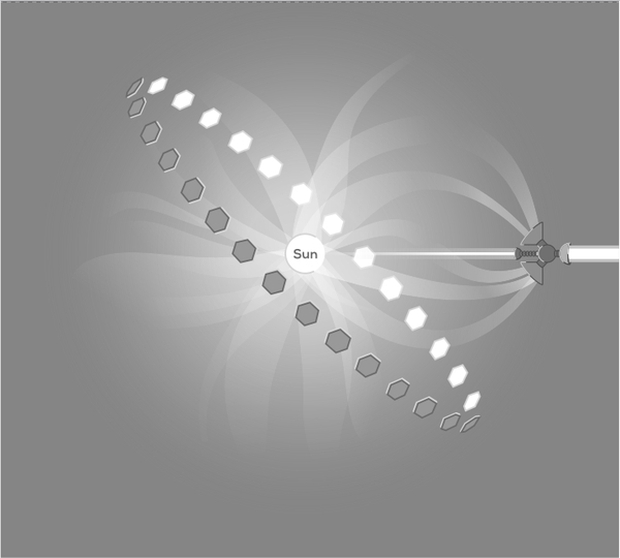
Image: This is Caplan’s Figure 2. Caption: Artist’s rendition of an operational active thruster around a star with a Dyson swarm, where the solar wind is collected by an engine which drives a jet of exhaust. The sun and ramjet accelerate to the left. Credit: Michelle Buhrmann.
Caplan analyzes both passive and active thrusters, the passive design being essentially the ‘solar sail’ configuration used by Shkadov. Here we can manage 10-12 m/s2 working with a G-class star like the Sun, and as noted last time, this amounts to 20 meters per second after a million years, or 0.03 light-years from its original position. What Caplan manages to do to improve this is to deploy matter collected from the star after heating part of the solar ‘surface’ using a mirror swarm (think Dyson swarm here). This material is then used to fuel fusion reactors, with the result being to achieve speeds a thousand times faster than the passive design. Now we can move the star 50 light-years in a relatively swifter one million years. A civilization stable enough to survive through entire epochs like this might see this as a viable approach.
The plan here is somewhat reminiscent of Benford and Niven’s, at least insofar as it uses a focused beam to disrupt the stellar surface and produce an ejection of helium and hydrogen. But whereas Caplan will use that ejection to fuel fusion reactors, Benford and Niven take a different approach that I’ll cite here for the interest of the comparison. This is from Greg’s afterword to the novel Shipstar (see also his “Building the Bowl of Heaven,” which he wrote for Centauri Dreams in 2014):
There’ve been several Big Dumb Objects in sf, but as far as I know, no smart ones. Our Big Smart Object is larger than Ringworld and is going somewhere, using an entire star as its engine…Our Bowl is a shell more than a hundred million miles across, held to a star by gravity and some electrodynamic forces. The star produces a long jet of hot gas, which is magnetically confined so well it spears through a hole at the crown of the cup-shaped shell. This jet propels the entire system forward – literally, a star turned into the engine of a “ship” that is the shell, the Bowl. On the shell’s inner face, a sprawling civilization dwells.
As you can see, Caplan’s tack is entirely different. Benford and Niven use the reflected light from the Bowl’s surface to produce the disruption on the stellar surface that creates the resultant beam. Lacking a huge reflecting object like the Bowl, Caplan considers the use of a Dyson swarm to produce the needed energy for the essential mass-lifting. From the paper:
Alternatively, such mass lifting may be possible at very high efficiency using similar principles to concentrated solar power. Reflecting large amounts of sunlight directly to one spot or small region of the sun’s surface (perhaps with statite mirrors like those described above) will locally increase the temperature and mass loss rate. Physically, the mirror reduces the area over which the sun radiates and drives up the surface temperature by the Stefan-Boltzmann law. Similar radiatively driven mass loss is believed to occur in Wolf-Rayet stars [29].
In other words, a small change in temperature produces massive energies. My math skills weren’t up to the challenge, but I wondered how long a thruster like this could function before changing the star’s classification along the Hertzsprung/Russell diagram. So I put the matter to Google’s Gemini AI, which produced a figure of 12.6 million years to turn the Sun into a K-dwarf like Centauri B. Keep in mind that we’re burning millions of tons of stellar material every second using the Caplan thruster. That also increases the Sun’s lifetime as it begins to burn its hydrogen at a slower rate. Thus a stellar engine becomes a way to keep a star burning far longer than its earlier classification would allow.
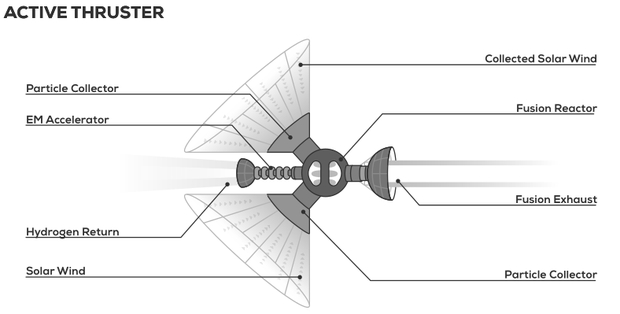
Image: This is Figure 3 in the Caplan paper. Caption: Schematic of an active thruster. Solar wind is collected by large scale electric or magnetic fields, which funnel matter into the engine. H and He are separated, with an He fuel mixture being used to drive a high velocity jet of exhaust away from the sun and out of the solar system, while H is returned to the sun using traditional electromagnetic accelerators, transferring exhaust momentum to the sun. The sun and engine accelerate to the left. Credit: Michelle Buhrmann.
We’re now in the velocity range that Caplan considers sufficient to achieve a retrograde galactic orbit or even galactic escape velocity. So here’s a science fictional thought. Stars now known to be on such trajectories might be candidates for SETI observations given the possibility of mega-scale engineering. He continues (the italics below are mine):
We therefore argue that hypervelocity stars on escape trajectories from the galaxy may be observable candidates for detecting megastructures, even though the operation timescales of stellar engines are short relative to intergalactic flight times. Recent work suggests that known hypervelocity stars may be traveling above the upper limit for classical ejection methods. Such stars may be candidates for detecting megastructures if additional powerful dynamical ejection methods are ruled out.
The Caplan paper is “Stellar engines: Design considerations for maximizing acceleration,” Acta Astronautica Vol. 165 (December, 2019), pp. 96-104 (full text). The Colin McInnes paper mentioned above is “Ringworlds and Dyson spheres can be stable,” Monthly Notices of the Royal Astronomical Society Vol. 537, Issue 2 (29 January 2025), 1249-1267 (full text).

In the case of a supernova or hypernova threat, rather than moving the home star, why not move the threat, using the same methods?
They can also be far more aggressive on the threating star and use the jet to reduce it’s mass to the point where it won’t have enough to suffer a core collapse.
Exactly so. Removing mass seems to be a side-effect of the thruster, but obvously it’s a virtue if practiced on the threatening star. Much would depend, though, on the timeframe, as the process is quite slow!
Which brings up questions about the very extended neighborhood and the density of intelligent life and potentially intelligent life, and the need for residents of System B to be aware of what’s going on within a giant “sphere” (not really a sphere since we’re talking time spans over which stars will naturally move relative to each other), within which sphere Civilization A, on the far side of star X, may be about to accidentally aim star X toward them like a ticking bomb.
In other words, in moving a problematic star away from yourself are you endangering someone else?
And is hiding in a dark forest still the safest strategy when the animals are throwing bombs around?
Easier to build a megastructure in your own system than another, surely, particularly if the star is misbehaving as pre-supernovas tend to do. Plus you don’t lose your investment when the supernova goes off.
Lol. “Big Dumb Objects.” I like the idea of moving one’s solar system. I’ve never heard of that idea. One would need a whole fleet of warp drives to do it though since any mass removal of any BDO’s would be greatly insufficient. Even a fleet of warp drive would take a long time to move a solar system. I like the idea, but it impracticable because it would be much easier to make another BDO, the Dyson sphere or better a Dyson shield in front of the planet which would absorb the radiation and re radiate in the infra red. That would be far easier to achieve than moving the whole solar system.
Even if it was an active galactic nuclear with a wide x ray beam in light years one could still block the radiation. One would have no choice. Moving the solar system would take too long. One could also simply leave in warp drives.
@Geoffrey
I agree that a shield would be a better option. If the SN damage is from a relatively transient increase in high-energy radiation, simply blocking it. One only needs to block the radiation from impacting the living worlds or worlds with life on the surface. In our case, Earth itself, and perhaps in a century or so, Mars. (I think subsurface cities are the best solution for the Moon, perhaps like those depicted in Ian McDonald’s Luna novels.)
The mass of a planetary shield is far less than that of any BDO to move a star, and it avoids any problems that changing a star’s output may have on the biosphere. It might also be a bit tricky when the SN is nearly behind the sun, and therefore blocking it might also block the solar radiation for a few days/weeks. Having said this, shielding a planet from γ-rays is not trivial; it needs meters of mass like rock to effectively block the radiation. How is that to be achieved, especially if that mass has to be lifted into space from the planet? Using space resources would seem the best approach. OTOH, perhaps the better approach is to create those O’Neill space habitats, whether from lunar materials or inflating asteroids, although that is also highly disruptive for the triaged life that is to be saved. I can just see the voting for the charismatic fauna to be on the saved list!
[ Blithely talking of changing the spectral class of a star to move it without even thinking of the potential consequences on the biosphere is technological arrogance that makes some of our stupidities seem small by comparison. At least the Shkadov Drive variants do not do that.]
I also question how much of an advanced warning we can get. Is it possible that we can forecast a SN explosion many millennia in advance? And even if we could, what is the likelihood that resources will be budgeted and acquired that far in advance? Humans cannot even do that when the danger is close. Here in California, the next “Big ‘Quake” for the Bay Area is still sometime in the next 30 years and has been since the Loma Prieta earthquake in 1989, going on towards 40 years now. How many households even have a food and water emergency stash in place for when it happens? Authorities will forever kick the can down the road to delay using funds today. It is easy to see the arguments why that is the “sensible/rational” decision.
Humans are so vulnerable to the “Great Filters” ahead of us.
” Having said this, shielding a planet from γ-rays is not trivial; it needs meters of mass like rock to effectively block the radiation”
At this point it might be just simpler to transform your species into more survivable form and rebuild your biosphere elsewhere(if you would still wish to).
@Wojciech
Then aren’t you back to moving planets or star systems? While we might transform ourselves, we cannot do that for all the species in the biosphere as it would no longer be a biosphere even if we magically could do this.
Shielding the planet, while extremely costly and difficult to do with currently feasible future technology, is really the only possibility if we want to preserve Earth and its biosphere. The only other viable approach is to make viable habitats with selections of species and propel them out of range of the SN if possible, or shelter them in the shadow of the giant planets, like Jupiter. A partial solution, but perhaps one, like the Biblical Ark, would allow us to repopulate the Earth after the devastation caused by the SN.
“I also question how much of an advanced warning we can get. Is it possible that we can forecast a SN explosion many millennia in advance?”
This should be possible if we can understand what is burning in the stellar core through neutrino spectroscopy. Problem is – low energy neutrinos are currently too hard to detect.
Excuse me I meant active galactic nucleus.
I thought that Bear’s Eon/Eternity/Legacy trilogy was very imaginative, especially the first book, Eon, introducing the idea – a sort of infinitely extended O’Neill habitat. It is a physical space manifestation analogous to Asimov’s time “travel” in the novel The End of Eternity that I visualize as a sort of elevator through time, albeit with the possibility of changing the states of each time period by subtle interventions. Asimov didn’t consider that external, cosmic events could result in futures that were not alterable by internal changes.
The same applies to P K Dick, whose universes often allowed changes to the future through precognition and human manipulation, but not by external events beyond human control.
This is interesting, because cosmic events heretofore have been influential in creating the human future, most notably the asteroid impact that caused the [final] extinction of the dinosaurs, except the avian lineage, and allowed the evolutionary radiation of the mammals, and of humans. We can even potentially prevent another such impact from happening. Closeby SNs are somewhat harder to prevent from impacting the Earth. What irony if one occurs, and the only survivors are our artifacts, most importantly, intelligent robots that create a machine civilization. Or machines that are the embodiment of mutated humans…like Daleks.
The book was made into a film in 1976 by a Hungarian director.
It’s called “A HALHATATLANSÁG HALÁLA” yes really.
See an oddly silent version here: https://videa.hu/videok/film-animacio/a-halhatatlansag-halala-1976.mp4-film-animacio-VWLyvTDMDf8q5vr3
There is a contradiction between a people who have the godlike power to create these objects but still obey the limitations of the mortals of today. If people can create vast plates and engines on the size scale of a sun… should we presume they lack the ability to reach into that star directly? Bear in mind that current research is developing high-entropy carbides can withstand temperatures very close to those of the solar photosphere… even outside a sunspot. So I suspect an advanced civilization can install a fairly compact infrastructure into the surface of a star, manipulate and harness the seemingly chaotic forces of its magnetic field, and use that to project stellar material in synthetic prominences (or more complex flow patterns) where its energy can be harvested.
Intrigued by Mike’s link, I looked up the highest melting point high entropy carbide, and it’s hafnium tantalum carbide (Ta4HfC5), with a melting point of 4215 degrees Celsius.
HECs could certainly have application for sundiver probes. One with a shield of this—if cooled by liquid Hydrogen, which would be, once heated, used as rocket exhaust—could just about scrape the surface of the sun.
They could also radically improve the ISP of nuclear rockets.
I suppose the process of movement could accelerated by going ahead to other star systems. You then use the idea to move that star into the path of our star system pulling it in the desired direction.
Or maybe create a graviton/warped-space-curvature (tractor) beam pointed at a giant star to pull the home star and its system towards the giant star. The energy of the giant star would power the beam at no cost to the home system.
Or perhaps Vinge’s time/stasis bubbles are the best solution. Envelop the planet/system in such a bubble to ride out the SN impact without any damage.
Sure, this is well outside the realm of physics that we know, but the heroic technology to move star systems using the rocket equation seems almost quaintly Victorian in concept. It is like building ever larger steamships to cross oceans because there is no expectation that fast flight is possible, or that physical travel may not even be needed for most journeys except for vacations and cargo.
“…building ever larger steamships to cross oceans because there is no expectation that fast flight is possible…”
You’ve just reinvented steampunk.
Surviving the light explosion would be fairly easy with a large disc obscuring it from the harsh radiation. However to close and then there is the decay products which push out huge amounts of lethal radiation as they move through the solar system. I suppose we could use a huge magnetic field to redirect the ionised decay products though.
Should we ever discover a BDO it will probably be a sculpture or a form of performance art for an advanced civilization that has little left to do beyond amusing themselves through the eons. They may include a variety of puzzling mechanisms and traps to befuddle civilizations that discover the BDO, the exploration of which will be keenly watched by the entertainment starved builders who will be in a desperate pursuit of novelty. If a few intelligent monkeys get themselves killed during their explorations that will only enhance the entertainment.
“Should we ever discover a BDO it will probably be a sculpture or a form of performance art for an advanced civilization that has little left to do beyond amusing themselves through the eons.”
Hoag’s Object comes to mind ;)
https://en.wikipedia.org/wiki/Hoag%27s_Object
Wasn’t there a SciFi story which intimated that Saturn’s rings were an art project?
Does this project take account into the expansion of the universe ? how will the star engine compensate for the rate of expansion over such long periods ?
@Fred
Compensate for what exactly? What do you think the expansion is of moving a star by propelling it?
IMO, the universe is expanding. If the star is not propelled, then the expansion will make it appear to be moving away from us, if the expansion was overcoming the local gravity of our galaxy. I don’t believe that is so. If the star is in another distant galaxy, it and its galaxy would be moving away from us. Same thing if the star is in intergalactic space, well away from any gravitational pull.
A star in intergalactic space will eventually be moving faster than c away from us as the universe expands, and as a result, “it becomes invisible to us as it drops below the light horizon.”
Any propulsion will mitigate that expansion. If the star is propelled toward us, it will just reach us more slowly than it would in a static universe. It could conceivably appear to be approaching, then stop and appear to be moving away from us.
@Alex
I’m doing a thought experiment: an engine that pushes a star, okay, but what happens to this system in a universe that stretches? More precisely, what if the universe pulls the star (relative to the engine) faster than the engine can push it? Is the star “tugboat” still useful if we assume the same vector?
I imagine that the ETI that built this thing thought of compensating for universal expansion, in other words that its engine must somehow make or increase its thrust to keep a constant distance from the target star. What concerns me is not so much this beautiful technology – if it exists – but the way it would evolve over a long period in a universe model. The idea may be stupid, I didn’t do any calculations…
BTW I read a book by Kathie Mack this winter where she develops this idea of the expansion of the universe “that will go faster than C” (compared to us), it troubled me a lot: so there are things we will never see? Perhaps the Dyson spheres and other machines are beyond this horizon? ;)
@Fred
The theory was that the expansion changed over time.
Firstly, there was the rapid expansion at the birth of our universe. Then there was the slow expansion that was slowing down as gravity was halting the expansion velocity. Lastly, the expansion was accelerating again, possibly due to dark energy, which would increase until it affected everything, even atoms, the so-called “big rip”. At any point, some parts of the universe would be expanding faster than c from the observer and disappear from “sight”.
Now to your thought experiment. If the drive, e.g. a Shkadov, needs to stay a fixed distance from its star, there are at least 2 relevant issues:
1. The star is losing mass, and therefore its gravity is decreasing. This means that the reflector needs less repulsion or thrust to prevent it falling back towards the star. Keeping the thrust constant would result in it accelerating away from the star. But note, as a star ages, like our sun, its luminosity increases, thus increasing any thrust on the reflector. This suggests to me that the reflector as a statite must slowly decrease in size.
2. The expansion of teh universe will also increase the separation of the reflector from the star. This would reduce its thrust from the star and would possibly mean teh reflector would need to be become smaller to allow teh star’s gravity to pull it closer to compensate. Is this effect what you were thinking of? If so, then you are likely correct. It just depends on the relative magnitudes of the 2 effects. [There may well be others that I haven’t considered, e.g., erosion of the reflector by the ISM.] However, both these effects are tiny over the time scales we are talking about – millions of years. Billions is another matter…
IIRC, the latest research suggests that the “big rip” scenario is wrong. So we can relax about our atoms tearing themselves apart as the expansion acceleration tends towards infinity. Stephen Baxter wrote a short story about the “big rip”. It seems that this scenario is stillborn.
@Alex
>as a star ages, like our sun, its luminosity increases, thus increasing any thrust on the reflector.
That’s right,which complicates the problem when the star becomes a red giant or a white dwarf. Thus, adjusting the parameter between repulsion and gravity will be a big engineering problem in the long term, especially if we take into account an “elastic” universe. Thinking about such technology over such long periods would define a particularly visionary ETI, but also capable of having some certainties about the universe (unless it is outside?). There is something majestic about this idea.
>Is this effect what you were thinking of?
almost, but it’s the same idea :)
A recent hypothesis by Richard Pinčák seems relevant to many of the discussions we’ve been having here recently. (Phys.org article, original paper) They thread together what must be hundreds of familiar advanced physics concepts I don’t understand. By assuming a certain symmetry assumption made in general relativity is wrong, and that it is possible to have a “G2-Ricci soliton on a compact S3 x S4 manifold” (some kind of hidden 3D rotation dimension + ordinary spacetime), they come up with a calculation to derive the weak scale geometrically. They also end up with a notion of black hole remnants that can store more than 10^70 bits of information, though I don’t know about editing it. I’d love to see someone explain all this, and perhaps the potential implications (if any) for transmitting information or matter, leaving the universe, etc., in a Centauri Dreams article!
All the BDO ideas [Dyson Sphere, etc] seem to be based upon the idea that interstellar space flight is an intractable and insoluble problem due to the laws of physics. Therefore, instead of exploring the Galaxy and beyond, simply build a gigantic sphere of geegaws to capture every photon of solar energy for your AI based / artificial reality civilization. Or build an artificial planetary surface shaped like a gigantic ring. Or…
The jury is still out on the feasibility of interstellar spaceflight. FTL is, of course, a non-starter but FTL buys you little because C is so abysmally slow at interstellar distances. That said, an acceleration pod capable of delivering sustained 1 G acceleration from momentum derived directly from the quantum vacuum could transit the galaxy (100K LY) in about 22 years ship-time. We are much further along in the realization of such a technology than most people realize. I predict a demo of a warp acceleration pod capable of the above in less than 10 years.
It is irrelevant how you accelerate. Your argument is that biological beings can transit extremely long distances due to time dilation. All well and good, but c is still applicable for the rest of civilization. 100K ly still means 100 millennia of external travel time. There may be a galaxy full of emergent civilizations when the crew and passengers reach their destination, or an empty galaxy if humanity were the only technological civilization and went extinct during that time. It is the same idea of seeing the future in a time machine or kept in stasis in “cryosleep”. Unless the Earth was made unlivable, becoming conscious 100 millennia in the future is more likely to be survivable on a planet where the biosphere is one your species evolved in, than a new one that may prove incompatible, forcing the need to terraform it or otherwise make it suitable for humans. If ever there was a need to transform humanity into a non-biological form, this would be it.
“C is so abysmally slow at interstellar distances”
Generally, fictional portrayals of FTL use speeds that are many multiples of c. Hundreds or thousands is not uncommon. And that’s without getting into the fictional works where travel is literally instant.
Another intriguing review! One note: “Here we can manage 1e-12 m/s working with a G-class star like the Sun, and as noted last time, this amounts to 20 meters per second after a million years” The quoted units are velocity (m/s) but it sounds like they should be acceleration (m/s^2), and my quick check says it should be 30 m/s after a million years (but with enough numbers rounded to 1 significant figure 20 m/s is plausible too.)
Good catch, Drew. I’ve made the correction re units of acceleration.
a small text about the Dyson’s spheres found in Galaxy 1976, by J Williamson & Fred Pohl, here page 85 :
https://archive.org/details/Galaxy_v37n08_1976-11/page/n84/mode/1up
…a detection by magnetic fields ? ;)
Alright, time to see if I can do better with a Big Dumb Object.
The residents of the homely world of Cart observe from their telescopes that their one and only star, Donkey, is on collision course with an imminent supernova. Having recently learned the art of space elevator construction, they devise a simple plan: create a thin carbon elevator cable linking their star with their nearest neighbor, Alpha Centonos, four light years away. Once the segments of the first cable are assembled, machines bring components from various rogue bodies disassembled and transported as needed along the vast length of the cable to create more and more cables. We will leave channels between cable bundles here and there to make room for express colonist transport tunnels along its length, so people can zip between the stars at a gee or so, provided you’re willing to risk the fate of the world for some VIPs (and who wouldn’t?).
Part of the energy source for this device is that material harvested in deep space is lowered down to the habitable zone of Donkey, where the cables end. Fortunately, this is out of the plane of the ecliptic. There, a massive weight is constructed, a mostly iron sphere, covered with rock, decorated with water and habitable land, the size of the Earth, which we’ll call Carrot.
The attraction of Donkey to Carrot is no mere 10^-12, but fully 1.8 * 10^-8 m/s^2 of acceleration. (Perplexity agreed with me, on its second attempt) The force to allow this comes from the cable, which is pulled by the Counter-Carrot they are constructing around Alpha Centonos, with periodic adjustments of the cables to ensure Donkey never actually eats Carrot. Hopefully, over time the orbit of Cart will mostly track with its accelerated star with relatively little climate-destroying anomaly.
Just so, for the cost of some mostly self-replicating probes ransacking a transect through the depths of interstellar space, they keep their own planet and get two more to play with. :)
@Paul
Nice to see a vid on Event Horizon about ‘Lurkers’, will you be doing more of these videos on different topics?
https://www.youtube.com/watch?v=uVaMlIAT9oA
Thanks, Michael. I don’t usually do interviews but I really like the Event Horizon team and made an exception. Thoroughly enjoyed the discussion!
It looks like you have a good number of posts on the video, although there is the usual number of nonsense posts. There may still be some interest and/or use.