
Problems of definition will long be with us as we take ever closer looks at exoplanets. But they’re suddenly on everyone’s mind because of the detection of what some are calling an ‘exomoon’ in the system CD-35 2722, found in the constellation Columba. The primary in this system is an M-dwarf thought to be 50–200 million years old. I imagine there is no shortage of flare activity on this star, although the paper doesn’t get into that. The interesting finding in this work just published in Nature is expressed in its title: “Planetary-Mass Exosatellite Detected Around a Star’s Substellar Companion.”
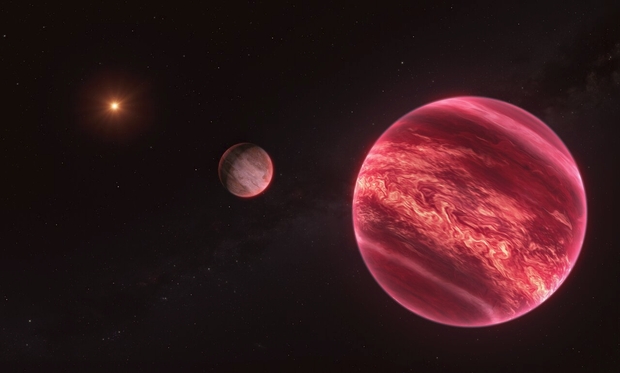
Image: This illustration shows the system around the star CD-35 2722, with the newly found moon-like object at the centre. The star –– the point source to the left –– has about half the mass of our Sun, and it is orbited by a brown dwarf, the reddish-brown object seen here in the foreground (right). The brown dwarf has about 37 times the mass of Jupiter: too massive to be a planet, but not massive enough to have sustained nuclear fusion like stars. This brown dwarf is, in turn, orbited by a newly discovered object at least as massive as Jupiter, seen at the centre of this image. This new object, found with ESO’s Very Large Telescope (VLT), is difficult to label. It behaves like a moon in the sense that it orbits an object that orbits a star. But this ‘moon’ is massive enough to be a planet, and the object it orbits, a brown dwarf, is neither a planet nor a star. Credit: ESO.
So is this the first solid detection of a ‘exomoon’? I can’t describe it as that, and ‘exosatellite’ is an awkward coinage. What we have here is an M-dwarf orbited by a brown dwarf about 30 times the mass of Jupiter. It is the brown dwarf, not the star, that is being orbited by a third object, evidently a gas giant with a minimum mass of 0.743 Jupiter masses. How this arrangement drives orbital mechanics of any other objects in this system (none have yet been found) is well worth pondering. For now, we see again the problem of definition.
Kevin Hoy (Universidad Diego Portales, Chile) is lead author of the paper on this work:
“This system is somewhat hard to define using Solar-System-based words like ‘planet’ and ‘moon’. The exosatellite is clearly massive enough to be a planet, but it does not orbit a star, though it orbits an object that orbits a star. Being the third wheel in this system makes us want to call it a moon, even if it is nothing like the small, rocky moons we have in our system.”
I think this discovery is straightforward. The object around brown dwarf CD−35 2722B fully qualifies as a planet. Brown dwarfs cannot sustain stable hydrogen fusion in their core for any length of time, so that they’re basically ‘failed stars’ that are cooling down throughout their lifetimes. Even if we demand that the term ‘star’ be defined by hydrogen burning, then whatever category we create to include brown dwarfs is clearly one that can sustain planets around it.
I’m seeing a lot of chatter about this detection, but let’s leave ‘exomoon’ out of the discussion. Anyway, it’s also interesting to see that brown dwarf CD−35 2722B has been directly imaged, as reported in 2011 in The Astrophysical Journal (citation below). Directly imaged planets are still a rarity.
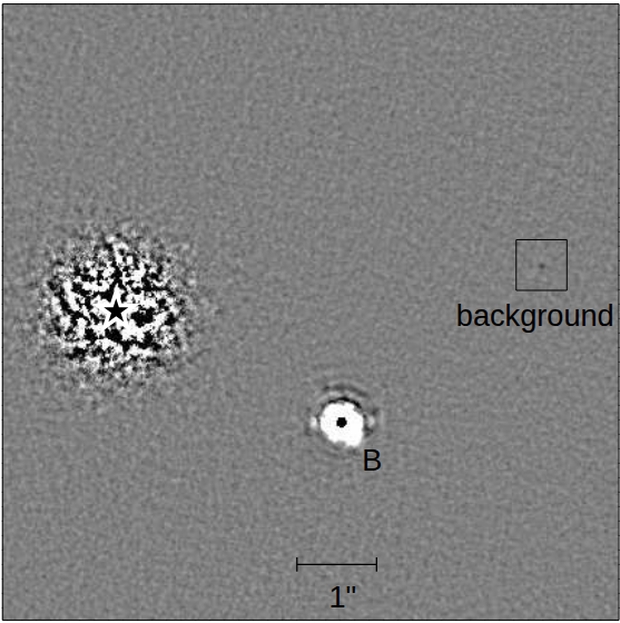
Image: The discovery image of CD-35 2722B, the brown dwarf in this intriguing system. Credit: Wahhaj et al. 2011, ApJ 729, 139.
So this is an intriguing find, and it also points to our continuing inability to locate what could indisputably be called an ‘exomoon,’ though the HD 206893 system continues to be interesting as a possibility for further research. Until we have a confirmed exomoon, though, this odd configuration will have to do. It reminds me as well that as our explorations continue, we still find how unusual our own Solar System is. Looking for commonality between different star systems, we find over and over again that any facile Copernican notion that we live in an ordinary stellar environment continues to be proven wrong.
Indeed, just what constitutes an ‘ordinary’ stellar system? The beauty of this work is that we seem to find surprises almost everywhere we turn.
The paper is Hoy et al., “Planetary-mass exosatellite detected around the substellar companion of a star,” Nature 16 July 2026. Full text. The discovery paper for CD-35 2722B is Wahhaj et al., “The Gemini NICI Planet-Finding Campaign: Discovery of a substellar L dwarf companion to the nearby young M dwarf CD−35 2722. The Astrophysical Journal 729(2), (2011), 139. Full text.
Somehow, this makes me think of a Jeopardy! answer. If the clue comes up, “A sub-stellar object that orbits another, larger, sub-stellar object, which in turn orbits a star”, what is the correct question?
As far as our Solar system being abnormal, the real question should be, is there a “normal” stellar system and, if so, do we deviate from it a reasonably likely degree?
Questions about nomenclature are entertaining. I look at it this way. A red dwarf is a red dwarf and a brown dwarf is a brown dwarf, neither of which need a naming change due to the relative distance and size of other bodies, all of which are gravitationally bound. The third body? (shrug) Call it whatever one likes. It looks like a planet to me so that’s what I’ll call it. There are similar systems where there are definitely two stars and one or more planets around at least one of them, and there are no debates about nomenclature.
More interesting is the formation story, how 3 large bodies bound in this fashion managed to form. I haven’t read the paper, but from the system description and detection methods involved they probably did form together rather than involving a later capture event.
“This system is somewhat hard to define using Solar-System-based words like ‘planet’ and ‘moon’.”
Maybe those Solar-system based word definitions need to be revised and made more precise in order to clear up the confusion. Perhaps the word planet should be defined not based on one stellar system (ours), but on an objects size/mass and orbit around any other object big enough not to be defined as a planet. If it orbits a brown dwarf (a definition based on mass), or a star (definition based on mass etc.) then why not make a definition for that object based on mass, not on whether or not it orbits our particular star. If it fits the new object definition, then it’s whatever we want to call that object.
A proposal was made in 2024 to redefine a planet as:
orbits one or more stars, brown dwarfs or stellar remnants and
is more massive than 10^23 kg and
is less massive than 13 Jupiter masses (2.5 X 10^28 kg)
From this link:
https://news.ubc.ca/2024/07/what-exactly-is-a-planet-scientists-propose-improved-definition/
Not sure if there were any further discussions on this, but if not, there should be.
The 2006 IAU classification doesn’t work anywhere, not even in our own system:
Orbit: The body must be in orbit around the Sun.
Shape: It requires sufficient mass for self-gravity to form a nearly round hydrostatic equilibrium shape.
Dominance: It must have cleared the neighborhood around its orbital path
Has any ‘planet’ in our solar system cleared its neighborhood around it’s orbital path?
Clearing the neighborhood isn’t the greatest definition since it leads to the question: ‘what do you mean by cleared?’ What do we call a large round object in any young stellar system, before anything has been ‘cleared’ in it’s orbit?
While a Brown Dwarf may be described as a “failed star” or a maximal “planet”, what of other types, such as cooled neutron stars, white dwarfs, or black holes, etc? How would a body in orbit around these bodies that, in turn, are orbiting a stellar primary be described?
We’ve talked about planets/moons orbiting rogue planets that could be Brown Dwarfs. Are they planets or moons?
As we have seen with Pluto, demoted from planet to dwarf planet, the once neat classifications of celestial bodies are much messier than once thought. The star-planet boundary is one that, IIRC, the body can oscillate between fusion burning (i.e., a star) and a non-fusion state (i.e., a planet), although lack of fusion doesn’t seem to apply to white dwarfs and neutron stars. There will no doubt be other objects discovered that cannot be easily classified by “rules”.
For those of us comfortable with ambiguity, speculation can turn to what this exo[moon/planet/satellite] is like and what exploration/settlement/outposts might be like to visit or live on, and what strange features such a body has to human eyes or machine sensors.
Is it a river, stream, creek or brook? Is it an ocean, sea, lake, pond or puddle?
This kind of ambiguity arises when we classify objects by different criteria, such as size, structure or relation to other objects.
A satellite is an astronomical object that orbits another, much larger object. There are, for example, satellite galaxies. Our own Milky Way has several satellite galaxies. Actually, both objects in an orbiting pair revolve around a common center of gravity, so we usually invoke the term ‘satellite’ when one object is much more massive than the other. A further source of confusion is that the more massive object in a binary pair is not necessarily larger than its companion.
Stars emit energy due to thermonuclear processes in their interiors. Brown dwarfs are the same, except their source of heating is due to gravitational contraction They are not massive enough to develop the central pressure and temperature to ignite fusion. Still, brown dwarfs are still hot enough to glow, and are composed of plasma. When they eventually cool off are they ‘gas giant planets’? Or due giant planets require a star to revolve about in order to meet the definition? And what about gas giant planets that are ‘rogue’ and traveling unaccompanied through space? If there is a fundamental structural difference between brown dwarfs and gas giants it is that the latter are composed primarily of un-ionized gases while the former are hot plasmas that give off more energy than they receive from their environment.
Jupiter is visible by reflected sunlight, but it also emits energy in the form of microwaves. Does that make it a brown dwarf?
In our solar system, the major bodies orbiting the sun are called planets, and some of those planets are orbited by other bodies we call satellites. There are also many smaller bodies such as asteroids or Kuiper Belt objects that also have satellite companions. As far as we know, none of the satellites in our solar system has satellites. I suspect that higher order pairings (satellites around satellites) do not occur because in the crowded environment of the solar system these orbits would be unstable, but I do not know that for a fact, and it may not be the case in other stellar systems.
Newtonian gravitationally bound systems always occur in pairs, that is, orbiting systems with more than two bodies do not exist in nature, they are inherently unstable. OTOH, two bodies orbiting a common center of gravity can be considered as a single body. So, for example, A and B can orbit around each other (a common C.O.G.), but a third body, C can orbit the pair AB’s C.O.G. Likewise, A, B and C may each have their own close companions, and the C.O.G. of the entire system may also orbit around a distant mass (which may also have its own retinue of companions). Our own sun could conceivably be a binary star, with a dim and distant companion we haven’t found yet. And that companion could have its own retinue of planets and satellites!
Castor (Alpha Gem) is a sextuple system. AR Cas and Nu Sco are both systems with seven known members–and any of those stars might have planets. The distance between members of a binary system can also vary enormously. Some binaries are actually in physical contact with one another, others are so far away from their companions that the evolution of one member cannot possibly affect the history of the other. Even within the constraints imposed by Newtonian mechanics, there is an almost infinite variety of possible system configurations.
@Henry
Some classifications are binary. Oceans and seas are saline, while lakes and ponds are freshwater. Puddles theoretically can be either.
Some classifications are fuzzy. Creek/river has no definitive features, just naming. Depending on the features, I would use “fuzzy logic” so that a particular flowing channel of water might be 10% creek and 90% river. The same for wood/forest. (Interestingly, sometimes the naming can be both; Sherwood Forest.)
Many adjectives have no binary state, e.g., “deep”. It could be 10 m in a pond, but more than 1000 m for an ocean. Sometimes it is a subjective feeling, e.g., “hot” can be 25 C for some people, but “cool/cold” for others.
Most of the time we don’t even think about some binary classification of words, but use them in some context that makes subjective sense for communication between speaker and listener.
The Wikipedia entry for Brown Dwarf indicates that the definition has changed over time. Initially called planetar, then changed to Brown Dwarf, which in turn became graded depending on whether lithium could fuse or not, and so on.
I doubt there is any knife-edge size for a BD, so that near the limit, there may be periods of fusion and non-fusion. If it is a failed star, then is it a planet? If it alternates between fusing lithium or not, does it change classification depending on its state when observed? Does a body orbiting it in turn change from planet to moon? To my mind, fuzzy logic applies here. Where BD can be mostly star or mostly “planet”, and a “super Jupiter” also starts to become a star partly as its mass rises towards allowing fusion to start.
Like art and pornography, some objects can be classified by class in subjective binary terms that differ between observers, and sometimes because we do not have the language to describe the class or description. [The naming of colors took time, so that the ancients used different terms to describe a color, e.g., Homer’s “wine dark” for the sea.)
Okay, I’m going to ask the obvious question: Would an earth sized world orbiting the moon/planet, which orbits the brown dwarf, which orbits the star be in a stable orbit?
What would you call it?
Could it have a satellite?
What would you… Oh never mind.
I was thinking about that and came up with a Moon Moon, and the satellite would be I guess a Moon Moon Moon. (To miss-quote Terry Pratchett, it’s moons all the way down.)
Hi Martin
I was thinking the same thing too. From the Paper an Earth like world around the Jupiter/Brown Dwarf couldn’t occur, But super Europa like worlds could well be possible around the Jupiter gas giant, and the heat and energy from the Brown Dwarf could make a satellite a nice environment for bacteria and microbes. They would have stable orbits, away from tidal heating and the warmth from the Brown Dwarf any satellites will be frozen like Pluto and Triton.
Hi Paul
One interesting system of Worlds here covering some of my top research topics of interest.
Red dwarfs, Brown Dwarfs, Jupiter like planets and exo Moons this Discovery seem to tick all my boxes. This system requires a closer look into, could Mars to Earth like rocky small worlds be orbiting the Brown Dwarf and Jupiter mass world? They would be very interesting places to study.
Satellite Detected Around a Star’s Substellar Companion
https://www.eso.org/public/news/eso2610/
Link to Paper
https://www.eso.org/public/archives/releases/sciencepapers/eso2610/eso2610a.pdf
I Didn’t receive an email on this post Paul and only found out about it from Lawrence.
Sorry to hear you didn’t get the email. Let me know if that persists, as the system seems to be working normally.
I also don’t get emails about new posts. I just check the CD site most days.
I did once get an email about new comments on a post, but then it stopped. (This was after the new website was built.)
Checking into this. Most readers don’t subscribe and thus don’t get the emails. But I’ll see if I can figure out whether there’s a glitch somewhere.
If you look at this combination as a star that is orbited by a failed star which has a planet orbiting it.
This gives you a binary star system with a planet orbiting one star.
While were on the subject I have just found more reading for myself and you folks here.
What exactly is a planet? Scientists propose improved definition
https://news.ubc.ca/2024/07/what-exactly-is-a-planet-scientists-propose-improved-definition/
Quantitative Criteria for Defining Planets
https://arxiv.org/abs/2407.07590
Planets need not orbit stars; rogue planets are still called planets. I see no problem with calling this exosatellite a planet, even if it only orbits a star indirectly.
I tend to disagree with the convention of calling a brown dwarf a “planet” simply because it forms in a protoplanetary disk and has a close circular orbit. The standard of approximately 13 Jupiter masses is not just easier to classify, but speaks to the essential nature of the object. Now etymologically a planet is a “wanderer”, and in antiquity included the Sun, but to our way of thinking, a planet is a place like Earth, made of rock, or at least roughly Earth-like matter. We extend that to weird metallic hydrogen in Jupiter, but that is still fundamentally a sort of degenerate solid with a sane density. When you pack 13 times as much matter in the same place, and make a degenerate electron plasma – now you have a density of 50 g/mL that is only ever seen in stars … and “brown dwarf planets”. When you look at such a body and see an object the size of Jupiter orbiting around it like a moon, that seems like a clear indication that really the object deserves to be called a star. Calling a Jupiter a “moon” is some sort of lese majeste.