
If we couldn’t figure out what to call CD-35 2722B b, which I assume is the correct way to refer to the planet-sized object in this red dwarf / brown dwarf/ gas giant system, another planet has a bit of a definitional problem as well. LHS 1140 b is an interesting super-Earth orbiting a red dwarf in Cetus in its habitable zone. Some 49 light years out, this planet is almost 6 times Earth’s mass and boasts a radius 1.7 times larger. Receiving 42 percent of the stellar radiation that Earth does, its surface temperatures allow the presence of liquid water.
But exactly what kind of planet is this? Is it an airless, rocky world, an ocean planet, or even a mini-Neptune? We can probably rule out the latter because its mass would be low for that category, and we can also, contrary to some press reports, not consider it in any way, shape or form ‘Earth-like.’ But thanks to new work out of Harvard and the Carnegie Institution for Science, we can now declare that it does have an atmosphere.
This is a useful finding because rocky planet atmosphere detection has been conspicuously difficult. What you gain with studying M-dwarf planets is the low contrast between a relatively dim star and a planet’s light, but you’re also dealing with a category of star prone to violent flare activity. Every M-dwarf in the galaxy is a young star compared to its likely lifespan, given that these stars, perhaps 85 percent of the stellar population, have lifetimes that can reach well beyond a trillion years.
Pulling a signal from water or carbon dioxide out of spectrographic data is problematic because these volatiles species would be expected in the lower levels of a planet’s atmosphere, a tough catch for any observatory. But helium escape is another matter. In detecting helium at LHS 1140 b, the new work, demonstrates that an atmosphere is indeed present, whether this is a water world or not.
Young M-dwarfs are notorious for violent flare activity, a problem not only because flares can obscure the signal of a transiting planet, but also because they can potentially scrub nearby planets of their atmospheres entirely. In this case the flares have helped us: The escaping helium is thought to be driven by bombardment of the upper atmosphere from the star’s X-ray and extreme ultraviolet (XUV) activity.
Helium escape is especially valuable because it is observable from the ground, unlike the classic hydrogen (Lyman-alpha) escape signature. We’re seeing the residue of a process that can play out over gigayears: lighter hydrogen escapes preferentially over time — a loss we can’t easily observe directly — leaving behind a helium-enriched upper atmosphere that we can detect.
The paper may even tell us something about the ‘cosmic shoreline,’ the dividing line between an orbit where an atmosphere can be sustained and one where it cannot. Indeed, this work, conducted using the WINERED spectrograph at Las Campanas Observatory in Chile, shows that the inner world at LHS 1140 is evidently airless, with the ‘shoreline’ located between the two worlds.
From the paper:
The cosmic shoreline is a proposed boundary that separates airless rocky planets from those that retain atmospheres for billions of years. The two planets in the LHS 1140 system are on either side of the proposed cosmic shoreline. Our non-detection of helium absorption by LHS 1140 c is consistent with the previously measured dayside emission, which indicates that the planet has little to no atmosphere. Therefore, this system is consistent with the proposed position of the cosmic shoreline.
Moreover, we seem to be tracking a phenomenon that changes in short order. Co-author Shreyas Vissapragada (Carnegie Science Observatories) comments:
“After much careful analysis and consideration of the spectra, we determined that helium was escaping from LHS 1140 b’s atmosphere in 2024 due to heating from stellar X-rays and extreme ultraviolet radiation. However, our 2025 observations revealed no escaping helium, so the atmospheric escape appears to be variable. It is a rare privilege to witness the atmosphere of an extrasolar planet change on such short, human timescales!”
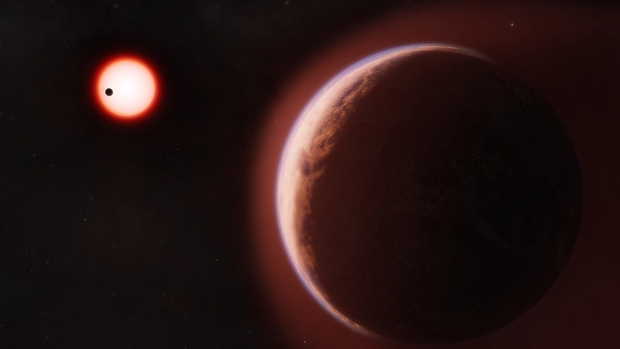
Image: In this artist’s rendering, the exoplanet LHS 1140 b is shown in the foreground, surrounded by a helium-rich atmosphere. Another nearby rocky planet orbits the same cool red dwarf star in the distance. This new study provides the strongest evidence yet that LHS 1140 b has retained an atmosphere. Credit: Carnegie Science.
Colin Cherubim (Harvard University), lead author of the paper in Science, points out that this is the first detection of an atmosphere on a rocky planet in the habitable zone of any star. Nice work, as Cherubim’s team had predicted precisely this mechanism in the LHS 1140 system. Escaping gases may indeed be a useful tool as we press on with more detailed investigations of planetary atmospheres on smaller, more Earth-like worlds.
The paper is Cherubim et al., “Helium escaping from the atmosphere of a nearby rocky exoplanet orbiting in a habitable zone,” Science 16 July 2026. Full text.


While “cosmic shoreline” is an evocative phrase, and rather Sagan-esque, I think it conveys teh wrong impression of a location. Presumably its location is going to depend on not just the orbit, but the surface gravity of the planet, and the amount of flaring by its star. As we have seen with the temporal change in the HZ with the term CHZ and the known position of the HZ dependent on a star’s luminosity on the main sequence, as well as the state of its atmosphere – composition and amount, the cosmic shoreline is a fuzzy location.
Shoreline is a rather fuzzy location, even on Earth, due to tides and overall sea-level due to climate and land mass distributions, and even possibly external additions of water from asteroids and comets. Some shorelines can move a km due to its location, such as the famous French island of Mont-Saint-Michel. Current sea-level rise is already changing the shoreline location in a number of low-lying places, such as on the Gulf or Mexico coasts of the USA. A relatively small amount of sea-level rise will put much of Florida below sea level. A total melting of the Antarctic and Greenland ice sheets will dramatically change the shorelines in much of the world, erasing some nations entirely.
This planet has a surface gravity 2.08x greater than the Earth’s. It sounds like a rocky, temperate planet with a Neptune flavored atmosphere.
I believe that, if we are going to go anywhere, we should be targeting destinations that are relatively near, given that transit times exceed a human lifespan, indeed even our technology’s lifespan in the harsh inter-stellar environment.
I’d like to hear more about 100-year projects, particularly strategies for funding and staffing such projects over their operating life. Universities have endowments which, properly invested, can fund university operations for hundreds of years. Universities have missions, staff, changing social and economic environments, in other words universities face many of the same challenges a very long term project may face.
Maybe we need the “University of Space (UOS)” which could be established and endowed with just such a purpose. Professors and students would staff the project “consoles” every semester, professors providing some continuity, students learning and growing expertise over their tenures and throughout their careers.
Without some kind of enduring social structure, without an underpinning of investor confidence, I fret that long-term interstellar projects cannot be either launched nor completed…
I’ve seen two articles suggesting the star is relatively calm:
” Orbits a calm, slow-rotating red dwarf star that does not exhibit heavy flaring, allowing the planet to retain an atmosphere for over 3 billion years.”
From Google search AI overview :
https://www.google.com/search?q=lhs+1140+b+planet&rlz=1C1CHBF_enCA1063CA1063&oq=lhs+1140&gs_lcrp=EgZjaHJvbWUqBggCEEUYOzINCAAQABiDARixAxiABDIGCAEQRRg5MgYIAhBFGDsyBwgDEAAYgAQyBwgEEAAYgAQyBwgFEAAYgAQyBwgGEAAYgAQyBwgHEAAYgAQyBwgIEAAYgAQyBwgJEAAYgATSAQk1Nzg1ajBqMTWoAgiwAgHxBdDW9hVXVRHW&sourceid=chrome&source=chrome.rb&ie=UTF-8
The wiki article suggests the same:
“LHS 1140 is a very inactive star, with no major flare events found by the discovery team of its planet. Unlike most stars its size, LHS 1140 has low amounts of activity and rotates every 130 days.”
https://en.wikipedia.org/wiki/LHS_1140_b
This is good news for atmospheric retention around M-dwarfs, and specifically the habitable zone planets in the Trappist-1 system. Hopefully more data from that system will be coming soon.
Out of curiosity I did a quick surface gravity calculation and came up with:
gp = G x Mp / rp^2 = G x (Me x 5.6) / (re x 1.7)^2 = ge x 1.93 or almost twice earth’s surface gravity.
I clicked the google search link that I posted above again as a test and the text no longer states anything about whether the star is actively flaring or not.
It looks like it’s getting it’s data from wiki, reddit(?), youtube etc..
The original google search now makes the statement:
“On Reddit, opinions are mixed regarding whether red dwarf planets like LHS 1140 b can truly support long-term habitability given stellar flare activity, though many view it as one of our best prospects”
I looked at the reddit article and this is where that statement is coming from:
“Red dwarves are generally poor candidates for life like ours because they are prone to severe radiation storms and planets within their goldilocks zone are extremely likely to be tidally locked. Still, it’s extremely cool.”
This is from a reddit user fatcharlie24 from 2 years ago. AI is using that old comment data from when the planet was first discovered in it’s results for this current search on LHS 1140. Wow.
The pitfalls of believing google (AI) searches are they could just be wrong or inaccurate or out of date with the latest results, especially if the search data on whatever platform it happens to be looking at hasn’t been updated.
I redid the search asking if the star lhs 1140 has flares and it (AI overview) now says:
“The red dwarf star LHS 1140 has not exhibited any major flaring so far. It is an unusually quiet and calm star for its type”
It quotes wiki articles as its source.
In any case if the planet has an atmosphere it’s still good news in general for planets around M-dwarfs.
@Ross
You have just made a good case for avoiding Google’s AI (Gemini) overview of search results.
Starting the search with LHS 1140, we get the latest Science article that is the OP reference.
It has the sentence:
Of the 2 references, 13 is 2017, 16 is 2022. So pick reference 16 and follow the reference. I can only access the arXiv version: Galactic Kinematics and Observed Flare Rates of a Volume-complete Sample of Mid-to-late M Dwarfs: Constraints on the History of the Stellar Radiation Environment of Planets Orbiting Low-mass Stars
Figures 5, 6 have the rotation and flare rates. It is clear that the flare rate of energies exceeding some value is very low (Log10 flares/day = -10), justifying the descriptor inactive.
This supports your original search results and highlights the poor quality of AI to extract the information one wants, as it has no notion of the quality of the source, just a collapsed summary of whatever search turns up. IDK why your new Google search AI overview managed to get the likely correct answer, but it pays to spend a few minutes using one’s own intellect to try to best extract the information. [In using LLM AIs more generally, I try to avoid using the Google AI overview summary approach and do a proper interrogation to find the information. It is always best to insist that the AI produce the reference and where the information can be found in the reference. Sometimes it just gets the information mangled up and produces the wrong result. So checking is still important. Maybe not in some future version, but for now I would advise it.]
As an aside, Google keeps shoving their AI summaries into everything. When I accessed the arXiv paper, it displayed the paper prior to letting me download it. That is useful. Now there is a summary option to get it reduced to a concise amount of readable text. IDK if this is useful or not, but when invoked, it doesn’t extract the information I am looking for. For a paper with an abstract, does the summary buy you anything?
@Alex
“good case for avoiding Google’s AI (Gemini) overview of search results”
I’ve seen the google AI summary wrong before (I googled the games of the 1976 stanley cup final between Montreal and Boston, and the AI summary was wrong about the games, the order of the games and the scores. It corrected itself later but not before I wasted time verifying the results) so I don’t trust it and won’t quote it unless it agrees with another reliable source. I clicked on my original link twice again today and both times it came up with different sumary text, but now it at least consistently mentions a “quiet red dwarf star” and no longer includes the reddit source.
I originally commented on this article because it mentioned a problem with young M-dwarfs being prone to violent flares. I remembered reading the news article on space.com and I thought it said this particular M-dwarf was relatively quiet, so to be sure I started googling and got what I thought was consistent results between the summary and the wiki article.
Original space.com article from July 16:
https://www.space.com/astronomy/exoplanets/astronomers-discover-1st-atmosphere-around-a-rocky-earth-like-planet-in-the-habitable-zone
The article does say:
“the red dwarf that this planet orbits is roughly 6 billion years old, a few billion years older than the age at which their extreme radiation activity begins calming down”
Another question:
I’ve been wondering whether there is a lower size limit of planets around M-dwarfs being able to hold on to their atmospheres. This planet has twice earth’s surface gravity, but would an earth or Mars sized planet in the same location still have an atmosphere? We need more data.
Talking to an AI is like talking to a person. You shouldn’t count on them being right, and sometimes they’re more awake than others.
In the case of Google, I’ve noticed big differences between the haphazard information from “AI overview” (the first unsolicited AI text you get on a search) and the very intelligent results from “AI mode” (when you have a conversation). So I asked Google AI. It said the difference is 50-150 tokens of query vs. 400-600, and 5000-10000 tokens of data rather than 1 million. I continued the conversation and received all sorts of other useful information. Based on these answers (unfortunately these links will only be usable until 8/8/26, I think), I would say that my subjective sense of how well an AI is thinking is reasonably accurate. This is a judgment we make with people every day – no reason why we shouldn’t use that same evaluative process here.
LHS1140 being only 3 Gyr old is younger than our Sun, so maybe it still has a considerable atmosphere. It’s also on the dividing line between mini Neptune and super earth so the helium is expected. This Centauri dreams article makes me think we really need to upgrade our extroplanet spectroscopy which might come the completely of the ETL in 2030. Copilot AI source.
Hi Paul
Another interesting discovery here too. In saving the paper I already had a few saved on this one.
With is mass and orbit this world isn’t likely to be “Habitable” in an Earth like way. But is it likely to be a super Earth with water and land and provide a nice habitable environment probably not. From memory here and I have a lot of papers on the subject this world is right on the borderline “Cosmic Shoreline” between a Hycean Ocean World and a Mini Neptune.
My best guess is this planet has a large Iron Core with a large silicate mantle making up two thirds of its mass and the remainder being a large high pressure ice layer. Only detailed observations will tell if it has a deep ocean layer at the surface or a hot high pressure atmosphere of steam.
One interesting place to study.
When a correspondent of mine pointed out this Science article there was something that puzzled us: and that was that helium leaking from its atmosphere could be detected in the first place. This is a tough one to contemplate. It’s not so much a matter of that that these observations can’t be done, but stopping to consider that this, of all things, about about an exoplanet massive enough to retain a dense atmosphere near a red dwarf is what the state of the art provides. Strange.
The first concern would be, “What about stellar helium? From flares or winds? From any type of out-streaming? The exoplanet is observed in transit, fore and aft of the star. Helium species, ionized or neutral appearing and disappearing in these entry and exit points? If it were any atomic isotope of higher atomic weight would it not be easier to spot? Not from a massive exoplanet perhaps, but from a stellar atmosphere. So perhaps there are two cycles of helium: one from stellar activity and one from exoplanet transit?
Helium ratios for Neptune, Uranus, Saturn and Jupiter to H2 probably tell more about H2 escape than vice versa. Whereas the terrestrial planets are quite depleted in helium.
Maybe what these observations give us is a calibration measure for how fast terrestrial planets would “weather” in the HZ of a red dwarf star. But since helium in a biosphere is an inert species, the biosphere, such as it is, of LHS 1140c might evolve somewhat but not necessarily to perdition. After all, we breathe in an atmosphere mainly composed of N2.
The paper clearly describes how they separated the stellar and planetary signals, with respect to absorption spectra and Doppler shift in both leading and trailing tails, and then evaluated and rejected several alternative hypotheses. The paper is short and an easy read in my opinion.
However, they didn’t include my favored hypothesis that the local ET use helium dirigibles which vent helium in the upper atmosphere when they want to descend for landing. Well, I like it.
Wonderful idea. I can see that on the cover of an old Astounding. Great image!
If He was part of the atmosphere, terrestrial life could still live in ot with no problem. After all, we can breathe compressed HeO2 mixtures to work and live at depths without the risk of the bends when surfacing.
As a speculative idea, I wonder why terrestrial life didn’t evolve forms that use H2 gasbags to float in the atmosphere. Water would have provided the source of H2, and “daggers” of air would adjust the life just as was used in airships. Fish use gas bladders to adjust their buoyancy in water, but no organism, whether animal or plant, has ever evolved H2 gas bags to float in the air (AFAIK).
Hi readers
This paper on Sub Neptune Planets turned up today
Impact of Clouds on the Atmosphere–Mantle Interface of Sub-Neptunes
https://iopscience.iop.org/article/10.3847/2041-8213/ae7432
Top targets need their own dedicated scopes, a la TOLIMAN
I think once we get to the moon we can do mass surveillance of stellar systems. Its nice to find these planets with atmospheres but ultimately ones with oxygen and the prospect’s of intelligent life are the ones we want to look at. Once we have found them then we can send out SGL probes to observe it in more depth.
I don’t understand how a planet would retain helium but not argon or nitrogen ?
Helium is escaping but not all the time, the rest is heavily diluted but should be there. It looks like the hydrogen was all but blown away.
Reading the article again, it seems that it has to be escaping to be detected, although I am not fully clear on that point. So maybe the heavier gases are held closer to the surface and so are not detected.
Another thing is that the planet could be tidally locked, and most gases have frozen out on the dark side, leaving just helium as a gas due to its very low freezing point.
In the discussion above, I had first wondered how exoplanet helium could be distinguished from stellar helium of an active red dwarf, especially, I would suspect, since the exoplanet source would be so much smaller. And in this case, while clearly interested in exoplanet mysteries, I am playing the “bad cop”:
So, I read the report again and tried to grasp how detection worked … And then was troubled by the idea that 2024 was a good year for exoplanet helium detection and 2025 was a bad year because — well, it was practically absent for some reason. And for the planet that represents an interval equivalent to decades in orbital terms, but I am not sure what it means in terms of red dwarf magnetic cycles. And that might suggest a means to distinguish exoplanet and stellar helium release if the red dwarf was behaving much as it was in the prior year.
But why would the exoplanet process in a closely bound temperate zone orbit of a red dwarf be so irregular? Is it dependent on stellar flare activity? Another mechanism related to the exoplanet? Observing a return to “production” is needed for more clues about what is going on,