
One of the things that gives the Fermi paradox its punch is the age of the galaxy. Back in 1950 when Fermi uttered his famous ‘Where is everybody?’ question, ideas about how old the Milky Way was were all over the map. Working with Hubble’s constant as understood at the time, the entire universe looked to be no more than 2 billion years old, a problem given what we were learning about the age of the Earth itself based on radioactive dating. So workarounds were needed, and they included the then widely supported steady-state theory, which saw a universe without beginning or end.
Then too, the problem of the age of the galaxy could not be satisfactorily worked out because we had no good methods to gauge the age of individual stars. A book could be written about the evolution of our thinking on both age problems, but for now, let’s say that Fermi asked his question about extraterrestrials at a time when values for the age of the galaxy were generally set at between 3 and 5 billion years. The tension between this and the Hubble constant values would persist, although Allan Sandage managed by the end of the 1950s to come up with an estimate for the universe of 13 billion years.
Fermi’s question gets more acute every time we come up with new information about how old our system is compared to the age of the galaxy. As we’ve discussed in these pages many times before, Charles Lineweaver’s work early in the 21st century demonstrated that we are newcomers compared to at least some of the stars in our vicinity. If that’s the case, then the idea of habitable planets being in existence several billion years before we showed up is plausible. And if we take ourselves as the measure (always dangerous, but we are the only datapoint), the idea of advanced extraterrestrial civilisations seems likely, assuming that these could find ways to avoid destroying themselves.
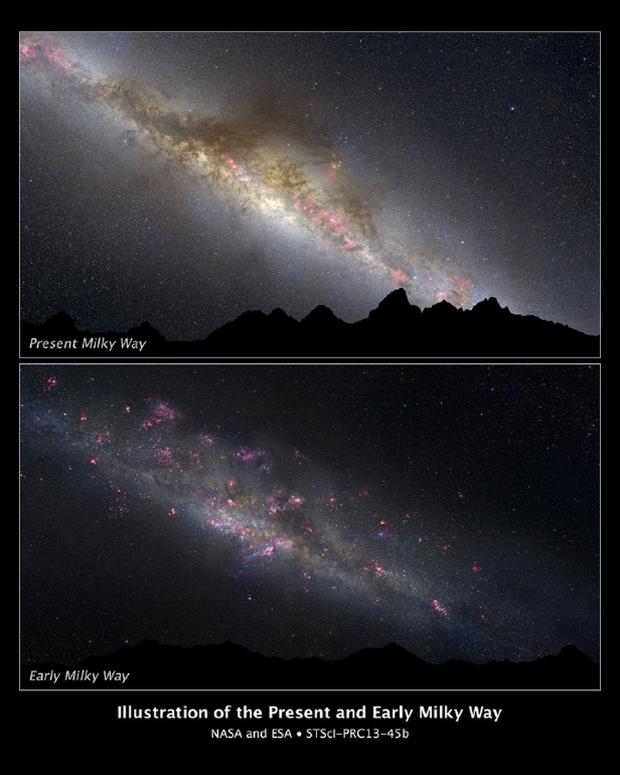
Image: The galaxy evolves. How many stars of the 400 billion now thought to exist here emerged at least a billion years before the Sun coalesced?
As always, though, we have to scout our assumptions. Just because it took what we now believe to be 4.6 billion years for Earth to produce intelligent life, why should that be the case everywhere else? An interesting new paper takes on that question by suggesting that no matter the size of their headstart, planets much older than our own may still be in the early stages of microbial life, without yet reaching the point of producing even primitive larger species.
The work of Chris Doughty (Northern Arizona University) and colleagues, the paper argues that we should be looking at what the team calls ‘plant energy,’ and stop focusing on time as an indicator of likely development. The hypothesis: “The biological evolution rate is a linear function of cumulative carbon fixed on a planet.” Note the word ‘fixed.’ What this describes is the process of taking carbon dioxide, an inorganic gas, and turning it into organic molecules like sugars. Photosynthesis does most of this work on Earth. It uses the energy derived from sunlight as the driver, with the carbon taken out of the atmosphere and oceans and put to use in biological systems.
Proposing a linear link between the amount of carbon fixed in this way and the rate of evolutionary development is a striking move. It’s even more so when considered as a tool for exoplanet research. The paper looks at the amount of carbon Earth has fixed over its lifetime and compares that to what other planets are likely to have fixed during their own lifetimes. 29 exoplanets are studied here, with only two of them surpassing Earth’s cumulative Net Primary Production (NPP), and therefore capable of developing multicellular and perhaps intelligent life. NPP refers to the carbon fixed by photosynthesis that ends up as new biomass.
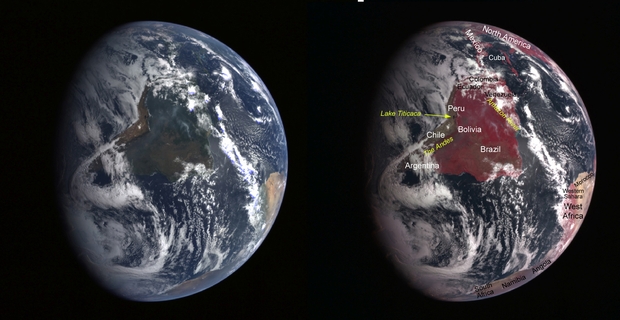
Image: How we see plant photosynthetic pigments. The MESSENGER image of Earth on the left is very close to what can be seen by the human eye. For the image on the right, a red component was substituted that shows near infra-red colors. The vegetation in the Amazon basin produces the purplish-red color in the center of the image. The new paper proposes that cumulative fixed carbon is itself a marker that can be tied not only to life but to the pace of evolutionary change. (Image credit: NASA/Johns Hopkins University Applied Physics Laboratory/Carnegie Institution of Washington, via JPL Photojournal).
The planets on Doughty’s list are chosen from the Habitable Worlds Catalog, which organizes NASA data based on factors such as radius, irradiation, temperature and age. The authors use stellar radiation, temperature and precipitation maps from several recent studies to calculate how Earth fixed carbon in different stages of biological evolution, and ask how long the examined planets would take to achieve the same amount of carbon.
From the paper:
Assuming Darwinian evolution, a baseline astrobiological assumption… each generation of life has a small potential for genetic change following either sexual or asexual reproduction. These genetic changes will either be successful or not depending on the environment, species competition or predation around the organism. We therefore hypothesize that Earth’s cumulative carbon fixed at certain periods has led to major evolutionary transitions such as the emergence of photosynthetic organisms, eukaryote and multicellular animals that fundamentally altered the Earth’s carbon cycle, accelerating it at certain points.
So we can think of the accumulated plant energy of an entire planet and acknowledge that planets with more plant growth as mediated by photosynthesis will tend to be warmer, wetter places than average. This gets interesting when we think about red dwarf planets, especially since these have enormous lifetimes and many are several billion years older than Earth. The authors make the case that these time factors provide no necessary advantage.
What counts is that life on a planet like TRAPPIST-1e, one of those studied here, would have lower rates of total photosynthesis because the surface receives correspondingly less light. Moreover, tidal lock on M-dwarf habitable planets would mean losing half their surface for photosynthesis. In this study, TRAPPIST-1e is found to have the capability of fixing no more than 21 percent of Earth’s carbon. An older world, but perhaps one with nothing more than microbial life.
We have interesting simulations of places like TRAPPIST-1e, climate maps that allow us to estimate how long it would take other planets to achieve the same amount of carbon fixed as we find on Earth. Of the 29 worlds considered potentially habitable by the authors, 27 are in fact orbiting red dwarf stars, and presumably tidally locked. Net Primary Production is calculated for each. The results are heavily weighted toward life at no more than microbial level:
If the biological evolutionary state is a function of cumulative carbon fixed and life began on each of the 29 exoplanets like it had on Earth, life on most of those 29 exoplanets would most likely be evolutionarily behind Earth (with two exceptions discussed below). The majority of our simulations led to most planets at the predicted microbial life stage with the exception of simulations using climates with 1 bar CO2. These very warm, wet planets accelerated NPP production which led about a third of the planets potentially ahead of Earth.
That sounds rather promising, but read on:
However, recent JWST observations showed no evidence of a thick carbon dioxide atmosphere on TRAPPIST-1c… or TRAPPIST-1e… therefore 1 bar CO2 may be unlikely on potentially habitable exoplanets. This raises the question of whether life can exist on an exoplanet with 1 bar CO2 in the atmosphere. CO2 concentrations in the early Earth may have been as high as 10 bar and up to ∼4,000 ppm CO2 in the atmosphere in the Cambrian (Royer, Reference Royer 2006), but 1 bar CO2 might not be conducive to land-based life.
The uncertainties here abound, as the authors are quick to acknowledge. We do not, in fact, know whether any of these planets actually have atmospheres in the first place. Nor, obviously, do we have any idea of their composition if they do exist. We have no knowledge about the presence of carbon at the surface, and also have to factor in the possibility of biological processes modifying the composition of any atmosphere present, just as Earth’s atmosphere was gradually transformed as the effects of photosynthesis began to be felt.
For that matter, can we assume that the life we are looking for uses carbon along the lines of life on Earth? If it does, this study predicts that most stars in our stellar neighborhood, despite sometimes being much older than Earth, are behind our planet when it comes to biological evolution. Two planets – GJ 1061c and K2-3d – do stand out as being of unusual observational interest for present and future space telescopes. Both are both larger and older than Earth.
This is useful information, given that our first thorough analyses of planets of Earth mass are going to occur with planets orbiting low mass stars. When we reach the point of instruments like Habitable Worlds Observatory that can image planets around G-class stars, the discouraging catalog analyzed in this paper may be replaced with a more positive one. If Doughty and team are right, however, we have an answer to the Fermi paradox and the time problem. Intelligent life has far fewer places on which to develop than we thought.
The paper is Doughty et al, Calculating potential cumulative carbon fixed and evolutionary stage for Earthlike planets in our solar neighborhood, International Journal of Astrobiology (2026). Published online by Cambridge University Press 22 September 2026. Full text.
I find that the hypothesis very “bold”, the logic somewhat sketchy, and the probable variablity of the calculations far exceed what the results imply.
The hypothesis is built on some weak observations that are then connected. Cumulative net primary productivity may have nothing to do with evolutionary rate, which is fundamentally based on the high biodiversity of the tropics. The high biodiversity may be due to the relative stability of the tropical biome, allowing an accumulation of species, rather than a greater evolutionary rate. Large populations tend to be stable due to the Hardy-Weinberg stability of alleles, while small founder populations in new areas like islands result is rapid speciation.
The idea of NPP is proportional to evolution would seem to require the “evolution by creeps” model rather than the “evolution by jerks”. ;-) Yet we know that it was the great extinctions that drove major changes in species and species radiation. The authors’ model would predict that stable states would ensure greater cumulative NPP and therefore evolution, whilst we observe that it was the crises that drove evolution and especially forms with greater intelligence and eventually hominids. Isn’t this more important for the issue of the Fermi Question?
Consider that the oceans have about the same NPP as the terrestrial plants. Terrestrial plants have only been around for well under a billion years, while oxygenic photosynthesis appeared in the oceans around 3.5 billion years ago. This would predict that the oceans should be far more biodiverse than the land, yet there is no evidence of that. Why not? Lack of shallow water areas?
There is little need to argue with the issue of stellar type, planetary size, and possibly CO2 atmosphere as a source of carbon. We know that Earth has far more carbon locked up as carbonate rocks, and that the carbon in the atmosphere depends on both heological and biological cycling. However, we also know that at a star evolves, it becomes more luminous, which ultimately destroys NPP due to heating and the drawing down of CO2 to offset this temperature rise.
A possible thought experiment is whether Venus might have had a faster rate of evolution until its greenhouse brought an end to surface life.
TL;DR, I think this analysis is built on very shaky assumptions, bolstered with possibly irrelevant calculations, rather than a sound theory. Is it really better than a simple model based on planetary age?
While I agree that the proposed equivalence of fixed carbon with evolutionary rate is suspect, I do think it is worth considering whether there is a fixed-carbon threshold that must be met in order to survive catastrophes, colonize new habitats, and regulate against extreme conditions.
Would Mars have complex surface life today if enough organic material had been available to either prevent or survive the loss of its atmosphere and surface water? Would Venus have avoided a runaway greenhouse if it had a sufficient biological carbon cycle to fix CO2 more aggressively in the crust?
Earth’s recovery from Snowball Earth has been partially attributed to the rise of carbon dioxide after the drop in photosynthesis. Would enough carbon have been available quickly enough to achieve this from the geological carbon cycle alone?
Similarly, if the speculation is true that mammals thrived after the KT extinction due to their being too warm-blooded to be preferred fungal hosts, then again, a high overall planetary organics and energy budget provided a path for radiation of complexity after catastrophe.
Put another way, does Gaia as a complex super-organism survive shocks to the system and keep multiplying its capabilities if the carbon and energy budgets are not beyond merely enough to keep water liquid?
@David
In the other direction, are super-habitable planets with a more abundant biosphere and fixed carbon have an earlier and faster evolution than Earth? As evolution rate must depend on the length of the reproductive cycle, would a planet with smaller organisms, (e.g., on a larger planet with greater surface g) have its life evolve faster due to their shorter lives than a planet like Earth where larger forms also evolve. Is there evidence that smaller organisms evolve faster based on cladistics, so that larger, long lived organisms evolve more slowly and have longer speciation longevity than smaller forms – e.g., whales vs mice? Or do planetary conditions constrain the range of forms and perhaps the phenotype search space?
All good questions as well. If any of this speculation is correct, then adding biosphere resource abundance to our measures of habitability sounds potentially fruitful. But point taken, none of these speculations gets us very far in “solving” the Fermi paradox, absent much more understanding of the constraints on development of technologically-capable species.
There are some important contingencies of what is a habitable planet that had not been conceived yet in 1951 when the Drake equation was formulated. It’s not enough to just have a planet in the Goldilocks zone around a star and have it the same size as Earth. The idea that it needs to be a G class star is new. Also the planet has to have a Moon and a fast rotation cause by a giant impact the Theia to give the exoplanet a fast rotation. Without this problems occur like loss of atmosphere from solar wind stripping and that over deep time or billions of years becomes a problem for photosynthesis like plant life. Consequently, we can’t just assume that we will see chlorophyll on every Earth sized planet. This would definitely make Earth more rare, however there still could be no less than ten to several hundred Earthlike planets in our galaxy. The probability is not that hard to calculate considering if we get similar solar system to ours, it still needs a collision to get a Earth size planet and a Moon. I am not an expert on probability, but we still could have no less than ten to one hundred planets in our galaxy with intelligent life, but still be more advanced than us.
Only a few percent of all the carbon ‘fixed’ by photosynthesis on Earth is currently present in the biosphere; the rest is buried underground as coal, oil and other forms of kerogen. The amount of fixed carbon on the surface is trivial compared to buried fossil carbon of this type, but fossil carbon is not directly involved in the evolution of surface life.
I don’t really see why a planet with less carbon fixation overall would necessarily have a less complex or active biosphere at any given moment in time, even if it has less kerogen underground.
“Uncertainties abound”.
Excuse, me for the typo. I meant 1961 for the conception of the Drake Equation.
How does photosynthesis depend on higher energy photons? Take a fern and put it in a warm, unlit room. It will die for lack of energy. In sunlight, under a 5800 K light source, it thrives. Under a cooler light, like from a K star, with less visible and more infrared photons, how well does it grow? Less energy capture means less food for animals to eat.
Chlorophyll has 2 linked photosystems. One uses blue wavelengths; the other uses red.
That is why you see LED lighting systems for indoor farming look magenta – there are red and blue LEDS supplying the needed wavelengths.
Some light harvesting organisms have adapted the “antenna” of the molecule to harvest longer wavelengths, even into the near IR. While terrestrial plants will not do that well around cool stars, local indigenous plants may well have adapted their biology to work with teh available wavelengths. We may be able to gene engineer terrestrial plants to do similar, beyond just adding more chlorophyll that darkens the leaves like forest plants.
Hi Paul
A very interesting study, that makes a lot of good points.
Again Red dwarf Stars do not look like good places, from this research.
I was just reading this one too before catching up on your latest post.
A Wavelet-integrated Search Pipeline for Narrowband Technosignatures in FAST Observations of 33 Exoplanet Systems
https://iopscience.iop.org/article/10.3847/1538-3881/ae8f34
Cheers Edwin
Had not seen that one, Edwin. Thanks for passing it along.
I have this idea that life needed multiple impacts and chemical reactions at different gravities to get started.
Chemistry in space…hitting a planet—getting spalled off back to a lower gravity setting once again…etc.
That might explain us as being a one-off.
Except that it has not been demonstrated that we are a “one-off”.
@Jeff
Ward and Brownlee’s “Rare Earth Hypothesis” only goes so far in suggesting that complex life that leads to intelligence is rare. They are quite content with the idea that life is common, but stuck at the prokaryote stage of archaea and bacteria.
This hypothesis fits with the Great Filter being the evolution of eukaryotes. @Abelard mentioned hydrogen hypothesis, which is the unique event that facilitated this evolution. The efficiency of eukaryote metabolism that allows for far larger genomes to be maintained eventually led to the burst of complex life that emerged in the Cambrian around 540 mya, possibly as a response to rising dissolved O2 in the oceans after the Great Oxidation Event.
Positing that even abiogenesis was a unique event exceeds even W&B’s beliefs. We may even be on the cusp of finding evidence of abiogenesis in our system. A decade or so in the future, our dedicated telescopes may discover [un]ambiguous biosignatures on exoplanets. Either of these 2, would indicate that life is not rare and is probably due to separate abiogenesis events.
If we find that everywhere we look, life is absent, especially where the environment looks like it should be habitable, then we would have to rethink our ideas of the ease of abiogenesis. If nothing else, it would reassert our position at the “center of the universe” and likely reinvigorate religious belief in a creator. I would hope that it would instill a greater sense that we should take a lot more care of Earth’s biosphere, rather than trashing it. In the farther future, we may become the “Old Ones” who “green” a sterile galaxy, and create the conditions for future intelligences to emerge.
Evolution can only take you back so far…chemistry only so far forward.
The TED talk about Unilever soap nozzles made me think about smokers on the sea floor, vortex shedding.
Some tornadoes are double helix, like MN in 1986 with vortex breakdown…but I read about soda lakes, maybe ice cracks and organic…it may be that a complex cosmic pinball is needed.
If we find barren smokers off Earth…it won’t look good for SETI.
It appears life appeared quickly on the young Earth–almost as soon as it cooled off!
But it took about four billion years more before a civilization arose capable of developing interstellar communications. That’s a long, long time without a planetary catastrophe like a drastic orbital perturbation, collision, climate collapse, runaway atmospheric excursion or stellar outburst. Even in the unlikely event that the initial conditions are ubiquitous and the evolution of spacefaring cultures is inevitable, how many worlds survive for billions of years without some cosmic event sterilizing them completely, or at the very least, resetting the evolutionary clock back?
That is the factor that determines whether or not intelligence is common in the cosmos, whether we are alone or not.. Regardless of the requirements for advanced life or its probability of developing, the real goldilocks issue is how often do these disasters occur on the average.
What we know now is encouraging: life appears to arise easily, it is not an unlikely event. We are also confident that stable, long-lived stars with planets are the rule, not the exception. But we still do not understand enough about the formation and history of solar systems to state whether they remain hospitable to life for several billion years at a time. Our research priorities should be clear.
As for the longevity or self-destructive potential of industrial civilizations–well, that is something we know next to nothing about.
Rather than speculating on the initial requirements for life or the inevitability of constraints , we should be concentrating on the temporal probability of natural planetwide catastrophes. And those catastrophes will be most likely to occur long before we are likely to see them coming, or doing anything about them. THAT is where the Great Filter lies.
And finally, the same technology that will allow us to escape a dying planet may also be the most likely cause of that death occurring in the first place.
My guess is we are alone. I doubt there are more than a handful of intelligent species in the Milky Way at any one time. But its just a guess; a well-informed guess, but a guess nonetheless.
@Henry Cordova
I wrote an essay on CD about a paper that models these effects.
Are Planets with Continuous Surface Habitability Rare?
A lot of things can change on a planetary surface, but as long as the change is gradual, life and evolution can adapt to it. This certainly has been the case here on earth over the last 4 billion years or so. So far, life itself has helped buffer some of these changes, playing an active role and helping adapt the planet, its atmosphere and oceans. Earth has survived asteroid impacts, severe atmospheric chemistry changes, ice ages, volcanic episodes, tectonics and climatic swings. Its possible we’ve managed to avoid irreversible, sudden changes of state that might sterilize the planet completely, perhaps by sheer luck, and we are not typical. But its hard to know that.
But external events, like major collisions with planet-sized bodies, extreme orbital perturbations, nearby supernovae or even more violent cosmic surprises like black holes, or flasher/radiation events are possible too, and they can be catastrophic no matter how stable, or adaptable life, the planet and sun are. Four billion years is a long time. Have we gotten very lucky, or are these threats very rare?
So far, it appears no super-successful life form has been able to take hold and cause such severe changes that the biosphere itself collapsed, although (until now) none has had technology that could magnify its disruptive effects.
Whether the earth is “typical” or “special” is still not clear. Although 4 billion years and a thriving, rich biology suggests to me its the former.
TRAPPIST-1 strikes me as an extreme case for this, given it’s about as small as a star can possibly be and still have fusion, and even then it still gets about 21% of the carbon generation as Earth. Most red dwarf planets would probably be around larger red dwarf stars with more intense light, and the tidal lock and light side/dark side means they can have a higher overall intensity of light compared with Earth before going into a runaway greenhouse effect.
I also don’t think there are planets several billion years older than Earth that could be conducive to complex biospheres, unless the planet is either weirdly enriched in radioisotopes or the tidal heating from eccentricity is just high enough to keep the core warm but not so high that it roasts the planet. An Earth-size planet 5-6 billion years old has probably cooled to the point where it can no longer sustain plate tectonics and is cycling between warm periods of volcanism and snowball epochs.
@Brett
Has anyone modeled a planet around a red dwarf, where the RD is old and cooling, and the planet is cooling internally. Would the CO2 remain high enough to keep the surface warm? Would life retreat into the lithosphere or underground reservoirs?
I have only seen the climate modeling to determine is such planets could be habitable, but not what would happen as heat sources declined, and potentially loss of atmosphere and surface water, like Mars, yet still be Earth or super-Earth-sized.
And in fact the Trappist-1 planets are unlikely to be tidally locked. They have mutual interactions which force (slow) rotation against their orbits.
Revol; Bolmont; et. al., “Drifts of the substellar points of the TRAPPIST-1 planets” 10.1051/0004-6361/202451532 (25 October 2024)
I think the error bars on these calculations are a bit too large for meaningful numbers, tho the approach is valid. Total amount of fixed carbon correlates with how much biomass is available for evolutionary pressures to drive. However, the influence of those drivers may outweigh the crude measure of carbon mass. For instance, a planet with greater tilt (such as Earth has) or orbital eccentricity will drive evolution faster thru environmental stressors. Moons of supergiants may have even more complex, yet repetitive cyclic stressors. Local radiation rates, availability of other elements, and random mass extinction events will all affect the rate of evolution.
It seems the Drake Equation is getting more, and more specific, parameters, but it still is wild speculation.
@Joe McG
This suggests that both Mars and Venus, which did not have a large, stabilizing moon, should have increased the rate of evolution before it was halted by massive climate change.
More like the probability for each variable gets lower, as they impound more features with p<1.0
I still think that Eukaryogenesis via Hydrogen Hypothesis (William Martin and Nick Lane) is the Great Filter and the reason we are alone in the galaxy.
@Abelard
It is a very persuasive argument, at least as far as it seems to be a unique, and therefore extremely low-probability event.
However, I am not so sure it is unique. Recently, the other “unique” event, the encapsulation of photosynthetic bacteria to evolve into chloroplasts, has been found to have occurred a 2nd, more recent time, just 100 mya. Is it possible that the origin of mitochondria was also not unique, but may have occurred again? Like the chloroplast story, the organisms with a different mitochondrial origin may be rare due to poorer fitness, which either restricted them to a niche habitat or simply caused them to go extinct, just as other organisms may have gone extinct competing with LUCA and no longer appear in the phylogenetic trees of organisms we have sequenced.
If this speculation was correct, then the hydrogen hypothesis, may not imply a very low-probability event and be a Great Filter candidate.
BTW, one reason that I am very cautious about “unique” events is that they start to sound like the Creationists’ “Irreducible complexity (IC)” argument of Behe, which leads to the need for a creator/ID. More concretely, the ID example is a tornado going through a dump and a Boeing 747 emerging. This is an extremely unlikely event to say the least, and therefore the IDers use a creator as the default. If the hydrogen hypothesis is correct, this can fall into the IC trap, although it would have happened less that 10 millennia ago!
It is easier for me to imagine that this was attempted multiple times in the past, with perhaps partial success, until a very successful version emerged that outcompeted earlier forms. This is the version we see today that phylogeny indicates converged on a single individual (the last common eukaryote) as there are no other surviving forms. The chloroplast example shows that unique events are subsequently found to not be unique, even if extremely rare based on the observational data we have.
I asked Nick Lane a long time about about the chloroblasts. He said this required the existence of mitochondria in order to happen and, as such, it did not conflict with a rarity argument for the former. A few years later, Lokiarchaeota was discovered with people claiming this discredited the Hydrogen Hypothesis. But further research found that Lokiarchaeota was indeed Hydrogen dependent, thus supporting the Hydrogen Hypothesis. This is why I still stand with this.
Your comment about its rarity being too much like creationism/ID is a good point. I’ve thought about this a lot. I actually consider this an entertaining prospect because we could expand out into the galaxy as a space-faring species and still have endless debates about evolution vs creationism with no resolution in sight. All this means to me is we simply learn to agree to disagree and go our separate ways. Something that will be a lot easier once we are in space in a large way.
I’m a hardcore rationalist/empiricist. But I get along just fine with religious people as long as they don’t want to take my head off.
@Abelard
Coincidentally, I am reading the scifi novel “Calculating Stars” by Robert Sawyer. The setup is that an alien arrives at a museum looking to do research on Earth’s evolution. A paleontologist at the museum offers to help the alien understand how evolution happened on Earth and sgow it the evidence we have. This leads to discussions where it is revealed that extant alien civilizations all believe that the universe was created, which sets up a conflict in the mind of the paleontologist.
A fun read.
Sawyer is a fine writer. I loved “Calculating Stars,” particularly the conclusion.
I think that originally, no-one even included red dwarfs in the estimates. As I recall, Carl Sagan and Isaac Asimov included only stars from early K to late F in their calculations.
Kepler specifically looks at spectral classes K, G and F.
Expecting habitable planets around M dwarfs is a comparatively recent belief.
It seems to me that the estimate of 400 billion stars in the MW (as stated in the article) must be over-enthusiastic.
Based on Gaia data, the total stellar mass is about 53 billion sun-masses.
Even if we take a low estimate for the average mass of a star of 0.3 sun masses, there are only about 160 billion stars in the MW.
I see numbers on this that are all over the place. These days, though, I rarely see any below 200 billion. You may be right and I’ve been known to be overenthusiastic in the past!
That’s true but it does not seem to be supported by models of the Milky Way. I saw a paper the other day which found the stellar mass is only about 2 x 10^10 sun masses. That would put the star number below 100 billion.
The authors say this is because older models simply extrapolated based on a single scale length towards the inner galaxy, but they have now found out the density is much flatter.
Interesting! Thanks for updating me on this.
The stellar population of the Milky Way is always, at best, an estimate, and is always based on assumptions which may vary wildly depending on the latest research, not to mention who is interpreting it.
What percentage of the total number of stars can be assigned to each spectral class? What is the average mass of the members of each class? How much mass is locked up in the interstellar medium? How are the methods used to determine total numbers skewed by the so-called ‘missing mass’ represented by dark matter? How much is hidden away in black holes, brown dwarfs, rogue planets, WIMPS and MACHOS? The population distribution may vary considerably with both space and time. And of course, selection bias plagues all our efforts to come up with a reasonable estimate. These are all approximations. They are probably improving as we learn more, but we really don’t know with any sort of precision.
There are also psychological or perceptual factors which may color our estimates. For example, although our own sun is always described as an ‘ordinary’ star because its mass and brightness are near midrange of the extreme values; in sheer numbers, G subdwarfs do not comprise a very large percentage of the total population, and they are actually much more massive and brighter than the typical star (whatever that is). There are also vast differences between the mean and median.
Calculating the number of Milky Way members is, at best, an informed guess,
sort of like trying to determine the mean household income of a distant country that has never conducted a proper census.
When asked, I always say “several hundred billion”. Your number of
1.6 x 10^11 is no doubt within an order of magnitude of the correct value.
The numbers in each spectral class are surely tied down quite well these days.
It’s true that I can find estimates of the “average” star mass between 0.3 to 0.5 sun masses, which is why I chose the lowest number (0.3) to give the highest estimate of star number.
The mass of gas and dust is given as a separate estimate to the stellar mass so is not relevant. “Stellar remnant” mass is also reported as a separate estimate. The reported stellar mass is that of main-sequence stars.
It’s not completely clear if this includes brown dwarfs and planetary mass objects. But it has been established these don’t contribute much to the total mass and there is only about one brown dwarf for each four stars. That ratio is about the highest estimate too.
“The numbers in each spectral class are surely tied down quite well these days.”
Sounds like ‘famous last words’. ;)
Here is a comic-strip style adaptation of the famous scene from the original Manchurian Candidate, reimagined from communist hunting to alien hunting as imagined by Google Gemini.
PANEL 1]
(A dimly lit, mid-century kitchen. SENATOR JOHN ISELIN is sitting at the table in his undershirt, looking stressed and rumpled. He is surrounded by stacks of charts. His wife, ELEANOR, stands over him like a shadow, pouring black coffee.)
JOHN:
“Eleanor, I’m telling you, it’s a disaster! Yesterday in Dallas I told the press there were four million intelligent alien species out there. Today in Houston, I said there was only one, and it was a giant space amoeba! I look like a fool!”
ELEANOR: (Sighing heavily)
“Johnny, you are a fool. But you’re my fool, and soon you’ll be the President’s fool.”
[PANEL 2]
(John throws his hands up in despair. Eleanor walks over to the refrigerator, looking completely bored by his panic.)
JOHN:
“But the Fermi Paradox, Eleanor! If the universe is teeming with life, where is everybody?! The voters want a specific number of extraterrestrial civilizations currently hiding in the Milky Way, and they want it now!”
ELEANOR: (Reaching into the fridge)
“Then give them one, Johnny. Just pick a number and stick to it.”
[PANEL 3]
(Close-up on Eleanor’s hand as she pulls out a glass bottle of Heinz 57 sauce. The big bold label reads: HEINZ 57.)
JOHN: (Off-screen)
“I can’t just make it up! It has to sound calculated! It has to sound scientific!”
ELEANOR: (Staring coldly at the bottle)
“Calculated. Right…”
[PANEL 4]
(Eleanor slams the ketchup bottle down on the table right in front of John’s face. She points a sharp, manicured fingernail at the label.)
ELEANOR:
“Fifty-seven.”
JOHN: (Blinking, confused)
“Fifty-seven? Fifty-seven alien civilizations? Is that… a Drake Equation variable?”
ELEANOR:
“It’s a beautiful number, Johnny. It’s precise. It’s memorable. It’s exactly fifty-seven card-carrying extraterrestrial civilizations currently infiltrating our local corner of the galaxy.”
[PANEL 5]
(A sudden, dramatic smash-cut. The kitchen is gone. John is now standing behind a grand wooden podium in the Senate, bathed in harsh spotlights. He is sweating, waving a piece of paper aggressively in the air.)
JOHN: (Bellowing into the microphones)
“I have here in my hand a list! A list of exactly 57 advanced alien civilizations that are currently ignoring our radio signals, hiding their megastructures, and actively participating in the Fermi Paradox at this very moment!”
The Fermi paradox is only a paradox if all the assumptions it is based on are true.
This paradox was presented in the 1950’s. We now know that every single star has at least one planet on average, probably more. We know that most of the stars in our galaxy are red dwarfs, with lower energy light. Recent studies indicate that life as we know it either can’t survive in such environments or would take much longer to develop. Considering time, distance and the inefficiency of electromagnetic communication seems to indicate that the probability of two civilizations developing at the same time, with the same level of technology and near enough to discover each other and communicate is essentially zero.
We’ve only been seriously looking for evidence of other civilizations for about 50 years. How much of our galaxy and how much of the em spectrum have we actually looked at? Declaring we are alone is like taking a cupfull of our ocean, looking at it and declaring whales do not exist.
Paul, your article raises a fundamental question about the Fermi Paradox.
Why do we keep confusing intelligence with technological civilization?
Our evolutionary path is only one possibility. Alien intelligence may take forms we cannot even imagine, without developing recognizable technologies.
The absence of technological signals does not mean the absence of extraterrestrial intelligence.
Are we searching for alien intelligence or merely for an extraterrestrial version of ourselves?
What if the Great Silence is actually a Great Failure of Recognition?
What if we are in fact receiving signals that we mistakenly categorize as known phenomena?7
Excellent questions indeed. Intelligence without technology designed for expansion or even communication is certainly plausible. But would that evolutionary result be universal? A single civilization with a start of several billion years would have plenty of time to have explored the galaxy, keeping Fermi’s question still alive. I go back to Brin’s 1983 paper and his “Principle of Non-exclusiveness,“ Diversity in outcomes should be expected unless there is some mechanism to keep it from happening. And I keep wondering what that might be.
@Delia, @Paul
The diversity issue is not ruled out by Delia’s suggestion. I would note that while intelligence applies to a spectrum, from bacterial genetic responses to the environment, through various organisms, where it seems to increase with increasing encephalization, all the way to human intelligence, where our leveraging of technologies is almost a runaway phenomenon, especially with the onset of the Industrial Revolution.
There could be pre-industrial civilizations kept in check by periodic collapses as technology proves too dangerous and reduces the intelligent species to a smaller population, which is forced to restart its technological development from some simpler state. Alternatively, technology allows for some transcendant state for intelligence, resulting in intelligence that is immaterial, like Bowman after his “star child” transformation in 2001: ASO. Another option, suggested by Delia, is intelligence applied in a different direction, perhaps using very different technologies that might be “like magic”. This could range from philosophical species (e.g., cetaceans), species that use non em communications (Le Guin’s ansibles), to technologies that we wouldn’t recognize that can shape fields and move stars.
The FP could easily just be due to advanced technological civilizations being extremely sparse, and either becoming extinct within a relatively short time, millennia rather than millions or billions of years, or still extant but transcendent and therefore invisible – godlike or mind-uploaded into planetary computers.
There are many possibilities, many of which may be taken by different species in the past, and may be chosen by humanity in the future. The physical starfaring of our current thinking with humans N.x in physical starships exploring and settling the galaxy may be just one possible future, which may still be relatively short-lived, and any signs of this starfaring may be lost if the next advanced technology species arrives millions of years later. Maybe we discover these magic technologies, and we can then recognize their effects used elsewhere. This may become as obvious as recognizing a cairn of stones from a natural pile, or forced planetary migration compared to a natural migration. (How long did it take to recognize low rounded hills in Europe as burial mounds and not natural landforms?)
It may be that physical starfaring in spaceships, and leaving evidence of visits in the past or contemporaneously, is either ruled out by physics, or always abandoned in favor of a different technology. We don’t use carts to transport goods long distances anymore. They have been replaced by powered vehicles such as trains, ships, trucks, and aircraft. )It would take a long time to spy a muscle-powered cart go by on any road, path, or trail today. Starships may be similarly rare.)