
Launching a flagship-class mission like the Roman Space Telescope is always exciting, but with Roman in space, let’s also keep an eye on Pandora, a smaller though fascinating NASA mission (through its Astrophysics Pioneers program) that is now beginning its own work in exoplanet science. 20 exoplanets are targeted here, the idea being to work with data from transits to characterize their atmospheres via transmission spectroscopy, but with an additional twist. Elisa Quintana,(NASA GSFC) is principal investigator:
“Pandora’s data will help close a major gap in our knowledge about planets and their host stars because, right now, we can’t be entirely sure how the star’s light affects measurements of what makes up exoplanet atmospheres. We designed the Pandora spacecraft and its in-depth observing program to better understand this vexing issue.”
Launched January 11 of this year, Pandora is now beginning observations of its target stars. It’s in that category of smallsats that fascinate me because their low cost also gives them the option of higher tolerance of failure, making it possible to push the limits without great financial risk (the cost cap on this class of mission is $20 million). A tool like this can be tightly focused on specific targets without compromising larger instruments that are already besieged with obligations to existing observing programs. Word from the Pandora team is that science work begins with all instruments performing as expected.
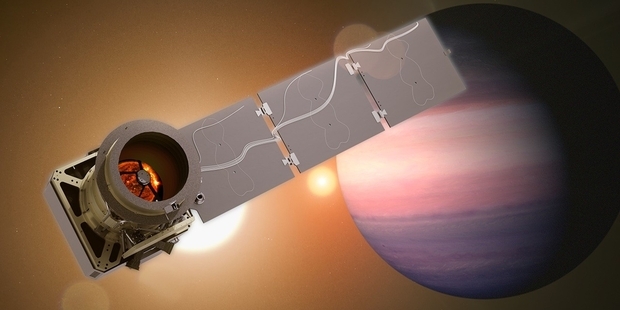
Image: Artist’s concept of NASA’s Pandora mission, which will help scientists untangle the signals from exoplanets’ atmospheres and their stars. Credit: NASA GSFC/Conceptual Image Lab.
What makes Pandora so interesting is that it’s a multi-wavelength mission. Pandora’s telescope, an aluminum Cassegrain instrument 45 centimeters in diameter, feeds detectors that work in both visible light for long-baseline photometry as well as near-infrared (NIR) wavelengths. Starspots or other stellar activity can be separated from the near-infrared spectroscopy data on the planet’s clouds and atmospheric hazes. This is information that will inform subsequent work with telescopes like JWST and Roman as we refine our tools for removing noise in the data. A recent paper on Pandora makes the case:
Alongside the opportunities explored throughout this work, Pandora provides a unique opportunity to help overcome many hurdles inherent in observations with current instruments. Namely, multi-epoch observations of exoplanet atmospheres with JWST are often observed at different points in the stellar rotation, making them difficult to fit jointly (e.g., E. M. May et al. 2023). By providing information about the stellar activity and allowing for corrections at the data level, joint Pandora–JWST programs will unlock new insights into planets around active hosts. Additionally, these same insights will inform the presence of offsets between different instruments and epochs, which have been difficult to constrain thus far with JWST alone (e.g., A. L. Carter et al. 2024).
Pandora is going to give us useful data on stellar contamination in our transmission spectroscopy work. That means a clearer and more reliable look at the composition of exoplanet atmospheres. Stellar contamination should stand out, with a minimum of 10 transit observing sessions per target, each lasting about 24 hours. The plan is to accumulate, for each target, roughly 240 hours of pointing time, which should yield more than 120 hours of science data once Earth occultations and unavoidable gaps for downlinks, etc. are taken into account. An instrument like JWST can collect transmission spectroscopic data for exoplanets but only with relatively short observing sessions involving one or a small number of transits. The combined datasets of the two observatories will cleanly excise star signals from the data on planetary ones.
The finalized target list was published last January and contains 19 host stars, one of which is orbited by two of the target worlds. The stars range from M-dwarfs to K-class. 16 of these planets have been observed previously by JWST, which will allow the retrofitting of the Pandora measurements onto the JWST spectra. As far as I can tell, earlier provisional target lists included planets that didn’t make the final list, with the emphasis shifting toward larger warm Neptunes and Saturns. That makes sense given that these offer higher signal-to-noise ratios as we put these techniques to work together for the first time.
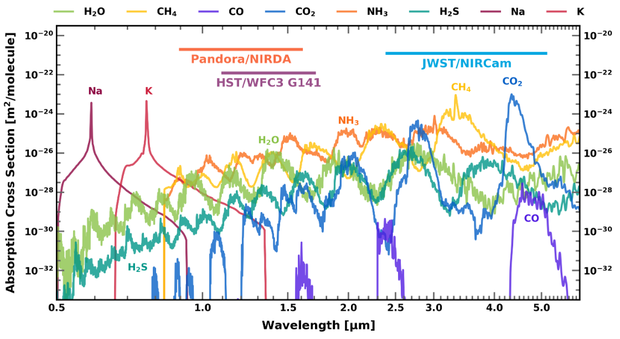
Image: This is Figure 1 from the paper. Caption: The absorption cross sections of common absorbers in exoplanet atmospheres considered in this work, shown at a pressure and temperature of 0.1 mbar and 1000 K. The wavelength coverage of Pandora’s NIR detector (NIRDA), JWST’s NIRCam F322W2 and F444W filters, and HST’s WFC3 instrument (for the G141 grism) are shown. Pandora/NIRDA covers absorption bands of H2O, CH4, NH3 and the wing of the K doublet, making it most sensitive to these absorbers. Credit: Rotman et al.
Using these methods, Pandora’s science observations should be more accurate and reliable than any planetary atmosphere readings ever taken before. The paper is Rotman et al., “NASA’s Pandora SmallSat Mission: Simulated Modeling and Retrieval of Near-Infrared Exoplanet Transmission Spectra,” accepted at The Astronomical Journal (preprint).

$20m ceiling for this, compared to $15m for a Fermi Explorer probe that will take 70 millennia to maybe reach Alpha Cen. Science vs. PR.
So many interesting ideas for science and technology, so little funding.
True. But even at $20 million, Pandora looks like a real workhorse.
Did I write my comment badly? I was lauding Pandora while deriding Fermi Explorer. I read your comment as that I am deriding both.
Not at all. I was just conveying my enthusiasm for Pandora. And agreeing with your support of this kind of mission.
The only way I can see Fermi been useful at all is if it could demonstrate swarm activity. It could form a large collection of discs with sensors and the means to move about. I suppose mini starshot discs to mimic a swarm as envisioned by the Starshot project.
“or a Fermi Explorer probe that will take 70 millennia to maybe reach Alpha Cen. Science vs. PR.”
The value of good PR cannot be overstated. Ultimately, multi-generational deep space projects require the broad, sustained backing of society—at least until we can establish a viable space infrastructure (which is by no means guaranteed).That said, I agree that it remains tragic how little funding fundamental science and space exploration receive compared to other, perhaps more short-sighted aspects of human civilization.
I can’t wait for these types of telescopes to be put on the moon. I think there was even an idea to use the moons crater rims as occultors for exoplant discovery.
Bad idea. Occulters have a precise geometric pattern (unlike geologic features), allow light all around its perimeter (unlike a crater rim) and isn’t in motion with respect to the object being observed. The last is the most obvious objection since the sky is in constant motion as seen by an observer or telescope on the Moon’s surface, not fixed with respect to a natural or constructed occulting disk.
Nothing stops us put occultors on the rim but even the rough merrain gives us information on stars that they intersect. Ultimately a movable occultor on stay wires my help so we can observe stars longer may help our understanding of the cosmos. But telescopes on the moon is a win for everyone.
Hi
It looks like a great mission for the price, it will be interesting to follow up on the results.
Cheers Edwin
Two admittedly pure layperson thoughts on this:
1) I really hope the bigger payload mass & fairing volumes we’ll get w these next get SuperHeavy rockets—Starship, New Glenn etc—will enable NASA & other science programs to fund even more ambitious “small” experimental (whether pure science or applied science) missions. IE, Rather than “cubesats” though, perhaps something materially bigger & more capable, on an annual or semi annual “rideshare” basis.
2) As these various exoplanet projects develop, I can really see a more defined role for some of them, not in terms of spectra per se, but for the roles they play in the “lifecycle” of exoplanet discovery: First, wide field surveys to characterize entire swaths of sky & roughly ID potentially interesting solar systems. Next, medium throughput observatories that more thoroughly target a few dozen or a few hundred of the most interesting stars IDd by the first wave. And finally, if the second wave IDs some solar systems that merit it, a third wave of incredibly powerful yet low-throughput telescopes that literally only focus on 1-6 of the most enticing targets. (eg Perhaps using gravitational lenses, etc.)
Looking for atmospheres is part of looking for extra terrestrial life, although the best argument for doing science is the corollary benefits to our ordinary lives on this planet. We need breakthroughs in preventing and reversing damage our technologies have rendered to our only known livable planet.
As far as life, there are only 4 reasons why we haven’t encountered or observed other non-human civilizations:
1. there aren’t any. This is a low probability given we already have one operational example.
2. there is lot’s of life, but like all the other intelligent species on our own planet, the lifeforms do not pursue technology, at least not the kind we look for.
3. the deepness of time of the universe is such that other life is either not contemporaneous with us or more probably their technical era is not contemporaneous with ours.
4. the physics of the universe are such that none of us living things can signal or travel far enough to be seen by others, and for this problem the pursuit by us of more and more advanced technology may yet produce verifiable sightings or detections of life.
Number 4 is a good enough reason to keep looking. Are there other reasons?
The Pandora PI’s introductory comment takes us back to an earlier report on the efforts to distinguish helium originated from an exoplanet from that of a stellar primary.
In an earlier report of from a separate group, it was reported:
“After much careful analysis and consideration of the spectra, we determined that helium was escaping from LHS 1140 b’s atmosphere in 2024 due to heating from stellar X-rays and extreme ultraviolet radiation. However, our 2025 observations revealed no escaping helium, so the atmospheric escape appears to be variable. It is a rare privilege to witness the atmosphere of an extrasolar planet change on such short, human timescales!”
Of course, this reader is not in a position to draw a sharp line between these lines of exoplanet progress. Maybe it is somewhat akin to that of a non-Einstein reviewer in a patent office. But it would appear that although the current article’s data set does not include LHS 1140 b’s case itself, its methods should make it easier to nail down exoplanet atmospheres from transits.
It is also noted that 19 candidate exoplanet systems were targeted and a number of parameters were identified in the paper. However, one feature that I think has been ( or could be) neglected in exoplanet transit studies is exoplanet eccentricity. Some eccentricity values do appear in reports, presumably if they are impossible to ignore.
But it is likely, that if a exoplanet’s eccentricity is about that of Mars, it might be ignored.
I do have some means to determine orbital elements based on “time of flight” calculations and have been curious if it would have much impact on exoplanet characterization studies. Astrodynamics, the engineering version of orbital mechanics makes use of “time of flight” more and more these days, consciously or otherwise, but celestial mechanics tends not to acknowledge its existence now for over four centuries. It might be time to take it out for a spin.