
Given how long stars live in comparison to human lifetimes, I always do a double-take at science fiction tales of starships dropping in to study a nova just as it’s about to go off. I suppose we have to assume the starship civilization has found a way to time such matters. There’s a Star Trek: The Next Generation episode that involves rescuing a planetary population from a star that’s about to explode (“A Fury Scorned”), but of all the nova arrivals, I like Samuel Delany’s 1968 novel Nova the best. Here, in order to harvest a rare element dubbed ‘Illyrion,’ the exact moment of the explosion has to be known and exploited through a mind-bending run through the debris.
Today’s paper doesn’t involve a nova, but it does involve a star that is doing things on a very short timeframe indeed. The star is known as Sakurai’s Object (V4334 Sagittarii). Japanese amateur Yukio Sakurai observed the object in 1996, noting how it appeared to be brightening. A 1976 detection of the progenitor star had recorded a magnitude of 21, whereas when Sakurai tagged it, it had reached magnitude 11. The apparent eruption here was first thought to be the result of a nova, but that was discounted for spectral reasons.
Several years later the unusual brightening began to decline. That was evidently the result of loss of mass and subsequent condensation of stellar material, which wound up hiding the star behind a dusty screen. It now shows a spectrum similar to what is known as a Wolf-Rayet star. Sakurai’s Object appears, however, to be in the much less massive Wolf-Rayet class known as a [WR] star. A conventional Wolf-Rayet star is massive, stripped of its hydrogen by huge stellar winds that leave the underlying helium-burning layers exposed. The odd [WR] notation turns out to be needed because low-mass objects like these can mimic a Wolf-Rayet star, so it was necessary to show that this is a different kind of object and a much smaller kind at that, though with Wolf-Rayet features.
There are also sub-categories of [WR] including [WC] that don’t need to occupy us now, although the paper explains what they mean. What’s intriguing about Sakurai’s object is its pace. According to current calculations it’s now roughly 6 times hotter than it was 30 years ago, and is climbing back toward the white dwarf temperatures it had before the eruption that made it observable by Sakurai. Albert Zijlstra (Jodrell Bank Centre for Astrophysics, University of Manchester), describes its significance:
“Most stars evolve so slowly that major changes take place over timescales far longer than a human lifetime. As a result, we usually have to piece together snapshots of stellar evolution by comparing different stars at different stages of their lives. Sakurai’s Object offers something far rarer. It is one of the very few stars known to have changed dramatically within just a few decades, giving us the opportunity to watch stellar evolution unfold in real time. With our observations, we can test theories of how stars evolve and gain new insights into one of the shortest and least understood phases in the life of a dying star.”
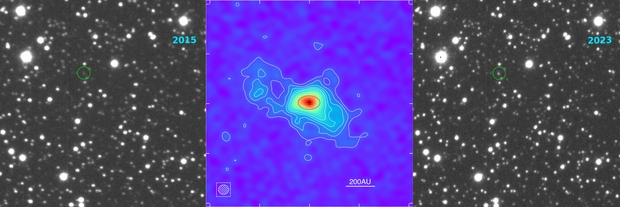
Image: The rapid brightening of Sakurai’s object allows astronomers to study the final phases of the stellar evolution in only a few decades. The left and right panels show the brightening. The middle panel is an image obtained with the radio telescope ALMA, showing the material ejected after the star re-ignited. The material currently extends over a size similar to our entire solar system. Credit: Stefan Kimeswenger, University of Innsbruck; Peter van Hoof, Royal Observatory Belgium. The observatory also has a short video showing the brightening.
What we apparently have here is a star once similar to the Sun that had finished its nuclear burning and was in the process of turning into a dense white dwarf star about the size of the Earth. But an event known as a ‘very late thermal pulse’ seems to have occurred. This happens when helium deep inside the star reignites, forcing a rapid expansion along with the ejection of stellar materials, so that the star has, at least for the time being, been reinvigorated. Along with another star called V605 Aquilae, Sakurai’s Object is one of only two stars that have been directly observed going through this process.
Let me turn to the paper to home in on the matter of thermal pulses:
Depending on when the pulse occurs, it is classified as an AGB final thermal pulse (AFTP), a late thermal pulse (LTP; post-AGB), or a very late thermal pulse (VLTP; see M. M. Miller Bertolami 2024). In the most extreme case (VLTP), the star is already on the white-dwarf cooling track when the flash causes rapid expansion and cooling, accompanied by substantial mass ejection into the circumstellar environment. The star is thus “born again” and returns close to its former AGB position in the HR diagram. Subsequent evolution involves reheating, and possibly an additional cooling excursion, as the star evolves back towards the white-dwarf domain with a markedly altered surface composition (T. M. Lawlor & J. MacDonald 2003).
No wonder this was a hard object to observe. The ejected gas and dust following the 1996 outburst caused the star to became hidden to direct imaging. Low density gases are coming off the star even as the outflowing atmosphere, moving at e 500 kilometers per second, is optically thick. Much of the spectrum produced is nebular. The team compared data from the VLT with computer models originally developed to study the processes that power the atmospheres and winds of Wolf-Rayet stars. The emission lines studied in this paper are embedded in the stellar wind, as opposed to the ejecta and dust. Much of the credibility of the analysis depends upon separating these factors.
The analysis reveals a stellar temperature at the surface pegged at between 27,000 and 36,000 degrees Kelvin. Scientists will now be able to study the process of the reheating following the eruption that occurred thirty years ago. Early indications are that the process is occurring more slowly than some models had predicted, so that Sakurai’s Object becomes a useful laboratory, like V605 Aquilae, into stellar behavior in this extremely rare class of stars. At some point, Sakurai’s Object will return to its fate as a white dwarf, only now under close observation as we ponder massive changes in a very short order.
Griet Van de Steene (Royal Observatory of Belgium), a co-author of the paper adds:
“Sakurai’s Object evolved much more quickly than pre-existing models for stellar evolution predicted. This led to a new generation of models that we now need to test. Our measurements show that the star is reheating more gradually than some of these new models predicted. That gives us an important way of testing which theories best describe what happens when a dying star briefly springs back to life. As we continue to monitor the star over the coming years, we expect to learn much more about this remarkable phase of stellar evolution.”
The paper is Marcolino et al (2026). The emergence of a [WC] star in Sakurai’s object. Monthly Notices of the Royal Astronomical Society, 552(1), Article stag1533. Full text.


0 Comments