
Anthropocentric thinking is a persistent problem when we’re talking about extraterrestrial civilizations. Some of our most cherished notions can be invoked so effortlessly as to defy the imagination. The Copernican idea that life must exist elsewhere because elsewhere is bound to be more or less like here has had a long lifetime in SETI studies. It seems like the most basic common sense. And yet, as we’ll see once again today, scientific results continue to make it apparent that the fact that we are here does not mean that they are there.
Finding stellar systems more or less like our own continues to be difficult. I’m not going full ‘rare Earth’ here but acknowledging that our circumstances may be unusual enough to tamp down estimates of the number of life-supporting planets. For that matter, our lack of knowledge about abiogenesis itself makes the case that we cannot necessarily expect it around other suns. On this matter, at least, we should be able to gather data soon, perhaps with a Mars lander.
Which gets me to today’s interesting take on binary stars. The binaries – HD 129171 and HD 129209 – are G-class, both having formed from the same molecular cloud. This is a common enough scenario, because binary systems are extremely common. In fact, about half of the stars in the Milky Way have a companion star, and thus are likely to share a common chemistry.
About 180 light years from the Sun (based on Gaia data) in Boötes, the system is proving unusually helpful. Using the UVES spectrograph on ESO’s Very Large Telescope (VLT) in Chile, an international effort led by Anne Rathsam at the University of São Paulo in Brazil is using this binary as a laboratory to study chemical differences between the stars that may be telling us something about planet formation and orbital evolution. What is driving the differences?
All this has a bearing on life, because for life to occur, conditions must exist for long enough to let the necessary processes go to work. And that may be a problem. HD 129171 turns out to be enriched in refractory elements, while its companion HD 129209 is not. Refractory elements condense at high temperatures, as opposed to volatiles, and the proportion of one to the other can be an interesting diagnostic tool, telling us something about the system’s history. A star depleted in refractories is likely one that has spawned planets, while one heavy in these elements has likely swallowed planets whole.
Rathsam’s work, available in a paper just published in Astronomy & Astrophysics, focuses on beryllium, whose abundance here is interesting because it is not produced in stellar interiors. Measured properly, its presence points to a star that consumed planetary material long after formation. Lithium, beryllium, and boron, in fact, share characteristics that make them exceptional in terms of chemical emergence in the galaxy. Jorge Luis Melendez Moreno (USP), who served as study advisor to Rathsam on this paper, explains:
“All other chemical elements originate from primordial nucleosynthesis [the formation of the first atomic nuclei in the minutes following the Big Bang] or stellar nucleosynthesis [the nuclear fusion process that occurs inside stars throughout their lifetimes]. But not beryllium and boron. They primarily arise through a process called ‘cosmic spallation,’ in which high-energy particles fragment heavier nuclei, such as carbon, nitrogen, and oxygen, producing lighter elements.”
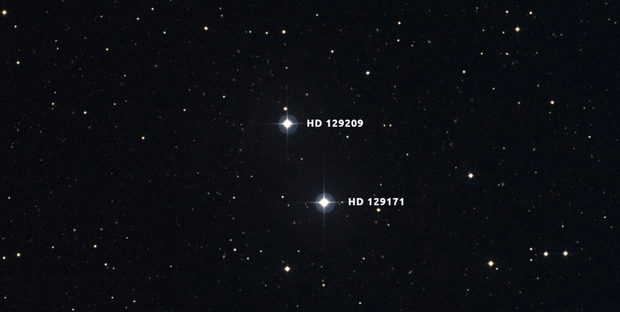
Image: The binary system of HD 129171 and HD 129209. Credit: Digital Sky Survey/Aladin/Anne Rathsam.
Lithium has its own uses as a marker, but the USP researchers found that beryllium is the more reliable tool, with a longer lasting chemical signature. HD 129171’s surplus of refractory elements (including magnesium, silicon, calcium and titanium) compared to its companion HD 129209 is accompanied by lithium and beryllium excess as well. The authors see evidence for rocky material equivalent to more than eleven times the mass of the Earth. This would have been ingested in the star, raising interesting questions about planet dynamics.
The infall of entire planets into a host star can be explained in various ways, from gravitational perturbations from other planets on eccentric orbits or skewed inclinations, to interactions within the early circumstellar disk driving young planets onto migratory trajectories. Although I hadn’t seen this paper before, the authors cite a 2025 study by Soares and team (citation below) that draws on simulations to show that about half of the stars simulated should ingest planets, leaving a chemical signature in perhaps 20 percent of them.
Evidently we can imagine system disruptions as a common occurrence in the Milky Way. We might add to this the fact that planet configurations with giant planets in circular outer orbits and rocky planets on inner ones are not common. Our observational data so far tends to confirm this, although tracking outer Jupiter-class planets with our current detection methods is always problematic given their sparse transit signatures. Overall, though, the picture that is emerging is that systems similar to the Solar System seem rare. If many systems are going through upheavals through planet migration and ingestion into the host, stable orbits may be trickier than we’ve thought. Rathsam comments:
“In our planetary system, the planets have relatively stable, low-eccentricity orbits. However, if planetary engulfment is common, it suggests that many systems undergo violent dynamic phases.”
Implications?
“Life wouldn’t just need billions of years to emerge and evolve. The planet would also have to remain in a sufficiently stable orbit to survive significant gravitational perturbations.”
If you’re wondering about our own star, it’s light in refractory materials relative to volatiles, which at least one recent study sees as a sign of planet formation at an early era. What became rocky planets and planetesimals, in other words, was never accreted into our star. I give that citation below. This and subsequent work seems to peg the Sun as the center of a dynamically quiet system compared to many, but be aware that the debate on this matter continues.
How useful is beryllium as a marker in such an analysis? The authors argue that despite the fact that beryllium is eventually depleted in a stellar interior, it persists long enough to provide reliable information. From the paper (my italics):
Refractory elements offer an excellent way to distinguish between the planet engulfment or the proto-cloud inhomogeneity scenarios. Since they have high condensation temperatures (≳1000 K), they are the primary constituents of the rocky material in planetary systems – terrestrial planets and cores of gaseous planets. In case of engulfment by a Sun-like star, this material is accreted by the star and then dissolved and mixed in the convective envelope, increasing the stellar surface abundances after the event (Sandquist et al. 2002). This process, however, produces a metal-rich outer layer with an unstable mean molecular weight gradient, which triggers thermohaline mixing (Théado & Vauclair 2012; Sevilla et al. 2022). For fragile elements such as Li and Be, this thermohaline mixing induces depletion, as it can carry these elements below the convective zone, into their burning regions. Thus, the chemical enrichment caused by the engulfment disappears over time. Nevertheless, Sevilla et al. (2022) demonstrated through simulations that the Li engulfment signature in stars with masses close to solar can be detected for ≥1 Gyr.
As far as I can tell, it’s the treatment of beryllium as a marker of engulfment that gives this paper its significance, as heretofore it has been used primarily as a diagnostic for the mixing of elements in stellar interiors. More broadly speaking, though, any reminders of the factors that make our Solar System adaptable for life should help us in identifying systems where life is less likely. That’s worth keeping in mind as we move beyond easy assumptions about life’s ubiquity and dig into realities that may make it more unusual than we thought.
The paper is Rathsam et al. (2026). Planet engulfment in the chemically anomalous HD 129171/HD 129209 pair. Astronomy & Astrophysics, 710, A236 (full text). The interesting paper on beryllium’s persistence is Soares et al. (2025). Assessing the processes behind planet engulfment and its imprints. Astronomy & Astrophysics, 693, A47 (preprint). The paper on the composition of our Sun is Meléndez et al. (2009). The peculiar solar composition and its possible relation to planet formation. The Astrophysical Journal Letters, 704(1), L66–L70. Abstract.

0 Comments