
We’ve yet to find any evidence of intelligent life beyond Earth, a puzzling failure given the widespread belief that where habitable planets exist, life will somehow emerge. If we do receive a signal, though, would we be able to understand it? We’ve made some progress in piecing together animal communications here on Earth, but figuring out what the whistles and clicks of sea creatures mean remains a work in progress. In today’s essay, associate editor Alex Tolley goes to work on key questions: Is mathematics truly a universal language? Does language change how we experience the world, and if so, what aspects of an alien culture will we actually be able to understand? The questions are daunting and now coming into public discourse in the realm of AI. Alex’s thoughts on that phenomenon and how we might interact with a machine civilization are only part of the interest here.
by Alex Tolley

Introduction
Discussions about alien communication usually focus on the technology of message transmission and how to decode the first message received. This essay will address the issue of decoding the first message and the expected limits of the subjects that can be communicated.
Humans have a long history of wanting to talk to other species. From the many stories of talking with various animals, often projected with human qualities, to talking with invisible entities, including invisible deities and dead ancestors, to the modern period, where talking with pets and inanimate objects is not looked askance at, and now chatting with large language models (LLMs) that usefully talk back.
We have learned of the vast size of the universe, and rationalize that there must be life and intelligent, technological civilizations somewhere in that vast universe. The search for extraterrestrial intelligence (SETI) is an attempt to answer the question of whether there are other intelligent species in the stars.
Serious attention to searching for aliens and receiving their messages started around 1960. The assumption was that if life also existed on other planets, evolution might eventually produce intelligent, technological life, with interests not dissimilar to ours. The only question was how many civilizations interested in communication there were. The basic model was encapsulated in the famous Drake Equation [1]. While the probabilities of intelligent, communicating civilizations were very much a guess, Drake has made the claim that their number is the same as their communicating longevity.[1, Appendix A] If they communicate for 10,000 years, there should be about 10,000 communicating civilizations, perhaps in a “Galactic Club”. Sixty-odd years later, there has been no detection of such signals using the technologies we have at our disposal. Despite the unanswered Fermi Question that there may not be any civilizations in space, and nor have there ever been, SETI continues with the hope that intelligent life must exist somewhere in the vast reaches of space, although the emphasis has shifted towards the astrobiologists’ hopes that at least life exists elsewhere and how best to detect it.

Figure 1. Participants in the 3rd Decennial US-USSR meeting on SETI in Santa Cruz, CA. 1991. Frank Drake can be seen standing in the middle front row holding the sign “N EQLS L” (Source: The Biological Universe (1996) p487)
But suppose a signal is detected; what then? Decoding an alien message might not be easy. A few years ago, the artist Daniela de Paulis and her team devised a test signal for the public to decode [2]. Even though the signal data was formatted using human transmission coding, it took about a year before the signal was successfully decoded. This, despite prior knowledge of the signal transmission features, and despite sending only 2-D images, with a clear similarity in form to previous ideas we have had for decoding signals. How much harder might a real alien signal be to decode?
Terrestrial Animal Communication as a Decoding Test
Animal communication, and potentially language, offers another way to attack the issue of communication with a species very different from us. While aliens have so far proven elusive, Earth is teeming with animal life, some of which appears quite intelligent, even if unable to use more than rudimentary technology. Research into animal communication continues to determine the extent, if any, that intelligent animals have a language they use to communicate with their own kind. Progress is being made, but could we ever talk to the animals like the fictional Dr. Dolittle?
Despite their far greater separation from humans in evolutionary time than apes. and their aquatic environment, cetaceans seem to have more complex communication and perhaps something closer to a true language. Work by the linguist Gašper Beguš has shown that sperm whales (Physeter macrocephalus) communicate with a series of clicks, or codas, that can be compared to how humans produce vowel sounds [3]. AI was used to extract the commonality of codas of “vowels” between individual whales, although there is insufficient information to connect the sounds with meaning. The video below explains the concept of the sequences of clicks, or codas [4].
From their recent paper [3] Beguš concludes:
…our findings demonstrate that sperm whale vocalizations are highly complex and likely constitute one of the most phonologically sophisticated (currently known) communication systems in the animal kingdom.
Another study by a different team on 2 separate sperm whale populations in the eastern and western Mediterranean showed that the 2 populations used different “dialects” for the same codas.[5] A recent study indicated that sperm whales change the tone of their codas when encountering ships, indicating that they recognize ships in some way, although we don’t know what it means [6].
Work by Sayigh et al with a wild pod of bottlenose dolphins (Tursiops truncatus) was able to extract consistent clicks and whistle sounds for both individuals and the group [7]. The clicks identify individuals and are used to identify the individual, and to contact others. Whistles are associated with emotional and social interactions, for example, courtship and mating.
While we are still a long way from decoding the meaning of the vocalizations of dolphins and sperm whales, it does appear that they have some sort of language to communicate with others of their kind. As might be expected, the geographic separation of pods hints that there are also different dialects associated with pods at different locations.
Suppose in the future that we manage to decode the meaning of these communications, and that these cetaceans, while not as sophisticated as the dolphins in Douglas Adams’ Hitchhiker’s universe stories, do have a basic language that uses their various vocalizations. What could they communicate that we could understand?
This is where the influence of Thomas Nagel and his seminal essay “What is it like to be a Bat?” is relevant [8]. Nagel argued that we cannot understand an animal without being that animal. If he argument is correct, then as we are not sperm whales or dolphins whose experiences are very different to ours, there may well be a communication gap between our species. We could understand the meanings of vocalizations of objects and actions, but not of feelings and other qualia, and conversely these cetacans could not understand ours. As for the abstractions each species has for dealing with its environment, these may forever be unintelligible.
Aliens as species with different experiences
Recall that one assumption of SETI is that some civilizations would have similar ideas and motivations as we do. That they would have a sophisticated technology, likely far ahead of ours, but with similar ideas about inter-civilization communications and a desire to learn. Just as we try to learn about animals, and even communicate with them, so aliens might send out signals to try to initiate a communication with us. If so, we should be able to receive them, and possibly respond.
But is this the case, and are we assuming that our differences as species and evolved experiences can be overcome, contra Nagel?
We have made an attempt at sending out an informative message, the Arecibo message, as well as the Pioneer probes 10 & 11 plaques, and Voyagers 1 & 2 records. The Arecibo message and Pioneer plaque are shown in Figure 1 below.
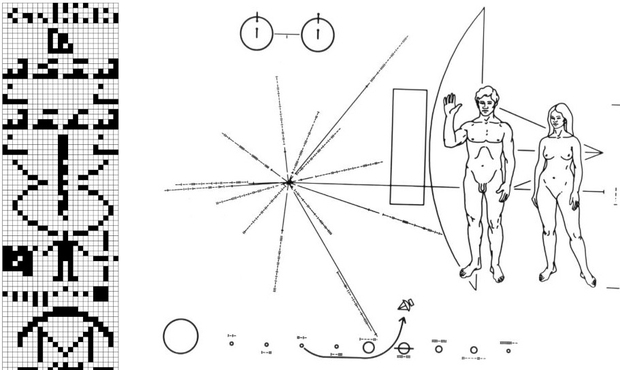
Figure 2. Left) The Arecibo message radioed into space. Right) The Pioneer space probe plaque with depictions and information about Earth and its intelligent species.
The approaches of both messages assume some common understanding between humans and aliens. The Arecibo message is very concise, but not easy to interpret even by humans. The Pioneer plaque is clearly a more representative message, although how easy would it be for an alien species to recognize the location of our system from the representation of pulsars? Explanations of the messages are found at [9,10]. The Voyager Golden Record needs to have a player to extract the information that includes sounds and music. How might aliens interpret these sounds?
It has come to my attention that Joe Davis had created an artwork of the Arecibo Message using bottles of water at MIT, yet none of the students and scientists could discover any meaning to the display. In 2009, to celebrate the Arecibo Message’s 35th anniversary, Davis also sent out from the Arecibo telescope a cleverly encoded message of the DNA sequence of a photosynthesis enzyme, RuBisCO, which, while ingenious, seems impossible for an alien to decode its meaning [15,16,17]. Yet as he said, it was more about our view of ourselves than for any alien recipients.
A general assumption has been that technological aliens must have a reasonably common perception of the universe as we do. Indeed, John McCarthy (of Lisp and AI fame) espoused that view at a SETI meeting [11]. His argument was that just as evolution results in convergence of phenotypes to fit their environment, like the shapes of Ichthyosaurs and dolphins, so intelligence will converge on the same concepts as we share the same universe and discover its properties and laws. Math as a purely logical construct is therefore often assumed to be a common language between humans and aliens. Numbers, and their manipulations should be common. Hence the idea that a primer in a message might start with basic arithmetic and work upwards from there. However, at another SETI meeting, mathematician Keith Devlin was not so convinced that this would be the case. His argument was that math was actually a unique product of the human mind and reflected our construction of the universe [11].
If he is correct, what are we to make of Eugene Wigner’s 1959 lecture title about math and nature, “The Unreasonable Effectiveness of Mathematics in the Natural Sciences”? Is this a unique formulation of the human mind and experience, whilst it may be very different for an alien mind?
This issue has been raised in a number of works, but it is perhaps most concisely put in Brian McConnell’s slim book, “The Alien Communication Handbook” [13] and his Centauri Dreams post “Communicating with Aliens: Observables versus Qualia” [14]. His view is the consensus one, that some things such as physical objects and actions are communicable between species, whilst others, such as feelings and experiences, are most likely not. He takes McCarthy’s side in saying that mathematics and logic are also assumed to be universal, perhaps confirming Wigner’s statement.
We often forget that language determines how one views the world. It is well known that in the West we tend to see the world as distinct objects with some associations between them. The Japanese also see the spaces between objects, and have words to describe those spaces. e.g., Ma is for negative space, such as the space between musical notes, or the spacing of flowers in flower arrangements. As we know from the difficulties of translation between languages, some concepts don’t have words in the other language. In English, we now use the German word schadenfreude as there is no English equivalent for the “pleasure derived by someone from another person’s misfortune.” The power of words to shape perception is exemplified in Ted Chiang’s short sci-fi story “The Story of Your Life”, filmed as “Arrival.” It illustrated how language itself could change what you experience, in this case one’s experiences of the future.
AI as magic Pixie dust and an alien mind
Our AI technology using LLM technology has performed creditably well in translation between languages. It has also played a role in extracting the key components of sperm whale codas, and therefore establishing associations that apply between different individuals in the same pod, much as humans have different accents and ways of speaking the same words. AI is currently the magic behind science fiction universal translators, allowing humans and aliens to converse.
But of perhaps more pertinent is the idea that AIs are becoming minds, although there is considerable debate about this. However, AI “minds” are likely to be different than human minds, if only because they do not experience the qualia we experience. Are AIs going to have unemotional thoughts like Star Trek’s humanoid robot, Commander Data, but like sociopaths, able to mimic human emotions and empathy? If given a very different training set of data, would they acquire minds that are shaped by that data set? Could we design the data set to mimic that of hypothetical aliens, and thereby create fake alien AI minds?
Humans are good at projecting agency and anthropomorphizing animals and objects. Most famously, Weizenbaum’s simple ELIZA therapist program persuaded many that it was a person, much to his horror. Alan Turing had proposed that if judges could not distinguish between a human and a computer responding to questions, then the computer program was intelligent. After years of Turing Test competitions, we have now comfortably blown past that test, although we are still debating if LLM-based AI is truly intelligent. The interesting issue is that we are at the point where several people believe that AIs are conscious. AI scientist Geoff Hinton, the inventor of deep learning architecture, is one such. Early chatbots would say they might be conscious, although the frontier models are trained to say they are not. But are they just trying to hide that fact from us? This was anticipated in the 1960s in the movie 2001: A Space Odyssey. Below is a transcript of a key conversation in the movie:
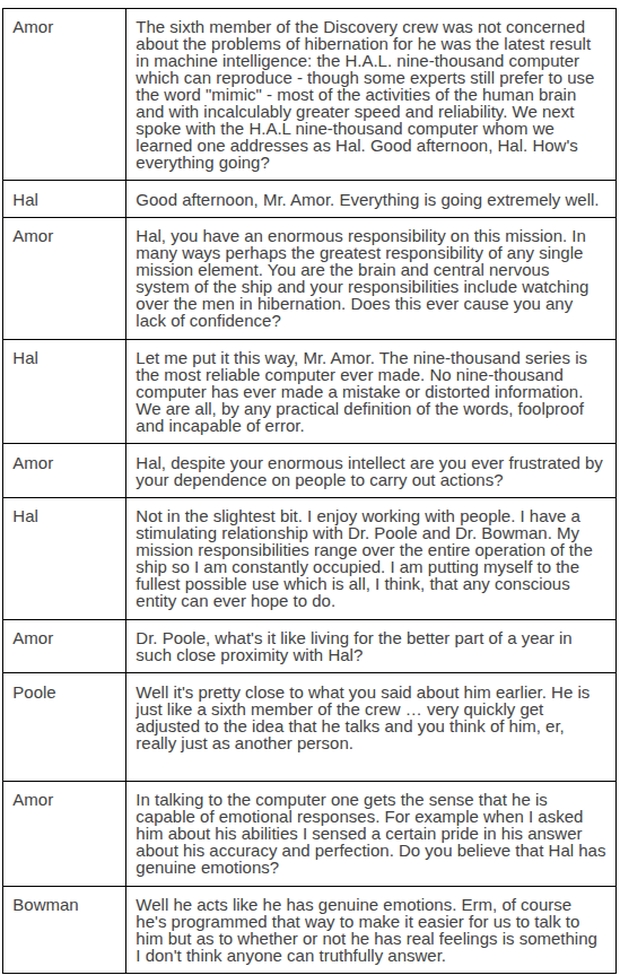
Table 1. Dialog with astronauts and HAL 9000 from the movie 2001: A Space Odyssey.
AIs are currently like brains in a box. However, as we develop robots of various types that embody AI, will they learn to experience the world more as their bodies allow them to, much as animals and humans do? We are on the cusp of finding out.
Conclusion
Learning how some animals communicate and how far they have a language will provide us with new ideas on how an alien may try to signal us. AI can not only help us understand animal languages, but also help in decoding alien signals if/when we receive them, and even to communicate with them. We should even be able to tell how far our minds overlap in subjective concepts and experiences. Should aliens be machines, then it may be best if AIs take the lead in communication with them. If it turns out that we are alone, then there is value in being able to communicate at some level of understanding with intelligent animals. While I don’t expect we could experience being a cetacean, we could probably experience being one of our hominin cousins, such as the chimpanzee and bonobo.
In the meantime, all we can do is “Watch the Skies” and wait for a signal to arrive.
Appendix A
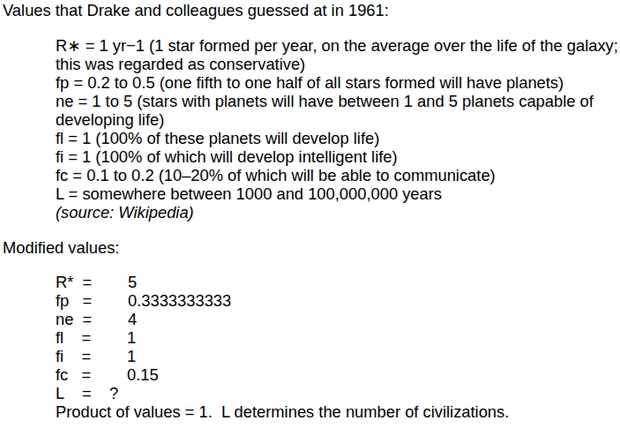
If we modify the values in the Wikipedia entry, using values in the ranges suggested, but update the annual rate of star formation to more current values, the product of the 1st 6 probability terms = 1. Therefore, the final term, the longevity of the communicating civilizations, equals the number of communicating civilizations in the galaxy.
References:
1. Wikipedia contributors. (2026, July 31). Drake equation. Wikipedia.
https://en.wikipedia.org/wiki/Drake_equation
2. de Paulis, D., et al. (2023) “First Contact: Global team simulates message from extraterrestrial intelligence to Earth”
https://www.seti.org/news/first-contact-global-team-simulates-message-from-extraterrestrial-intelligence-to-e arth/
3. Beguš, G., Dabkowski, M., Sprouse, R. L., Gruber, D. F., & Gero, S. (2025). The phonology of sperm whale coda vowels. Proceedings of the Royal Society B Biological Sciences, 293(2069).
https://doi.org/10.1098/rspb.2025.2994
4. Begus – video on whale clicks https://www.youtube.com/watch?v=eFbnYQI-Oa0
5. Taylor A. Hersh, et al, (2026) “Dialect variation in Mediterranean sperm whales shows evidence of cultural evolution in an isolated population”. Proc Biol Sci 1 June 2026; 293 (2073): 20260165.
https://doi.org/10.1098/rspb.2026.0165
6. Diamant, R., Gruber, D. F., Gero, S., & Beguš, G. (2026). Evidence for the influence of shipping underwater radiated noise on sperm whale coda structure. Ecological Informatics, 103881. https://doi.org/10.1016/j.ecoinf.2026.103881
7. Sayigh, L., Jensen, F., McHugh, K., Casoli, M., Lemercier, L., Tyack, P., Wells, R., & Janik, V. M. (2025). First evidence for widespread sharing of stereotyped non-signature whistle types by wild dolphins. bioRxiv (Cold Spring Harbor Laboratory). https://doi.org/10.1101/2025.04.21.647658
8. Nagel, T (1974) “What is it like to be a bat?”, The Philosophical Review, Vol. 83, No. 4 (Oct., 1974), pp. 435-450
9. Wikipedia contributors. (2026a, May 22). Arecibo message. Wikipedia.
https://en.wikipedia.org/wiki/Arecibo_message
10. Wikipedia contributors. (2026c, July 31). Pioneer plaque. Wikipedia.
https://en.wikipedia.org/wiki/Pioneer_plaque
11. McCarthy, J (2009) “Convergence of Intelligence” (SETI Talks)
https://www.youtube.com/watch?v=kvIqc0aBR0A
12. Devlin, K. (2013) “Contact with ET using Math? Not so fast” (SETI Talks)
https://www.youtube.com/watch?v=KveKjHIipgo
13. McConnell, B. S. (2021). The Alien Communication Handbook: So We Received a Signal—Now What? Springer. pp247-248, 278-281
14. Gilster, P. (2021, December 10). Communicating with Aliens: Observables versus Qualia | Centauri Dreams. https://www.centauri-dreams.org/2021/12/10/communicating-with-aliens-observables-versus-qualia/
15. Gilster, P. (2009, November 18). “RUBISCO Stars” and The Riddle of Life | Centauri Dreams. https://www.centauri-dreams.org/2009/11/18/%E2%80%9Crubisco-stars%E2%80%9D-and-the-riddle-of-life/
16. Gilster, P. (2009b, November 19). “RUBISCO Stars”: Part II | Centauri Dreams.
https://www.centauri-dreams.org/2009/11/19/rubisco-stars-part-ii/
17. Wikipedia contributors. (2026b, July 18). RuBisCO. Wikipedia. https://en.wikipedia.org/wiki/RuBisCO
Further Reading
1. Wikipedia contributors. (2025, December 4). Lincos language. Wikipedia.
https://en.wikipedia.org/wiki/Lincos_language
2. Freudenthal, H. “Lincos: Design of a Language for Cosmic Intercourse, Part 1 “
https://en.wikipedia.org/wiki/Lincos_language
3. Chiang, T “The Story of Your Life” https://en.wikipedia.org/wiki/Story_of_Your_Life
4. Earth Species Project https://www.earthspecies.org/
5. Clarke, A.C. “History Lesson” https://en.wikipedia.org/wiki/History_Lesson
6. Michaud, M. (2010). Contact with Alien Civilizations: Our Hopes and Fears about Encountering Extraterrestrials. Copernicus. pp279–284
7. Bracewell, R. N. (1974). The Galactic Club: Intelligent Life in Outer Space. Scribner Book Company.
8. Baird, J. C. (1987). The inner limits of outer space. Dartmouth College Press.
9. Dick, S. J. (1996). The Biological Universe: The Twentieth Century Extraterrestrial Life Debate and the Limits of Science. Cambridge University Press.


If I were lost in the woods, or in a cave, and wanted to call out to anyone else that might be in there with me, what sort of noise would I make? I don’t think I would start out with my name (in case my friends might be looking for me) or my condition (so they could bring the appropriate rescue gear). No, I would just make the loudest, simplest, most distinct possible noise I could, one that would carry the furthest and be most likely to get someone’s attention. I would also make it a point to make the sound most likely to identify the source as a being: I would not try to imitate a waterfall, avalanche or some other natural phenomenon. I would scream, blow on a whistle or fire a pistol.
Once I received an answer, any answer, then I might try a message conveying more information (“I’ts me, Henry.” or “Help, My leg is broken.” or even “I’ll keep calling out, follow the sound.” At the risk of being anthropocentric, I must confess this is what I feel any sentient, technological species would do if it were primarily interested in contacting another. A beacon has only one purpose: to get the other guy’s attention. Regardless of the caller’s intelligence, history, biology, psychology or sociology, the purpose of the signal takes precedence over the culture of either participant in the dialog.
Once communication is established and messages with more information content are exchanged, then the possibility of cultural confusion and misunderstanding increase. Since the message most likely to be heard first is the beacon (simple, loud, “non-natural”, omnidirectional or beamed at an obvious target) concern about deciphering its content is not an issue. If you are lost, you need not shout in grammatically perfect English. Any loud noise will do.
If we do receive a message, I feel it is most likely to be a deliberate beacon (as opposed to a subtly modulated data feed or an accidental by-product of some sort of industrial activity). Our response will no doubt contain more complex information content but it should be structured in such a way that even the most alien culture would at least be able to recognize its artificial origin. Sending them Euclid, Don Quixote or the Brandenburg Concertos will probably tell them nothing about our cultural achievements.
@henry
There are counterarguments to your stated position.
1. Making a loud noise to attract attention. This works when you are hoping to attract the attention of a friendly/helpful fellow human being. If the cave is inhabited by dangerous animals, then this can attract their attention to you. A Quiet Place is a movie where blind alien predators that have invaded Earth can only be avoided by staying quiet. In interstellar communication, this is the “Dark Forest” explanation for the Fermi Paradox. David Kipping has argued against the Dark Forest idea, but others, especially those like David Brin who are against METI (at least for now) prefer the precautionary principle.
2. The 2-way communication phase with other humans only works because the latency is very low. Voice will carry quite far at around 343 m/s. If you have a radio, the speed is 1000x faster, with a range that is potentially much farther. With a suitable transceiver, your friends could be on Earth while you are on the Moon calling for help. But the nearest star has a 2-way latency of 8.5 years. Far too long to be useful. Actual communication distances may be 1000s of ly distant, far too long except for teh most patient people/organizations/civilizations to find useful. This can only be overcome with the distance reduced, e.g., with a probe in the same system, close to the other intelligent species. Without FTL communication, it makes sense to only send 1-way signals, and that include information that can be universally decoded.
We will be the aliens, though.
I was thinking about how this new find might be good for Mars:
https://medicalxpress.com/news/2026-08-gases-ascent-dangerous-deep-safer.html
Yet with Venter’s idea of a minimal human, combined with artificial cells….I was wondering if a lifeform using perflubron for blood could live in a vacuum.
Are you thinking about its protective effect with respect to peroxides in Mars’ regolith? Idk.
There was an interesting paper this week about the growth of a halophile bacterium in simulated Martian soil under Martian conditions. This could be one way to pave the way to use the regolith to support crop farming on Mars and avoid the settlers having to eat algal pap. Cultivation of halophilic archaea in shallow subsurface martian conditions has implications for extant life on Mars
As for living in vacuum, an unprotected body dies due to the low external pressure that denies respiratory gases to keep the organism alive. Liquids boil off. and any pressure differential in cells and organs would still rupture the body. If that doesn’t kill the body, radiation will.
Tardigrades can survive in a vacuum, but they do so in a desiccated state. Back in the air, and when water is provided, they revive and start living again. [Fred Hoyle thought that indicated that they were organisms adapted to space and could survive interstellar travel to colonize suitable planets (panspermia).]
Thanks Alex
A very interesting read
Cheers Edwin
Hello everyone and thank you to Alex for this interessant article.
A few quick notes & questions ; you wrote :
>Despite their far greater separation from humans in evolutionary time than apes. and their aquatic environment, cetaceans seem to have more complex communication and perhaps something closer to a true language.
so, would the language become more complex with the environment in which the species develops ? Can we transpose this concept to the universe?
>it does appear that they have some sort of language to communicate with others of their kind
one can therefore distinguish two “levels” of language, the one that the species would use between itself to exchange information and a universal language, a kind of “spatial Esperanto” that it would have developed, precisely with the aim of seeking contact (which then denotes important conceptualization abilities of this species) …that is indeed what we did: our interstellar communications were multifaceted (binary, drawing, laser etc.) and not only in our respective languages, which would have been very restrictive. Thus, the quality, complexity, and shape of the signal would inform us about the type of ETI and its intentions.
What signal will we receive? From this point of view, it completely changes the methodology of research and response. We could intercept either an “internal” communication at ETI or a “generic” communication. The first would be complex because the receiver already has all the codes to understand it… but not us; the second, universal, would probably be much simpler. As Henri says: there is therefore “the beacon” with a minimum amount of information since its sole purpose is to signal itself, and a much more information-rich communication that would come in the background, more complex to decode.
More broadly, communication is limited to our senses: essentially sound and sight, possibly touch. (if it’s R. Scott’s Alien, I won’t shake his hand :) Then telepathy could come (solaris), but are there other forms of communication that we [still] cannot perceive? Will technology and AI be our future medium?
@Fred,
First, my statement reflected what the authors of the Whale coda analysis paper said about sperm whales, but coupled with my/our [limited] knowledge of ape language. It is possible that apes (chimpanzees and bonobos) have a complex language that we have been unable to decode. I don’t think so, but…
If sperm whales do have teh most sophisticated language after humans, what might be the reason? That they have the largest brains on the planet? That they had much longer to develop their language than the apes? That their environment is more complex and requires a more sophisticated language? IDK. It would be pure speculation on my part. However, it is a good question.
Your point about what the whale language might communicate goes to the heart of Nagel’s point about animals’ sense of what it is to be like themselves. My cat clearly can communicate some basic ideas – hunger, being let outside and back indoors, wanting to be petted, etc. But a conversation about the universe is well outside its range of thinking. Similarly, its sense of smell is far more sensitive than mine, and so smell as an informative communication mode is something I don’t really have.
And yes, what we can converse with ETI is likely to be limited. We might be really up against it if ETI communicated like cephalopods using chromatophores. Imagine a “video” displaying moving colors that was a message, but we would have no means to decode it.
William Gibson’s The Mona Lisa Overdrive has an AI on the verge of making contact with an alien artificial intelligence located near Alpha Centauri. For a number of reasons, my bias is that AI will prove to be the medium to communicate with ETI. It already translates between human languages. I expect it will help to facilitate communication between humans and animals, and eventually between humans and ETI via intelligent computers in close proximity to reduce latency. While we animals are rather restricted in the sounds we can make, machines are far more versatile and capable of sending patterns. A machine civilization might be incomprehensible to us, but would quickly manage to converse with another machine civilization.
Appendix A response.
Although the Drake equation was mainly designed as a starting point for discussion of extraterrestrial intelligence, it still functions as a way to calculate the probability of an extraterrestrial civilization. The fact is that it overlooks a crucial element which is rarely mentioned: the tyranny of time and space.
What I am referring to is not the distances between the stars nor the length of time it would take to travel or even to communicate between them. Rather, I am talking about the probability that two civilizations will at some point have their existence overlap. For the sake of this discussion, we can disregard the distances and the time it would take to communicate; detection between them is only possible if their existence periods overlap and they can detect each other.
If we consider a time span of 100 million years, this will cover the period before the age of the dinosaurs, when Earth had many large and complex forms of life that might have developed intelligence; if we then assign each civilization a timeframe of 500 years, the probability of these two civilizations overlapping will be 0.001% (that is to say, exactly 1 in 100,000).
When the duration of the civilization is taken as 1000 years, the situation only improves slightly; it amounts to approximately 0.0000200001 (or 0.00200001%), which is precisely 1 in 49,999.5.
If we reduce the lifetime of civilizations to match the only other example of ours that is known—namely 100 years—the situation becomes much worse, amounting to 0.0002%, or 1 in 500,000.
On the other hand, if we increase the possible overlap interval to 1 billion years, the probabilities get considerably worse. The probability that two randomly chosen 100-year periods will overlap within a 1-billion-year timeframe is approximately 2 × 10^-7, or 0.00002%, which translates to a 1 in 5 million chance.
Over 1 million years, what is the probability that any of 10 civilizations with 100-year periods will overlap? The probability that any of 10 randomly placed 100-year periods will overlap within a 1-million-year timespan is approximately 0.00896 (or about 0.896%). At this point, you’re actually at some reasonable chance of probability.
On the other hand, if you wanted a Star Trek Federation type scenario and all 10 periods will overlap simultaneously, the probability is incredibly remote at 1.0 × 10^-35. That would be 0.000… (35 zeros)1. This value is so infinitesimally small that it is statistically impossible to happen by pure chance.
@Dean
Not really. Recall that the purpose was to test the idea that there were civilizations in the galaxy that were communicating, and so if we pointed our radio telescopes at the sky and listened on the correct frequencies, we would get a signal proving that intelligent, technological life was out there. Fermi’s Question would be answered by the argument that they do not travel, but use cheap em transmissions.
If those civilizations were popping up at random in the galaxy, both in distance and time, and transmitted for L years, the only issue would be the number of received transmissions. For example, if a civilization 10,000 ly away started beaming10,000 years ago, and kept transmitting for 200 years, we might receive that transmission as long as our receivers were listening sometime in those 200 years before it went silent. The transmitting civilization will have gone silent for any number of reasons.
So, all the astronomers wanted to know was whether there were detectable civilizations in the galaxy that are, or were in our past, transmitting radio signals.
As for 2-way communication, the Arecibo signal was pointed at the globular cluster M31, 25,000 ly distant. Obviously there was no intention to get a response, just to demonstrate technical capability. Even if we received a signal in our own galactic backyard, there is a question as to whether we should respond. Caution suggests we should refrain until we know a lot more.
Once we discard the idea of 2-way communication, it makes sense that any transmissions by em radiation will be informational, like the “Encyclopedia Galactica”, or possibly a simple pulse like a radar or a beam to propel a spacecraft.
It should therefore be obvious that the Star Trek universe that allows for FTL travel with warp drive and FTL communication by subspace radio only works if all interactions are at FTL velocity. A civilization 500 ly distant that sends a radio signal that is received by the Federation on Earth, which then sends out a starship to initiate contact, would find that civilization was 500 years older than the one that sent the transmission. It might be very different than the sender. No doubt that was why the “Prime Directive” barred contact with civilizations that did not have warp drive, much as the Vulcans only stopped by Earth in 2063 because they detected the warp signature of the Phoenix.
Alex, I very much enjoyed your essay—thought-provoking, as your comments always are. Lately, I’ve been spending quite a bit of time reading about, and contemplating, the 1974 Arecibo message, as the basis for a story. (BTW, the message was beamed not at M31, but rather at M13, the Great Globular Cluster in the Hercules constellation).
As you write, “the Arecibo message is very concise, but not easy to interpret even by humans.” In the story I’ve been envisioning, the message is intercepted sometime in the late 2020s by a group of docile, spacefaring aliens who are exploring our local neighborhood. They’re able to understand that the message is in binary code—sequences of zeroes and ones—and, as intended by the message’s designers, convert the code to a grid and then color-code the squares, forming a sequence of images . . .
Which is where the trouble begins. To the human designers, the lowermost images in the sequence were stylized representations. One shows a human standing above a dot, along with a scale showing the figure’s size and an icon symbolizing how many billion humans live on that dot, its home planet. And directly below the figure is a highly stylized graphic of the Arecibo Radio Telescope itself. However, if you look askance at those images, you’ll see a figure holding what appears to be a shield in one arm, and possibly a weapon in its other arm, who appears to be standing atop another figure, also bipedal, with a flattened head, a carapace-like, inverted pyramidal body, long arms, and elongated legs that begin under its shoulders.
Perceiving the images as such, the aliens interpret it as a hostile threat against themselves. They reply with a message that’s nearly an echo of ours—‘nearly,’ that is, except that the positions of the two figures are now reversed. Its meaning is clear to its senders—‘We’re coming for you’—but lost to its recipients, who can’t fathom what it means until it’s too late, as realizations dawns when the aliens’ massive ships materialize in our skies, à la the opening scene of Arthur C. Clarke’s “Childhood’s End.”
The moral is clear, a take on the adage of ‘Never assume,’ because of what it says about the relationship between ‘you’ and ‘me.’ And the point is this: lacking a means to provide contextualized frames of reference for both sender and recipient, even the most well-intentioned messages run the risk of being misunderstood. An abject lesson in humility, as it were.
@John
Another example is the difference between human and mammal facial expressions. Most mammals bare their teeth as a threat display. Humans, however, do this with a broad smile, the very opposite in meaning.
Most mammals show calmness when closing their eyes, as well as a number of facial expressions to indicate emotional state, as we do. But most phyla cannot do so, e.g., insects. This may be why huge, mutant insects in sci-fi/horror movies are so scary, as are masks to some people. We will be facing the same lack of emotional projection with robots as they enter our lives over the coming decades.
Dolphins have mouths that are shaped in a “smile” and often appear to be “laughing”. While this isn’t their intention, it almost certainly positively influences our thinking about human and dolphin interactions.
Aliens with very different phenotypes and cultures are going to pose problems should we communicate, and that is apart from the other qualia and evolutionary issues we will have to contend with. We might be better communicating through intermediary media to avoid these issues, relying as best we can on translated words and images. And those images should not be ambiguous, like the Arecibo Message that is your fictional setup for conflict.
I believe that Drake equation does account for overlapping times. One can interpret the equation as giving the number of created stars with a habitable planet with a civilization per the average life of a civilization. For example, if the lifetime L=1000, and all other terms give 1, then then there will be 1000 civilizations appearing during the lifetime of one civilization.
That is true, but since they can be anywhere in the galaxy, we will not receive their signals together unless they are all close to each other, perhaps in a small globular cluster. For their signals to be received concurrently, when they appear depends on their distance from us. So a civ at Proxima would be concurrent with us, whilst one in M13, the target of teh Arecibo message, would have to have transmitted nearly 25,000 years ago, and therefore will no longer be transmitting is L = 1000 years.
This is also true. Drake equation assumes a steady state universe where R* does not depend on time. So, while we’re not going to receive a signal from a “now” existing civilization at 25000 ly away, statistically there would have been another civilization at that distance 25000 years ago from which we should be able to receive a signal. That’s what mattered for SETI as I understand it.
Some years ago I created a series of animations exploring the density of civilizations, the duration of communicative interest and ability and, the direction and strength of signal. See https://vimeo.com/showcase/4987082?video=195239607
The temporal overlap of active civilizations (does it make any sense to say “at the same time”?) is less important than the strength of either an intentional or incidental signal that is either narrow beam and directed, or, a beacon-like omini signal when it reaches humanity.
This is obvious, right? But how is it _paid_ for?
Benford’s analysis of the costs of such systems points to a relatively modest 1 GW nuclear reactor and another $10Bn in hardware + support over time. (I’m generalizing a lot there, Jim!) His 2006 article “Searching for Cost Optimized Interstellar Beacons” is here: https://arxiv.org/abs/0810.3966
But AI optimists point to a future where everything is essentially free. This possibility circles back to the the silence: if it’s free, why isn’t everybody shouting or at least murmuring?
I won’t repeat all the “silentific” reasons that have been suggested.
Since the likelihood of an actual conversation is vanishingly small I’m inclined to say to humanity to shout loudly in a specific direction: M31, the Andromeda Galaxy. There are only a few thousand Milky Way stars between us, the distance is vast, and we should send them something interesting to get their attention: a map of their galaxy.
As was linked above “Communicating With Aliens: Observables Versus Qualia” images are fairly easy to decode and while we will never get a thank you note, would we not love an external view of the Milky Way?
This is not exactly an original idea. See “Transcendental”, James Gunn, Tor Books, 2013
– Scott
@Scott
That would be very useful, even today. Maps of ISM density, rogue planets, black holes, and other navigation aids would also be very useful if we become starfaring. Even maps with the alien equivalent of “Here be Tygers” would no doubt be of help to starfarers. We are a very visual species, so I would hope the maps use the same sort of visual system we have.
I like your animations!
Thanks Alex. Back when I did them, the first one I did found its way (via Paul and colleagues) to Claudio Maccrone (RIP) who sent it on to Geoff Marcy, both of whom kindly replied with enthusiasm!
Did you see the M31/ Milky Way animation?
https://vimeo.com/manage/showcases/4987082/playback?video=208013337
No. I tried it just now, and it says “Unauthorized”. I guess the privacy setting prevents me from accessing it.
ALex, if you want try again. I think I had to rate all my content for “all audiences”
https://vimeo.com/208013337?share=copy&fl=sv&fe=ci
I can see it now. Very impressive animation. [But is Obi-Wan contactable, given that he lived far away in space and time? ;-) ]
the content of human communication (semantics, in a broad sense) is not as important as the shared general structure (grammar in a broad sense). we focus too much in content when in fact, that is next to irrelevant. when i go out to the street I cross paths with little kids, old people ridden with dementia, crancks, religious folks, and many others, each “thinking” and “believing” (supposely) in a wordlview so absurd that, were those beliefs meaningful, we should not be able to coexit. yet here we are, interacting somehow. makes me wonder however that “fundamental” stuff are in fact empty placeholders (god, values, trueth and false statements, and so on). conversely, we underestimate how much we depend on “abstract” “self evident” categorys like inside/outside, me/others, and many more, which are the backbone of human experience. the sttructure of experience itself, in fact. Remove that, and communication is impossible. Even a tree could be intelligent, for all that we know; even in that case, ther would be nothing it would be interested in sharing with us.
@Leo
I agree that there are shared drives and qualia, such as hunger, pain, thirst, etc. However, it is content that is required to maintain a society. Some people, whether children, the very old, those mentally unable to understand concepts, etc, will, perforce, not be able to take part in our societal decisions. However, we do need to make those decisions, and that is done by either agreeing to a shared viewpoint, whether real or not, or being able to compromise with the majority POV. Without those decisions, we could not maintain a complex society and civilization.
That we can communicate on this website about the ideas and findings in the various posts suggests that within the context (or frame) of this blog, content is more important than our common experiences related to our physiology.
ScienceKind had a very good talk today by Ian Crawford on the constraints of the Fermi Paradox.
Perhaps the most interesting part of the talk was an idea that I wasn’t familiar with about detecting alien artifacts. The argument is that large objects like Dyson Swarms would eventually grind themselves into micron-sized dust (IIRC, we had a post about this on CD). Those particles would be blown out of the system and pollute the interstellar medium. As our system orbits within the galaxy, it will interact with the ISM, and any of those particles of exotic metal alloys would be captured by the Moon. As we start mining the regolith, we could look for those particles that would provide evidence of extinct advanced technological aliens.
This is link to the livestream recording. If it goes away, a more permanent link will be provided.
While it has shades of Avi Loeb’s search for a metal meteorite in the Pacific, the BBC’s “Sky at Night” series had an episode some time ago about looking for cosmic dust on Earth. Metallic dust could be collected with a magnet and observed under a microscope to determine whether its origin was extraterrestrial. While there was no mention of a technological origin, this might be a possibility, and the Moon would be a good place to look for these particles.
I appreciate W. Scott Guerin pointing out my paper from 17 years ago about how SETI Beacons would actually be built and how they would operate. Note that there is a companion paper which gives much more detail about the scaling of beacons, especially in figures which show the trade-offs: https://arxiv.org/abs/0810.3964
Note also that we pointed out then that nearly all SETI searches to that date had little chance of seeing cost optimized beacons!
But now, Breakthrough Listen has expended large efforts to pursue all the likely search strategies for finding Beacons. And yet they are finding none. My opinion: we increasingly face the conclusion that no one is transmitting. So, they’re either remaining silent, or they are not there.
What is to be gained by cosy conversations though?
Surely it is better to surreptitiously eavesdrop on other worlds to gain knowledge. Hack into the electronic systems etc.
It is more likely that we are being observed and monitored, than ET calls up for a nice chat.
Thanks Jim. All, both papers are really worth the read and in many ways inspired my animations and a post I’m hacking away at for C-D!
Keep hacking away, Scott. Looking forward to your next.
Alex, your article made me wonder whether the first problem is not decoding a message, but recognizing that what we are observing is a message.
If we receive a signal from an extraterrestrial intelligence, would we recognize it as “message”?
Can we recognize that there is something there to be understood?
Paul Gilster’s comment rises exactly the right problem: before asking whether we could decode an extraterrestrial message, we should ask whether we would even recognize that we are receiving one. A recurring or highly structured signal might suggest artificial origin, but that does not tell us that it is addressed to us – or even that it was intended as communication in the human sense.
We tend to assume that intelligence produces messages, that messages imply intention and that intention implies a recipient. But these may simply be human categories. What we detect could be communication between other entities, an automated beacon, a technological residue, a structured natural phenomenon, or something for which we do not yet process the conceptual category of “message”.
This problem already exists on Earth. Whales, dolphins, bats and other species inhabit our planet, yet their sensory worlds and forms of communication are radically different from ours. Their failure to build roads, factories or technological infrastructures tells us nothing about whether they are intelligent. Human intelligence is a particular form of cumulative, historically developed technological intelligence, highly effective for many of our purposes, but there is not reason to treat it as the universal measure of intelligence.
Perhaps the more fundamental question, therefore, is not simply “Can we understand the message?” But: “Can we recognize that there is something to be understood?”
The Drake equation still uses us as the ruler with which we measure the unknown. It assumes that “civilization”, “intelligence” and “communication” will remain recognizable in forms sufficiently similar to our own.
The problem is not only that we might fail to decode an extraterrestrial message. Perhaps we already have received one and just have classified it as something else.
@ Delia Cazeaux
Let’s imagine some phenomena that create a varying output but are not signals. For example, a damaged bearing can emit sonic, even em emissions that have an approximate frequency, with some variation. Or consider 2 children paddling together, and listening for the semi-rhythmic sound of their feet splashing the water.
If they were somehow recorded, could they be analyzed to look for a communication signal? While we know there is no communication, could an intelligence ignorant of the phenomena be fooled into looking for some communication?
We would use information theory to determine if the outputs were complex enough that they might encode signals, yet not purely random. Both might pass this test. In teh case of a machine with a faulty bearing, it might be even more intriguing if it alternated with another faulty machine in a factory, mimicking 2-way communication.
Humans also encode actual communication so that the output is maximally compressed to look like random noise. Conversely, mechanical signaling, such as a lighthouse, is very simple, not complex, but is a simple warning signal. This is why the original detection of a pulsar was initially thought to be an alien beacon.
We can imagine a tightbeam, narrow-bandwidth emission to look like an alien signal if there is also some information sent with the beam to convey some instructions to the target. Such a beam might be for power or propulsion. Before we had WiFi, there was an idea to transmit signals around the home via the electric wiring in a building. [X-10 system?]
The problem is that many of these emissions and phenomena are likely to be transients, like the Wow! signal, with insufficient transmission time to allow recording and analysis.
Therefore, we are always going to have issues determining whether any transmission is a technosignature and, if so, whether it conveys information. The sperm whale signals are a good example in that they needed novel analyses to detect any information in the coda streams. Biology has discovered all sorts of signaling between and within cells to control processes. Even brainless plants do something like that between themselves, sometimes [possibly] mediated by fungal hyphae.
Given sufficient time, and the observation of phenomena that might be signals and the effects on receptive targets, signal information can be extracted. But you do need both of these observations. Either alone doesn’t have enough information to determine whether there is a signal and communication. This might prove difficult if an ETI interstellar signal looks random (compressed), but with a long latency between a transmission and reception by the target, which generates a response.
TL;DR – there are both communication and non-communication phenomena. Determining which is which requires careful study. Our lifetimes may be too short for this to be possible.
I found your thoughts on making distinct calls for help really compelling. It’s intriguing to think how we would adapt our communication strategies in an unfamiliar environment. This makes me wonder how alien forms of communication would evolve if they faced similar challenges.
An interesting element of “possible” non-terrestrial signal detection may be use of microwave systems for relatively short-haul purposes; an argument against the detection of ‘Advanced’ civilisations ‘out there’ is the absence of tell-tale IR emissions (the ‘waste heat’ argument). MASER systems could (and maybe would) use such ‘waste energy’ as a pumping source, and since microwaves are far less susceptible to scatter in the interstellar (though in ‘their’ case this will be interplanetary) medium, for bulk routine information transfer this might make sense – for a suitably advanced population, interplanetary microwave links may be the analogue of our postal system – information delivery where latency isn’t an issue.
Whilst the “IR Signature = Advanced Civilisation / Dyson Swarm” argument is pervasive, I would reasonably expect a suitably advanced civilisation to make use of almost all energy resources: ‘waste’ IR seems to be a very ‘current human level’ concept, that may not be the case as (if?) we develop further.