
Finding ways to tweak space missions to rescue data or extend observations is a fascinating process. We’ve seen no shortage of such efforts, from the heroic retrieval of Europa data after the failure of the Galileo mission’s high-grain antenna to the stabilization and ‘rebirth’ of the Kepler space telescope through deft handling of its gyroscopic resources. We can also think about the Voyagers and the continuing measures that keep them working on dwindling power.
Now I’m hearing about a new way to handle data gathered by the James Webb Space Telescope. Scientists at Northwestern University have created a technique that relies on slick computation to extract exoplanet images out of the glare of their home star. The data from the mission’s coronagraph are subjected to models superior to existing methods, with the now demonstrated capability of producing new scientific results from the missions’ archives.
Glare is everything when it comes to planet imaging. Here’s lead author Rodrigo Ferrer-Chavez on the new work:
“Planets are a million times fainter than their stars. So, to image exoplanets, we need to remove that glare. That is a very tricky problem because even the tiniest changes in the telescope can affect how that glare appears. Slight shifts or tilts — even on the scale of just a few nanometers — can change the pattern of light. Our method models how light travels through the telescope and accounts for those tiny changes, allowing us to remove the glare much more precisely.”
This topic has been on my mind because of our ongoing discussion of ‘sunshades,’ either in swarms or in the form of enormous sail-like structures that would assume a station-keeping orbit near the L1 Lagrange point to reduce solar irradiation. Sunshades – sails of any kind, for that matter – remind me of ‘starshades,’ the idea of using a large, flat structure to minimize stellar radiance to find exoplanets. I suspect the capabilities of starshades have a long run of research ahead of them. Right now the coronagraph technology in JWST is state of the art, and will be upgraded yet again when Habitable Worlds Observatory one day launches.
The Northwestern method would allow us to maximize such efforts. The authors believe it can improve the sensitivity of a space telescope by as much as 15 times. Appearing in Nature, the study explains how to take a light source that can be as much as 100,000 times as faint as the host star and identify it. Coronographs, useful as they are, do allow some starlight to get into the image, to the point where astronomers have to process images to remove what glare remains. Reference stars can be useful for this, but even JWST is hard pressed to get past the problem.
Have a look at the image below. In the caption, the authors refer to PSF, which stands for ‘point spread function’ and is essentially the glare of the parent star. Modeling this glare depends on properties of the star as well as quirks in the instrumentation itself, which may include telescope-pointing errors and stability factors such as thermal drift. The latter are huge, as the paper notes, especially if we’re trying to image Earth-class planets. From the paper:
Advances in PSF modelling that do not rely as heavily on observatory stability could have transformative implications for exoplanet imaging, for both current and future observatories. For example, one of the main challenges for future missions such as the HWO, with the ambitious goal of imaging Earth analogues around Sun-like stars (1010 brightness contrast), is achieving an extreme and unprecedented stability at the picometre level (100 to 1,000 times more stable than the JWST).
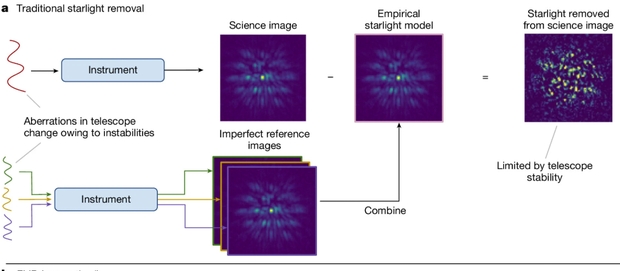
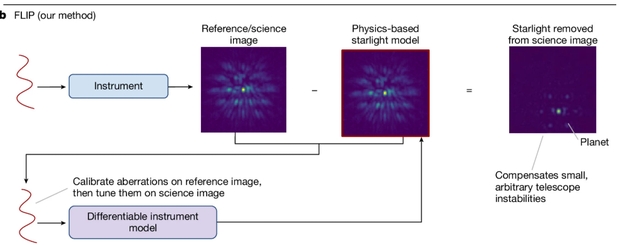
Image: This is Figure 1 of the paper. A quote from the caption: “The stellar PSF is shaped by inevitable and imperfectly known aberrations in the telescope (including star–coronagraph misalignment and optical phase aberrations, represented by coloured curves to the left of the diagrams). Starlight subtraction methods based on empirical reference images are limited by telescope instabilities that cause changes in these aberrations, as these result in dissimilar reference PSFs (symbolized with curves and image outlines of different colours) and thus imperfect PSF subtraction when combining them into an empirical PSF model. Our method, FLIP, pre-calibrates an instrument model on reference images to reproduce the reference PSF and then solves for small changes in telescope aberrations that better explain the science image.” Credit: Ferrer-Chavez et al.
Northwestern’s Jason Wang, who leads the research group that includes Ferrer-Chavez, notes that the thermal changes referred to above could cause a mirror to expand or contract by a picometer. This despite the fact that JWST has its own system of cryocoolers designed to maintain stable temperatures. The cryocoolers themselves can cause vibration that affects the image. All of this, as you can imagine, is much on the minds of HWO’s team as they progress.
The name of the new method is Physics-based Learning for Imaging Planets, or FLIP (its counterpart, currently the go-to method, is KLIP, or Karhunen–Loève image processing). In FLIP, a digital twin of the telescope is created and then tweaked to eliminate the design imperfections in the telescope that distort or shift its optics. Having matched the telescope’s observations, including the unwanted starlight that is not eliminated by the coronagraph, the team is able to subtract the background glare, as we see in the above imagery, which shows the dramatic contrast between FLIP and existing methods.
That FLIP is a workable construct is shown by the observations chronicled in the paper. Data from HIP 65426 and 51 Eridani are the primary sources being studied here. The increased sensitivity resulting from FLIP methods found 51 Eridani b in JWST data that was several years old. The planet had been found before with ground-based telescopes, but carbon dioxide in its atmosphere absorbed light in the infrared wavelength that JWST uses to make these observations, making the planet image acquired by its Near-InfraRed Camera (NIRCam) indistinguishable. This was, says Wang, “…science left on the table because we didn’t have the right tools to analyze the data in the most optimal way.”
Tackling a star with no known planets, the researchers then used JWST data on TYC 5899, with results that improved sensitivity vs the KLIP method by 15 times. The potential for exoplanet discovery is clear, although the model can be improved. The paper adds:
…although FLIP can effectively compensate for phase drifts and random star–coronagraph misalignments that limit KLIP, our models have not yet been systematically calibrated to retrieve accurate estimates of these instabilities with associated uncertainties. Clear avenues for improvement include a more sophisticated detector model to process deep observations of very bright stars, disentangling degeneracies between different model parameters, a detailed exploration of algorithm hyperparameters reducing the computational cost of the method and a framework to handle large data volumes for ground-based applications.
In current terms, we are looking at a tool that the authors believe will allow fainter, colder planets or less massive ones, to be detected through JWST’s existing equipment. I see that the authors target giant planets at wide separation from their star, always a difficult catch for any exoplanet detection method. They also believe that the method can be extended to JWST’s Mid-Infrared Instrument (MIRI). It will be interesting to see if further validation of FLIP has any bearing on HWO design, particularly in terms of stability. Conceivably, “the ultrastability requirement for the system may be partially lifted,” and that could offer design options that impact HWO’s budget.
The paper is Ferrer-Chavez et al., “Imaging exoplanets below the telescope stability limit,” Nature 659 (2026), 58-62 (full text).

0 Comments