
Here’s an interesting notion, courtesy of science fiction writer Jack McDevitt. Jack’s story “Lighthouse” (available in Cryptic: The Best Short Fiction of Jack McDevitt (Subterranean Press, 2009) posits an apparently normal brown dwarf that, upon closer study, turns out to be deeply anomalous, in ways that seem designed to call attention to it. There appears to be no intent to establish contact but rather to warn anyone traveling near the object that there is a solitary black hole, all but undetectable, in its immediate vicinity.
And there is not just one brown dwarf, but several thousand that display similar anomalies in their spectra, as determined by a survey of these stars throughout the galaxy. Could these markers be a warning system for interstellar travelers? Written with Michael Shara, the story is a nice, compact bit of hard science fiction, working with realistic spectroscopic analysis and ingenious speculation. It’s also realistic about the kind of non-scientific pressures astronomers can face. Here the characters are wrangling over the unusual role deuterium plays in the spectra as they try to make sense of what they are seeing:
“I don’t buy it, Kristi,” Greg said. She had him on the vid relay, from his office. “There’s got to be a natural mechanism at work. Maybe high pressure chemistry. Maybe magnetic fields. Maybe radiative levitation. Geochemical processes can concentrate minerals by orders of magnitude on Earth, so why not deuterium on the surfaces of brown dwarfs under far more exotic conditions?”
He sounded really concerned. It was why she liked him so much. He was worried about what would happen to her career if she tried to go public with her notion. She imagined it was hard for him not to say, You’re skating at the edge of academic disaster. Blow your reputation now and you’ll always be at the fringe.
I like that bit. It wasn’t so long ago that writing about starships in a scientific journal was unusual, but these days we have many theorists pushing propulsion concepts and speculating on Fermi questions. Anyway, I notice that Jack’s story “Cool Neighbor” is freely available online. It’s another look at a brown dwarf, this one close indeed, and it reminds me of my own certainty that we would find a dim object like this within a light year or less. Alas, it was not to be, as the WISE data made clear, but we did find a lot of interesting objects, including Luhman 16 whose members are the closest brown dwarfs in the inventory.
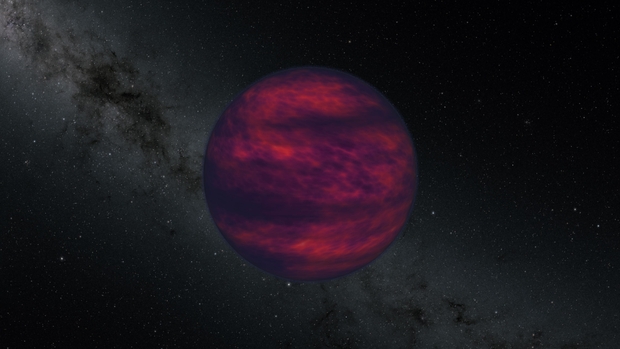
Image: Untold numbers of brown dwarfs roam the cosmos, like the one in this artist’s concept. But only a few dozen have been studied in detail with space-based telescopes. With the help of NASA’s SPHEREx, scientists are in the process of analyzing thousands more. Credit: NASA/JPL-Caltech.
Luhman 16 B, is to my knowledge the first brown dwarf to have its weather mapped, which fits nicely with the recent news about WISE 0855, a brown dwarf not all that much further away than Luhman 16 at 7.5 light years. In the just released study, WISE 0855 is subjected to atmospheric analysis that shows water clouds changing in thickness as the time series work proceeds. Brittany Miles (Steward Observatory, University of Arizona, Tucson) took spectra of the object every 15 minutes for 11 hours, to reveal not just the movement in the water clouds but processes of deep convection bringing up gases from below.,
We have JWST to thank for the find, as Miles notes:
“This is the first time we’ve been able to confirm that water clouds are becoming thinner and thicker on a nearby world. Before JWST, we only had photometry, which mixed up the effects of clouds, chemistry, and temperature all together. Now we can actually distinguish them.”
WISE 0855 is hard to distinguish from a free-floating planet, given that its effective temperature (265 K) is not all that much warmer than Earth’s. Churning carbon monoxide and phosphine are what is currently identified in the data as rising from below thanks to the heat within the object. The same process of convective churn is seen on Jupiter and is tracked on this brown dwarf with the greatest clarity yet, a molecule-by-molecule variation seen in real time. WISE 0855 doesn’t look like Jupiter but it displays similar weather patterns.
Brown dwarfs are ubiquitous these days, but I still remember the announcement of Teide 1. This object, in the Pleiades cluster, turned up in data from the IAC-80 telescope in Tenerife (Canary Islands), with the paper published in 1995 in Nature. Shortly followed by Gliese 229B, the object launched the study of remarkably low temperature stars, now classified in ways that sometimes muddle the distinction between planet and star. How far we’ve come since then. Have a look at the just released image from SPHEREx, which is only a partial look at the thousands of brown dwarfs that are being identified.
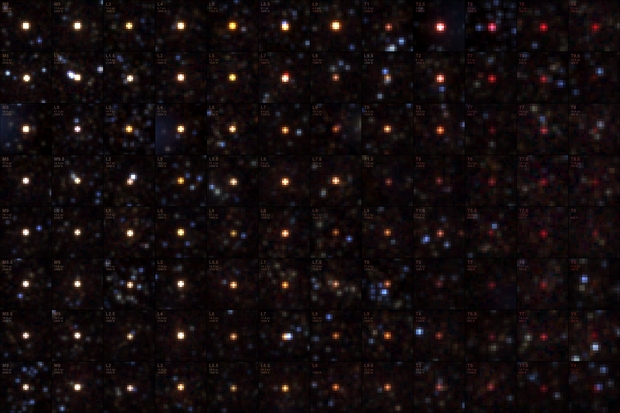
Image: As it maps the sky, NASA’s SPHEREx telescope is finding thousands of brown dwarfs hiding in the dark. A selection is shown in this collage of observations, listed by spectral type, distance, and temperature in degrees Kelvin. Credit: Zafar Rustamkulov/NASA/JPL-Caltech.
SPHEREx (Spectro-Photometer for the History of the Universe, Epoch of Reionization, and Ices Explorer) is making the case that brown dwarfs have a range of atmospheres rich in chemistry that show striking similarities to gas giants. The image above is drawn from SPHEREx infrared observations of 37 nearby brown dwarfs with a wide range of temperatures, from 2200 degrees Celsius (2477 K) to -20 degrees Celsius (253 K). Water, carbon dioxide, carbon monoxide and methane turn up in the analysis of their atmospheres.
Launched in March of 2025, SPHEREx is engaged in mapping the entire sky in near-infrared light, taking on the order of 3600 images per day. The instrument is multi-purpose, its major goal being to study the distribution of galaxies in the distant universe. But the brown dwarf component makes it possible to observe atmospheric chemistry across a wide range of temperatures in these objects. Although the paper deals with a relatively small number, thousands more brown dwarfs are now being analyzed. Lead author Zafar Rustamkulov (Caltech) adds:
“From orbit, SPHEREx sees wavelengths of light that are basically impossible to see with telescopes on the ground because water in Earth’s atmosphere absorbs them. We are picking up light from the deep, red clouds of brown dwarfs all over the sky.”
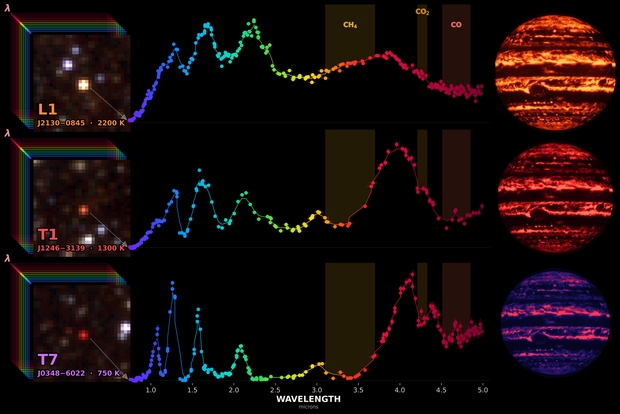
Image: Thanks to its spectral coverage, NASA’s SPHEREx is revealing molecules like methane (CH4), carbon dioxide (CO2), and carbon monoxide (CO) in brown dwarf atmospheres. The telescope’s view of three different brown dwarfs appears on the left; the depictions on the right imagine them as Jupiter-like worlds. Credit: Zafar Rustamkulov/International Gemini Observatory / NOIRLab / NSF/ AURA, M.H. Wong (UC Berkeley) et al. Acknowledgements: M. Zamani.
Rustamkulov also notes how the absorption patterns in these spectra change as brown dwarfs age and grow cooler, with some of the objects in the SPHEREx data showing thinning clouds and increasingly methane-rich atmospheres. He adds:
“The state-of-the-art models are capturing the general chemical trend, but when it comes to these cloudy transitions, the models are struggling to match the data. No two brown dwarfs are alike. Even at the same temperature, their spectra look quite distinct.”
Indeed. The paper comments that “state-of-the-art brown dwarf model grids generally fail to trace their complex features.” So exactly where are we right now? From the paper:
…the models generally approximate the smoothly coherent abundance trends of CO and CO2 as they are converted to CH4 with declining temperature and increasing age. We also show that the addition of clouds does not improve Diamondback model fits (see Figures 14 and 15), especially at the cloudy L/T transition (see Figure 7), implying the need for more theoretical work connecting clouds with chemistry. Optimistically, the models seem to qualitatively represent the low-gravity and low-metallicity L dwarfs (see Figures A2, A3, A4, and A5, which probe a more extreme regime of parameter space.
So we’re beginning to unlock some of the secrets of brown dwarf atmospheric chemistry, but as you would expect, our existing models need to be tuned up in this new era of rapidly multiplying observational data. I’m reminded by the last several posts here that any graduate student looking for abundant challenges might want to consider dwarf possibilities, from white to brown, as both categories are yielding data we are only now able to explore. The exoplanet landscape around these objects is particularly frothy with potential.
The paper on WISE 0855 is Miles, et al., “Water Cloud and Chemical Modulations in the Coldest Brown Dwarf,” accepted at The Astronomical Journal (preprint). The SPHEREx paper is Rustamkulov et al., “SPHEREx 0.75–5 μm Spectra for a Sequence of Nearby Brown Dwarfs,” The Astrophysical Journal Vol. 1009, No. 2 (28 September 2026). Full text.


The idea of aliens modifying the isotopic ratios of a planet to draw attention to it is not original to McDevitt. The same idea is found in Greg Egan’s earlier novel Diaspora, with a planet where every element is present only in its heaviest stable isotope, not just hydrogen/deuterium.
Good to know. I haven’t read that one but will put it on my list! Thanks, Mike.
Polyhymnia is close enough for a mission to see how dense it really is.
I hope it’s ok to point your attention to this interesting development in exoplanet detection. It seems AI tools are becoming advanced enough to bring about new candidates, even for amateurs.
https://www.scientificamerican.com/article/amateur-astronomer-harnesses-ai-to-find-a-possible-hidden-exoplanet
https://eumemic.github.io/exoplanets/
On the possibility of nearby undiscovered brown dwarfs: in 2016 it was found that there were far more nearby (<6.5pc) brown dwarfs in one half of the sky relative to the other half. Statistically the chance of this happening, if it were random distribution, is only 9.8%. So it is a bit inconclusive, because it could be due to chance, but on the other hand it is unlikely. I don't know if this has been resolved since with further discoveries ?
I also seem to recall that WISE avoided surveying within a few degrees of the galactic plane.
Anyhow, it seems to me that, just maybe, there are additional nearby BDs still to be discovered ?
Also, free-floating planets, too cool to be detected, are another possibility.
“… it was found that there were far more nearby (<6.5pc) brown dwarfs in one half of the sky relative to the other half. "
Maybe its because there are more astronomers or observatories working in that hemisphere. Selection effect?
I don’t know, but the paper was dated 2016, which is after the WISE survey. WISE covered 99% of the sky reportedly, and shouldn’t have suffered from the same biases as surveys conducted from Earth’s surface.
It’s possible this anomaly has been resolved with subsequent discoveries, but I thought it worthwhile to raise the question.
There is plenty of chances of very cold brown dwarfs been out there. I mean the galaxy is billions of years old. And most certainly lots of sub BD’s been out there. The Nancy Grace Roman telescope is expected to find over 10000 brown dwarfs on its observations.
I would begin by looking to see if Gliese 710 might be dragging one in-bound
I read somewhere (sorry, no reference) that the number of BDs to M_dwarfs was about 10:1. When calculating teh aggregate masses of stellar types, it seems that M_dwarfs may be the class with the most mass, but that BDs may even be greater than this class. IOW the BD class contains more aggregate mass than any other class of star.
So where are these stars? It seems they may be the smaller star of a binary. Does this generally prevent other planets from forming in the system? Are BDs quite common in such systems, eclipsing even “super Jupiters” in size, with other planets in the same system? Like Jupiter and Saturn, would they have large retinues of moons, and possibly rings from colliding moons? If they are part of systems, are they gravitationally released if the primary loses enough mass at the end of its main sequence life, and perhaps become the dominant source of rogue/nomad “planets” in the galaxy, having cooled to gas giant planetary temperatures?
Alex, there are fewer BDs than stars according to recent papers. The reported ratio (BDs to stars) is often 1:6 but I recall some found 1:4.
Prior to WISE, many thought that the IMF would continue to increase below the hydrogen fusion limit, hence the estimates for a larger number of BDs than stars. This turned out to be incorrect; apparently the IMF reaches a peak around M3 and then reduces at lower mass.
At planetary mass (below the deuterium fusion limit), the IMF (according to one recent paper) picks up again, because there are two channels of formation, i.e. the planet-forming mechanism and the star-forming mechanism. The star-forming mechanism works down to 4 Jupiter masses and maybe lower, but also planets of this mass can form around stars.
One paper claimed there are circa 23 free-floating planets per star, but most of these will be small. I guess we just have to wait and see if that is anywhere near true.
@KB
Thank you for the correction. I saw a reference to that while looking at other data on BDs. It does seem like quite a change in expected frequencies, but that is part of the fun of doing science. While I can change the frequencies in my BoE calculations, I cannot do that with the AI calculations unless I specify the data for the AI to work on. AFAICS, it only changes the number of BDs in the galaxy and reduces the aggregate mass by a couple of orders of magnitude, leaving the M-class stars as the largest in both number and aggregate mass.
Updating my approach to determine aggregate masses of stellar types, I prompted Google’s Gemini :
The AI provided more sophisticated calculations to produce the table below.
The resulting table shows that M dwarfs have the greatest aggregate mass, whilst the brown dwarfs have greater numbers but lower aggregate mass. (MW = Milky Way)
Spectral Type Mass Range (M_sun) Average Mass (M_sun) Estimated MW Number Count % of Total MW Mass Estimated Aggregate Mass (M_sun)
O 16.0 – 150.0+ 30 2.00E+04 0.00% 6.00E+05
B 2.1 – 16.0 4 2.50E+08 0.02% 1.00E+07
A 1.4 – 2.1 1.7 1.20E+09 0.08% 4.00E+07
F 1.04 – 1.4 1.2 6.00E+09 1.40% 7.00E+08
G 0.80 – 1.04 0.9 1.50E+10 6.50% 3.25E+09
K 0.45 – 0.80 0.6 2.50E+10 15.00% 7.50E+09
M 0.08 – 0.45 0.18 2.10E+11 72.00% 3.60E+10
Brown Dwarfs (L, T, Y) 0.013 – 0.08 0.04 6.50E+10 5.00% 2.50E+09
Brown dwarfs are about 10x as frequent as M dwarfs, but in aggregate about 1/14th that of M dwarfs. So they should be everywhere, but not randomly located in space; otherwise, they might well be closer than 4 ly distant, as suggested might be the case for rogue planets. If they are randomly located, then they must be too small/cool to be detectable with our current instruments.
If there are BDs closer than Proxima, they might make good targets for earlier colonization by “slow boat” starships, especially if the idea of building floating habitats is a workable concept. The habitable surface area of a BD of 13x Jupiter mass = 120-145x Earth. IOW, a “Dyson Sphere” floating in the BD atmosphere would offer the surface area of well over 100 Earths, the equivalent of colonizing 100+ Earth-like worlds around other stars. The materials to construct such a city would use local H2 and heavier elements from other moons/planets around the BD or even manufactured locally from the BD’s atmosphere. If the BD is still too hot to live in unprotected, a heat pump could add heat to the hydrogen in the flotation envelope whilst cooling the city living space.
What a valuable piece of real estate that might be on Sol’s doorstep/backyard.
Running a similar prompt but for luminosity basically says that why bother with Red Dwarfs, they may be more numerous but their luminosity is not that good compared to the other stellar types. Type B’s are where the most luminosity comes from. Living around them and then moving on may be the way to go, well until they go supernova.
Alex, observations of young star forming regions show there are not that many brown dwarfs. There is something like 1 BD for each 4 to 6 stars.
The peak of the frequency histogram occurs at spectral type M3.
However your work is interesting, in that it could shed light on my previous question on the number of stars in the MW. But you need to use the latest data on the IMF (and somehow correct that for loss of the more massive stars as time goes on).
The size of brown dwarfs don’t get larger than Jupiter, but actually get smaller the more massive they are. This seams counter intuitive, but it isn’t since the gravity gets stronger in the center and at the same time they don’t collapse since they are supported by electron degeneracy pressure. After 13 Jupiter masses, the temperature is around 1 million Kelvin so they have deuterium fusion. At 78 to 79 Jupiter masses the the fusion of hydrogen into helium begins at 4.5 million Kelvin, the proton proton chain and then we have a red M dwarf star. The cores of Jupiter and Saturn are still hot and have a large core pressure. Jupiter core pressure 30 million bars, 17,000 K, Saturn 18 Mbars, 13,000K. New Solar system, 4th ed, page 197. Copilot AI.
Deep in the center of gas giants and brown dwarfs therefore have metallic hydrogen which is pressure ionized hydrogen which therefore conduct electricity. They have magnetic fields which are caused by electric arcs in their interiors which is caused by the Coriolis deflection of convection currents of the liquid, metallic hydrogen caused by their fast rotation.
We have sometimes talked about BDs as possible locations for either habitable moons/planets in very close orbits, or for colony structures around such stars.
But when they cool further, would not the best location be floating in the “atmosphere” of such a star? Using fusion to keep an envelope of hydrogen warm and therefore buoyant, the habitat would not need to be pressurized, and would have access to elements (mostly hydrogen) to maintain itself. Heavier elements, such as iron and silicon, would be acquired by sorties to mine other moons/asteroids. Because the habitats are floating, apart from any “wind stresses”, they could be linked in vast rafts resembling enclosed continents. Unlike Dyson spheres, these rafts, even if fully enclosing the BD, would be stable, and the inhabitants would live on the outer surface with a view of the universe.
What sort of intelligences would live like this, I leave to the imagination.
Has there been a sci-fi story like this? The nearest I can think of is Stross’ Accelerando with humanity living like this on Saturn, and the many about such floating cities on Venus. But any on a BD?
@Alex: the possibility for life on brown dwarfs has been suggested by, erm, Avi Loeb. Asking an AI, it does seem that despite a gravity of 2.5 g x the number of Jupiter masses, light elements are still able to exist in cloud layers, though probably at much higher pressure. The atmosphere is foggy, preventing any meaningful photosynthesis or anti-photosynthesis because the incident and emitted photons are the same energy. However, I can picture a lifeform with long piezoelectric filaments (perhaps carbon nanotube-based) that would extract turbulence energy, and there is also chemical energy to be had from rainfall and convection. We would certainly have to admire the drive of anybody able to make a sortie out from a brown dwarf for a resource run! But I think I’d look for life forms on our own outer planets first.
@Mike
I have to admit I was thinking of enclosed cities protected from the outside environment. Essentially, space stations suspended by flotation devices. The intelligences would not be humans [N.x] but more likely machines/robots.
The “surface” gravity of a brown dwarf is pretty intense, 30 to 200g. The wind speed has been measured at 1,450mph. I think any such floating colony would be ripped to shreds.
@KB
See my comment to Mike Serfas above. The surface gravity would be impossible for our human phenotype, as well as most complex life would want to take along. Unless we can apply anti-gravity fields, that would seem to rule out most biological intelligences.
As for wind speeds, that would have to be dealt with. But since we can fly at speeds greater than 1500 mph, clearly we can design structures to withstand those environmental conditions. Obviously, the flotation devices couldn’t be fragile envelopes, although if the structures move with the wind, then the stresses would be greatly reduced. An issue for the engineers of the future!
A thought on generating lift. On Earth, with near windless days, we think of buoyancy as a simple way to generate lift, using reduced-density hot air or lighter gases. Balloons and airships for the atmosphere. In bodies of water, air works well, even if compressed. Fish use swim bladders to stay in midwater, and older deep-sea submersibles used lower-density liquids.
In faster-moving air or liquids, lift can be generated with shaped surfaces. Aircraft use wings, as do fish with swim bladders, like sharks and rays. In very fast air, a lifting body is sufficient.
As long as an object isn’t propelled as fast as the surrounding air, it will experience a flow of air over its form. Given the right shape and angle of attack, the air flow will generate forces that can generate lift.
I suggest that in the fast winds of a BD, the habitats could be kept afloat by generating lift as the winds blow of the surface, whether like an airfoil or an angle of attack to the flow. The lifting force can be adjusted dynamically to the wind speed. Should there be a downdraft or pockets of relatively still atmosphere, the habitat could glide until it reached more favorable winds to lift it back onto its course. Just as birds can similarly maneuver in shifting winds and up- and downdrafts while in flocks to maintain general cohesion of the flock, so could groups of habitats do the same.
I think Geoffrey Landis suggested something similar in a short story about the search for life in the winds of Venus – “Cloudskimmer”, collected in the anthology “Life Beyond Us” (2023). I have also read about larger birds able to stay aloft without flapping their wings using different wind speeds and wind shear, not just updrafts.
Alex all this is pretty heroic I must say. Why would anyone want to live like this ? There are far simpler places to build colonies.
“Why would anyone want to live like this ?”
They don’t. I find that proponents of fantasies like this, including people living their entire lives in multi-generation arks, typically assign others to that fate but never themselves.
@Ron
I wouldn’t be quite so dismissive. My wife used to say that had she lived in the 18th/19th century, when the westward expansion was going on, she would have waved goodbye to those brave souls trekking across the American continent. Basically, your sentiment.
But clearly, people did make the effort. Even earlier, Europeans braved the voyage across the Atlantic and lived indentured lives for some years on arrival in the colonies. About 50% died within a few years.
While I have no desire to live as a subsistence farmer, many people prefer that way of life. Yet many of those peasants leave the land to live in the slums of megacities. I couldn’t tolerate that life, but they do.
The past is another country. While there are some attractive reasons to live in London back in the 1960s when I was a teen, I wouldn’t want to go back and live in that period now.
Living in a space city or STL starship might seem very unpleasant, even if the designs and visuals seem to make them attractive propositions. This would be very attractive if the Earth were dying and becoming uninhabitable. It is often a choice of “stay or leave” based on the balance of pros and cons at the time. War with the threat of death or slavery may make the choice stark. Refugees are making that choice by the millions today.
Unless FTL travel is possible, we often try to think of workarounds to avoid being awake in a cramped tin can. This could be by hibernation, cryosleep, traveling as a frozen embryo, traveling as a digital mind in VR, etc. If one could be made unconscious before takeoff and regain consciousness on arrival, the trip would seem instantaneous. If the destination was as pleasant as the point of departure, a prepared living space, then this might make STL travel quite acceptable. (I would like long air travel to work like that.) It should be obvious that machine entities that wanted to avoid the long travel time in a conscious state could either switch themselves off, or reduce their “clock speed” to make time pass subjectively more quickly.
Heinlein had some of his colonists arrive at a destination like Earth with 1940s farm implements and that period’s way of life. We have moved on since then, making that approach increasingly untenable for all but the most intrepid. I couldn’t do it, but many could. I suspect those wannabe Mars colonists will need to be that hardy.
After WWII, Britain provided nearly free transportation to emigrate to Australia. It was sufficiently generous that emigrants could try twice. Many couldn’t tolerate the change and returned home. It was said that one could tell which Brits couldn’t accept life in Australia by whether they complained that they couldn’t get a decent cup of tea. ;-)
“While I have no desire to live as a subsistence farmer, many people prefer that way of life.”
Really? I’ll wait. Find me one of those. I know many farmers, and they love it, but not one is a subsistence farmer.
“…leave the land to live in the slums of megacities. I couldn’t tolerate that life, but they do.”
Imagine that. Do you understand why they do? The migration isn’t new, witness the industrial revolution. Subsistence farming is dreadful, as is indentured slavery.
“Living in a space city or STL starship might seem very unpleasant, even if the designs and visuals seem to make them attractive propositions.”
A solution in desperate need of a problem to solve.
“This would be very attractive if the Earth were dying and becoming uninhabitable. It is often a choice of “stay or leave” based on the balance of pros and cons at the time. War with the threat of death or slavery may make the choice stark. Refugees are making that choice by the millions today.”
A world in this state will not have the ability to design, finance, build, launch and sustain such a thing. Running or sailing to get out of the reach of tyrants or escape destitution is not a valid comparison.
Other than Sci-Fi space operas these things can’t exist. Examples of fictional ones that seem sensible to me have been the habitats and spaceships invented by Banks in his Culture series. The societies involved are quite different from the ones that have historically driven migration on Earth.
@KB
As people have said, “Why colonize Mars when it is far simpler to set up a colony in the Gobi Desert?”
For sheer lebensraum, the O’Neillian space habitats/cities are the easiest way. John Lewis demonstrated that the resources in the solar system would support trillions of people living in such habitats. My personal experience of living on a small island would make O’Neill Island One habitats far too small, and even the Island Threes usually depicted as 2 parallel cylinders contra-rotating might be a push. However, with easy travel between habitats, it might be more like living on the Hawaiian Islands or Indonesia.
But this site is based on the assumption that humanity, in whatever form, wants to travel much farther, and eventually colonize the galaxy, and perhaps the universe. Even sublight starships will allow colonization of the galaxy within a few tens of millions of years. However, the energy required is vast, and so colony ships may be “slow boats”, hopping from one body such as an Oort cloud object to the next, slowly reaching the nearer stars, with the Polynesian expansion across the Pacific as an analogy.
But then what happens when we reach the new star? Do we colonize an Earth-like world before setting off for the next star, repeating the same process? Do we repeat the expansion into our solar system with swarms of space cities, before going onwards?
If we really prefer to live on a planet with lots of space, then space cities won’t be the desired way to live, even if our cities are already such analogs for most people. Do we want to live in space cities where an accident could conceivably kill everyone? Even a lethal biological agent might kill the population if the space city were quarantined to prevent a pandemic from spreading. If humans act as we still do, then such a way to live is risky.
So planetary living offers a potentially safer habitat, and terraforming is possible for biological humans. But if one wants to spread out, then the best way is to use the resources of each star system, not just suitable terrestrial planets. So either space cities or use the “surface” areas of large planets, like the gas and ice giants. If contiguous space is preferred, then a large planet rather than separate space cities.
My initial suggestion of a BD assumed that there were more BDs than other stars, so that they might be closer to Sol. If so, “floating” cities spread across the star within the atmosphere might be faster and easier to reach than other star types. This frequency assumption appears to be wrong.
However, as the gravity would be too high for humans and other complex Earth life, this would be unsuitable, even if other issues could be handled. AFAICS, the only solution for the high gravity would be to have the cities traveling around the atmosphere at only a little less than orbital velocity, which rather makes this a very complex engineering problem. Perhaps better to create a Dyson swarm around teh BD.
However, my personal POV is that our starfaring will be carried out by machines/robots. Therefore, they might populate the atmospheres of the large planets in our system, and do the same in other star systems. Whether this is a binary choice between this form of colonization or free-flying space cities seems doubtful for such entities. Just as life expands into all possible niches, so will the machine entities, with the advantage that they only need energy to exist, not a life-supporting cocoon.
TL;DR, the BD atmosphere cities are a purely speculative SFnal idea, not some serious suggestion that any terrestrial entity would choose on its way to galactic colonization, any more than the Bespin mining cities in Star Wars make any sense, other than as an exotic location. Biological life may even be limited to Earth, but this will not apply to our artificial creations. IMO, autonomous machines will be the resource extractors and constructors in the solar system, and they will be best suited to become star-faring…unless unexpected technologies facilitate human star-faring.
You can light the BD up by fusion induced impacts the escape velocity is that high.
SIMP0136 (20 light years) has been reported on Centauri Dreams right-here three times, by my count.
JWST is reporting more detail: https://earthsky.org/space/weather-on-exoplanets-simp0136-webb-space-telescope/
At ~13 Mj it might be a rogue planet rather than a B.D.