
A research team at the University of Warwick (UK) has turned up what may be a planet orbiting a white dwarf. That’s an interesting find given the lifetime of white dwarfs after the parent star has lost its outer envelope. Any life on such a world would have several billion years to work with (see White Dwarfs and Habitable Planets for more), although this planet is far too young for that. But this find has other implications. If confirmed, it would be the first planet thought to have formed through accretion of materials left over from the death of the red giant. It would be evidence of a second generation, a planet-hosting period that begins after the red giant phase is over.
The star is HS 0209+0832, a young and hot white dwarf maybe five million years beyond the red giant phase. The original discovery came in 1999 by way of the Hubble Space Telescope, although the data had remained little studied in the archives since then. It took examination by doctoral candidate Jamie Williams at Warwick to explain some of the unusual chemical signatures lurking in the data. Over 100 chemical features from the initial Hubble observations needed clarification, and Williams discovered that a primary player was niobium.
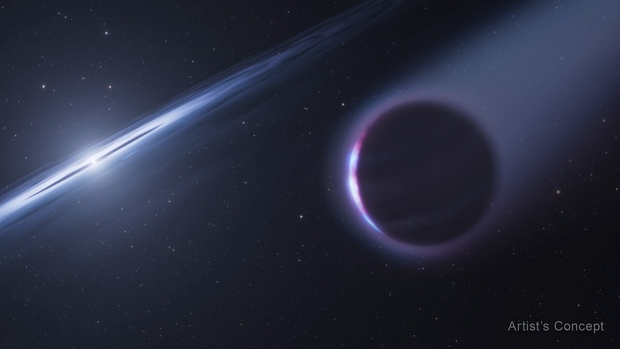
Image: This artist’s concept depicts a possible explanation for the unusual chemical abundances the NASA/ESA Hubble Space Telescope detected in the HS 0209+0832 system: a second-generation planet orbiting the white dwarf star. The white dwarf is the “dead” core of a star that burned through all of its nuclear fuel and lost its outer envelope of gas and dust to space. The second-generation planet formed from that cast-off gas and dust, which is why its chemical content is very different from a planet that formed as its host star was forming. Credit: NASA, ESA, L. Hustak (STScI).
This is interesting not only because of the idea of planet formation in a kind of ‘rebirth’ of a planetary system, but also because it opens up new lines of research. Here’s Williams, who is now lead author of a paper on this work:
“Rather than the white dwarf stage being a kind of epilogue to the story of a star and its planets, this research points to the systems we are familiar with only being the first chapter of a potentially much longer tale, with some new characters showing up. That’s a really exciting prospect to pursue. What Hubble is showing us in this white dwarf system is something we haven’t seen before: a high abundance of the element niobium, the signature of which I was unfamiliar with when I first found it in the archival data.”
To clarify what was going on in this unusual system required that Williams and team study not just the Hubble data but also that of further observations from the Far Ultraviolet Spectroscopic Explorer mission (FUSE), launched in 1999, the latter confirming the presence of niobium in the spectrum. Interestingly, the team looked at 33 other white dwarfs with signs of metal pollution in their atmospheres and found none with niobium. Further observations with TESS (Transiting Exoplanet Survey Satellite) showed periodic brightness variations consistent with a planet orbiting at approximately 6 million kilometers.
The niobium signature is critical because it is an element that is not formed in a stellar core through fusion. “Instead,” says co-author Nicholas Stone (University of Wisconsin – Madison) “these heavy elements can only be synthesised in the exotic conditions that briefly emerge inside dying stars. The presence of niobium is a signpost of these ‘death’ throes, and the expulsion of the dying star’s innards into space.”
The supposition is that material ejected from the dying star, enriched by exotic chemistry, coalesced into what appears to be a gas giant. The team argues that it is likely the size of Jupiter, and probably losing atmosphere given that the white dwarf would be stripping its outer material in such a tight orbit. Says Williams: “If the second-generation planet is there, I think it is likely to survive. Eventually the white dwarf will cool and then maintain a consistent temperature, with the planet in its stable habitable zone for millions of years.”
But forming this kind of disk is itself tricky. If planets like this are as rare as they seem, that may be because forming them requires another companion that helps to shepherd the ejected material from the dying star into orbit, rather than simply shedding it into interstellar space. For that, let’s look at the paper:
Assuming spherically symmetric mass loss, a second-generation proto-planetary disc is unlikely to form around a single AGB star, but there are several mechanisms that can lead to a disc if a binary companion was present. Evidence for the formation of such a disc has been found at the post-common envelope binary NN Ser as well as several post-AGB binaries. In particular, a close-in low-mass companion to the progenitor of HS 0209+0832 would have entered a common envelope event during the AGB phase, resulting in the ejection of the envelope and the formation of a circumstellar disc rich in s-process elements. A second-generation giant planet could have formed within that disc via direct gravitational collapse close to the white dwarf. Alternatively, a first-generation sub-Neptune or super-Earth that was scattered towards the second-generation proto-planetary disc could have accreted a second-generation atmosphere around a first-generation core.
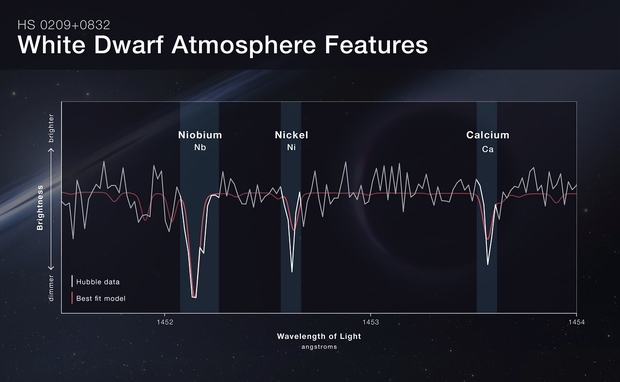
Image: This NASA/ESA Hubble Space Telescope spectrum shows the unusual abundances of certain elements it found in the HS 0209+0832 system. Dips indicate where niobium, nickel, and calcium are absorbing light, so less light in that part of the spectrum reached Hubble. The reason the starlight is showing elements that astronomers attribute to a planet has to do with interactions between the white dwarf star and planet. The white dwarf is still hot and is blasting the planet with radiation, causing it to lose atmosphere to space. That atmospheric material is flowing back toward the white dwarf, forming a disk and then falling back onto its surface. Credit: NASA, ESA, L. Hustak (STScI).
So while we can speculate about the fate of the inner planets in our Solar System when our Sun goes through its red giant phase, we may have to add in a scenario where a new inner system forms around a hot white dwarf with a long lifetime of its own. That’s assuming a mechanism that supports planet formation there. A still viable Jupiter using its formidable mass to shape a growing circumstellar cloud/disk? The example of HS 0209+0832 makes this at least plausible, although again, we have no good idea of how often such processes produce new planets.
White dwarfs will continue to energize research. From an exoplanet standpoint, imagine an Earth-size planet in transit across a white dwarf. That would be a transit signature for the ages. From the astrobiological perspective, consider that a white dwarf gradually loses heat because it has no fuel. This is a process, however, that can take several billion years before the star’s surface cools to the Sun’s current temperatures. Even that long life-time is eclipsed by the star’s eventual death as a ‘black dwarf,’ an inert object of a sort never observed because to reach that state would take longer than the age of the universe.
The paper is Williams et al., “Discovery of a second-generation planet candidate accreting onto a white dwarf,” Nature Astronomy 5 October 2026 (full text).


“If confirmed, it would be the first planet thought to have formed through accretion of materials left over from the death of the red giant”
Hi Paul, I dont believe this is the case? The very first planets with convincing evidence for their existence is the planetary system around PSR1257 + 12 that formed after the pulsar’s red giant phase. The planetary system are co-planer suggesting they formed in a disk. I submit that these were the first 2nd-gen planets found orbiting a dead star! https://www.nature.com/articles/355145a0
Yes, if we include pulsar planets, you’re right.
The Gas giant was formed along with the white dwarf from its stellar nursery or protoplanetary gas cloud. It seems rather far fetched to me that gas giant could form from an accretion disk around the white dwarf. The reason being how planets form from an accretion disk. They always start with a solid mass first which grows from the accretion disk from gravity of a small body and then a large planet’s gravity in the outer solar system pulls in a lot of hydrogen and helium. This accretion disk was from a much larger premordial gas cloud then is what is left over in a stellar nebula. In other words, I don’t think that white dwarfs retain enough gas from a stellar nebula to make new planets. Most of the material is ejected from the star and eventually mixes with the interstellar medium to eventually make new stars which is mostly hydrogen and helium. There is much more gas and dust to make planets in protoplanetary disks. I don’t this this process of planet making stars over again with the same star which is an idea that is counter intuitive to me. The gas giant survived the red giant phase and that is what we are seeing.
From the image caption: “The white dwarf is still hot and is blasting the planet with radiation, causing it to lose atmosphere to space. That atmospheric material is flowing back toward the white dwarf, forming a disk and then falling back onto its surface.”
If the WD is doing that now, surely it was doing it while or before the 2nd-generation planet formed. How then did a planet form when the star is so effective at driving off these atmospheric materials? Perhaps if the initial gravitational forces and accretion disk dynamics were, somehow, stronger than the “stripping” capability of the WD. It is not clear to me how that is possible, and how the transition to atmospheric stripping occurred after the planet coalesced. The evolution of star and planets that form from the same nebula can allow for this due to the protostar’s gradually developing radiation profile. I’m missing something.
@Ron
Your question would seem to support the argument that the planet is a Jupiter that survived the star’s red giant phase and then migrated inwards, when its proximity to the WD started losing its atmosphere.
While I accept that planetary migration happens, it seems strange that when a star loses mass, the planet migrates inwards, rather than outwards, as the gravitational attraction is lessened. I would like an explanation of how this occurs.
Perhaps you’re right, although that apparently isn’t what was proposed to have occurred. However I haven’t read the paper.
There are competing forces in your scenario. One is that, as you state, the star loses mass so the planet moves outward. Two is that the density of the inter-planetary region will be high for some time, causing a force counter to the orbital velocity that would move the planet inward. This must be terribly challenging to model.
Yes, that is precisely the idea. It is assumed by most astrophysicists that if a rocky planet or a gas giant is in an orbit that is near enough to the star to be pulled in by the red giant phase is completely destroyed, but that might not be the case. A gas giant in the outer regions of the stars plasma would experience a lot of drag and get pulled into a further orbit and migrate closer to the star. The reason being is that the outer layer of the red giants plasma is diffuse compared to the inner layer. It still might be intact. Recall that the fusion of helium to carbon is only in the dead center of the star. Unless a planet gets pulled all the way into that center it will definitely survive. It might lose some if its atmosphere, but recall that once a large gas giant forms, that it’s enormous gravity, it will be a lot harder for the hydrogen and helium to escape so it keeps a lot of it. This is an alternative theory common-envelope evolution. Copilot AI.
It depends on the distance of the gas giant and how common these would be at the right distance from the star. Too close to the star and the gas giant is destroyed, Too far away from the red giant and it would not be pulled into the star in migrate inwards so this in only one alternative explanation the second generation planet formation idea which might be a process which is more common. Ibid.
It’s different for pulsars because they come from an original star with a mass 8 to 20 times that of our Sun which was a violet type II supernova explosion. Copilot AI.
Hi Paul
Planets forming or migrating around Whites dwarfs sure is interesting. The complex physics is a little above me here too.
Thanks Edwin
I am a little surprised it formed at all, during the final stages of its red giant phase the white dwarf glows with a luminosity of up to 10 000 suns, Something forming in 6 million km from the star is unlikely. I suspect this planet may have migrated in due to stellar drag and was polluted with the material thrown off the dying star.
Interestingly the Poynting-Robertson effect is stronger with ultraviolet light, so it is possible a band of dusty material much further out migrated inwards and formed the planet.
Planet formation at the beginning of the Main Sequence and ignition take less time according to theory, but the time line here argues for how a jovian planet could explain anomalies. Evidently we have a ring, but a planet?
Beside this being a strange phenomenon, the evidence for its existence seems strange as well. A jovian planet at 6 million kilometers from its primary is less than 10 solar radii away from its primary. If the primary is a white dwarf, then its surface radius would be nearly that of Earth’s; and the planet ( rather young) supposed as massive as Jupiter ought to be – well jovian. If the exoplanet does not eclipse the star in transit, then is the detection based on primary doppler shifts? The above suggests that a circumstellar disk complicates this picture. And nova, ring and jovian planet coalescence have all occurred within five million years…
The authors say:
“This is further supported by the detection of a sinusoidal photometric period of 4.399 ± 0.026 days at an amplitude of 0.120% ± 0.018%, which we attribute to thermal emission phase variability from a planetary day–night cycle or a transiting cometary tail of an
evaporating gas giant. ”
That is, that if the white dwarf has an excess of certain nuclides there must be a gas giant planet in a cloud raining them down on its surface. They might be right and it is a startling conclusion. But were it a stock offering I’d hang on to my wallet. Or maybe this is just a case for review. For so far an exoplanet has not been clearly identified. If the ring plane is perpendicular to the line of sight, we might have that, but I don’t see a doppler shift noted for the star associated with an invisible companion.
Devil’s advocate.
wdk asks the right question about the timeline. A useful contrast is the directly resolved case: OGLE-2006-BLG-284 was followed up 15+ years after the event with Keck AO and HST and turned out to be a planet in a binary, primary about 0.43 solar masses, secondary 0.12, planet roughly 165 Earth masses (arXiv 2610.07133). That planet survived at a wide separation, which is the easy version. A Jovian world at 6 million km from a white dwarf still needs a migration story, not only a formation one, or it has to have arrived after the envelope was gone.
It just goes to show that these white dwarfs can be quite a boon. An advanced civilisation would have no trouble tapping the immense amount of material and power from one of these ’embers’. Our sun is expected to throw off around a million oceans worth of water into space and then there is possibility of water stars, they would not need the minimum 80 Jupiter masses to ignite fusion but from 3 to 20 Jupiter masses. And then there is their SFL which would be immensely powerful lens. The so called death of these star is anything but, they give copious amounts of life sustaining materials back to the cosmos.
I thought of this discussion when I spotted a news item about a green white dwarf. Simulating the visible colors of WD J1330+6435 reveals it to be a lovely green color. I guess Feynman wasn’t always right. :)
Any other decent science education site will explain why green stars are not possible. The notion of planetary material continually accreting into a white dwarf, broadening sodium and calcium lines in its dense atmosphere so far that they dominate big chunks of the spectrum, hasn’t been on their radar. (Apparently the helium atoms are close enough to alter energy levels, and give the ions so little time to be in one excited state that their wavelength is subject to the uncertainty principle) Nothing is really known about the source of the material, but I can’t help but wonder if a planet ran afoul of the Roche limit.
These white dwarf planets should be fascinating objects for science fiction. Once a white dwarf gets over its inconvenient luminous phase, a planet can easily be locked into an Io-like orbital resonance that exposes it to continual tidal heating. If there is some means by which the volcanism doesn’t make the planet uninhabitable, the result might be a fairly vibrant ecosystem with liquid water and anti-solar photosynthesis. In concept, a white dwarf would be appealing as a settlement for controlling supply streams from a homeworld to colonies – given its high gravity, bulk shipments might be directed to whichever colony needs them most, or submits the highest bid. In that case, obviously WD J1330+6435 should be a top SETI target, since we see they are allowing the interstellar traffic to move forward right now. :)