
One light day. I love the attention being paid to Voyager’s achievement at reaching one light day from Earth. I’m always looking for ways to get across to a public audience the sheer audacity of talking about travel to another star. That means impressing upon them the magnitude of the distances involved.
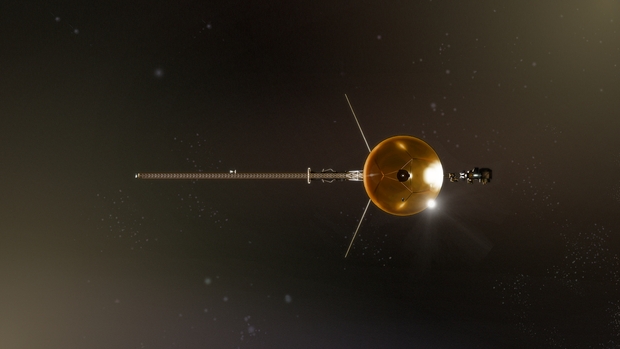
With Voyager 1 now more than 25.9 billion kilometers from Earth (over 16 billion miles), the opportunity presents itself. NASA has responded with its ‘Shine Bright for Voyager’s Light Day’ effort to flash Voyager’s call sign to the heavens. It is a symbolic act reinforcing the dedication it took to get Voyager this far out, and a reminder that both spacecraft are still functioning.
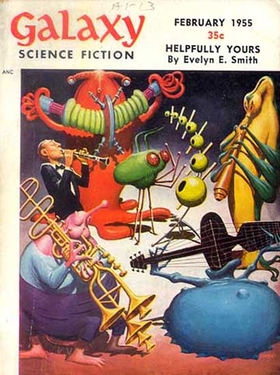
The light idea actually takes me back to a James Gunn short story called “The Cave of Night,” which made a splash in Galaxy when it ran in 1955, was soon reprinted and made into a drama on the wonderful X Minus One radio show. Eventually it made a TV appearance I watched in black and white as a kid. In the 1959 show “Man in Orbit,” which ran on Westinghouse Desilu Playhouse on CBS, astronaut Lee Marvin is stranded in orbit, and with his receiving communications out, people on Earth flash their lights in synchronized mode to let him know that his own transmissions are being heard. John Glenn received exactly that greeting from the citizens of Perth, Australia in 1962.
Image: The first appearance of “The Cave of Night,” in Galaxy Science Fiction’s issue of February, 1955. Credit: Phil Stephensen-Payne’s Galactic Central, an extraordinary archive and index of SF magazines.
Glenn’s circumstances, of course, were far less dire, but Voyager in itself is a kind of message declaring ourselves an exploring species, and I like the idea of enlisting public support in a new kind of demonstration. The idea is that people will go outside after sunset today, November 17, and send a signal either through an automated flasher that NASA makes available for smartphones or through something as simple as a flashlight. The signal is a simple ‘VGR’ in Morse code, and to make this happen using a flashlight you can consult the NASA directions online.
The precise arrival at the one light day mark is November 18 at 5:16:07 a.m. EST (10:16 UTC). Let’s think again about the light day celebration as a teaching tool that may be helpful to some of the Centauri Dreams readers active in the field who do public talks. A light day is the distance light can travel in 24 hours, hence 25,902,068,356 kilometers or 16,094,799,096 miles. Voyager 1 was launched 49 years, two months and 12 days ago, and is currently moving at about 17 kilometers per second. The spacecraft has taken almost 18,000 days to reach the one light-day milestone. If we’d like to get to Proxima Centauri, it will take roughly 75,000 years, or it would if Voyager 1 were pointed in that direction.
The spacecraft is actually heading in the direction of Ophiuchus, so the Proxima journey is just used as an illustration. If we wanted to tighten up the calculations on how long it would take a spacecraft moving at Voyager 1’s current speed to get to Proxima, we’d need to add in the Sun’s tiny but residual effect in slowing Voyager 1 down, which eventually will drop its final cruising speed to 16.6 kilometers per second. We’d also have to factor in the movement of Alpha Centauri toward the Sun, which will make it considerably closer than its current distance in about 20,000 years. But I think 75,000 years is close enough.
And a quick note returning to James Gunn’s story. Gunn was writing in the era when Collier’s had recently run a series on the human future in space that featured Wernher von Braun. As I understand it, Gunn wanted to take advantage of that surge in public interest, a full half-decade before Yuri Gagarin’s first orbital flight, to dramatize a near-future space mission. Writing so soon after the successful return of the Starship spacecraft and the stunning imagery shot during re-entry, I can only say that the resources we have in firing public attention are greater now than they have ever been. Good for NASA for coming up with a symbolic way to remind us of how far we have come.
If you’re interested in James Gunn’s story “The Cave of Night,” you can find it in several anthologies, including Judith Merril’s SF: The Year’s Greatest Science Fiction and Fantasy (Dell, 1956) and Gunn’s own collection Station in Space (Bantam, 1958). Magazine collectors like myself will find it in Galaxy Science Fiction for February, 1955.


0 Comments