
An intriguing mission to L1 has caught my eye, one with implications for solar sail development as well as climate issues here on Earth. But the research on that story is taking longer than I anticipated, so for today I want to cut to a brief account of the new dwarf planet candidate in the outer Solar System. This is an example of the power of the Vera Rubin Observatory on Cerro Pachón in the Chilean Andes, and a reminder of the numerous discoveries headed our way from its ongoing Legacy Survey of Space and Time, which will produce a high-definition view involving 10 TB of data every night.
ED138, which still awaits confirmation, looks to be a fitting companion for Pluto and Ceres in the dwarf planet category, joined by later discoveries Eris, Haumea and Makemake. Each of these last three objects has its own interest as a possible mission destination, with Makemake’s ring system, Haumea’s extreme spin and shape (not to mention its ice moons Hi’iaka and Namaka), and unusually reflective Eris’ possible internal activity and large moon Dysnomia. One would assume, given how early we are in the decade-long survey’s lifetime, that there will be numerous other dwarf planets out there, conceivably in the hundreds as we collect new Trans-Neptunians and Kuiper Belt Objects.
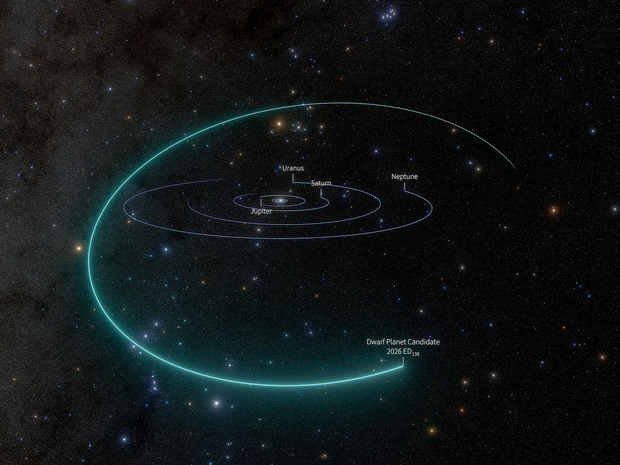
Image: A view of the solar system showing the orbital pathway of dwarf planet candidate 2026 ED138, discovered in data from the Simonyi Survey telescope at the NSF–DOE Vera C. Rubin Observatory. Initial analysis indicates that it may be among the largest and brightest bodies scientists have discovered in this region of the solar system. Photo: NSF–DOE Vera C. Rubin Observatory / NOIRLab / SLAC / AURA / R. Proctor. Image Processing: M. Zamani (NSF NOIRLab). Orbit data provided by the IAU Minor Planet Center (MPCorb catalog), funded by NASA PDCO and the Tamkin Foundation. Star map: NASA/Goddard Space Flight Center Scientific Visualization Studio. Gaia DR2: ESA/Gaia/DPAC.
We can thank a familiar name, Matthew Holman (Harvard & Smithsonian Center for Astrophysics) for this discovery, working with Mario Jurić at the University of Washington. ED138 turns out to be the largest trans-Neptunian object we’ve found in the last two decades, and Jurić points out that it was discovered while scientists were still putting the Rubin instrument through the commissioning process. That’s an impressive thought, and one that bodes well for the LSST.
We know little about the object, of course, other than that at present it is some 46 AU out, a bit further than Pluto’s average distance of 40 AU, and there is much to learn about the characteristics of its orbit. The early work, which includes archival images of the object from as early as 2016, has suggested that the orbit is perhaps 25 degrees from the ecliptic, which must indicate gravitational interactions in its history that probably involve Neptune. Says Jurić:
“Rubin is giving us an unprecedented capacity to explore the sky through a combination of speed, depth, and precision. And the discovery is just the beginning: Once we identify a new object, we can search back months, and sometimes even decades, finding it in images where nobody knew to look. This ability to both discover and ‘precover’ objects is transforming how quickly and accurately we can determine their orbits and understand the distant solar system.”
That this is a large object was evident from its albedo, which allows an estimate of 600 to 1500 kilometers in size. I see that Harvard’s Avi Loeb has just written about ED138, noting that it appears in the sky close to the plane of the Milky Way, where background stars make observations difficult. This is the kind of thing that’s made to order for the Rubin Observatory given the intention of using it for continuous monitoring of the sort that will flag the movement of such tiny light sources. Needless to say, the instrument should also be our best detector of interstellar objects like 1I/`Oumuamua, 2I/Borisov and 3I/ATLAS.


0 Comments