
The technologies we will one day use to reach other stars have myriad uses close to home. That’s obvious given the power needed to make an interstellar crossing and the propulsion issues that may be resolved through solar- and lightsail designs and beamed energy solutions. Make an effective solar sail as a driver for interplanetary exploration and you’re already designing with an eye toward scaling up to larger spacecraft and more distant targets. But some of these technologies also have application to our own planet’s habitability.
Thus the flurry of activity around adapting solar sails as ‘sunshades,’ designed to intercept solar energy both for easing temperatures on our planet but also for generating power in quantities that could eventually pay for their development. The idea has been kicking around for a while, but I think a good introduction to it is in the essential Paradise Regained: The Regreening of Earth, by Les Johnson, Greg Matloff and C Bangs. The 2010 title should be on your shelf for its vigorous exploration of space technologies as a way to mitigate resource depletion, ease climate concerns and power a civilization that will, let’s hope, survive long enough to reach Kardashev I status.
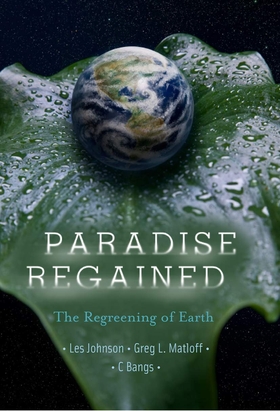
What the authors refer to as a ‘Dyson Dot’ emerges as a solar sail concept that, operating near L1, can be gradually brought online in the service of lowering Earth’s temperatures. Let me quote from the book:
…we propose the term Dyson dot. This is a deliberate allusion to the original idea of the Dyson sphere, which was proposed by Freeman Dyson as a system of orbiting space facilities designed to completely encompass a star, thus capturing its entire energy output. The Dyson dot would be designed to block or capture only limited amounts of a star’s radiation that would otherwise strike one of its planets.
In a 2013 paper in Acta Astronautica, Robert Kennedy, collaborating with Kenneth Roy and David Fields, worked through the prospects of such geoengineering in quantitative terms. I’ll send you to the paper for details (and of course Matloff, Johnson and Bangs also work through the numbers), but in the case of the Kennedy et al. paper, the proposition is to place a lightsail of some 700,000 square kilometers in a non-Keplerian orbit just sunward of the Sun-Earth L1 point. Thus we reduce insolation on Earth by about a quarter of one percent, an interesting figure, for the resulting temperature drop (1.8℃) is similar to what happened during the period called the ‘little ice age,’ which so changed Earth’s climate between about 1550 and 1850 (these dates vary, with some historians taking the period back to the beginning of the 14th Century).
This would have been an interesting time to have lived in northern Europe, a time when Iceland was cut off by sea ice from continental Europe and the river Thames froze over for the first time in recorded history. If we wanted to do something similar with Earth’s climate in ways that would turn the solar constant into a controlled variable, sails in various configurations might be brought into play, including not just structures as large as the Kennedy paper suggests but also swarms of much smaller sails, with all that assumes about connectivity between sails and station keeping for maintaining position.
It’s also true that we would be dealing with the prospect of harvesting vast amounts of solar energy that could pay for the whole enterprise over time. So the idea is attractive, even if it does not, to be sure, solve all the problems of climate change beyond easing temperatures. What to do about the host of issues that our reliance on hydrocarbon creates is another matter.
The EarthCup Sunshade Competition
Climate issues are so broad that a multi-pronged approach is inevitable, and it doesn’t surprise me to see the attention that sunshades have begun to generate. As witness the emergence of the EarthCup L1 Sunshade Project, described on its website as “a global, pro-social, pro-ecology vessel: a recognition of what Buckminster Fuller called Spaceship Earth.’” Here we’re talking about large numbers of small sails rather than Texas-sized structures. Michael D. McDonald, CEO of OVIAR Global Resilience Systems and Executive Director of Health Initiatives Foundation, is EarthCup L1 Project lead.
Recently I’ve been discussing this new foray into sunshades with Grover Swartzlander (Rochester Institute of Technology). The solar sail concept is ideal for sunshade thinking given its scalability and flight history, both implying that we can work with these concepts to find out what combination of materials and techniques will enable us to produce a stable platform near L1. Using a competitive framework not dissimilar from that of the familiar X challenges, the initiative has assembled 10 teams in a competition designed to examine the issues involved in placing 1-meter hexagonal membranes into low Earth orbit using a dispenser designed by scientists at the project. The initial white paper challenge is to grow into what backers hope will be a global sailing competition that should drive R&D in all areas of solar sail development.
The second phase of this project, supported solely by private funding, seeks to engage researchers, universities, policy makers and individuals in an effort that reaches across national boundaries. Up to 50 teams are envisioned covering everything from design and packaging to launch, deployment and communications with the spacecraft. This phase is intended as a critical design review (CDR), along the lines of traditional space mission development.
The satellites envisioned for the competition, the brainchild of EarthCup aerospace engineer Walter Holemans, are referred to as ‘Msats,’ or hexagonal membrane satellites. Along with designing the Msats, EarthCup is developing a unique means of deployment, one somewhat simpler than the methods currently used with CubeSats. Each flat hexagonal Msat is, the scientists says, “popped out one at a time.” The dispenser is designed to handle as many as 50 Msats, all ultimately deployed from a single rocket launch. Ahead for EarthCup is a demonstration mission of the dispenser system, although launch details are still being negotiated. Ultimately, a whole series of EarthCup races growing in size and sophistication over the years are intended to occur.
Swartzlander presented these ideas at the recent Optica Frontiers in Optics conference, noting the relevance of optics technologies to the effort. Materials technology is critical to the project:
”Among those challenges are designing optimized optical and materials properties for both shading and solar sailing. In recent years I have been pioneering the use of diffractive solar sails owing to their ability to face the sun while still providing a force perpendicular to the sunline. An example include Bragg gratings (aka slant volume holograms) which allow precise wavelength selectivity. Such selectivity is desired for sunshades so that they neither affect crop yields and photosynthesis nor photovoltaic power generation.”
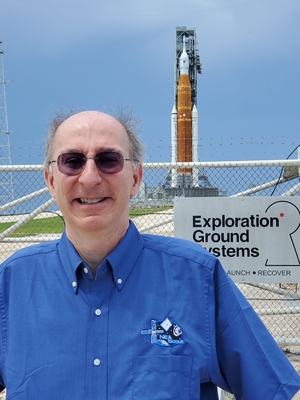
Les Johnson, an author and physicist formerly at NASA Marshall Space Flight Center but now retired (and a long-time friend of Centauri Dreams), notes the similarities and differences between an interstellar sail and a sunshade. To the observer, the two gossamer films, once deployed, look much alike, each a square kilometer in area and thinner than a human hair. But the observer would also note that while the traveling sail is silvery, reflecting almost all the light that impinges upon it, the other sail is translucent. The silvery sail uses solar photons (and perhaps a close solar pass) to provide acceleration, while the sunshade directs much of the photon energy away from the Earth behind it.
As Johnson points out, the push of sunlight is about nine micronewtons per square meter on a perfect mirror. A square kilometer sail thus receives about nine newtons of ‘push’ from the Sun. But the two objects put these forces to work in entirely different ways. The sunshade, Johnson says:
“…is built to block sunlight, and for it the same push is mostly a problem. Sunlight pushes the sunshade off the balance point between Earth and Sun about 1.5 million kilometers away, so engineers must adjust its reflectivity or tilt to hold it in place, and favor designs that scatter or bend light rather than bounce it straight back. Where the sail is a one-off precision instrument with a lifetime of years, the sunshade element has to be cheap, mass-produced and boringly reliable for decades. It would be only one of the millions of identical copies needed to dim the Sun by a percent or two. In a sense, the sail rides the sunlight while the shade simply stays in the way, and the same thin, light film can either carry us to the stars or help keep our home planet livable.”
So that’s the vision here, one that is drawing increased attention as physicists explore technological aids to the climate problem. I’ve noticed a bubbling of interest in the sunshade concept recently, one symptom of which is the 1st IAA Planetary Sunshade Workshop, which was held at the University of Nottingham (UK) last May. Several papers have appeared in the technical literature on various aspects of the idea, perhaps the earliest being by Roger Angel (University of Arizona in Tucson). I have also learned that there is a group at the Politecnico di Torino (Italy) that is working on a precursor CubeSat mission near L1. I provide citations for both these efforts at the end of the post.
As a driver for advances in sail technology, the EarthCup L1 Sunshade Project usefully injects a competitive impulse into the research. And it reminds me that whatever advances we make in sails by way of materials and deployment methods translate readily into the kind of long-haul exploratory mission that Centauri Dreams often discusses. Creating climate alternatives feeds exploratory imperatives as well, a point Swartzlander makes in a recent email:
There is sublime irony in the connection between a system of sunshades at the Earth-Sun L1 point and interstellar travel using solar sails. The station-keeping propulsion required of sunshades will most likely be provided by the solar radiation pressure upon them. That point has already been established in the peer-reviewed literature. Hence, the TRL advancement of sunshade/sailcraft will naturally benefit the development of solar sails intended for interstellar flight.
But what is more profound is that sunshades provide a means to concentrate light to irradiances many orders of magnitude greater that of the sun. That gain in irradiance would immediately provide the ability to blast a sailcraft to velocities exceeding the solar escape velocity. Construction of a sunshade constellation may begin within the next few decades, assuming policy makers decide to undertake the ambitious and expensive task. Hence, we may start to envision interstellar solar sails being routinely flown in this century.”
The paper on Dyson Dots is Kennedy, Roy & Fields, “Dyson Dots & Geoengineering: The Killer App Ad Astra,” Journal of the British Interplanetary Society Vol. 66 (2013), 340-358. Abstract. The paper from Torino is Coco et al., “Planetary sunshade for solar geoengineering: Preliminary design of a precursor system and mission,” Acta Astronautica October 2025. Full text. Other references can be found at the EarthCup site. Roger Angel’s influential paper on sunshade cooling is “Feasibility of cooling the earth with a cloud of small spacecraft near the inner Lagrange point (L1),” Proceedings of the National Academy of Sciences, 103(46), 17184–17189 (full text).

0 Comments