
I’m always interesting in discoveries unusually close to the Sun, maybe because I keep hoping that there really is a brown dwarf or rogue planet much closer to our system than Proxima Centauri. In the absence of that discovery, let’s talk about the unusual triple-system that has just turned up thanks to work at the University of Montreal, where the Trottier Institute for Research on Exoplanets (IREx) brings together research from a number of Canadian institutions.
Located some 28 light years from Earth, the system has been dubbed Welopōʻai, which is a Hawaiian coinage from the Imiloa Astronomy Center of Hawai’i, an institution whose existence explains some of the Polynesian names that have begun appearing in our astronomical catalogs. In this system, then, we have Welopō‘ai Aa, Welopō‘ai Ab and Welopō‘ai B. I had to resort to AI to retrieve the pronunciation here, and found that it’s weh-loh-POH-eye, which linguistically combines a notion of lineage with the circle depicting an orbit.
So let’s take this complicated system into focus. Using the SPectropolarimètre InfraROUge (SPIRou) spectrograph at Mauna Kea, the researchers led by the University of Montreal’s Étienne Artigau had been looking for the signature of exoplanets around the red dwarf IRAS 21500+5903 in the constellation Cepheus. The velocity change found via SPIRou dwarfed what they expected from an exoplanet, leading to the conclusion that there must be a massive companion object, one which would have to total as much as half a solar mass. Follow-up work using the Gemini North telescope turned up the image of a white dwarf.
This was interesting indeed, for IRAS 21500+5903 was already known to be part of a binary system, with a second white dwarf considerably farther away from the primary than the new discovery. Using the new nomenclature, we can call the outer white dwarf, which is about 124 AU from the red dwarf, Welopōʻai B. The newly discovered white dwarf, which we can now call Welopōʻai Ab, is a scant 4.6 AU from the primary, a bit less than Jupiter’s distance from the Sun.
Intriguing, no? Patrick Dufour, who specializes in white dwarf stars at Montreal and is a co-author of the paper on this work, points to its allure:
“We have no clean explanation for how it got here. That is the question driving our next observations.”
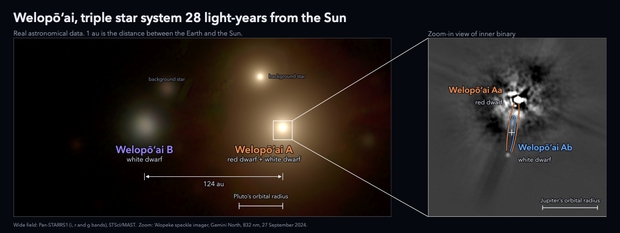
Image: Observations of the Welopōʻai triple-star system, located 28 light-years from Earth. The image on the left shows the two components of the system: Welopōʻai A, a closely orbiting red dwarf and white dwarf pair, and Welopōʻai B, a second white dwarf located much farther away. The image on the right provides a close-up view of the inner pair, revealing the faint white dwarf companion (Ab) detected using the Gemini North telescope’s ‘Alopeke instrument. The overlaid curves illustrate the stars’ orbital paths. Credit: Pan-STARRS1/STScI/MAST (left); International Gemini Observatory/NSF.
The assumption is that the inner white dwarf in this system was once about 40 percent more massive than the Sun, which would mean at some point it became a red giant, so that the red dwarf near it would be engulfed. Yet the red dwarf clearly survived, and is in what appears to be a stable orbital configuration with its close companion. The paper suggests that Kozai-Lidov oscillations involving the outer of the three stars could result if that object’s orbit were sufficiently tilted. Such interactions could have profound effects on the orbital eccentricity of the inner stars, but it will take more observations to figure out whether this explanation fits and how such interactions evolved over time.
The team’s video so impressively uses sound to depict the system’s orbital interactions that I’ll add not only the video but their lengthy description.
Image: Animated simulation and sonification of the Welopōʻai triple-star system, illustrating how the gravitational interactions between its three stars could influence their orbits over time. The animation begins with a close-up of the inner red dwarf and white dwarf pair before zooming out to reveal the more distant second white dwarf. It then explores the possibility of Kozai-Lidov oscillations, a phenomenon in which the gravitational influence of the outer star causes the inner pair’s orbit to cyclically change in shape and orientation. Although these oscillations are expected to occur in the Welopōʻai system, observations have yet to confirm how pronounced they are.
The accompanying sonification translates the stars’ orbital motions into sound, allowing listeners to hear the changing rhythms of the system. Musical tones accompany the stars as they move along their orbits, with changes in the timing and character of the sounds reflecting their evolving motions. As the inner orbit becomes more elongated and then more circular again, these changing patterns in pitch offer an audible representation of the gravitational dance between members of this stellar family. Credit: Heidi White, Trottier Institute for Research on Exoplanets (IREx), Université de Montréal. Simulation data from Alexandre Correia, University of Coimbra.
Being surprised by our observations is hardly a new phenomenon, as Galileo demonstrated when he decided to look at Jupiter and found its moons, and as the paper on this work points out, the first exoplanet around a main sequence star (51 Pegasi) was confounding because the idea of a ‘hot Jupiter’ had little traction in the scientific community. Now we have an oddball survivor, an M-dwarf that somehow survived the red giant phase of a close neighbor and returned to a stable orbital arrangement with it. We’ll soon be learning more, as the collaborators on this find intend to tighten up the numbers using further Gaia data as well as archival-plate astrometry and JWST observations.
That work may also resolve an unexpected infrared excess at Welopō‘ai Ab which may involve a debris disk, although the authors consider this a tentative conclusion. Fortunately, JWST photometry is made to order for the follow-up.
Thanks to my good friend Antonio Tavani for the pointer to this discovery. The paper is Artigau et al., “Welopō‘ai: A peculiar triple system 8 pc from the Sun,” Astronomy & Astrophysics Vol. 715, A321 (November, 2026). Full text.


0 Comments