
We’ll have a lot to talk about when observations from the Nancy Grace Roman Space Telescope start coming in. But first we’ve got to get it out to its halo orbit around the L2 Sun-Earth Lagrange point. With the Sun, Earth and Moon permanently blocked out, the seeing should be good from this vantage some 1.5 million kilometers out. Just now I’ve had a note from Jim Benford reminding me that launch is currently scheduled for tomorrow, August 30, at 0726 ET (1126 UTC). The additional good news is that Jim’s son Dominic will be one of two hosts of the live coverage from NASA. I remember meeting Dominic some years back at Goddard Space Flight Center, where I had the chance to see the JWST telescope being prepared to go through its vibration testing.
Dominic has spent more than a decade working on the Roman telescope, so the honor of working the NASA live coverage is well deserved. The photo below shows him during preparations for the Sunday coverage, which starts at 0620 ET (1020 UTC). You can tune in on Facebook, Instagram, Twitch, X, Discovery+, Amazon Prime, YouTube, or NASA+ (see https://www.nasa.gov/live/ for links and updates).
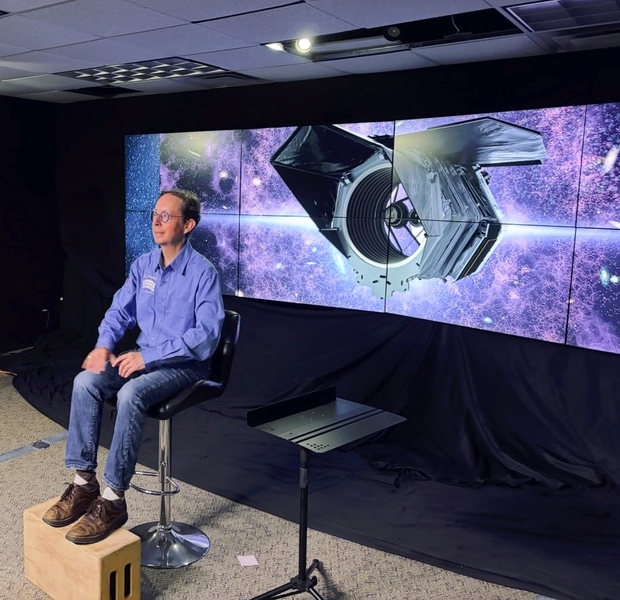
And as Jim reminds us: “As with any launch, timing can change because of weather or other conditions, so check NASA for the latest schedule. Fingers crossed!”

Hi All
Lets hope for a successful launch!
Thanks Ed
For occulter disks or sail bits?
https://thedebrief.org/scientists-create-material-that-can-shapeshift-and-expand-80000-using-only-light/
Congratulations on a successful launch! At least to nominal orbit insertion so far. The most striking part of the launch to me was actually the rapid automatic landing of the booster. In part because seeing a rocket land on its flame this way is an iconic sci-fi image, but also because there would be more tolerance for ‘surprises’.
I cannot also help but react to the excitement of the people here and elsewhere for the data-collecting power of this mission, particularly its field of view. As I understand it, this is one of two surplus obsolete telescopes from NRO from 2012. The scientific community is awed by this previous generation’s incarnation of Big Brother. Now yes, there’s a tremendously impressive coronagraph the NRO had nothing to do with… but as we ponder these trillion-pixel images, we nonetheless should ponder where we stand.
So far it’s looking good:
https://www.nasa.gov/news-release/nasas-dark-universe-seeking-nancy-grace-roman-space-telescope-launches/
I watched the launch from Indian River and it was a wonderful experience. It was my 3rd attempt to see a Falcon Heavy launch, and 3rd time was the charm. Glad the result was the launch of a major new astronomy platform!
Always great to hear from you, my friend! The launch was great even on NASA TV. But to have been there…
One corner of the Internet I follow (the “Off Nominal” Discord channel—great Podcast BTW) was watching the NASA livestream & became fascinated with Dominic’s necktie. One intriguing theory was he **might** have been sporting a “Double Eldridge” knot, which requires TWO neckties.
Any chance we could get Dominic to confirm or deny?
Actually, yes. I’ll get an answer on the tie maybe by tomorrow. As you saw, it was an interesting tie in an unusual knot, a specialty of Dominic’s. But I’ll ask about the Double Eldridge.
Thank you for noticing! I do often tie the Eldredge, but for the broadcast I chose the Boutonnière Knot. It has a tighter cinch at the bottom end of the knot that, in my opinion, enhances the triangularity and makes it a bit more noticeably distinct from, say, a Windsor. With a dark tie and studio lighting, I didn’t want to assume people would see the overlapping folds of the knot.
This is amazing! Thanks for the response! Sartorial interests aside….
I don’t know if your public education role extends beyond the telescope’s launch commentary for NASA, but I spoke to one of the co-hosts of the weekly podcast “Off Nominal.” If you’re interested, they’d like to have you on as a guest sometime to discuss the Nancy Grace Roman Space Telescope.
If this is something that aligns with your duties on the project, what would be the best way for them to make a formal request? Your personal NASA email? Somewhere else?
(In case you aren’t familiar, “Off-Nominal” has been around since ~2017 & they do casual style interviews with all sorts of folks in & around the world of spaceflight & space science. See https://offnom.com/ for details.)
Larry, I’ve contacted Dominic, who plans to email you directly.
A successful launch. Now looking forward to a successful deployment. Nancy Grace Roman Space Telescope Launch (NASA)
There is a real time tracker on the web.
https://www.youtube.com/watch?v=dvbGXz4iFk4
On the solar wind
https://phys.org/news/2026-08-solar-orbiter-ion-magnetic-boundary.html
Structures
https://techxplore.com/news/2026-08-crumples-inflatable-membranes-multiple-stable.html
I have long been a fan of foldable and inflatable structures. I have books on this going back to the 1960s. Foldable structures can be made using easy-to-manufacture flat sheets of material, then folded to make 3D structures that are fairly stiff and resilient to external forces. Origami is an advanced form of folding, and is often mentioned as the inspiration for folding panels for a launch and then unfolding them for deployment. Creating similar forms using inflation was also used, with many temporary structures transported and deployed to sites.
The link you provided has added a new wrinkle in that these inflated forms can also be metastable. This is something that may be newer, although I think it is well-known in biology, principally in plants, for example, in the rapid opening of seed pods to disperse seeds, or possibly the rapid closing of the 2 leaves in Venus flytraps.
Inflatable structures should have a role in spaceflight, and indeed this is the basis of several experimental structures such as Bigelow’s Genesis modules, successors to the toroidal spacewheel station proposal from Goodyear back in the 1960s. McConnell and I also used inflatable technology for our proposed “SpaceCoach” crewed spacecraft. Inflatable space structures have a long history and are still being proposed. I hope these new ideas on inflatables will be used on Earth, and eventually in space. Inflatables that are constructed from flat sheets and then inflated to form 3D structures should be obvious technology for use in space, where mass and volume are critical for delivery by rockets or simpler manufacture in situ.
The planet hunters are going to be very pleased, 60 000 to 200 000 planet transits and microlensing events. I can’t wait until we have observatories on the moon as well.
The NGR telescope should generate some very interesting data. Now that the JWST is showing the value of spectroscopic data in the NIR for characterizing gases, I am also hoping the upcoming proposal to test Raman spectroscopy from space to characterize elements and molecules will be helpful in characterizing different minerals of asteroids and moons on flyby and orbital missions. This would reduce the need for very local use of the technology, as used on Mars’ Perseverance rover. How long before we can stuff advanced AI into it?
Raman spectroscopy from space is an interesting idea. While I could wish for a kinder culture, this is probably this is where the Scramble for Space begins. It sounds like the signal to noise ratio has to be a trillion times better, but they may be able to do it. With the help of AI, I found NASA’s blurb on Interworld Slingshot Resource Surveys and something at Techport, and downloaded a more general paper explaining how time-gated Raman spectroscopy screens out fluorescence background at ResearchGate.