
With New Horizons now 63 AU out, it’s time to ponder that record hibernation period that the spacecraft just went through. Over 10 months long, this one had the same goal as previous such periods, to hold down operating costs but also give a break to onboard instrumentation in hopes of augmenting mission lifetime. As a kid, I often thought how cool it would be to be involved with a distant spacecraft. For some reason I always visualized this as being here on Earth while working with a craft beyond the Solar System. So maybe I was dreaming more of being a flight controller than an astronaut.
I hadn’t realized until reading Alan Stern’s recent update that while hibernation means there are no commands and responses going back and forth, the craft does continue active data gathering from its Solar Wind at Pluto (SWAP) plasma detector and the Pluto Energetic Particle Spectrometer Science Investigation (PEPSSI) instrument. The Student Dust Counter is also in operation. Since awaking early in the summer, New Horizons has been delivering data from these instruments back to Earth.
I see that future flybys of Kuiper belt objects (KBOs) are still a distinct possibility, assuming that one can be found within range of the vehicle. And yes, the Vera Rubin Observatory is already in use in the search for such objects, with planning extended to requests for time on the Roman Space Telescope, now scheduled for launch within days. Writing about New Horizons always comes with a tinge of melancholy as I contemplate the fact that no successor is ready, but it’s a relief to see how active this tough little craft continues to be. There are good successor concepts out there, but none are currently funded.
Meanwhile, we have the interesting news about possible liquid flows on Pluto’s surface, revealed by New Horizons images of Sputnik Planitia, the nitrogen glacier whose northern regions reveal convection cells separated by features that suggest liquid nitrogen has flowed there in the past. The new work out of Southwest Research Institute (SwRI) and published in the Planetary Science Journal, suggests that this process continues, doubtless through liquid nitrogen upwelling from beneath the glacier.
SwRI’s Kelsi Singer, one of the study’s co-authors, comments:
“The surface of Sputnik Planitia is quite young, probably less than one million years based on modeling of the surface overturn, and thus these features that we are looking at must have formed since then. Pluto has many unique terrains seen nowhere else in the solar system, and this area of Sputnik Planitia is one of them. Its surface provides a different set of conditions compared to what we are used to on Earth, and exploring that allows us to better understand how materials behave in environments that are difficult to produce on Earth.”
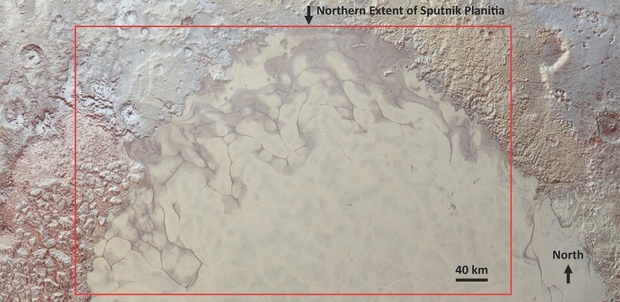
Image: Pluto’s northern Sputnik Planitia glacier (in the western or left side of Pluto’s bright heart) is shown here in a color mosaic made from NASA’s New Horizons imagery. The direction of north is shown on the image. The image is ~ 700 x 350 kilometers across. The red box has been added to show most of the region containing dark features attributed to the wetting of the glacier by liquid nitrogen sourced from a “basal melting” process beneath the glacier. NASA/Johns Hopkins APL/SwRI.
These findings are based on studies of a glacial surface far from Earth and involve liquid nitrogen rather than water, but it’s interesting that the paper reports that the surface patterns on this region of Sputnik Planitia have darkened in ways that are similar to Earth glaciers that have undergone their own wetting by subsurface liquid. The team worked with images from the Landsat 9 satellite that included the Greenland ice sheet. Computer models of glacial melting led by Orkan Umurhan (SETI Institute) reveal a transport mechanism to the surface and indicate an icy flow that can persist on the surface for short periods, which would account for the dark features.
And there is another Earth analogue that perhaps comes into play. From the paper:
We have posited that the striking, dark, irregular linear and diffuse features prevalent at the northern margin of SP are manifestations of the upwelling of liquids or liquid slurries from beneath the SP ice sheet. We have further posited that these liquids were created as a basal melt at depth below the glacier, and we have quantitatively shown the plausibility that such a mechanism can then advect through conduits to the surface of SP where it will horizontally spread out, leaving a darkened surface akin to that observed in northern SP. The buoyant ascent of liquid nitrogen through the denser N2 ice is akin to terrestrial volcanism where less dense basaltic melt rises through cold continental crust.
Does this process occur on other dwarf planets in the Kuiper Belt? We won’t know that until we have mapping missions to objects like Eris. The paper also mentions the obvious candidate at Neptune, the large moon Triton, as a possible example of such processes factoring into the geysers Voyager 2 observed during its flyby. For that matter, it’s fascinating to consider that despite the success of New Horizons at Pluto/Charon, over half the planet (I know I’ll get emails about calling it that) remains unmapped at high resolution because of the geometry of the encounter. So for the time being, we don’t even know whether apparent flows like that at Sputnik Planitia occur elsewhere.
The SETI Institute’s Umurhan points out that the physics of solid nitrogen materials under stress and strain are not well understood, and have to this point “never been studied in real detail in the laboratory.” We need, in other words, to go out there and look, and New Horizons has just reminded us why.
The paper is Stern et al., “Evidence for Possible N2 Basal Flow beneath Pluto’s Northern Sputnik Planitia,” Planetary Science Journal Vol. 7, No. 7 (31 July 2026), 185 (full text).



It strikes me that this is likely a one-way flow. That is, there is upwelling but no subduction as there would be with tectonic convection is large bodies like Earth. Said another way, this is just slow motion upward movement of light volatiles, with denser material settling downward consistent with the low mass of Pluto and the extremely low temperatures. That’s interesting to study since something like this happened on Earth and elsewhere, though far earlier and far faster, and therefore not directly visible to us.
The Chinese are expected to send an orbiter cum lander to Neptune around 2033..
NASA’s decades orbiter mission to Uranus too is expected to launch..
Hoping also the SWRI proposed 2019 “Pluto orbiter and beyond” too will materialise.
If Musk gets a fuel tanker into orbit around the earth and it is used for deep space craft refuelling the US will be there in half the time. We need some papers to be published on the effect of an extra boost from this fuel depot, I suspect the scientific rewards will be quite welcoming.
Hello, RP.
Regarding the “orbiter cum lander”, where would the latter land? Triton?
Any more details?
Best regards,
wdk
The posited possible mechanisms for this phenomenon don’t seem to explain why it is occurring on the north side of the left lobe of SP. Their terrestrial glacial analog is that this would be due to interactions with warmer conditions at the edge, such as seawater. What would that be on Pluto? Or possibly because this area of the SP is shallower than elsewhere.
Does a fuller explanation require an orbiter, or even a lander? That would be somewhat far off.
As always, every new observation invites more questions.
Hi Paul
One very interesting article on Pluto here, interesting dynamics at play on the surface that are causing these features and making one dynamic world.
Cheers Edwin
For a brief period in time during the Sun’s red giant phase Pluto will be warm enough to be pleasant, well if we ignore the atmosphere literal vaporising into space before your eyes. I also suppose it will also go through a Titan phase before that.
‘Balmy Temperatures: Pluto’s current average surface temperature sits near an inhospitable -230°C. During the peak red giant phase, temperatures will rise to a Earth-like 27°C (300 Kelvin).’
@Michael
Once the frozen gases boil off and create a thicker atmosphere, the water ice will melt and create an ocean world with low gravity. A lovely playground for any technological biological species. Stapledon’s 18th men on Neptune might use it as a vacation spot! (Stapledon was wrong to posit a supernova extinguishing this species confined to the solar system, so they might well have lived on until the red giant stage collapsed back into a white dwarf. Perhaps they will migrate back into what is left of the inner solar system.)
I suspect once the Sun starts to fall apart we can collect some of estimated 100 000 earth masses of material that will be ejected. Once the white dwarf is born it is still insanely hot with hundreds of times the suns luminosity. Moving in should not be a problem I would think.
This is a timely article for me. My SF reader’s group is doing Larry Niven’s World of the Ptavvs, which features a showdown on Pluto. The book was published in 1966, so it will be interesting to see how much of it holds up.
Charon is large compared to Pluto that is the largest Moon compared to its planet in the solar system. The tidal heating is probably responsible for the nitrogen upwelling. Therefore, we might not see this on any other of the dwarf planets without large Moons.
The orbit of the moon around Pluto is near a perfect circle. So unlikely the cause of tidal heating. Maybe a density change of the nitrogen mass due to a subsurface heat source.
I stand corrected. Pluto and Charon are also tidally locked.
G.H,
This is an instance where the relation between Triton and Neptune is worth noting.
If we consider lunar motion about Earth as counter clockwise and Earth’s rotation CCW as well viewed above the NP, Neptune’s moon Triton is orbiting clockwise (CW) about Neptune and Neptune like Earth is rotating CCW. Triton’s eccentricity is negligible.
Does this minority type motion have any consequence? Well, Neptune appears to have high speed prevailing band winds similar to Saturn and Jupiter’s flowing to the west near the equator, somewhat synchronously with Triton. And Triton, despite a near circular orbit, seems to have a number of geysers…
With that picture arriving from the Voyager 2 flyby, conjecture about what to expect at Pluto years later with the New Horizons flyby?
Well, my guess was or would have been something more static. But counter to expectations, recently came across an interesting presentation about solar induced chemical reactions in the thin blue haze atmosphere surrounding Pluto:
ps://www.msn.com/en-us/news/technology/james-webb-just-saw-pluto-for-the-first-time-and-this-shouldn-t-be-possible/vi-AA29LUc9?ocid=msedgntp&pc=HCTS&cvid=06aa21ee677c42f6b6af555fe3889010&ei=36
Another source quoting New Horizons science findings:
https://space.sciencearray.com/pluto-paints-charon-moon-red-methane-tholins
These presentations both give credence for the case of widespread cryo-chemical production in the outer regions of the solar system of compounds essential for biochemistry. And its transport from one body to another. E.g., from Pluto to Charon is tracked.
It is clearly difficult to summarize these discoveries, but I hope that they can be explored here in the coming months.
The reason why Pluto has ongoing surface-processes that are still active on a “human” should be fairly obvious: Pluto’s orbital eccentricity and distance from the Sun implies that its atmosphere undergoes a “freeze/thaw cycle” once every 284-year orbital period. During the “freeze” period, Pluto’s atmosphere “snows out” all over the planet, including its highlands, building up glaciers of predominantly nitrogen “snow”. During the “thaw” periods, these glaciers become mobilized to flow from the “highlands” down into the “lowlands”. The natural and totally expectable result is active periodic geological (“plutonological”?) cycles occurring on a 284-year cadence.