
Building the infrastructure we will need for interstellar exploration requires an imaginative look at today’s technologies as applied to distant targets. Indeed, we can leverage the scientific interest in, say, an orbit around each of the ice giants to explore launch capabilities through beamed energy, but we will also need to consider how we can use economical smallsats to provide stationkeeping nodes in such studies. Advances in miniaturization and the growing sophistication of CubeSats all point in the same direction. We can exploit our early flybys by fleshing out an observational smallsat matrix around targets at system’s edge to form a robust data and communications network.
The thing that is going to vitalize the development of small satellite packages is a new kind of propulsion system of the sort recently developed at MIT. The problem is easily stated: A small spacecraft – think suitcase size or less – has to maximize payload while ensuring flexibility in adjusting trajectory or tweaking orbital parameters. Chemical thrusters can give you rapid maneuvers and orbital insertion while electrical thrusters can produce low-thrust for long-haul cruise purposes or stationkeeping. Both systems are bulky, which has led to the kind of trade-off that is holding back smallsats for longer deep space missions.
The MIT work, discussed in a recent paper in the Journal of Propulsion and Power, describes a way to combine both types of thruster by extending existing ‘electrospray’ thrusters into the realm of chemical propulsion. Electrospray technology was used successfully on the LISA Pathfinder mission in 2015, which was essentially a demonstrator mission to study the detection of gravitational waves. The tiny thrusters could produce thrust in minute increments that allowed the spacecraft to maintain position without introducing vibrations. Observations that are ‘jitter-free’ become possible..
The basic electrostatic thruster can be the size of a small coin or a computer chip. An electric field acts on a propellant – a conductive liquid – which is being fed to each thruster, the latter sitting on top of a reservoir of the propellant.
Let’s pause for a moment on the conductive liquid, which the paper refers to as an ‘ionic liquid. ‘ I’m seeing these described as a liquid salt at room temperature. The liquid is made up of negative and positive ions without a neutral solvent, which makes the fluid electrically conductive. In other words, there is no need to ionize the propellant. The idea is simply to pull the ions out of the ionic liquid using an electrical field. A storage benefit also accrues: These liquids are non-evaporative and can be stored without pressurized tanks or seals. The electric field charges a specified amount of ions, which are then channeled out of the reservoir through the thruster tips as a spray.
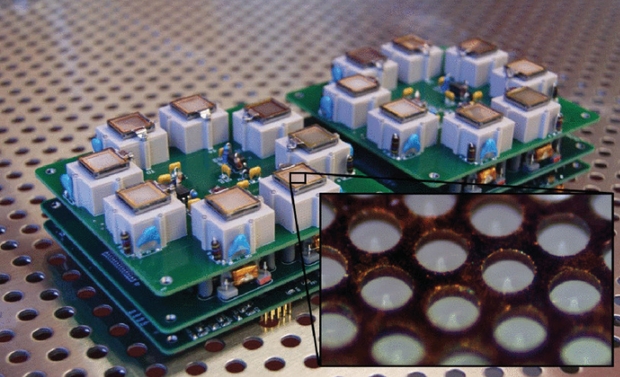
Image: These four flight unit electrospray thrusters were delivered by MIT Space Propulsion Laboratory to NASA for the upcoming Green Propulsion Dual Mode (GPDM) mission. Insert: The emitter arrays. Image credit: Amelia Bruno.
So we know that electrospray thrusters work. Moreover, the method is scalable, allowing thrusters to work in tandem for larger missions. Being able to combine this technology with more powerful chemical methods dramatically extends the possibilities for missions to other planets without the thrust penalty of conventional electrical propulsion systems. Amelia Bruno (MIT Department of Aeronautics and Astronautics) is lead author of the new paper:
“If you can have chemical and electrical propulsion in one small package, it’s the best of both worlds. This opens the door for small satellites to do even more science, more observations, and more interesting missions, all on a smaller and cheaper platform.”
The step forward here is the discovery that a chemical propellant can work with the same system and deliver higher levels of thrust when needed. It’s two propulsion methods working off the same tank of propellant. MIT has introduced a ‘green’ monopropellant developed originally by the US Air Force for chemical propulsion. Called ASCENT (Advanced Spacecraft Energetic Non-Toxic), the ionic liquid propellant is free of the health hazards of hydrazine for those working with it – hence the ‘green’ in the above reference. In this case, green means lower overall costs with fewer environmental liabilities.
The flight demonstrator that grows out of this is called the Green Propulsion Dual Mode (GPDM) mission. Scheduled for launch in November of this year, the mission is to be the first in-space checkout of this form of propulsion, testing the switching from chemical combustion mode to electromagnetic acceleration mode. A single propellant tank will feed the chemical thruster as well as the array of four electrospray thrusters. A Falcon 9 launch vehicle will deploy the 6U CubeSat with the new propellant onboard as a secondary payload.
Recent tests have shown that electrospray thrusters fueled with ASCENT operate successfully over periods lasting up to 100 hours and although the propellant was originally designed for chemical propulsion, it turns out to be just as efficient as the various ionic liquids the team has experimented with in their electric thrusters. Thus a single tank of fuel aboard a CubeSat can be used to produce both chemical and electrical propulsion in a compact system. No previous satellite has ever been designed with a shared propellant tank.
Paulo Lozano is a professor of aeronautics and astronautics at MIT:
“We could send CubeSats to Mars, or the asteroid belt, where they could make the journey slowly, using electrospray thrusters. You could then use your chemical thrusters to quickly move to look at interesting features. You could have a lot more flexibility to do a lot more things.”
Marshall Space Flight Center leads the the Green Propulsion Dual Mode mission, with MIT supplying hardware and subsystems, along with Georgia Tech. The NASA Small Spacecraft & Distributed Systems (SSDS) program manages the GPDM project. Keep an eye on this program.
The paper is Bruno et al., “Performance Characterization of Electrospray Thrusters with Energetic Ionic Liquid Monopropellant,” Journal of Propulsion | Power published online 31 May 2026 (abstract). Also available is Tong et al., “Mission Architecture for the Green Propulsion Dual Mode Mission,” presented at the 38th Annual Small Satellite Conference and available here.


Its 600 ISP is better than chemical rockets but nowhere near ion engines.
As I recall this is one of the HAN (hydroxylammonium nitrate) fuels. As HAN is a solid, water,nitric acid or some other ionic solvent which can act as additional fuel is added to the mix to make it liquid. They’re “green” to the extent that the mix has a very low vapor pressure, but they’re scarcely innocuous. Of course, compared to hydrazine . . . .
The ionic nature of the propellant for electrospray thrusters really isn’t relevant to the propulsion mechanism, you can do electrospray propulsion with just about any liquid. Rather than ionizing the propellant on a molecular or atomic level, as with ion thrusters, (Which is a real power hog!) it’s more of a normal surface electrostatic charge doing the work. The charge to mass ratio of the droplets is extremely low compared to, say, cesium or argon.
It’s more important because it’s the basis of the liquid having an extremely wide liquid range with ultra-low vapor pressure, which is really handy in a space propellant.
I see these thrusters and small nuclear batteries being part of cubesats that a larger bus can Pez dispense.
I have seen drawings from Scott Lowther of http://www.up-ship.com of SDI orbital railguns.
Something like that could be dual-use…expelling cubesats.
You would still need Super Heavy Lift to perhaps send a huge mass-driver outwards…but that might allow more options for cubesats…the main bus accelerates but the cubesats sloughs off some speed even before a burn.