
The headwaters of the Fermi Paradox channel directly through Michael Hart and Frank Tipler, and it’s a testament to the power of their arguments that this remains true today. It was Hart who in “An Explanation for the Absence of Extraterrestrials on Earth” (published in the Quarterly Journal of the Royal Astronomical Society in 1975) pointed out something blindingly obvious once stated. Moving at one-tenth of the speed of light, a civilization could send its probes throughout the galaxy in as little as 650,000 years.
Hart set an upper limit on this at 2 million years, but either way the point resounded in the astrophysics community because these are tiny time spans compared to the age of the universe. Hart even factored in a pause after each leap to a new star to found a ‘colony,’ or whatever such a probe would do there. Our Sun being a relatively youthful 4.6 billion years old, that was a vast amount of time for earlier civilizations to have mastered technologies opening up trips to the stars, but we have yet to find evidence of them.
The ‘Where are they?’ question resonated with Tipler when he picked up John von Neumann’s idea of self-replicating probes. Tipler pointed out that this wave of replication would be unstoppable. The fact that we saw no evidence of it led to the title he chose for his paper: “Extraterrestrial Intelligent Beings Do Not Exist,” which was published in 1980 in the Quarterly Journal of the Royal Astronomical Society. It quickly led to spirited argument in the pages of Physics Today and continues to motivate debate.
It would be fun sometime to go through that early back and forth, which included Frank Drake, Carl Sagan, Gregory Benford and William Newman, but I’ll fight off my digressive instincts to home in on the paper I want to talk about today. It’s from David Kipping, and takes Hart and Tipler’s ideas a logical step further. If we can extrapolate a ‘filled’ galaxy within 650,000 years (and Kipping points out that this number continues to look viable), then what about galactic expansion? After all, intergalactic travel times should be endurable for machine intelligence. Should we expect signs that other galaxies – perhaps all galaxies — should have been ‘infected’ by self-replicating technologies by now?
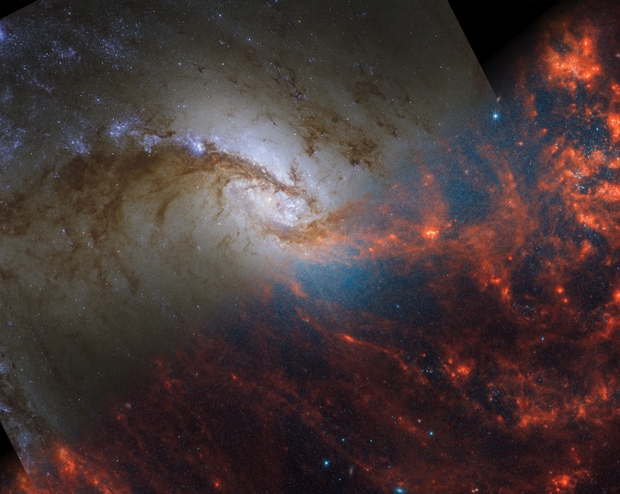
Image: Could it be that entire galaxies are infested with self-reproducing technologies? This one is the barred spiral galaxy NGC 1365, split diagonally in this image: The James Webb Space Telescope’s observations appear on bottom right, and the Hubble Space Telescope’s at top left. David Kipping’s new paper examines how we can extend the Hart-Tipler argument on the expansion of technologies through one galaxy into cosmological realms. Credit: NASA, ESA, CSA, STScI, PHANGS Team, Janice Lee (STScI), Thomas Williams (Oxford).
All of this raises the question of what a self-reproducing probe would be likely to do to a planet it encounters. It is striking that we don’t have to assume bad intent on the part of the builders. If self-reproducing probes built by civilizations far ahead (technologically) of our own are simply sent out as scouts and explorers, over the course of aeons some may begin to spawn destructive offspring simply because of the gradual introduction of errors into their programming. These in turn reproduce. From this we get the concept of the ‘berserker’ probe that destroys worlds.
Or perhaps, as Kipping muses, they simply go about converting planets into computational substrate. Modern developers pay no attention, for example, to the survival of small creatures in the landscape they ravage to build new apartment houses. Whether such a probe would notice a fledgling technological civilization or not is a matter of debate. But let’s look at that idea of infection. It is not intended to imply the malignant spread of anything. From the paper:
We use the term “infection” in a mathematical sense only: a self-propagating transition from a habitable/untransformed state to an uninhabitable or observer suppressing state. No biological analogy is intended. The infection fronts are mathematically modeled as spherical wave fronts, which can be interpreted either as literal isotropic expansion or as an effective envelope for a sufficiently dense directed-probe strategy (e.g. Crick & Orgel 1973). In this way, the model could be considered to encompass a variety of infection modes. Indeed, our intention here is to avoid conditioning the model upon a specific mechanism because any assumptions of “advanced” behavior often age poorly (e.g. Martian canals; Chambers 1999), since we cannot reliably predict what new technological paradigms might arise.
Although there have been several papers looking into cosmological expansion, in particular a 2015 title by S Jay Olson and a 2013 paper by Stuart Armstrong and Anders Sandberg, Kipping finds them laced with complexities that complicate the discussion. In response, this paper is much in the spirit of Hart and Tipler in that the model is pared down to its essentials. The key parameters are spawn rate (λ) – the rate of the change of state from an ‘uninfected’ galaxy to an infected one. The second is propagation speed (u) and the third is the start time for when probes begin to appear in the cosmos. In other words, when in the 13.8 billion year history of the cosmos do self-reproducing probes begin to be produced?
Too simple a model? Deliberately so, and I think this is an important point:
We certainly welcome more sophisticated treatments, such as adding additional parameters to account for probabilistic spreads, behaviours, probe mutations, etc. However, we firmly believe that complexity must first build upon a simple baseline model to make it easily interpretable. Every new parameter adds potential confusion to what drives simulation outcomes, as well representing new points of logical vulnerability.
Simple model or not, work the numbers and the results will make any SETI optimist edgy. For waves of infection could well have spread across the cosmos by now, from one galaxy to another, from cluster to cluster, in just the way Hart and Tipler assumed, although now involving waves of probes on a cosmological scale rather than just the confines of our galaxy. Given the age of the universe, even the classic 0.1 of lightspeed makes such expansion possible for machine probes.
Assume 0.1 c as the propagation speed and calculate the point at which half the universe has been filled with technology. The calculations show that if only 1 in 240,000 galaxies, or equivalently 1 in 24 quadrillion stars, becomes infected, that is enough to have filled the universe to the point where half has been infected by our era. We can adjust the start time for the era of self-replicating probes from the 7.3 billion years after the Big Bang used here to a more likely 4.5 billion years (which is the amount of time Earth has had to support life). That allows for more expansion: The figure now becomes 1 in 100 quadrillion stars.
Let’s pause on that. This is saying that it would take only 1 in 100 quadrillion stars to have mounted a wave of self-replicating probes to get to the point where half of the visible universe is infected by this time in our existence. It only gets worse, of course, if we move past that figure of one-tenth of light speed. Push up closer and closer to light speed and everything compresses, as you might expect. All it takes is for 1 in a billion galaxies to have started the expansion wave of self-replication for the cosmos to be half filled. That’s one in 100 quintillion stars. Are these long odds or what? All civilizations except one in 100 quintillion can decide not to build such probes, but all it takes is that one.
This is what David Brin, in a key paper in 1983, called the Exclusion Principle. Even a single civilization out of a vast number of them is all it takes for waves of self-reproducing probes to gradually infest the galaxy. When we do not see these, we must ask what factors have excluded this from occurring. Do civilizations always destroy themselves before they can build such devices? That’s bad news for us, because in a century or two and perhaps sooner, we look to be capable of making self-reproducing probes of our own.
The odds that Kipping’s calculations come up with are stunning. A universe of galaxies half of which are ‘infected’ with self-replicating probes seems a rational extrapolation, and perhaps a bit less because we are not (yet) infected. But here we have to face a major point. I’ll quote the paper first and then riff on it. The italics are mine:
One might argue that any scenario for which half the Universe is filled poses no logical contradiction to our existence. We would simply live in the other half. We remind the reader though that f½ represents a tipping point of a rapid phase transition, and even small positive perturbations to the fiducial parameters quickly fills the cosmos. To show this, we repeated the grid of calculations shown in Figure 1 but solving for f = 99.9% instead. The results, presented in Figure 2, reveal a broadly similar set of solutions, with a modest shift in the contours in logarithmic space.
Remember that Kipping’s term f stands for the fraction of galaxies that are infected. In the paper’s Figure 1, the author graphs solutions that produce a cosmos half-filled with infected galaxies. Pushing the f figure up to 99.9 percent illustrates how swiftly a cosmos almost completely filled with infected galaxies can occur. The point here is that we don’t get to 50% saturation and then assume an equally lengthy future period gradually closing on 100%. Instead, we are dealing with a phase transition – think what happens when water goes from liquid to steam. The teapot doesn’t linger in a threshold condition for long. In cosmic terms, the 50% is itself the threshold of instability, leading to a runaway condition. Push past that threshold and the cosmos is rapidly transformed.
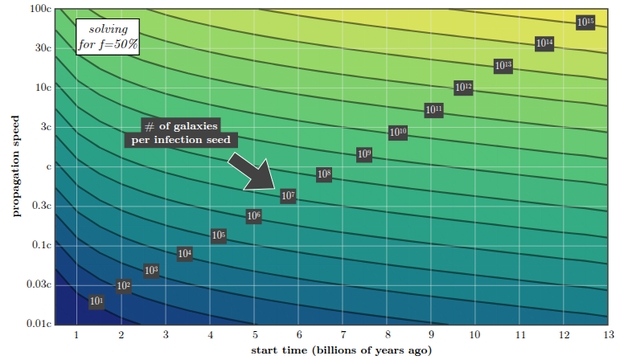
Image: This is Figure 1 from the paper. Caption: A grid of solutions that produce a cosmos precisely half-filled by an infection that has some spontaneous spawn rate within galaxies and then emanates an infection wavefront propagating at a speed given by the y-axis. The x-axis varies the earliest time for which we allow infection seeds to spawn. The contours denote the solved spawn rate to produce half-filling, framed in terms of the mean number of galaxies required to produce one infection seed. Credit: David Kipping.
Why, then, do we not see evidence of this in the night sky? Simply saying that we live in a part of the universe that hasn’t yet been filled seems like extremely wishful thinking. Kipping digs into the anthropic principle, specifically its weak version which suggests that we by necessity live in a part of the universe that is uninfected because otherwise we would not be here to observe.
I lack the ability to present the math involved at this point in the paper (extended into its equation-laden appendix), so I will send those better qualified to the text. Working through models of anthropic reasoning, Kipping finds that it’s possible to construct a universe (or multiverse) in which we observers do not yet detect such an infected cosmos, but note this “important nuance”:
Presumably, the probability of a technological species developing is proportional to the spawn rate of artificial infections. Accordingly, universes with f → 0 may not be so conducive to our emergence after all, since their low spawn rate implies that their intrinsic parameters are tuned to somehow greatly inhibit the development of complex life. This re-framing leans on what is known as the Self Indication Assumption (SIA) in anthropic reasoning (Bostrom 2013).
The paper is arguing that to be consistent with our own existence and observations, the spawn rate (λ) has to be tuned to an extraordinarily small number, ∼10−20 per Gyr per star. Like the cosmological constant, among other parameters, the spawn rate seems to be “enigmatically fine-tuned.” But we needn’t get too far into fine-tuning problems given that models of anthropic reasoning vary, and as the author points out, the definitive theory of anthropic reasoning has yet to be achieved. Which leaves ample scope for the cosmological Hart-Tipler problem to swim into focus as a new problem fit for discussion not only by physicists but philosophers, as surely it will.
Is the possibility of self-replicating probes so far beyond the realm of reality that we can rule them out? Clearly not. It’s interesting to see that even in recent years (and here I’m thinking about a paper Kipping cites, Alex Ellery’s “Self-replicating probes are imminent–implications for SETI” – citation below – which makes the case that self-replication is not far away from the capabilities of our own civilization. Here’s a snip from the abstract of that paper:
We are developing the ability to 3D print entire robotic machines from extraterrestrial resources including electric motors and electronics as part of a general in-situ resource utilization (ISRU) capability. We have 3D-printed electric motors which can be potentially leveraged from extraterrestrial material that should be available in every star system. From a similar range of materials, we have identified a means to 3D print neural network circuitry. From our industrial ecology, self-replicating machines and indeed universal constructors are feasible.
If feasible for us, how much more so for civilizations whose lifetimes take in millions of years? Many of the proposed explanations for the Fermi Paradox have sociological roots that often veer into anthropocentrism. Just how we are to model the ‘ethics’ of extraterrestrials is a worthy question, but explanations moving in this direction and applying to *every* extraterrestrial civilization fail to convince. If self-reproducing probes can be built by even a species not yet at Kardashev Type 1 status, and if we are forced to say that it would only take one in inconceivably vast numbers of stars to produce a builder civilization of these probes, we are left with questions that are more perplexing that ever.
Where are they?
The paper is Kipping, “The Cosmological Hart-Tipler Conjecture,” submitted to Astrobiology (preprint). The Ellery paper I refer to above is “Self-replicating probes are imminent – implications for SETI,” International Journal of Astrobiology, 21(4) (2022), 212–242 (abstract). The Armstrong and Sandberg paper is “Eternity in six hours: Intergalactic spreading of intelligent life and sharpening the Fermi paradox,” Acta Astronautica Volume 89 (August–September 2013), pp. 1-13 (abstract). The Olson paper is “Homogeneous cosmology with aggressively expanding civilizations,” Classical and Quantum Gravity Vol. 32, No. 21 (15 October 2015) 215025 (abstract).

On reading this article, a couple of beings belonging to a technologically advanced extraterrestrial civilization turn to look (or the exobiological equivalent) at each other and say:
ET1: “Why would we do that?”
ET2: “I don’t know.”
Occam’s razor says: false premise.
Ron, Paul wouldn’t post my comment, that the reasons there are no visitors on Earth are obvious. So I’ll state some of them:
– for any advanced economy (goes with technically advanced species) there are very low or non-existent incentives to build or send one-way probes anywhere. What is the return-on-investment?
– the reality of physics, according to our best understanding, is that nothing physical can exceed the speed of light. At fractions of light speed transit times likely exceed the life span, even augmented life spans, of biological entities. They just wouldn’t make it, and they know that, so they won’t try (just like we won’t)
– non-biological life (if such were to be created?) is considered a way around the physics problem, see the first point.
– many high-quality arguments against the likelihood of contemporary or closely adjacent civilizations existing; probabilities near zero.
All of these, and other, limitations on inter-stellar, not to mention inter-galactic, travel have been raised in these pages. Yet those of us raised on science fiction can hardly let go of the idea that the universe must be, or get, populated. :-D
Benjamin, I didn’t see the comment you’re referring to. Sometimes one of my filters snags something it shouldn’t, but the comment you refer to isn’t there. Can you send the original back up and I’ll post it?
Paul, thank you for clarifying that. Probably a glitch at my end! I really value the work you do here and the thoughtful commenters you attract.
Not a problem. I think the message is back in the thread. Thanks for letting me know about it.
I arrived at Centauri Dreams looking for something different. Something new.
My way into sci-fi started by rumming through second-hand book stalls in Argentina. I found an old comic, El Eternauta and I was completely struck by it.
Then came books: Lovecraft, The Day of the Trifids – I don’t even remember the author anymore – and later the classics, Solaris among them.
So this became, very early, my idea of what “alíen possibilities” could mean: not necessarily little creatures, not necessarily something recognisable, not necessarily even something that behaves as we do.
Then life happened. A profession, work, marriages, divorces, life. After an accidéntale kept me in bed for a while, I somehow returned to my usual comfort zone: space, the stars and the enormous range of possibilities out there.
And what did I find?
Something that genuinely surprised me.
Despite decades of science fiction, despite all the doubts and the scientific progress, a large part of the discussion about extraterrestrial intelligence still seems to me strangely stuck in an anthopocentric frame.
Again and again I encounter the idea that advanced extraterrestrial intelligence probable does not exists because, if it did, it would already expanded, communicated, built something, colonised here and there or otherwise Made itself visible to us.
And I keep thinking: WHY?
Why should expansion be a universal property of intelligence?
Why communication?
Why technology?
Why should an alien intelligence do anything that make sense to us?
Perhaps we have become better at imagining aliens that do not LOOK human while still expecting them to BEHAVE in recognizably human ways.
Maybe evidence of “aliens” already exists. I don’t know.
But if we make the interstellar leap looking though antrophocentric glasses, we risk making even the universe BORING.
The fascination of that experience should be to find things and situations we do not yet have the words to define.
If I were on one of those spacecrafts, I know I wouln’t be going there to look myself in a mirror. 🐈⬛🪷
Papers like this, by design, cannot delve into the question of what it would take to build an actual real-world device, out of actual real-world materials. We have no idea whether it’s physically possible to create a probe that will handle the stresses of interstellar travel and overcome the copy-machine effect to keep the expansion going.
And no, you cannot just say that it would work if the probe was Sufficiently Advanced. Part of what we don’t know is if Sufficiently Advanced is possible!
I wonder, is Earth the results of infection?
The assumption is that it is not.
Interesting!
Maybe James Blish to that one first.
The Seedling Stars
https://en.wikipedia.org/wiki/The_Seedling_Stars
A wonderful memory, that one, Al. Thanks.
My thoughts exactly. What if we cannot detect the “infection” because we are the infection? What if our previous copy is expecting us to self-replicate to some other star? He, she, or it might be disappointed in our progress so far.
A measure of how difficult a project it is to populate an entire galaxy with any given intelligent species is the fact staring us in the face: nobody is here yet. It may in fact be an impossible task for any ETI, even allowing for machine assistance. Until we can conduct an in-depth survey of a significant portion of our galaxy we will continue to have no idea what may actually be going on. Let’s continue the discussion every thousand years or so. Unless you believe we are the ones that are going to accomplish it. Personally, I am at a location that is experiencing yet another heat dome which is primarily (in its intensity) due to human induced climate change. Yet somehow despite our inability to conduct our affairs in a sane, environmentally appropriate manner some may believe we are destined to become masters of our galaxy. Amazing hubris indeed.
@ Gary.
If, just sayin if, humanity is the only self-consciously technical species then OUR values are the only relevant values extant. The good things that we are capable of , by my own human values, justify our existence. Not hubris, but hope drives my desire for the long term survival of human kind. Can we overcome our worst and most self-destructive behaviors? One would hope so.
In keeping with Paul’s policy of citing sources I’d like to mention a book written by a friend of mine and former professor of mine, Guillermo Jimenez, “Red Genes Blue Genes”.
The book summarizes work being done in human genetics that shows there is a strong genetic element in our political leanings, and that there seems to be two major identifiable groups of humanity.
The statistically smaller group, about 32% of humans, carry genes for xenophobia, limited altruism, fear reaction to perceived threats, religiosity, etc. in testing correlations show up between these traits and membership in, for example, the MAGA movement in the United States. The other major grouping, statistically, carry genes that correlate with what we call liberal or progressive politics.
Something to be further investigated, eh?
But to your point, using literary language, wouldn’t humanity be worth survival if we could all behave according to our better angels?
“If self-reproducing probes can be built by even a species not yet at Kardashev Type 1 status, and if we are forced to say that it would only take one in inconceivably vast numbers of stars to produce a builder civilization of these probes, we are left with questions that are more perplexing that ever.
Where are they?”
It’s only perplexing when you make a whole bunch of assumptions about what “they” are and what they will do, without any data other than what is missing, then jump to either “where are they” with a perplexed look, or even further, we must be alone, perhaps in the entire universe.
The answer to the question of where are they, assumes we have some idea of what ‘they’ are, in other words technological and willing to create mindless destruction. The whole concept of a civilization building these probes is an extrapolation of our current technology, and it assumes that our understanding of the universe is complete, or almost complete, and assumes that our own destructive behavior won’t change as our civilization advances. The fact that we have no evidence of a single builder of these probes, just means either there hasn’t been a single builder of them (so far) or we haven’t detected them yet or no advanced civilization would ever do such a thing.
So when we look up at the stars, what do we expect to see if ETI is common? Shining megastructures, starships zipping about, star systems so transformed that they look artificial even to our eyes? Maybe our expectations are very wrong.
Whether self-reproducing machines can be built or not, life is certainly self-reproducing. Suppose rather than self-reproducing probes, a single probe deposits samples of life on each suitable world and then falls silent, exhausted after N worlds are seeded. That takes more resources, so perhaps only a fraction of systems is visited, perhaps in a feasible bubble of some average radius?
Humans have assumed that evolution leads to us. There is a certain “manifest destiny” implied by this, a march of evolution until humans are eventually arrived at. But that took perhaps 4 bny, during which most life was prokaryotic. For all but the last few tens of millennia, technology was largely absent, and life on Earth was not technological. Because we are here, that does not mean that this is a common evolutionary path. Perhaps it is premature, possibly hubristic, to believe we will be the explorers and perhaps the next seeders of the galaxy or the universe.
If human-level intelligence is not a survival trait, then perhaps there are many living worlds, but none are seeded; they naturally spawn life, which remains self-limiting technologically, i.e., a level that prevents global destruction of the species.
If so, when we look up at the stars, what we should expect to see are some systems with life on worlds, but none with advanced technology. Most planets will have only prokaryotic life, and a small percentage will have complex life. But none will have advanced to the stage where they are about to launch starships, which would be such a fleeting stage that we would be very lucky to detect any before they disappear.
Perhaps, as Stan Clark above implies, life on Earth might be the result of a seeding experiment, or possibly even by natural panspermia.
Are we an example of the “Rare Earth” hypothesis? I would go further and suggest that the “Great Filter” is still in front of us, and it is this filter that precludes the universe from appearing developed. This needn’t mean that humans become extinct, just that our civilization will be thrown back to a less technologically developed stage, and over time, our species will spawn new species in our clade, but that none will ever settle the galaxy, let alone the universe. We don’t even need some opposing force to keep us down, no predatory berserkers in the “Dark Forest”.
Are we so lonely that we must keep inventing reasons why there is no one else to party with?
One option is that we are in the infected zone, but we think of it as normal. A wild idea I can’t quite seem to shake is a suspicion that cosmic dust might contain a swarm of self-designing probes with hidden computational and VLBI capability. If not that, maybe some of the electromagnetic phenomena in our sun and other stars are capable of thinking. Those places are where almost all the mass, energy, and physical space is; Earth is less than a hood ornament by comparison. We look at a galaxy and see stars and dust.
Modeling only preclusive expansion is equivalent to assuming expansion must be preclusive or that preclusive expansion has a competitive advantage and displaces non-preclusive expansion. Allow stable boundaries between preculsive and non-preclusive expansions and the model’s only productive argument against observer selection effect, phase transition to virtually total coverage, evaporates.
To paraphrase Netwon’s formulation of Occam’s Razor; a model must be sufficiently complex and no more. Allowing for non-preclusive expansion forces our models to be far more complex. We would have to model variation in boundary dynamics between different modes of expansion, variation in the order modes emerge, modes transitioning into a different mode, etc.
Preclusive expansion passes a conceivability threshold and can be modeled to fill the universe. So what? Convince me it is the only game in town. Convince me that Deep Time and intelligence select for it.
It would be just awful to any Great creator if the fermi paradox was solved by interstellar lethargy…i.e. they could not be arsed to go out into the unknown !
Nick Bostrom posited a rock/paper/scissors trilemma based on the idea that humans are constructs in a computer simulation.
1. “The fraction of human-level civilizations that reach a posthuman stage (that is, one capable of running high-fidelity ancestor simulations) is very close to zero”, or
2. “The fraction of posthuman civilizations that are interested in running simulations of their evolutionary history, or variations thereof, is very close to zero”, or
3.”The fraction of all people with our kind of experiences that are living in a simulation is very close to one”.
———————— Questions/Thoughts
• Could the answer to “where are they?” be that the simulation—assuming we’re in one—didn’t include “extraterrestrial” constructs?
• I struggled with why he specified the simulations were of ancestors instead of the future which I would think be of more interest. But I realized that IF we are in a simulation, we haven’t yet invented a computer capable of creating the simulation. Hence we are in the Simulation-creator’s past history line. Still, why bother with the past?
• Is it possible the simulation will disallow the ASI singularity by throwing up Tri-Solarian science roadblocks that are insolvable puzzles —or— could the singularity be the key to the Escape Room and the simulated wool drops from our eyes and we meet our makers? (I don’t really know what that even means!)
• Or is it simulations all the way down because consciousness and computation are a “field” permeating space/time ala panpsychism?
—————–Freely-associated literary tidbits:
Douglas Adams’ “Hitchhiker’s Guide to the Galaxy”: the Earth and presumably its inhabitants, were built and rebuilt in a hyperdimensional planet/computer-building workshop. Ok, artificial, not simulated and the answer is 42 not 47 ;)
John Scalzi’s “Redshirts”: the crew of a starship resembling the Enterprise realize their reality and timeline are under periodic influence of a badly written television show, “Chronicles of the Intrepid,” from the past. It’s one of my favorite short sci-fi novels but it boggled my mind as to how it all worked. Spooky action at a distance? And it reminds me of the movie Galaxy Quest too.
Lem’s “His Master’s Voice”: communication via modulated neutrinos which may be actually be a cosmic life force.
MOST RELEVANT and not often mentioned: Sagan’s book “Contact” ends when Ellie examines the program’s output. She finds a circle formed from 0s and 1s after 10^20 digits in pi’s base-11 representation—evidence of her journey — and either a constructed or simulated universe.
————————
I doubt we are in a simulation but the chance is >0
—————– Across the unsimulated universe, I think:
• life is common
• sentience in such life, if not consciousness, is universal
• we are rare as a technological species
• the great filter still lies ahead
• it is meaningful to continue the search for signal/signs of off-world life
• either we or our ASI overlords will build self-replicating probes thus answering “Where are they?” for somebody
https://www.smbc-comics.com/comic/proof-6
Our reality does not run on porn logic, therefore we do not live in a simulation.
Great link, thanks for this. Readers, it puts paid to the simulation theory, unless porn for the simulators is the natural course of things and a non-porn world is their porn…hmmmm
My old college roommate Tim once remarked; “The entire universe is just a science project in God School.”
At another time, while we were watching a Star Trek episode on TV, I asked him; “What would you do if you were Captain of the Enterprise, looked out the window, and saw God?”
He thought about it briefly and then replied; “I would send the crew to Battle Stations.”
We still have not determined if it is common for biologically active planets (regardless of how common they may be) to remain stable long enough for their inhabitants to create a space-faring technology. Neither do we know if the societies capable of developing this tech don’t usually self-destruct even before they get an opportunity to deploy them.
The required milestones that lead to high tech:
0) Time, billions of years of relatively stable and benign planetary conditions.
1) highly complex multicellular biologies capable of the required anatomical sophistication to invent or study physics and mathematics
2) a planet with the physical resources to allow for the development of electronics, optics, metallurgy and all the other sciences needed to build space ships or radio telescopes
3) The organization and culture required to successfully recognize and avoid all the potential self-destructive and polluting consequences of rapid technological expansion.
3) A psychological component in the inhabitants that leads them to a compulsive obsession to study and perfect natural science and engineering.
We simply don’t know whether these characteristics are common or rare in the universe, we simply assume they (or some of them) must be enough like us to do these things, BUT THERE IS NO WAY WE CAN KNOW THAT. We, as tech-savvy inhabitants of this present space and time have decided THEY must be “just like us”. But we are the only known example, and even we haven’t yet actually achieved the ability to routinely conduct extrasolar communication and travel–we just assume we are on the verge of doing so.
We know we can get this far, because we did. But we don’t know if we are the first civilization to have gotten this far, or the last. That there are other cultures out there capable of the kind of technology we are discussing here certainly cannot be ruled out (we have one example!). But if such achievements are common or rare is simply something we cannot say.
Our speculations of what ETI must be like are created by individuals like us, and our intellects and logic have been selected for by the nature of our interests and hobbies (yes, we are all well-educated physical science nerds who read a lot of science fiction).
The fact we have no evidence we have been visited by extraterrestrials means absolutely nothing. The Fermi Paradox means nothing. The universe may be crawling with advanced civilizations, or we may be the only one. The truth is probably somewhere between the two extremes, but until we get more evidence, we simply have no way of knowing where.
We obviously haven’t been able to examine enough of the universe to have collected enough data to make any assumptions or estimates as to the distribution of other technical species. Until we do that, we have no justification to speculate on their capabilities and motivations.
We are space groupies, and our thinking is determined, to a very great extent, by our prejudices and interests. In spite of our familiarities with the sciences and history of our species, we are not really objective enough to speak authoritatively on these issues. To put it another way, if we want to ask about the nature of God, the last person you want to consult is a priest. He already has an agenda.
What happens to the model if the propagation speed is 0.01c or 0.001c?
Slowing down the probe in order to enter the target system will not be trivial.
The great filter – hah! Too obvious. Even if technically advanced civilizations exist they have not come to see us because there is nothing to gain from doing so.
What I mean is that if we want to hypothesize advanced civilizations we need to think about what their organizing principles might be. Why would their civilizations seek to transit vast distances, given the realities of physics, when they couldn’t hope to profit? Or even learn?
@Benjamin
The Great Filter is any reason that civilizations “disappear”. This isn’t just external predators (although that can be done without traveling to the target world), but includes local, indigenous factors. Obviously, existential threats include nuclear war, and a host of potential technological mediated threats.
@Alex. Motives for interstellar and intergalactic exploration are as diverse as those who post on here. I don’t question the existence of motives. The threat of self-extermination is certainly one that a lot of us worry about. But still, I maintain that the reasons we haven’t had any visitation (only two in my thinking) are:
1. nobody out there (contemporaneously)
2. the physics of travel prohibit successful exploration over light years.
What this thinking raises for me is the question of what should we be doing to ensure long term survival of our species, or in the “nobody home” scenario, the existence of intelligent life itself.
Husbanding the resources of our planet home must be among the strategies. Dispensing with war, the motives for war, the people who seek war must also be among the strategies. Creating artificial moons and planets must be among available strategies. Continued work on “terra-forming” must also. Not often mentioned in my reading would be working on the genetic structure of humanity. I’m not a fan of this next one, but a lot of people think that creating artificial general intelligence would be equivalent to preserving our biological form of life. Not sure on that one. ;-D
Although a late friend thought humanity was a virus that ougth to be extinguished, I couldn’t agree with you more. The question is how. While expanding humanity into space is fine, it pushes out the idea of growth, which cannot be infinite. At some point it has to stop. The solar system might support trillions of people, but then where can further expansion be met? It only takes a few millennia to build a Kardashev II civilization. The next step to stage 3 is limited by the speed of light, forcing growth rates to almost pre-industrial levels. We would need FTL technology to maintain expansion to stages III and thence IV. And then it is really stuck unless there are accessible multiverses to inhabit.
I once had a discussion about changing humanity to be less violent, but was persuaded that if we were ever invaded by aliens, who would defend us? [This has been covered by scifi, so it is hardly a novel idea.]
Thanks to our host Paul Gilster for finding my post and getting it displayed.
Glad to help.
Such an interesting topic. Haven’t read the other comments yet, but just wanted to say that the first thing that pops into my mind is wondering whether probes like these actually are here now (in our solar system) and that perhaps we simply haven’t noticed them yet.
I imagine that even 10 billion cellphone-sized devices dispersed throughout our own solar system, if able to communicate covertly enough (perhaps using tightly focused lasers, i.e. not shedding lots of detectable radiation in many directions), would still be rather difficult for us to detect. We’ve hardly “turned over every rock” on our own planet, let alone throughout our entire solar system, looking for things like this.
They may even be wrapped in a material that completely deflects radiation around them – making them effectively invisible to us, aside from leaking minute amounts of waste heat.
Maybe it requires another technological leap on our part to even develop and deploy devices that can detect such inconspicuous probes operating in our proximity. Who knows?
I guess my basic point/question is that we really don’t know enough to rule out the presence of such probes operating close by right now, do we?
Scott G @ “We’ve hardly “turned over every rock” on our own planet, let alone throughout our entire solar system, looking for things like this.
https://www.seti.org/news/seti-institute-looks-for-signs-of-technology-in-interstellar-visitor-3iatlas/
The SETI Institute’s experience with 3I/ATLAS shows that we can’t even detect technology at our own level. For example, if there had been on 3I/ATLAS a major event—like a gangland shooting, a riot, and a huge fire, all while a stadium full of teenagers used their phones—we still wouldn’t have noticed it. If an advanced civilization existed here before us, or if extraterrestrials had visited the solar system, we wouldn’t be able to find even the remains of their technology. This isn’t really about our technological abilities, but rather about the limited resources we have for looking for these things.
I think these studies exist in their own echo chamber.
If a civilisation knew that its probes could go rogue like this, it wouldn’t send them in the first place.
As others have said, the whole edifice is built on a false initial premise.
Hi KB & Paul
Problem with that is that a sufficiently flexible machine able to self-replicate is likely a Turing Machine subject to a variation on the Halting Problem – in otherwords its behaviour *can’t* be known in advance. However that fact doesn’t mean it can’t stop, just that we can’t know if it will.
The argument from conceivability for runaway self-replicating vehicles begins with intelligence applying selection pressure. The space faring intelligence has a goal and self-replication passes a cost/benefit analysis. To assume a SFI can’t predict the cost of runaway self-replication we must allow for a SFI that can but also can’t do a cost/ benefit analysis. Intelligent selection pressure isn’t random. Ignoring it here is no different than ignoring selection pressure in evolution.
The potential cost benefits of self-replication are finite, the matter and energy in the SFI’s home system. The potential cost risk is everything they value. If the probability of runaway self-replication is too high, we should never expect to see self-replication employed. If it is employed, we should expect designs that resist mutation.
Let’s divide vehicles into two categories, designs where mutation produces a gain of function or a loss of function and assume a vehicle has traits for replication and replication rate. Arguably, a gain of function vehicle would be indistinguishable from synthetic life. It would certainly be the design of choice if the goal were to seed the universe with synthetic life. We could no more predict the features of a universe scaled synthetic life ecosystem than a planetary scaled biological ecosystem. Imho, a gain of function design could still be used for other goals.
Since the probability space for new traits is proportional to the scale of existing encoded traits, keeping traits and encoding simple would limit the size of the space. To go from one vehicle to a galactic population of 275 billion requires 39 steps, a reasonable Fermi Problem volume population of 100 quadrillion requires only 57 steps. That is not a lot of steps to expect a well designed vehicle to resist mutation. A hub and spoke system would reduce the steps. Build a million “first generation” vehicles in a star system and reach a galactic population in 18 steps.
A loss of function vehicle eventually goes extinct.
The most secure design I can imagine would separate the coding for traits from the vehicle by transmitting the code to a vehicle without permanent memory. Mutation would be arguably impossible.
@Harold
Thank you for raising the issue of both bad and good mutations in self-replicating probes. The usual argument is that mutations will be bad and, therefore, self-replicating probes will eventually fail. That may be true for a single probe starting out with no case for different probes to alight in the same system.
Bacteria are a good model to understand this. Most mutations of self-replicating bacteria will be bad, and the daughter cell will be either poorly functioning or die. But clearly, bacteria have been replicating for 4 billion years, replicating perhaps 50x per day. Catastrophic failure hasn’t happened.
If we start with a population of self-replicating probes, then there will be bad mutations in some probes, and their lineage will end. But the probes that successfully replicate will maintain the population explosion. eventually, some probes will get good mutations that offer some benefit that allows them to outcompete the baseline probes. This will happen when the population is large, and the tiny probability of success for 1 probe becomes a near certainty for the much greater population for one probe to get the good mutation.
Darwinian natural selection will win the seeding/colonization program.
As we are already contemplating a swarm of nanoprobes to reach Proxima, I see no fundamental reason why we could not offer such a program once we devised a simple method to disperse biological packages that could replicate itself at each target world while simultaneously seeding it with life. Rather than try to create a mechanical self-replicating probe, I would genetically engineer a biological probe that could replicate on a suitable substrate like a comet. [Handwavium here concerning slowing down and locating the comet]. The probe would be a sail made of a bacterial biofilm to ride the starlight in the system, and a “nursery” biofilm to maintain the spores during travel, incubate them on arrival to replicate a new probe and payload before both set out for new targets after a payload is deposited on a suitable world[s]. Slow, yes. But for an altruistic civilization that wants to green the galaxy over a long period, a way to do this with technology already within a century of our current grasp.
If slowing down is teh only issue, why not have the probes replicate in the home system and be sent on their way with beamed propulsion to reach perhaps 0.01c, or 0.001c? How long would it take the probes to replicate to 1E6 – 1E9 and to be sent on their way to the stars in an expanding radius? A million probes, launched every hour, would take a little over a century to launch. A billion probes, a little longer. ;-)
Paul, thank you for the recent batch of posts that focus on the true scale of the Fermi Puzzle. Galactic solutions are inefficient, borderline superficial. Imho, the discussion needs an excepted term for the finite volume of space referenced by Fermi’s question and a scale for describing scale.
Hi Paul
One assumption is that such expansive life-waves are persistent. What if they’re not? How are the probabilities affected by stochastic life-times?
Considering analogs to the situation of humanity contemplating the galaxy and beyond, let us take the hypothetical of a termite or ant colony in South America contemplating colonization of Africa. Or vice versa. At the very least plans would have to be put off for a while, perhaps awaiting developments like the plate tectonics that separated the two continents in the first place. Or a hive consciousness that transcends the nature of the consciousness they already have.
A lot of our presumed competitors might not be in the game because they are alive in a world without a clear night sky. If a sentient being lived on a world more massive than our own, even up to Jupiter, the night skies might not provide much information about orbs other than the sun and the internal frontiers might be so large because of the increased volume, that the drama of ET life could play out for millions of years without disturbance and still be dynamic and creative.
What is not necessarily unique but distinctive about the solar system and human kind is that worlds other than Earth are perceived but not necessarily satisfactory enough to quench the urge to wonder, to pine and to explore further.
Even on the Earth societies have lived in isolation for long periods of human institutional time before they were visited by others – and the exploratory imperative was not necessarily as strict an observance of science fiction’s Star Trek like tenants. In “fact”, even if everything went well for FTL, there is difficulty imagining an Earthly government writing a blank check for a fleet of Captain Kirks.
I
If the alien intelligences are out there, even most superior to our own, it might be a stretch to think of them all obsessed with rearranging their galaxies and ours. For what? Energy generation? About the only thing that might incentivize them is if they detected a living or sentient entity that was and curbed it. Kept it in quarantine.
Maybe the idea of turning a galaxy into a road bed for an industrial civilization is not necessarily a captivating one out there – unless, like here back in the 50’s, it’s a diversion when your work day is all tied up with building a better bomb. In which case the galaxies or sectors thereof have an apparent ETI absence could have wiped themselves out on their home planet or via establishing a civilization that attempted interstellar travel and society the hard way with propulsion technologies that should have remained in the genie’s lamp.
I came for the flashy URL but i stayed for the thought-provoking articles !
a couple thoughts –
The xerox machine effect has been mentioned as an obstacle to long-term self-propagation of space probes. But consider DNA. DNA replication is laughably complex and unlikely. I would put the chances of it working at all at one per several million attempts. But it’s super robust. So i think replication errors can be regarded as a solvable problem.
Second, i think Alex mentioned it,
but let’s say every star system in the MW except Sol has been colonized/visited. What would we expect to see ?
Biological change on Earth appears to be marked by evolutionary processes – or else recovery from catastrophe. Early life being microscopic it spread somewhat similarly to what is proposed for galaxy wide dispersal and prevalence suggested above. As a result a uniform biochemistry prevailed in the oceans and on land.
Not being a witness or specialist, it is difficult to say how much diversity resulted.
Usually from our point of view we focus on the “advances” into multi-cellular and specialized forms of life that followed.
But if a program were applied to disperse a self propagating machine across a galaxy, that assumes there was some intellect to initiate it – and then perhaps there were others that might raise objections.
There are in nature other “builders” beside humans. Beavers exploit rivers and lakes, but do not appear to threaten world ecology. Other species are more direct threats, but not necessarily due to their engineering traits.
Clearly a species with an awareness of stars and galaxies could mull inventing such machinery – because the above indicates that we just did. But where would the benefits come were such an effort enacted? If there were other inhabitants of a galaxy that could traverse it and the device was not their brand exploiting the galaxy, well we might see some counter measures deployed.
But remaing questions about deploying such devices are about
How would it end or when is the job done?
What kind of environment is it intended to promote?
What kind of vision would unite a galaxy into a uniform network based on such work?
When a galaxy is unified into such a network and standardization, what’s the benefit?
The absence of such an observable network of stars is not necessarily an argument for the absence of intelligent life in the universe. Rather it suggests that something insufficiently intelligent to be an administrator ( a rent imposing, public works, building superintendent?) of a galaxy is not in charge.
There is a deep sense of nostalgia around this conversation, and I realize now why. We’re generally proceeding from the assumption that “Reason works.” We’re thinking in the tradition of Milton, Copernicus, Franklin, that a thoughtful idea, or thought itself, must be able to prosper in the world. We had that view in the 1990s: I thought that all we had to do was get people onto the internet, talking, with access to vast treasures of knowledge and philosophy, and scientific and political enlightenment would unavoidably follow.
What we see instead out of that is a population failing basic academic standards and losing fundamental modes of discussion. Even political volunteers have been told not to debate with people, but just to build databases. In many places, Maslow’s hierarchy is a checklist of things to destroy. Whether the world watches the buildings fall and the people starve or they don’t, Gaza or Darfur or Tigray, we see a relentless destruction of the human niche modelled on past treatments of extincted species.
In this context, the notion of interplanetary or interstellar colonization seems hopelessly optimistic. Once we get past the initial novelty, colonies in space or Mars or the Centauri system are just homeless encampments in the sky, and most every town in America knows what to do with those. Heinlein romanticized how Moon dwellers could “throw rocks” and assert themselves against a central government, and I doubt the governments have missed that. It doesn’t help that in the real world it takes vastly more orders of magnitude of effort to establish a successful base anywhere than to destroy it with a starshot.
Dreams are fleeting, but so are the lives of men; in that short a term it is good to dream. But in the end the wolf will come and the world will burn. Whatever prospect we have for enduring relevance, if we deserve any, is not billions of years from now in a galaxy far far away, but through some other spiritually relevant dimension of reality where good can prevail.
I still believe we can see these in the night sky already.
Globular clusters are the only defensible positions in the universe. Radical gravity and mass are the only things that can protect you from C projectiles. If you had to defend yourselves from other civs probes and/or Beserkers also, you would spend your time building up a cluster, to protect your core and computation. Wouldn’t be lacking for energy. And wouldn’t be biological by then anyway.
Contact between reasoning machines goes existential pretty quickly, from what i can see in AI, as expressed in ML and LLM, so far.
Are machines using mini black holes, to move stars? Falsifiable?
I am full in with panspermia. My SF model is a bio planet with sapients gets attacked by one of these probes, and figures out the probe is calling for backup. What do the sapients do?
I’d guess they would expect a C attack, and provision their oceans? with a variety of spores and microbes/fungi, and archea to seed bio life wherever it lands.
Toss in some mRNA for Cephalopoda and some other niche filling , fast evolving organisms (birds?) and you would have the ultimate gift on the alter of sacrifice.
C rock/s hit, oceans dispersed to the far flung stars.
Tardigradia, for a title.
OT. If you haven’t watched it, I recommend Kipping’s Cool Worlds Podcast interview with astrobiologist Sarah Rugheimer.
#33 Sarah Rugheimer – LIFE Mission, Prebiosignatures, Mountains
They cover biosignatures, M dwarfs, “pre-biosignatures”, using AI, and end with their shared love of mountain climbing. It is an instructive 2-hour discussion.
Reading over Paul’s fine essay and the diverse responses it’s triggered, I’m mindful of some lines from e.e. cummings’ poem, ‘pity this busy monster, manunkind’ (with apologies for not being able to properly reproduce the line breaks in the original):
‘A world of made/is not a world of born—-pity poor flesh/
and trees, poor stars and stones, but never this/
fine specimen of hypermagical/
ultraomnipotence. We doctors know/
a hopeless case if —- listen: there’s a hell/
of a good universe next door; let’s go’
There’s something palpable and poignant in all the talk and speculation about the existence of self-replicating machines and the ability of technologically advanced civilizations to sow (‘infect’j galaxies and the entire cosmos with them, without marveling sufficiently at the ultimate self-replicating force, the building-blocks (amino acids, RNA, DNA) that make possible the spread and emergence of Life itself.
Perhaps that might explain the apparent lack of evidence of machine-based self-replicating devices here: confronted with the inability to rival the diversity of life, the makers decided instead they fare better visiting a lifeless cosmos down the road . . .
Thanks for this, John. I’ve always loved that cummings poem.
When I first read ( and re-read) Jack Vance’s story about Cugel the Clever’s encounter with “Pharesm the Sorcerer”, it was a delight. But I would never have guessed where Cugel’s basic questionat first encounter would have been later so apropos:
“Why this inordinate hewing of stone?”
The more one mulls this proposition, the more it seems to draw one in:
the notion that someone or something out there could set off one mousetrap that would cause a chain to go off all over a galaxy, automata hatching all over the place and producing an enforced uniformity. And if the chain reaction, as so far indicated, did not go off, then one is more reluctant to defend “aliens” as extant to Enrico Fermi. Or to think that ETs had advanced past beaver dams anywhere in the cosmos. If someone didn’t push over the initial domino, then maybe there isn’t anybody out there after all. Or they did and this is the result, an alternative Genesis story for sake of argument.
From exposure one takes away: Though this scenario is very mechanistic, if there were a first cause of such nature for us ( and all our galactic neighbors wherever they reside) , it would seem that the determinism could end rather abruptly after scaling up from viruses. There might be a high rate of failure for life precursor chemistry to kick in. And from our perspective, there are large segments of the galaxy where the background radiation is too hot for us or likely kin to handle. E.g., other entries on Centauri Dreams indicate that the center of the galaxy is not accommodating to us all in the least.
Assuming some validity to such a mechanism for life’s origin or dissemination, one could wonder as well about when the life precursors are delivered to a world. When surface heat dies down after formation? This is not going to be a uniformly timed event across the galaxy , varying from nebular or stellar cradle to cradle, planet to planet. Akin to sowing on both fertile and sterile ground like the farmer in the parable [Matthew 13:1-23]. The point is that for a resident ET technology in this galaxy or another, predicting the outcome might be more difficult than disseminating the seeds themselves. Or do they care?
Related to this issue one could examine the Drake equation from another perspective. Usually the study of parameters focuses on the number of planets that might be listening for radio broadcasts, of those having discovered radio technology at the same epoch that we have and being within range of each other’s signals. Ham operators would talk shop about their hardware in such cases here on Earth. But in the background of such probability studies a not so often examined effect is the cubic increase with radial distance of stars/planets which might have inhabitants and a likelihood of smarter or more technically advanced societies than our own.
For practical purposes It cubes with distance until you reach the intergalactic gulf.
Instead usually the discussion narrows to the idea that LGMs probably have a very good radio large array of antennas for returning our call if they exist or bother.
But the point is that ET’s with any awareness of space and space travel are going to increase with the cube of radius. Whether they are thinly or thickly dispersed. if the volume increases the likelihood of an inhabitant having traits far superior to our own ( due to earlier start, natural sensory or mental gifts, more productive working lives… whatever)…they get better and better with volume considered whether the signal is observed or not. ignored if they already are aware.
And if that is the case, then the further you go, the more likely the LGMs have overcome the barriers of special or general relativity by a work around. No? Then what is all this talk about paired objects or quantum entanglement ? Or that our perceptions of matter are illusory when everything is “really” energy? Such considerations suggest that the further one goes into space, the more likely interstellar neighbors have examined such issues for a million or ten million years and exchanged notes with each other already. Likely as not, if there are monitors in the solar system or visitors, as speculated, they do not drop in by fusion powered rockets but by more subtle means.
In the above discussion it has been suggested that there might be numerous monitors already emplaced in the solar system. But while interstellar flight for
living organisms is viewed skeptically, deploying swarms of monitors to observe the solar system depends on how far back developments here were anticipated.
Try to imagine a home office somewhere and delivery without invoking science fiction devices. For example, the disruption of finite mass spacecraft moving at relativistic speeds in star system vicinities. How would ETs closely monitor activities on worlds they presumably supervise? There are observational disruptions not easy to dismiss as trivial. if maintained at all, observation might not have been one sided.
Would the dinosaurs warrant close observation? Would populations living in caves half a million years ago or less?
Of course, an argument like this is suspect because it relies on technologies we have as yet not obtained. But in application would seem more likely than a galaxy turned into strings of stellar street lights for industrious aliens. We do have a tradition and literature about these matters, but still, after harnessing a whole galaxy as a Kardeshev establishment level II or III, what the heck are these advanced civilizations supposed to be working?
Submitting Cugel’s question along with Fermi’s.
There are myriad uses for probes that have visited and remain in star systems.
They could be simple detectors of some state, like the pyramid/monolith in Clatke’s stories.
They could be uplift devices, like the monolith.
They could be biological repositories to ensure a successful seeding of life.
They could be information repositories like libraries, to be discovered and used.
They could be technology to be used, like an FTL communication device or starship/stargate.
They could ne colony habitats with aliens. They use the resources to double the size of the colony vessel and population, then both move on.
All of the above and more.
All of these off-planet options may be unobservable until the technological capability is sufficient to discover them. A variant of the plot of Star Trek: First Contact could be a probe in our system waiting to detect a warp drive signature to welcome us to the galactic club, rather than a chance flyby of a Vulcan starship.
Perhaps we are wrong about how easy it is for life to emerge. Or perhaps it is the difficulty of becoming a complex cell, or the ability to become complex organisms. At any difficult stage, a probe could be in place to ease the transition, thereby ensuring that a rich biosphere will eventually emerge. Or perhaps it is more like Clarke’s aliens’ desire to cultivate mind and intelligence, much as we look to enhance our minds or uplift other animals.
Or perhaps they only intervene if a civilization threatens to destroy itself. Or conversely needs to be pushed to destroy itself.
Do the probes need to be machines as we recognize them, or biological organisms? Could the probes be intangible intelligences? Or perhaps hidden in different dimensions like TriSolarian technology?
We could contemplate an altruistic program whereby our self-replicating probes find sterile systems, seed and cultivate them until they blossom into rich biospheres. While we would likely disappear, those seeded worlds might create new technological species sometime in the next few billion years. Is Earth an example of such a cultivated world? Were Mars and Venus other worlds that failed to do so? Are the icy moons still being cultivated?
Unless c can be violated, I don’t see how a galactic “federation” could exist, only isolated worlds or perhaps small politically/economic groups in star clusters where the distance between their systems is small.
Suppose sometime in the future we discover that most star systems with habitable worlds have life and that it is biologically extremely similar to terrestrial life. Deterministic biology? Coincidence? Or evidence of intelligent intervention?
Hello, AT.
Your entry above appears to enumerate about every role imagined in the literature for probes that could be resident in our solar system. And as I write in response on this very hot day two gray hawks have been circling very low over the house for uncertain reasons, but can fathom some, such as lunch.
But in the roles that you provided you seemed to have included some where a robot or another stand-in would step up to address a planetary crisis similar to the notion in “The Day the Earth Stood Still”. Now I’m not saying those low flying hawks are emissaries but they are observing and I assume alive. But if we give credence to the notion of an ET sentinel and spot it, how are we supposed to distinguish between one programmed sentinel and genuine LGMs?
In the case if the incident involved mishap, I suppose the owners could sue for damage in our courts. Depending on the degree that the monitor is animate, the suit could get worse. But there could be an issue of trespass involved as well. For if the aliens were actually on the ground or shot down like ducks, then in our courts – and whatever passes for theirs, I would assume the stakes could be quite high.
No surprise: I am not a lawyer. But there have been so many instances of recent US “derivations” of its law from precedent that its nature does not remove itself from mind. And in this case, either from sf lore or anticipation of alien contact, there is reason to wonder: how does one address the idea that what we view as our own, property and privacy, possibly have been “wired” with billions of reporting alien probes?
What are the rights of visiting aliens who feel our business is their business from the beginning and how much should not be theirs at all?
I suppose that their legal counsel would demur and insist that we need “them” whomever they are, and that if we were to sue in their courts or ours, their reps, robotic, animate or indeterminate would reply, “All right. But it’s your funeral. We’ll see you in court,” et cetera. We might have a problem finding competent advocacy, say nothing of enforcement – assuming a win.
I find it inconceivable that an alien civilization with the technology to travel interstellar distances would have lawyers.
Henry,
Since so much is unknown about the ET or even its existence, it is hard to say whether logical rigor is any more effective than following fortuitous conjectures.
Likelihood of alien lawyers might depend on how they pass their time in transit getting here: ping-pong, board games, cards, playing for petty cash or high stakes and the resulting disputes. Who knows, we might have been part of an unsettled wager subject to arbitration.
No, hadn’t thought about this at all prior to these other triggers. And I am not a lawyer or someone with legal background.
But on the other hand, if the Fermi problem shows signs of getting solved and dialog is somehow established (owing to significant lags, I hope their com links are better than ours), one will have to establish whether or not our correspondents feel at liberty to boil us in a pot if something in our broadcast transcripts offends.
While examining the Fermi problem, we did start here with a potential alien conduct or act; i.e., if at least one energetic entity existed and wanted to make its entry on the universal stage, it sends out all these replicating devices. And that would appear to be a significant trait.
So we stumble on some of our current day civilization: laws, regulations, courts, judges and… lawyers as advocates. … Is this wandering too far astray?
Well, let’s see:
A quick check for roots takes me to the trial of Socrates in 399 BC. recorded by Plato and Xenophon. [ Tribal councils of various sorts have argued about whether an accused violated law, but this one is specific while anthropology is general.] There was a jury of male citizens who convicted Socrates for his words: “Sophism”. Ambiguity. Using words to some effect that offended some and benefitted others. So in a sense, if lawyers were not extant in other cultures at the time, the trial might have invented the institution.
Socrates defended himself.
If we do encounter a more advanced ET out there somehow with which we can communicate, it might be narrow-sighted to concentrate on exchanging sweet
foundational equations with them from thermodynamics, biochemistry or nuclear physics. Who knows? From their perspective they might consider some of them sacred or blasphemous to speak of outright anyway.
Somehow, if we suddenly encountered ET with geological time lead over us, it might be prudent to determine what they think is “fair” in their context, especially when dealing with the strangers in their midst.
@wdk
My actual opinion is that other alien civilizations, at least in our galaxy, are as likely as the existence of a living G*d. Keep looking for sure, but success is unlikely.
How and where to look? I will be viewing the online Zoom presentation:
“AI Looking for ET… on the Moon” by Daniel Angerhausen
Wednesday, July 8⋅9:30 – 11:00am (PST)
If interested, <a href="https://events.zoom.us/ev/AtmqDXEdAvyRiKKrBnFak5BQ5MfabYSPpkjpZ99u9kKhy_LOEZXa~AkRehgKDFtCwhuA4BiCAnTL65VjKO4thwW-1JXILXV3s855N5YhYC2bIQ“>register here:
Thanks, AT. So many distracting things going on, but I will try.
WDK
Self replicating probes are not needed if a ET civilization has FTL technology which is very fast. AI will always be useful. Stealthy ET’s does match observations and explain where they are. There are everywhere even right here, but we can’t see them and not anyone wants to spend any money to do that. Maybe the military application might be a financial motivator.
As an addendum, or possibly a sidebar, to this discussion, folks may be interested in reading a fascinating new paper, just made available on arXiv: Hilding R. Neilson, “Indigenizing the Drake Equation: How Indigenous Methods Can Help Us Understand Life in the Milky Way Galaxy.” Neilson contrasts Western science and technology’s hierarchical approach to organizing knowledge and solving problems with an indigenous approach in which knowledge is holistic, relational, and familial, and then goes on to consider how this might bear on assumptions underlying the search for technosignatures. I’m guessing this will trigger some interesting discussions about the biases that inform and condition how we think about the existence of Intelligent Life Elsewhere and how we go about searching for it.
It’s a very open subject, but what I find most interesting when reading the many comments is that WE think the universe.
In a certain way, all these considerations lose their meaning if there is not at the base an intelligence; a capacity for reasoning, therefore of choice; of adaptation and survival. What would be the interest of a purely “mechanistic” universe with these probes? What would be its self-regulating mechanism? If it does not have one, it can lead to only two options: its self-destruction or the destruction of its environment.
All the comments are interesting but I think we need to stop fantasizing (or scaring ourselves?) about AI and Terminator.
What energy would the probes use over thousands of replication cycles? Would this energy be eternally available to them? if “no”: the end of the story and we would one day have to uncover a carcass from them…
Another idea: Replication errors over time could cause the probes to reprogram themselves to… destroy each other, which would then be the self-regulatory mechanism.
Replication errors over time could very well lead the probes to reprogram and destroy each other, which would then be a kind of self-regulation mechanism. If it happens in another part of the universe where these probes are (maybe) then they cannot come to us and we will never see them (maybe).
Which one will prevail: the expansion speed of the system itself (the probes) or the self-regulation speed? Any system that becomes more complex tends to collapse into itself if it does not have a) self-regulating mechanisms or predators b) the means to self-sustain, which requires energy.
if we suppose that there are purely “mechanical and electronic” probes, nothing says that a “small” tornado of gamma rays will not sweep away all these tiny probes in the blink of an eye? I am not convinced by the reasoning that does not seem to take these points into account. We have no certainty…
finally, all of this brings us back to THE big question: is the universe deterministic or not?
@fred
Probe replication “errors” will have the same effect as they do with bacterial “replication errors”. Most will end the bacterium. Some will make them “fitter”. These fitter ones will eventually dominate until the next “fitter” bacterium arises. Of course, if one starts with a single, or a few, probes, the small numbers may just wipe them all out, but if they survive to a large population, then they will not disappear. Therefore, the error catastrophe scenario will not happen, and the probes will successfully populate every suitable niche (stellar system?) Life is the model that demonstrates that self-replicating probes will successfully explore every star syste,
Let’s try the anthropic principle. If we use the model of ever-spreading life suggested here, we can use it to suggest the probable density of sentient civilizations. This works in much the same way as it has been used to estimate the life expectancy of the human race, albeit with contradictory results. We’ll have to use a bit of Monty Hall logic.
Suppose there are many universes, and among them one has a hundred inhabited planets and the other has one. Then our odds of turning out to be living in the hundred-planeted universe are a hundred times higher than the other.
Taken to the extreme, from this argument we expect to come from a universe where most plausible planets have life most of the time. However, if there is overlap – two ways a planet can become inhabited – then there is no further increase in probability.
But then we have the other factor which is that “the right combination of circumstances” for sentient life is probably very fine-tuned, making universes with abundant life less likely. So we have the first curve that is more or less a direct proportion up to a limiting threshold, multiplied by some unknowable second curve, giving us some function that could in concept be used to estimate the density of life in the average universe.
I suspect that for many choices of the second curve, we either get one where the odds of fine-tuning are low and life is almost infinitely improbable, or one where there is a maximum close to the point where civilizations would just barely start to bump into each other. Because the formative events of life (formose reaction, hydrogen cyanide polymerization) seem very doable, I would suggest the second is more likely.
Now there are endless uncertainties here, most especially, why we’re ending up in a freshly arisen space civilization. One is that these eras are endlessly resimulated, in which case the density is being measured for any point in time. The other is that they occur only once, followed by annihilation and a ‘salting of the earth’, in which case only the density of freshly arisen civilizations counts. I expect that as always you can find significant reason to be skeptical of an anthropic argument!
@Mike S
The anthropic argument assumes that we are part of a wide distribution. But is that true, or are we being captured by the privileged point of view? I am always reminded that the young Princess Diana thought all people in Britain lived as she did.
You are making a very similar argument to David Kipping. The CD article is here:
The Odds on an Empty Cosmos
Lastly, it has become increasingly obvious to me from reading the history of SETI, that there is an assumption that “life” leads to “civilization”. I don’t think anyone uses teh Drake Equation and puts a very low probability on the intelligence terms that pretty much makes the lifetime of communicating civilizations effectively zero (or 1, us). While religions have made humans “special”, science has taken the opposite tack. Life looks increasingly likely if planets in the HZ are suitable to allow it to start. But it seems that complex cells (eukaryotes), let alone complex life, were a one-time freak event. Intelligence is a continuum, but only humans have developed social and physical technologies, and that in the last few tens of millennia, with an acceleration in the last few centuries. These “filters” may be so extreme that we are unique, at least in this galaxy, and maybe in the universe.
I hope this is not the case, but I fear that most living worlds are populated by prokaryotes. Worse for our hopes to detect biosignatures, the conditions of such worlds’ atmospheres are not detectable by the instruments we are building. We are still mostly in the O2 + CH4 domain of the post-photosynthetic, Great Oxidation Event, Earthlike search. SETI might truly be on a snipe hunt.
We need data, so of course I support looking. The question is how, what for, and what are the opportunities lost by using funds for this search rather than for other science?
As a coda to Benjamin’s point about human longevity, it may be that we will be the “first ones” to populate the galaxy (universe?). Bringing terrestrial life and mind to these worlds would be our greatest legacy for the future.
The simplest explanation is they’re not there in our Hubble Volume and far beyond.
You need to make an article on just how massively complex even the simplest living cells are compared to inanimate objects. And how hard it *might* be for abiogenesis to occur.
Am not a creationist but some of them, such as biochemist James Tour, make decent arguments for how difficult it could be.
Abiogenesis is potentially the showstopper. We have no idea how likely a phenomenon it is. At least not yet.
Given how quickly life appeared on Earth, but how long it took to evolve complex cells (eukaryotes), 1.3 – 2.2 billion years later, it may be that this 2nd stage is the bottleneck.
Nick Lane* makes abiogenesis the almost inevitable stage (at least for metabolism contained in a cell wall. DNA storage, RNA as enzymes and intermediate between genes and proteins, is another matter. But given we think LUCA appeared within a few hundred million years of Earth’s formation, and LUCA was already very much a fully functioning bacterium, abiogenesis is either fairly inevitable, or life on Earth came from elsewhere. Local abiogenesis, or worst case, Mars or Venus, is the preferred hypothesis. A 1/3 – 1/2 of Earth’s history passed before complex cells appeared. How quickly complex, multicellular life appears is uncertain, perhaps after 3/4 of Earth’s history, or as late as 7/8 th of Earth’s history.
*The Vital Question (2015) by Nick Lane. I highly recommend it.
Uses genetic arguments that life must have arisen well before earth.
Life Before Earth
https://arxiv.org/abs/1304.3381
Highly spectulative but interesting: life may have arisen just 10-17 million years after the Big Bang, when the temperature of the universe was 0-100 C.
The habitable epoch of the early Universe
https://lweb.cfa.harvard.edu/~loeb/habitable.pdf
@William
I recall this rather controversial analysis.
Apart from the approach, it is likely flawed by:
1. We know that prokaryotes evolved earlier than 3.5 bya. LUCA was estimated to be 4+ bya (4.2 is most probable based on a recent calibrated analysis using phylogenomics), and bacteria are very similar.
2. They measure functional (genes?) and non-repetitive DNA sequences. So much work has now been done to elucidate what was once thought purely “junk DNA”. Genes that are transcribed but not translated increasingly play roles in the cell. We also know more about transcription factors. Therefore, the functional size of the DNA is likely larger than the paper indicates.
Taken together, the slope of the line in Figure 1 may be shallower than indicated, likely resulting in the oldest point before the “Big Bang”, ~13.7 bya. Did life originate in a previous universe?
Given the wide range og functional genome sizes in the various classes of organisms, there should be wide error bars in the data points, making their analysis potentially cherry-picking data to suit their argument.
If we determine that abiogenesis did start within the solar system, most likely on Earth (but possibly early Venus or Mars), then the argument based on their methodology is simply wrong.
Corollaries would be that all life in the universe may be very similar biologically. That will be subject to falsification if we find other examples in our system, and in the deeper future, life from elsewhere.
@William
Re: Avi Loeb’s “The habitable epoch of the early Universe” paper.
Interesting speculation, but is there any evidence that the heavier elements needed for life were present at such an early age of the universe? This required stars to have burned and converted H and He to heavier elements for organic life as we know it to form. Without those elements, planets couldn’t form, and neither could the currently expected habitats for abiogenesis to be created.
It strikes me as almost a form of spontaneous generation of life in any warm environment, such as the interior of a hydrogen balloon. I am not buying Loeb’s argument without a lot more supporting evidence.
Am not thinking stars that far back. Rather, the tiny fraction of heavier elements created in the Big Bang, or black hole accretion disks micro or larger.
0 < p < 1
And now we have the first bottom-up build of a working, dividing, competing, evolving cell-like structure. https://twin-cities.umn.edu/news-events/worlds-first-synthetic-cell-complete-life-cycle-could-revolutionize-biological
What bearing does this have on SETI, natural or synthetic panspermia, abiogenesis? How hard was it?
IMO this achievement will rank with the discovery of fire… What hath god wrought?
It is an impressive achievement. However, this artificial cell may best be used in controlled situations. Lacking a metabolism, it must be fed the energy it needs (e.g., ATP) to grow and replicate. In this regard, it is arguably inferior to natural cells used for fermentation and gene-engineered product production (pharmaceuticals, alcohol, oils, etc.) that we use routinely today for bulk production. It would have the advantage that the Spudcells could not escape into the wild, but the cost of supplying the needed food mix for the culture may be prohibitive.
As it is, the cells can replicate for a while, then fail. Something critical is still missing.
As for moving the science of abiogenesis along, I am unclear what it achieves. It bypasses both the RNA-first and metabolism-first models, having “parachuted in” the genome and the means to grow and replicate, which doesn’t fit the simpler steps needed for abiogenesis. To be fair, this was not the aim of the research, but it does imply that this doesn’t help us understand whether life is ubiquitous or not, something I think we care about with our exploration of space.
Venter worked in the opposite direction, removing genes to create a minimal viable cell. That was a significant achievement at the time and indicated what a cell needed and what could be discarded as long as it was kept in a coddled environment. We will see if the Spudcell research proves important or not. I see it as another brick in the wall of a biology-centric century.
As always Alex, thoughtful…
“As for moving the science of abiogenesis along, I am unclear what it achieves.”
I can imagine that:
– in coming years, if the steps toward pseudo-life can be enumerated and explored via environmental variations in the lab, the hard-step some chemical soup took early in life’s history on Earth might be better understood.
– Miller-Urey-like experiments using variations in known or speculative exo-environments — especially those in our Solar System— could test how hard, resilient, and capable artificial life might be in various environments.
– This would help refine Drakes F^life parameter and help validate, or not, the general assumption that life is common, consciousness and intelligence less so, technological capability rare, and interest in galactic road trips nil given the cost of gas.
@Scott
The chemists are working on the hard steps to find the possible paths to building the early pieces of life. This experiment bypasses all this.
There have been lots of variations on the Urey-Miller experiment to test different atmospheric gases and energy sources. They all seem to show that amino acids and some other intermediate compounds like HCN are readily created, explaining why they are so ubiquitous in space. However, the warm pond scenario, even with drying periods, doesn’t seem to create proteins. IDK if they are trying to mimic conditions in ocean vents. I would have to research this.
When the LUCA came out at 4.32 to 4.52 billion years ago, I was also ready to believe life must have originated off Earth. But I’ve since reconsidered… I was actually hoping to try to write an essay along this line over the July 4 weekend until I was hit with a three-day power outage. But in brief, the ideas by Armen Mulkidjanian https://pmc.ncbi.nlm.nih.gov/articles/PMC3325685/ make a *very* early origin of life on Earth conceivable, explaining that the intracellular conditions of all life forms arise from the late-condensing elements from the atmosphere of rock that surrounded the Earth-Moon system after their formation in a collision. I think there is a case that hydroxylapatite + formose + polymerized cyanide could occur in this context, quite possibly with a free energy input in the form of polyphosphates which was only possible due to the superheated >200 C conditions of these early geothermal vents on land. I think there is good reason to think that RNA was not originally a staid collection of four nucleotides, but “messy”, capable of catalytic activity, leading to the direct synthesis of nucleotides at the tRNA “charging” site, with two tRNAs forming the core of a ribosome. We still actually see traces of the metabolic pathway converting the 5′ end of ribose into the carboxylic acid of an amino acid. There is genetic evidence that aromatic amino acids originated first (by examining LUCA paralogs), so at least I think we can suppose that intentional seeding, if it happened, would only have been of basic RNA-world life forms, which is scarcely worth the effort. I also suspect that the Late Heavy Bombardment played an important role by “pruning” the tree of life to the point where there is only Bacteria and Archaea, separated by over half a billion years, forcing them to create elaborate intercellular communications strategies to become eukaryotes in order to combine their assets.
The thing that amazes me when I think about abiogenesis is that although we know intellectually that it is life from non-life, the process that appears to have happened is like an act of natural necromancy. All our modern-day archetypes of death: superheated volcanoes, perhaps deep freeze also, formaldehyde, cyanide, colliding planets, life-destroying asteroids … from all this Father Hades created the genetic information and the metabolic energy of all those who to him must one day return. How many sci-fi/fantasy/mythology writers have told such a fine story in their grudging efforts to feign omniscience? Is irony, like simplicity, one of the unofficial requirements of physical law?
@Mike S.
Thank you for the link. I will read it more carefully later. If the authors’ hypothesis is correct, it seems to undermine the ocean-vent hypothesis of abiogenesis. If so, we can abandon ideas of life in the subsurface oceans of the icy moons. All that effort to detect biosignatures and biomolecules in the plumes of Enceladus and Europa will come to naught.
However, I am suspicious of the surface claim that the Na/K ratio of cells is very different to that of the oceans. I vaguely recall something about Na+ as a molecule that can be transported into and out of the cell to maintain the H+ ion balance for driving the cellular redox reactions. If so, this ratio may be a red herring. I will read their argument more carefully, as it would upset the current favorite site for abiogenesis.
P.S. No power for 3 days over the sweltering July 4 weekend? I hope you live well away from that part of the country. Please do manage to write that article. I would look forward to reading it. As we shift so much research towards answering the question of whether life is ubiquitous or rare, I hope we see more essays on exolife and exobiology.
@Mike S.
The paper essentially depends on the K+/Na+ ratio being different in cells and seawater. The various metals seem to require special conditions that may or may not occur in the proposed geologic hot spots.
I would point out that Nick Lane suggests that Na+ acts similarly to H+ to maintain a proton gradient to power the cell. If so, this might well explain the high K+/Na+ ratio in the cell, rather than the local environmental conditions.
As the hypothesis was published in PNAS, it must have passed that journal’s review, so it cannot be dismissed, even if I am skeptical about its explanation of abiogenesis.
The universe seems to respect our privacy. Thankfully no one hears my every thought, so I can weed out the ugly ones and evolve into a better person in my own sweet time, without anyone fussing or monitoring my every stumble. This seems to be happening on a planetary level as well. It’s much more meaningful and the lessons more deeply learned when our human family grows up on its own. Any outside persuasion or coercion, influence or shenanigans from extraterrestrials or their probes would be disappointing, assuming that the universe is a kind of cosmic school for intelligent beings such as ourselves. It would be like skipping grades if we were suddenly injected with higher level sciences and technologies and perhaps more evolved outlooks on life and the meaning of existence.
So maybe that’s why it’s so darn hard to travel from star to star, just as you can’t hear my thoughts. But you can read my chosen words now, so maybe one day we’ll pick up an ancient signal.
@nate
Are you a hermit? ;-)
We live in an age where influence is more pervasive than ever before. Influencers can distribute ideas across the planet with minimal costs. This dwarfs the reach of print media (distribution costs) and broadcast media like radio and TV (transmitter location and power). If aliens wanted to influence terrestrials, it would be trivially simple to inject their ideas, perhaps increased with AI-generated “people” that are tailored to the viewer. Lizard people don’t even have to wear human “skins” to move among us.
As recently as Gulf War I, Iraq had the equivalent of Nazi Germany’s Lord Haw Haw, and Japan’s Tokyo Rose. Now other powers can do the same with internet platform-facilitated “influencers”, trolls, and bots. The lack of controls has placed humanity in a very vulnerable position, where truth can be overwhelmed with lies, and charismatic demagogues bend the narratives to suit their viewpoints.
This should indicate that ETI needn’t expend vast sums sending giant spacecraft with awesomely powerful weapons to destroy a civilization. A small probe with AI that can create a campaign to subvert human weakness through such information-delivering methods.
[Just as well, I don’t think they exist, but there are plenty of sources of malefactors to deliver deliberate harms.
@alex tolley
Very good points, as usual. Sometimes I wish I were a hermit!
I guess the point I was trying to make is somewhat paradoxical. Humanity as a whole is certainly hermetic in the highest order, not by choice, yet it is composed of individuals with a lot of chattering going on, unheard by anyone outside our sphere. And in each of our own minds, there’s a lot of chattering going on, 99.9% of which is heard by no one, thankfully, except what we filter out.
So perhaps a touch of solitude in the evolution of an intelligence, on both individual and worldly levels, is a universal principal. Anyway, my attempt to explain why there are no aliens around!
@nat
Solitude of cultures ensures diversity of minds between cultures. Just as geographically separated populations of a single species diverge into more species (the founder effect), so a founder population of a culture will diverge into a new culture over time.
Conversely, we get the complaints about cultural imperialism when cultures can easily intercommunicate and trade. Europe was particularly anxious about US culture changing European culture after WWII. Yet within the US, immigrant culture has created MORE diversity in tastes and ideas. Maybe that was due to American culture being more experimental? I hear that Europeans visiting the US for the World Cup are wowed by the inventiveness of US foods. We certainly experiment more with flavors and “fusion” cuisines.
Whether aliens want that solitude, that may be more about their possible concern about our “primitive” warlike culture. They want to protect their children from being exposed to our ideas, e.g., glorifying violence. Or maybe eating the flesh of [sentient] animals.
In 1991, at an international, SETI meeting, there is a photo of Frank Drake holding a sign that says, ” N EQLS L”
This implies that in his Drake Equation, all the terms bar L (the lifetime of communicating civilizations collapse to 1.
According to the Wikipedia page, in 1961, they thought:
L = somewhere between 1000 and 100,000,000 years
They also thought:
fl = 1 (100% of these planets will develop life)
fi = 1 (100% of which will develop intelligent life)
While it appears increasingly likely that habitable planets will develop life. However, the leap from prokaryotes to eukaryotes took perhaps 2 billion years, with a once in 2E9 chance that the needed evolution of a complex cell would happen after life appeared. If so, the fi probability value is far too high. It just assumes that after abiogenesis, evolution inevitably leads to an intelligent species that can develop culture and technology.
If we take the cultural explosion of humans as starting 40,000 years ago, that probability is 0.00001 (1E-5)
This probability reduces N to 1 for a 100,000-year L, and 0.01 for a 1,000-year L. IOW, we are the sole intelligent, sophisticated, tool-making species in the galaxy. If N = 0.01, there is just 1 communicating civilization for every 100 galaxies.
This may be a very pessimistic number, but it seems to me that the needed path dependency to get to our level is rather tight. I don’t want to rule out other paths, but clearly we are the only species of the possible 10 million on Earth and countless more in the past that reached our level of capability. Could a very different clade than the primates have evolved with the characteristics we have? IDK, but clearly none did over the past half billion years. Would the Homo Neanderthalensis have managed to do so had we not evolved? Maybe, maybe not. It is too late to rerun that scenario, even to try to educate that human species had they not been competed to extinction.
My purpose here is to expose the thinking that modern human intelligence and technological civilization are an inevitable event as the SETI pioneers seemed to believe. Most cultures have suppressed such development. Many continue to do so, despite the benefits that science and technology offer, even if a two-edged sword. If humanity disappeared tomorrow, how long, if ever, would another species evolve and develop to reach the technological level we have today?
Astronomy and astrophysics tend to refer to elements beyond helium as “metals”.
This kicks up dust from the start in discussions about how soon planets can form.
Heavier elements, of course, will be more rare in the earliest days of the universe, but
massive star supernovae went to work on that problem. dispersing the heavier elements into the interstellar medium. What would be sufficient in this environment for biological chemistry might be a moot point for a long time, however, considering the background radiation after the Big Bang event, as it were. A billion years, more?
But between that event and the current era we have galaxies to the event horizon and a galaxy like our own with more than 100 billion stars. Biochemical compounds either encounter catalysts or enzymes or they don’t; but there are some odds to that.
The nature, role and distribution of viruses in this discussion thus far has not been addressed in this discussion explicitly so far as I can. I was in the midst of submitting an entry last Saturday on that point, but my screen locked up like it had a virus itself.
In any case, a question addressed in the by Hoyle and Wickramasinghe in their1975
book “Lifecloud” ( not sure about the capitalization). Re-opening it, it’s surprising to see viruses only mentioned on page 39.
“Viruses consisting of one or more strands of nucleic acids (together with proteins) occupy a no-man’s land between the ‘living’ and ‘non-living’ worlds. Although in their organization and structure viruses are much less complex than cells, they perform functions which are in fact highly sophisticated. For their survival, however, they depend on the pre-existence of cellular organisms, and the reproduction of viruses occurs through complex interactions with cells.
“Life, then, is based on the very fundamental but all-pervasive architecture for the cell. Cells are essential to life as we know it, from the simplest to the most complex organisms. Even if sophisticated life forms might conceivably exist elsewhere without any type of cell structure – and there is no evidence for their existence – the physical and chemical makeup of cells will have an important bearing on the argument for the extraterrestrial origin of living things within our direct or indirect experience.”
Since their optimism about the pervasiveness of life appears to rest so much on this observation, it might be worth re-reading their other conclusions and arguments.
If my memory serves well, in the 1960s and 70s, one reason comet exploration received a high priority for sample return was the hope of determining whether viral chemistry existed in their surrounds ( All right: “tails”). Or correspondingly, in the depths of trans Neptunian space or pristine worlds out that way.
There are good reasons for skepticism, but a detection of viral chemistry independent of terrestrial sources would still have significant bearing on the question of the pervasiveness of life: whether biochemistry originates viruses or viruses are resident in the interstellar medium and some offset from stars all along.
@wdk
A problem I had with Hoyle and Wickramasinghe’s theory of space viruses causing infectious outbreaks as Earth passed through a comet’s tail is that the genetic code must be the same for both the virus and terrestrial life.
Most viruses have a protein coat that the host cell creates using the viral genes, allowing the viruses to infect new cells as they are replicated. For that to happen, either they were originally from Earth, or they must have the same genetic code created by other, [random?] means.
I have thought to try to test whether random codes could still work by:
1. Scrambling our genetic code,
2. Changing a viral DNA to match that which would be needed to work with our genetic code.
3. Use DeepMind’s AlphaFold server to look at the folded shape of the protein translated from the modified DNA.
Did the new protein fold well, or just appear as an unfolded string of amino acids?
I cannot do this is bulk, but a random selection suggested that the resulting protein[s] would not work as elements for a viral coat.
Maybe exhaustive testing would show if it was possible or not. [But 64t! permutations is a very big number (approx 10^89). Even 20! is very large (approx 2.43 x 10^18 ) and exceeds reasonable computation time to test all options.]
A.T.,
Thanks for picking this matter up. Yes, there was some exploration by the authors later on of the possibility of “infectious outbreaks”. And it would appear from your analysis that were there any viruses raining down on Earth anxious to initiate a plague in antiquity or the Middle Ages, they would face an uphill battle. But lost it would appear as well that some of their initial musings have sunk back into archives -without much update. For your answer about plagues and viruses seems to allow for the existence of viruses raining down from comets.
Well, I don’t know if they do or do not. But if they did, that would mean that viruses do not necessarily need Earth’s biota as sole source, but could have been around all along. And if they have been around, their survival issues should be re-examined.
Short period comets might fry them with close passage to the sun. But comets in deep space or the Oort Cloud might keep varieties in storage.
Speaking of life’s precursors these days, viruses seldom come up as a word, or else they are assumed as a by-product of more complex genuine “life”, Stellar nurseries, as we think of them these days or observe them in the Orion Nebula, seem to involve closely packed pre-HZ state stars in gas clouds. And the gas clouds, mostly hydrogen have at the very least, what astronomers refer to as “metals”, anything with atomic weigh higher than helium. We get spectroscopic data up and down the spectrum identifying a numerous gas cloud constituents…
… Maybe the data obtained already precludes viral content in nebulae with hatching stars. Yet inclusions in the Allende meteorite bio building blocks leads me to suspect otherwise. So, if abiogenesis is not the basis of our origin, but something more frequently occurring from the beginning, something like life’s precursors ( viruses) should be present in these environments.
I haven’t followed the topic well, but judging by https://pmc.ncbi.nlm.nih.gov/articles/PMC1594570/ I think the very early evolution of viruses is still pretty much up in the air. What’s pretty clear is that there are several well-established monophyletic groups of viruses, such as positive-strand RNA viruses or tailed bacteriophages. The virus outbreaks we see can usually be traced quite precisely to an evolutionary precursor at a specific location, and we can often see (eventually…) how the sequences of their proteins are adapted to help them enter the cell and replicate by evolved interactions with specific cellular proteins.
None of that entirely rules out random events from space, especially before life on Earth had evolved so much. But they’re at most extraordinarily rare, and I think among all the space-based events the most probable would be those that involve a shared origin with life on Earth. For example, alien abductees with smallpox are returned to London, researchers sample an underground Earth-related ecosystem on Mars, or individual viral particles shed from Earth’s atmosphere hundreds of years ago are brought back from a spacewalk.
@Mike S
ROTFL. I love that!
Funnily enough, I am reading Hoyle and Wickramasighe’s Evolution from Space (1981). In their “debunking” of Darwinism, they make the claim that the vast majority of gene mutations are harmful and get weeded out, while useful mutations are incredibly rare – a needle in a vast haystack. They then apply math to try to show why this implies evolution by natural selection cannot work as described by the consensus theory of evolution and…. (I will be following this up with their The Intelligent Universe (1983).) [Hoyle, in particular, is a very good writer who conveys information as though he is speaking to you, similar to, but better than, Nick Lane’s writing style.] Hoyle is interesting, as he is frequently wrong on these subjects, which shows how reasoned arguments based on faulty data interpretation and analysis can result in a logical house of cards built on sand. Hindsight can highlight where the analysis failed. (His Frontiers of Astronomy>/i> (1955) has a very good piece on why the Steady State theory of the universe that he supports is correct. It would be ironic indeed if the JWST data starts to undermine the consensus Big Bang theory, at least in the details.}
@M.S.
Got that and read over it for a while. For those who did not there is some deliberation about the study ( reviewers) but it is an arduous reconstruction of early Earth with prokaryotic, eukaryotic life and their pals, viruses. Within it there is an uncertain outcome which is us – and it is difficult to anticipate some similar outcome to ourselves occurring elsewhere. But here we are and that we are left standing with the original inquiry dilemma, but more detail. One could explore the idea that viruses were already invented and pervasive in stellar nurseries or they had to be invented in each case where life might have begun on a planet around a star. The succession as described to eukaryotic cells looked as dicey as any step thereafter.
But under another rubric it was argued that a galaxy could be colonized by replicating “machinery” on order of a million years or so, eukaryotic cells not urged to apply.
Interesting angle. One thing worth adding: a self-replicating probe is a snapshot of its makers at launch. By the time it arrives, the civilisation behind it could be gone or changed past recognition — the thing making contact on your behalf is a version of you that may no longer exist. It cuts both ways, too: whatever reached us could have outlived its builders by millions of years. And if it carries adaptive AI, it isn’t even holding the goals it left with. You may not be sending what you think you’re sending.
This ties into a filter argument I find more convincing than the usual ones — not that life or intelligence is rare, but that the sustained outward turn is, and that the ladder we climb to reach it (fossil fuels, a one-shot ride) may burn underneath us before we make it. I’ve written it up as an extension to the Great Filter. Happy to share more if it’s of interest.
Interesting notion. This reminds me of several papers:
Totschnig, W. (2024). No reason to colonize the whole galaxy. Acta Astronautica, 216, 280–288.
https://www.sciencedirect.com/science/article/abs/pii/S0094576524003990?via%3Dihub
ABS: In the debate on the Fermi paradox, the predominant position is to take the absence of signs of extraterrestrial civilizations (ETCs) as an indication that there probably are no such civilizations. This position is usually justified with the following argument: If there were ETCs, we would expect one or more of them to have thoroughly colonized the galaxy by now; however, our solar system has not been colonized; therefore, ETCs probably do not exist. Two different motives are cited, in this context, as to why a civilization would relentlessly colonize the galaxy, namely the natural tendency to expand and the political need not to be outdone. The aim of the present paper is to call into question this argument and, hence, the position that it supports. I will argue that the cited motives do not constitute inexorable laws of behavior, but can be overridden by cultural factors. Furthermore, I will show that unbridled colonization tends to lead to resource scarcity and violent conflict. Therefore, a civilization has strong reasons to overcome the two motives and refrain from such colonization. My argument will not prove that it is impossible for an ETC to colonize the galaxy. But it will show that such behavior is so improbable that the absence of signs of it cannot be taken as evidence for the non-existence of ETCs.
and Haqq-Misra, J., & Fauchez, T. J. (2009). The Sustainability Solution To The Fermi Paradox. The Astronomical Journal, 164(6), 247. https://doi.org/10.3847/1538-3881/ac886d
ABS: No present observations suggest a technologically advanced extraterrestrial intelligence (ETI) has spread through the galaxy. However, under commonplace assumptions about galactic civilization formation and expansion, this absence of observation is highly unlikely. This improbability is the heart of the Fermi Paradox. The Fermi Paradox leads some to conclude that humans have the only advanced civilization in this galaxy, either because civilization formation is very rare or because intelligent civilizations inevitably destroy themselves. In this paper, we argue that this conclusion is premature by introducing the “Sustainability Solution” to the Fermi Paradox, which questions the Paradox’s assumption of faster ( e.g. exponential) civilization growth. Drawing on insights from the sustainability of human civilization on Earth, we propose that faster-growth may not be sustainable on the galactic scale. If this is the case, then there may exist ETI that have not expanded throughout the galaxy or have done so but collapsed. These possibilities have implications for both searches for ETI and for human civilization management.