
Mission planning for any future star probe will adjust not only for conditions in the interstellar medium but also the Solar System’s outer reaches. Let’s confine ourselves for now to conditions in the outer heliosphere. Currently we have precisely one spacecraft operating here. New Horizons has only reached 65 AU from the Sun, while Voyager 1 exited the heliopause in 2012 at 121 AU, and Voyager 2 crossed in 2018 at about 119 AU. New Horizons won’t have sufficient power to keep taking data as it makes its own crossing in the 2040s, but from its current position in the Kuiper Belt we can look back at what the spacecraft has reported so far about the solar wind and the local interstellar medium.
New Horizons’ Solar Wind Around Pluto (SWAP) instrument is the key here, examining how the solar wind slows as we leave the inner system behind. A new study from Southwest Research Institute (SwRI) points out what happens as this stream of hot ionized hydrogen and helium nuclei fills the heliosphere. The wind’s speed varies, some 300 to 500 kilometers per second from sources near the solar equator and up to 600-800 km/s from regions near the corona.
You would expect this ‘wind’ to cool as it begins to push against the interstellar medium, and indeed it does, forming the termination shock that both Voyagers have penetrated and crossed, and toward which New Horizons now moves. It’s at the termination shock that we see a sharp drop in the solar wind speed that indicates the outer boundary, the heliopause, is approaching. New Horizons should still be functional when it reaches the termination shock, conceivably as early as the end of this decade. Voyager 1 found it at 94 AU, Voyager 2 at 84 AU, reminding us how malleable the heliosphere is as its outer boundaries adjust to the onset of interstellar plasma.
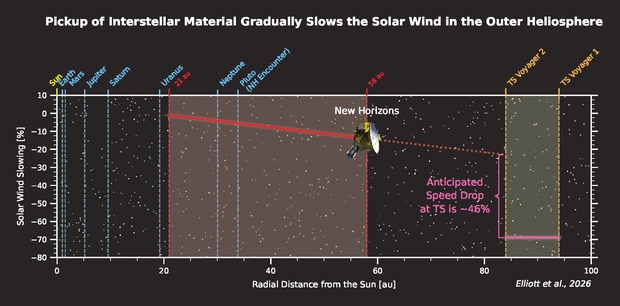
Image: An SwRI-led study sheds light on the deceleration of the solar wind as it journeys away from the Sun and interacts with and picks up interstellar material. NASA’s New Horizons spacecraft measured the solar wind as it traveled from just beyond Uranus’ orbit into the outer Kuiper Belt (red shaded region), detailing the gradual slowdown caused by interactions with interstellar materials (red line). Credit: SwRI.
We can learn a great deal as we accumulate data on solar wind interactions in the outer heliosphere. SwRI’s Heather Elliott led the study. Says Elliott:
“Eventually, the solar wind reaches the outer boundaries of the heliosphere — the sphere of influence where the solar wind affects the space environment — where it interacts with incoming interstellar material. The shape and properties of these heliospheric boundaries control the amount of Galactic Cosmic Rays (GCRs) that can enter our solar system and reach Earth. Therefore, the data from New Horizons combined with observations from other missions, such as IBEX, IMAP and Voyager will enhance our understanding of the edge of the solar system.”
So far, the data have been useful as New Horizons keeps moving outward. Along the way, the solar wind begins to run into neutral gas particles that have entered the heliosphere from the outside interstellar medium. The interaction with the solar wind, in which these atoms become ionized, adds mass to the solar wind, Elliott adds. And that is the mechanism for slowing the wind down.
In previous years, we have learned that between 30 and 43 AU, the solar wind has slowed 5 to 10 percent in comparison to its value near Earth. This is from data not only from New Horizons but also Voyager 2. Assuming New Horizons is still operational when it hits the termination shock, we would expect to see a sharp drop in the speed of the solar wind. In fact, Voyager 2 found a 46 percent drop in speed at the termination shock at its distance of 84 AU.
And note this from the paper:
The drop in speed in the Voyager 2 TS [termination shock] measurements was dramatic. At the Voyager 2 TS crossing, the speed went from ∼320 down to ∼140 km s−1 a few days after the crossing, corresponding to a ∼ 56% speed reduction across the TS (J. D. Richardson & E. C. Stone 2009). A sudden speed drop of 56% would be large and steep enough to readily confirm that NH crossed the TS. Unlike Voyager 2, the SWAP instrument on NH also measures interstellar hydrogen pickup ions, such that the modification of the TS by the interstellar pickup ions will be measured at the upcoming NH TS crossing.
As a sidenote, it’s worth remembering that there is no clear boundary here. Indeed, the shape of the entire heliosphere flexes and churns in response to ambient conditions and thus is partially dependent on the clouds of interstellar material the Sun is moving through at the time. At present, we are in the whimsically named ‘Local Fluff,’ part of the Local Interstellar Cloud, and near or perhaps already edging into a region called the G-Cloud, a prominent citizen of which is the system called Alpha Centauri. In any case, we’ve learned from the IBEX (Interstellar Boundary Explorer) satellite that the interactions on the heliosphere paint a picture of a dynamic, changing shape as opposed to the smooth ‘bubble’ that is often depicted in artist renderings of the heliosphere.
IBEX and its successor satellite IMAP (Interstellar Mapping and Acceleration Probe) carry an interesting message of their own: We can continue to learn without having an actual set of instruments on the scene. In sharp contrast to New Horizons, these two spacecraft work by remote sensing, detecting energetic neutral atoms (ENAs) produced in the interaction of the solar wind with neutral atoms at the heliopause. So we have one satellite in a highly elliptical Earth orbit (IBEX) and another at the L1 Lagrange point, both of them helping us to understand conditions at the termination shock and beyond.
As Elliott pointed out in that first quote above, conditions in the heliosphere’s boundary with the LISM matter if for nothing else because of the dangers posed by Galactic Cosmic Rays (GCRs), leading to issues of spacecraft design both for manned as well as unmanned missions. It’s good to know that New Horizons is on the case and will remain so, but for how long? What I’m hearing is that the spacecraft’s Radioisotope Thermoelectric Generator (RTG) should be able to keep observations and return of data robust through the end of this decade, but as with the Voyagers, we’re moving toward the end of active life.
What will replace our one source in the outer heliosphere? The need for resources in and beyond the Kuiper Belt should have us moving toward mission designs and propulsion options that go beyond chemical methods. Sail missions like the Solar Gravitational Lens mission now being developed at the Jet Propulsion Laboratory continue to intrigue me, particularly as we begin to explore assembly options enroute to deliver the largest possible payload. We will need precursor ‘sundiver’ missions as we test out these technologies.
The paper is Elliott, “The Gradual Slowing of the Solar Wind in the Outer Heliosphere,” The Astrophysical Journal, Vol. 1001, Number 1 (3 April 2026). Full text.

Hi Paul
New Horizons continues to give us some great data in the distant solar system.
Be interesting to see what is next?
Cheers Edwin
Closer in:
https://phys.org/news/2026-06-solar-storms-cosmic-rays-earth.html
Now I wonder if a feed-back loop using this technology:
https://phys.org/news/2026-06-kind-laser-avenues-plasma.html
-powered by the Sun itself–could direct solar outbursts towards awaiting Starwisps
The very useful illustration of solar wind speed vs AU (not in the cited paper) is interesting. The solar wind velocity gradually declines with distance from the sun. Why? Gravitation? I don’t recall if that fact is used when determining the solar wind thrust on an electric sail. I always assumed the wind velocity was kept constant.
Where the velocity suddenly declines around the termination shock due to ISM nuclei becoming attached to the protons, is the momentum kept at the previous slow decline (m * v), or also suddenly declining with the particle velocity?
It seems the use of the term “termination shock” is currently used in this astronomy context as well as in geoengineering for the situation when a technology applied to reduce the intensity of sunlight reaching the Earth’s surface, e.g., creating artificial clouds, is ended, and the full impact of the unreduced sunlight and the higher GHG concentration trapping heat is experienced.
Has the Breakthrough Starshot team modeled the impact on the nano-sails when they hit the TS distance? Is the retarding force of the ISM particles penetrating the “bubble” of the heliosphere significant or not? Or would the sail have already been reoriented to be edge-on at the TS distance?
I’ll float that past Jim Benford, who led the Breakthrough Starshot sail work. My guess is that the sail would already have been turned edge-on at this point, but let’s see what Jim says.
Yes, Paul, to minimize the amount of dust that penetrates it, the sailship will rotate, driven by very small lasers in the sail. They rotate it in a short time, reducing the cross-section of the sail by eight orders of magnitude. The incoming interstellar medium is mostly partially ionized hydrogen. These hydrogen atoms collide with the thin sail material, are stripped of their electrons as they pass through it. This results in charging the sailship. That static charge helps keep the ship rigid.
Jim, and what point is sail rotation supposed to occur? Right after the sail leaves the beam?
Yes, after the acceleration stage, the sailship would then test its systems and sensors for agreement with the pre-acceleration and pre-launch baseline plans, assess any differences and relay these results and stored acceleration-phase data via telemetry to Earth. Then, assuming no further instruction or data request from Earth, the sailship would rotate. It would pass through the heliopause in about 3 days.
Edge on although is necessary to reduce impact chances it would affect the communication aspect of the sail by been much smaller. I suppose flipping it over every now and then for comms would be a way around the issue.
I was looking at my copy of “Solar Sails” by Vulpetti, Johnson, and Matloff, to see whether any of their calculations allowed for the impact of particles at the heliopause. The only hint was in the chapter “Fast and Very fast Sails” where the issue was when to jettison a non-functional sail. The answer was only to do so beyond the heliopause (HP), beyond the termination shock(TS). If the TS is the start of the ISM’s retarding force, it might slow up light sails depending on the density of the ISM, or more likely damage the sail even at the lower velocity of this sail type. Therefore, I can see that jettisoning the sail is best done at the HP, as the solar wind velocity and momentum are not relevant for such sails.
Sails like Janhunen’s electric sail, or Greason’s Plasma Magnet(PM) , which use the solar wind(SW) for the propulsive force, will be affected by the change in SW velocity at the TS, but not by the neutral ISM particles. The PM, in particular, would be affected by the TS as it expands its sail as the SW particle density declines, and theoretically maintains its propulsive force as a result.
Heretofore, IIRC, we only considered the effect of the ISM on electric spacecraft, principally after the HP, especially craft using the SW. This was one reason I was interested in whether the TS reducing the SW velocity also caused a steep drop in useful momentum, or whether the momentum was still largely maintained by the greater mass of the charged SW particles. [Was there any theoretical knowledge of the TS before Voyager 1 reached it?]
The CD article A New Shape for the Heliosphere(Mar 23, 2020) suggests that rather than a smooth, almost spherical shape indicated by its term, it is a very convoluted shape. Given the potential effects on different sail types, it may be important to know where the TS and HP boundaries are if sail deployment changes have to be made. These may be the new maps we need if the various sail technologies are to be used for missions beyond the heliosphere. An interesting return to the age of sailing ships and the maps needed for their safe journeys off the coastlines. Will the new maps charting the positions of the TS and HP be analogous to reefs and shoals, or currents and storms?
The termination shock is a fascinating phenomenon, and I wish it showed up more in science fiction. The name is even perfect for it!