
With well over 6,000 exoplanets now confirmed and a continuing flow of data containing new detections, it has been clear for some time that our own Solar System’s model is hardly a template. I enjoy dipping into the bewildering variety of new systems and pondering the contingencies that have led to their architecture. Science fiction is an intensely visual genre, so I naturally try to imagine the more extreme systems. But more than most, today’s catch at HD 39474, an F-class star in Pictor some 360 light years out, is just begging for a gifted SF writer to go to work on it. Here we have, in addition to the central star, a long-period transiting brown dwarf with a planetary system, coplanar and aligned with the brown dwarf, packed inside its orbit.
HD 39474 is also, at least for now, known as TOI-201, TOI standing for TESS Object of Interest, an indication that while the Transiting Exoplanet Survey Satellite’s photometry has found what looks like a planetary transit, that result has not yet been confirmed. Various things can mimic a transit, including stars in an eclipsing binary system, so confirmation through radial velocity methods or additional transits is necessary. Nonetheless, a new study in Nature looks solid, and the system it points to is of exceptional interest. The work describes a ‘mono-transit’ in TESS data sets that is tentatively identified as a massive brown dwarf designated TOI-201c.
A single transit can indicate a planet or brown dwarf whose orbit greatly exceeds the observational period, which is why such a transit is not enough to confirm the detection. But there is a lot more going on here. In fact, according to Alessandro Sozzetti (INAF-Astrophysical Observatory of Turin), TOI-201c has been characterized by transit timing variations of an inner planet as well as the photometric transit and radial velocity measurements, with upcoming confirmation through GAIA astrometric data. Being characterized through four different methods appears to be a first.
The work, led by the European Southern Observatory (with strong involvement from Italy’s National Institute for Astrophysics (INAF) reminds us of the blurred star/planet distinction. Brown dwarfs can have planetary systems of their own, warmed by their exceedingly faint light. TOI-201c has the longest orbital period, some 2,881 days, for which a mass has been confirmed, in this case through radial velocity readings.
Within the brown dwarf’s orbit are two further transiting objects that are aligned with it. Getting into the dynamics of system formation here is going to be interesting work. TOI-201d has a period of 5.8 days and appears to be a rocky super-Earth, while the gas giant TOI-201b is in a 53-day orbit. With an orbital eccentricity of 0.622, the brown dwarf is a significant perturber. According to the researchers, anything much farther from the star than the orbit of Mars around the Sun would be dynamically unstable.
Luca Naponiello (INAF), second author of the paper on this work, takes note of the brown dwarf’s impact:
“The presence of the brown dwarf on such an elliptical orbit forced the planets to form and survive by occupying the innermost and hottest edges of the primordial disk. Furthermore, the data show that during the close approach of the brown dwarf, the warm Jupiter undergoes strong and sudden variations in its transit timing, bearing witness to an intense and vigorous dynamic interaction currently underway between the two giants,”
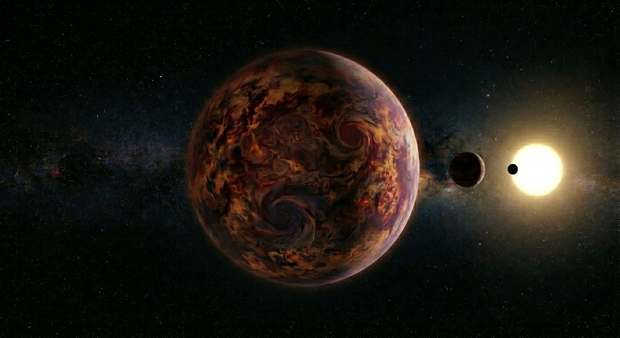
Image: Close-up artistic representation of the TOI-201 system. In the foreground is the massive brown dwarf TOI-201 c, followed by the hot Jupiter TOI-201 b (subject to strong gravitational perturbations), the star TOI-201, and finally the super-Earth TOI-201 d. Credits: INAF / generated with AI Gemini.
ESO spectography from its FEROS and PLATOSPEC instruments complemented the TESS data to offer up this extremely stressed system, which makes the case that even in environments as challenging as these, planets find a way to form. How long they last is another question, and I assume future work may give us some thoughts on the survival of the gas giant here. In any case, finding an inner gas giant in these circumstances draws into question theories of gas giant formation that assume distances beyond several AU from the central star. We should be hearing a lot more about the system at TOI-201 given the stress it puts upon earlier formation models.
The paper is Jones et al., “A distant brown dwarf coplanar to a warm Jupiter and a hot super-Earth,” Nature 654 (17 June 2026), 614-618 (abstract).

So the brown dwarf is about the size of our Jupiter, but an order of magnitude denser. It orbits with the same order of magitude radius as Jupiter.
The hot Jupiter is less dense than water. Doesn’t this make it a “hot Saturn”? Any moons would be rocky, their icy surfaces lost.
The rocky planet must be hellish. A surface temperature of ~1000 °C,, but presumably tidally locked. I can barely imagine what the surface must be like. At least we can rule out any possibility of life.
Can there be other planets in the system outside the very eccentric orbit of the BD, or must they be so disrupted that they either could not form or were lost? Is there enough room for planets around the BD?
Hi Paul
Yes one interesting system to ponder here.
Cheers Edwin
See https://arxiv.org/abs/2604.23926 and https://arxiv.org/abs/2604.23929 not to mention the Wikipedia page. The star is 2.6 times more luminous than the Sun. Maybe you could postulate something on a permanently shaded nightside of d, but I think some ‘hidden ultra-deep crevices’ near the warm poles of Mercury should be more fun. The Jupiter is also too hot, though you could postulate an artificially stabilized object in the large L2 region. But the brown dwarf? Well, periapsis is the semi-major axis (4.33 AU) times 1-e (0.38) = 1.6 AU, and 2.6 / 1.6^2 = 0.96. So indeed the (presumed) planets of this brown dwarf have times when they are near optimal Earth temperatures, assisted perhaps by a bit of heat from the brown dwarf. The brown dwarf planets probably need to be fairly close to be plausible, so it seems fair to expect rather elongated satellites that face the main star once per revolution around the brown dwarf.
So I’m thinking long days of increasing temperature until some threshold is reached when each creature comes out of (fully frozen) hibernation, with various strategies in evolution and warfare to be the one that is able to come out of hibernation first and prey upon the others. Hiding underground could be problematic because the whole planet would be permafrost – any failure of a mechanism to heat such a bunker would leave its inhabitants in hibernation indefinitely. Yet anyone remaining above ground is easy pickings for the first predator to come along. Bodies of water might make for interesting strategy, with the pattern and timing of thaw depending on their depth, but I’m not nearly ready to game that out. :) The prospect for unintended long-term hibernation could make for an interesting plot, somewhat similar to an interstellar society, with survivors of various past civilizations occasionally returning to share technology or grievances. I’d like to see what people can do with this.
@Mike Serfas
I trust your calculations much more than mine, so I take my calculations with some trepidation, even though they seem similar to yours.
I find that the BD is so eccentric that at periapsis, a planet orbiting it would have a surface temperature about 250K, so with a denser CO2 atmosphere for a short time, the planet would have a temperate climate, falling quickly to a low point at apoapsis. If the BD radiated enough radiation, a closely orbiting planet might sustain a temperate climate for a partial orbit of the primary. With a close orbit of the BD, the planet would be tidally locked, so that the planet would experience constant eclipses of the primary as it passed behind the BD. The hemispheres f might only see the primary for 1/2 the orbit, with fairly rapid changes in lighting.
Any surface life on that world would face some interesting adaptations. However, if the planet were more like an icy moon, it could maintain a subsurface ocean, or even a deep surface ocean warmed by teh primary, the BD, and internal heat. Certainly OK for bacteria and even some small complex life, like tardigrades.
It seems to me that a number of possible climates could be supported depending on the planet’s orbit around the BD, from fairly constant temperatures in a deep ocean, to cycles of warmth and freezing depending on where the BD was in its eccentric orbit.
How possible would it be to detect transits of the BD? Could the planet’s temperature be modeled based on the BD’s orbit and its own orbit around the BD? If, in the future, it were shown that such a planet could maintain life, would it be worth looking for it? It could certainly make for an interesting world-building background for an SF story.
Given the source, I take your comment as very high praise indeed! We both came up with a figure just slightly cooler than Earth’s effective temperature (255 K), and the brown dwarf, though only 162 K itself, might provide a few extra kelvins to a planet near the Roche limit.
I like your point about the subsurface oceans. The paper linked from Michael’s link below describes brown dwarf planets as either being dragged to destruction, to a synchronous orbit, or being pushed fairly far away. I don’t see a figure for the brown dwarf rotation rate, so you could postulate a planet secured as close to the Roche limit as we find entertaining. I would guess such drastic tidal forces, somewhat supplemented by the warm Jupiter’s interaction, ought to be able to create a very interesting system of subsurface oceans varying by the “latitude” (away from the primary). Then these could be linked to surface oceans during the “summer”, whether by obscure passages or catastrophic events. If present, life would colonize from one environment to the other, but these are very different situations – one with constant temperature, high pressure, low natural energy availability, and the other with long freezes but abundant sunlight.
Continuing with the warlike scenario from before, this would offer an interesting scenario for an epic hegira into the depths, where a technological culture would have the potential to grow continuously and gain an overwhelming advantage over the surface dwellers. I’m liking this as a sci-fi setting more all the time. :)
The drown dwarfs surface escape velocity is nearly that of the sun. It would make interesting osberth manuavers.
Life and civilization need both an energy gradient and a chaos gradient within their systems to thrive in a ‘Goldilocks zone’—neither too stagnant nor on the verge of collapse.
An interesting question is whether this Goldilocks zone can exist in a brown dwarf planetary system suitable not only for simple life but also for complex life capable of leading to a technologically advanced civilization.
Can the edge of chaos exist in a brown dwarf planetary civilization?
“HD 39474 is also, at least for now, known as TOI-201, TOI standing for TESS Object of Interest”
An acronym nested in an acronym…
For something more serious, I wonder what life would be like on a planet in such a system:
1. If the planet orbits the brown dwarf, then the central star will still be the brightest star in the sky, probably bright enough for photosynthesis. But it would appear smaller than the brown dwarf in the planet’s sky, unlike the Sun and Moon appearing similar in size for us.
2. If the planet orbits the star, the brown dwarf would be visible in the planet’s sky, and possibly its orbiting planets as well. And the movements of the brown dwarf might sometimes send asteroids into the inner system. If intelligent life evolves, they might have myths and legends about this strange star that is followed by meteor showers.
Just wondering if a sentinel race could light up the brown dwarf. If you drop a large fusion bomb on its surface would it induce a much larger explosion. It is incredibly dense and the surface gravity should aid the impact.
Remember, even in a star too small for a convection layer, fusion only occurs in the core, very far down from the surface. You’d need to either add enough mass to make H2 fusion viable, or pull a 2010.
I was thinking along the lines of a large fusion device impacting the surface at its, 200 to 500 km/s, escape velocity. The device explodes and combined with its forward momentum compresses and heats the already dense hydrogen to fusion temperatures. I am not expecting the whole thing to go bang which would defeat the object of just keeping it glowing for longer.
I misread the first paragraph and thought it meant that the brown dwarf had a planetary system. Which made me wonder – would it be a “planetary system” or a “satellite system”? A BD isn’t a star (and this one is near the borderline between a planet and a BD) so what would the objects orbiting it be called?
The star is far too young to host any form of advanced life and the brown dwarf has probably disrupted any Earth sized planets in the HZ. The gas giant (if it migrated inwards) probably made a mess of the HZ as well.
@frankH
Agreed. But what about prokaryotic life, which appears to have appeared on Earth within a few hundred million years since formation.
While the BD has indeed disrupted any planet in teh HZ, especially given its orbital eccentricity, it may still allow for planets/satellites orbiting the BD to harbor life, whether as clement as planets in teh HZ, or perhaps like icy moons outside the HZ.
I think Mike Serfas’ thoughts on this are relevant.
If life were to exist in that system under those challenging conditions…
Interesting article on BD habitable zones.
https://planetplanet.net/2014/10/09/real-life-sci-fi-world-4-earth-around-a-brown-dwarf/