
I don’t usually post comments at the top of the site, but I’m making an exception here for a couple of reasons. The recent paper I reviewed by Clément Vidal and colleagues covering technosignatures and strategies for detection is a significant work, the kind of consolidation of resources the field needs as the original radio and optical-oriented SETI expands into new realms. We now have options calibrated for intelligence via archival and observational detection of megastructures, planetary or stellar engineering, or other projects far beyond our own level of technology. Dean Zierman’s thoughts on the Vidal paper open a number of issues and highlight assumptions we’ll always need to examine. Dean is a telecommunications expert specializing in radio frequency communications, one who has been deployed to over 150 disasters and dangerous events including earthquakes, hurricanes, tsunamis and the 9/11 attacks on the United States. He has served as a subject matter expert on communications in hostile or austere environments for multiple agencies and organizations. Herewith his thoughts on the technosignature hunt and the recent review paper, which I hope will feed further energy into our conversation.
by Dean Zierman
Observations in relation to this paper. I’ll be quoting frequently from the document.
“Another limitation is the meaning of the lifetime L of a civilization. What does it mean for an interstellar civilization seeding life or colonies, or for galactic colonization models? Some colonies might go extinct, while others could transform so much that the link with parent civilization or others would be lost.”
This does not consider how long a specific technology lasts.
It also does not consider how different types of technology interact with each other or with civilization. To be fair, these ideas have not yet been covered in the literature.
“This galactic and stellar context shows that there is ample time for advanced civilizations to have explored the galaxy systematically.”
“It means that there could have been up to 4500 opportunities for visitation by one single spacefaring civilization over the lifetime of the Earth.”
The windowing issue remains unaddressed. Specifically, it is necessary to determine the duration during which an advanced civilization might explore or be detectable within the Earth’s solar system, as well as the period during which an Earth based civilization has existed in the solar system. It is also important to assess whether there is any temporal overlap between these two windows.
“Even before searching for traces of past extraterrestrial visitation, we can ask whether we are the first advanced civilization in the geological history of Earth. It turns out that traces of a civilization –even one going through an anthropocene phase– would be very challenging to detect because of erosion dynamics such as surface weathering or plate tectonics. These constraints are discussed through the Silurian hypothesis (Schmidt and Frank 2019), and the authors conclude that artefacts or fossilized examples of a population older than 4 million years (Ma) would be unlikely to be found.”
“Still, what could be searched for in this 4 Ma window? Here are a few examples. We could look for evidence of large scale agriculture that would have led to a disruption of the soil nitrogen cycle. Another line of research could look for evidence of mining, such as anomalous geological structures 7 that would be indicative of large mining operations.”
This suggests that on Earth, a civilization eventually produces enough pollution to be noticed. In the past 12,000 years, about 70 civilizations have collapsed.
These might be the same technological signs we could detect on planets outside our solar system.
“According to Schmidt and Frank (2019), all of the pollution of the anthropocene would fit within 1 cm of sediment layer, which makes sense given how short our industrial civilization has existed on geological timescales. This explains why even if there was a pre-human civilization which went through its own anthropocene, we might not have noticed it in our sediment analysis yet, while also leaving open the possibility that we could discover such a layer in the future.”
Over the last 12,000 years, only a few have reached a level where they may have produced detectable pollutants. Of those, only the most recent may have caused changes large enough to be detected in isotope ratios or radioactive isotope production.
“This makes sense if we look at the Barrow scale that proposes that civilizations progress by increasing their ability to manipulate, manufacture, and control smaller and smaller scales (see Barrow 1998, Vidal 2014, and the Barrow scale section 4.1.0).”
Another way to look at this is that as a civilization’s ability to manipulate and manufacture at smaller scales increases, it becomes less necessary to do the same thing at larger scales. This smaller scale also means that what is built at a larger scale is likely much more efficient and harder to detect at interstellar distances.
“Although there are reports of unidentified flying objects (UFO) dating back over millennia (Stothers 2007), the first modern sighting to popularize UFOs was reported by Kenneth Arnold in 1947:”
“How many reports are really unidentified or anomalous? Out of 12,000 reports analyzed in Project Blue Book, 6% of them remained unexplained. How are UAP reports categorized? 90%-95% end up as (1) explained phenomenon. The remaining 5-10% of reports could end up (2) unexplainable due to lack of credible data. Those that do have credible data imply either (3) an unknown physical mechanism, or (4) an unknown manifestation of extraterrestrial intelligence (see Fig. 4).”
This would seem to be a straightforward method for looking for UFOs, or the modern term UAPs. Unfortunately, due to the rise of our own technology, the noise level is rising exponentially faster than our ability to screen it out of any possible signal. This is similar to the phenomenon of using radio to look for SETI. Given that we are generating UAPs with our own technology, the technology we’re using is also generating more noise.
It has been observed, somewhat jokingly, that the resolution of our digital cameras has greatly increased, leading one to believe that the resulting pictures of UAPs would be much clearer and thus more definitive. What has happened is that we have increased our ability, with the increase in the number of possible detectors, to detect more UAPs, which are also at the edge of their detection resolution. In short, we have many more fuzzy, questionable photos.
“Villarroel et al. (2021, 2022a) conducted an analysis of 1950s archival photographic plates from the Palomar Observatory Sky Surveys (POSS-I, 1948-1958 and POSS-II, 1980s-1990s).”
This is another example of our technology generating noise that is becoming impossible to filter out. If it weren’t for all the “stuff” we have sent into space, this would be a straightforward and definitive technique. But we have already FUBARed this to a near hopeless extent. The latest ground-based telescopes coming online should be able to detect these objects if they existed. Oops, I guess that’s not happening.
An idea occurs to me. The massive array of Starlink satellites has started using their star trackers to look for other satellites above them and track them for collision avoidance. It might be possible for someone to obtain copies of this data and, using modern algorithms, identify satellites in much higher orbits that are ignored for tracking, and that could be ETI satellites’ orbits.
“To sum up, many present and future observational facilities such as the Vera Rubin Observatory or the Nancy Grace Roman Space Telescope as well as planned missions in the solar systems that together with machine learning techniques have the potential to enable a much more systematic and comprehensive search for anomalies and possibly artefacts in our own solar system (see also Haqq-Misra et al. 2022c).”
Almost definitionally the search for anomalies is the 1st step in the scientific process. So just searching for anomalies should be considered an adequate scientific reason to perform many of the studies discussed.
The issue with the Kardashev scale, and even more so with the Barrow scale, is that they do not focus on what a civilization is trying to achieve with its technology. For example, in Larry Niven’s novel The Ring World Engineers, a civilization spends vast resources and time building a single massive structure. But do they really need something that big? Another problem is that you can’t use the structure until it’s finished. Since it’s just one structure, everything depends on it, so if it fails, everything is lost. It’s like putting all your eggs in one basket. If the goal is just to have more space, wouldn’t it be smarter to build several Banks orbitals? Or maybe it would make more sense to create a lot of O’Neill cylinders inside asteroids. These cylinders could even be used as slow ships to travel to other star systems.
The whole question of Big Dumb Objects begs the question of why build a BDO? Almost anything you could think of as a reason to build them, you could do much better with other technology. BDO’s then become the ultimate SETI MacGuffin. Just because somebody can build something doesn’t mean that they would build it, especially when there are better ways to accomplish the same thing. All of this leads one to speculate that more advanced civilizations would not appear high on the K scale but would be much higher on the B scale, with smaller, very efficient, and dispersed objects with low radiation indexes that are hard to find. This just means we should be looking for smaller, darker objects rather than the big, bright, flashing ones.
4.2. Surface Technosignatures
4.3. Atmospheric Technosignatures
4.4. Orbital Technosignatures
These sections, in my opinion, show the paper’s biggest limitation. The information is technically correct but lacks a clear framework for how technology creates civilizations that then modify technologies, which in turn change civilizations. It misses an important time and scale element.
As I mentioned above, civilizations and their interdependent technologies have risen and fallen. The vulnerability of civilizations and technology to collective and cumulative risks creates a myopic view of the detectability of these technologies in both time and scale. For 10,000 years, you would’ve been looking for just fire on earth, for example. How would you be able to tell the difference between civilization and a natural phenomenon?
As technology advances, detection actually becomes harder. For example, we once had FM radio stations that broadcast in all directions with over a megawatt of power in the hundred megahertz range. This created a window of about 60 to 80 years when this technology could be detected. Now, we use higher frequency cellular systems that offer two way communication for many more people at much higher data rates. Instead of a few powerful narrowband transmitters that could be picked up with large antennas (perhaps on the backside of the moon), we now have many low power wideband transmitters. These blend into the background noise, making them much harder to detect.
Many technologies can be detected during their rise and fall, sometimes even within the short lifespan of a single civilization. One example not covered in the paper is the development of laser communications between satellites and ground stations. Although this technology is just emerging, it is unclear how long we will remain detectable. Among the technologies discussed, this type of laser communications may offer the best chance to find evidence of technological activity. It could be the easiest to detect and might be picked up by current or future detectors. It may also have the longest detectability period and the largest scale compared to the other technologies mentioned.
4.2. Surface Technosignatures
4.3. Atmospheric Technosignatures
Many of these might have such short detection windows that they approach the probability asymptote.
4.4. Orbital Technosignatures
4.5. Exoplanetary System Technosignatures
4.6. Multiplanetary Systems and Terraforming
5. Stellar Technosignatures
This brings up concepts the same as BDO’s becoming more SETI MacGuffins.
SETI MacGuffins with low detection windows that approach the probability asymptote.
6. Interstellar Technosignatures
I found this section to be the most interesting and comprehensive. That’s not surprising, as this is the field I’m most familiar with, other than resisting the fall of civilization: communications.
Although the authors were very comprehensive, I did notice two aspects of communication they did not discuss. The mentioned modulation schemes, but they did not mention encoding or spread-spectrum schemes. These are actually related. For example, you could use a frequency-hopping system to spread your data over a wider bandwidth, which can give you some advantages in certain propagation conditions. You could also use direct-sequence spread spectrum, which has its own advantages, and you can combine the two.
The authors also mentioned at the beginning that it was assumed that all communications would be essentially noiseless. In reality, that doesn’t exist. All modern communication systems either have inherent resistance to this noise or incorporate some form of error correction into the modulated data. This could be bidirectional error correction, which is what is used mostly on the Internet, for example, but would be impractical at interstellar distances, or more likely, some form of forward error correction.
I am a little disappointed but not surprised that they did not raise the issue of toxic information, as that concept is the antithesis of most scientists’ ideologies.
7. Travel Technosignatures
Although interstellar travel is often downplayed, aside from the time window problem, it might be the most likely technical signature to be detected. Sadly, it is usually dismissed as impossible by those who want to show their supposed intelligence over others’ ignorance. This mostly shows them cherry-picking facts and lacking imagination. The time window problem is discussed further up, as in when they have visited while we could also observe them. In this particular case, it’s when they are traveling that we can observe them.
“In comparison to chemical rockets, a nuclear fission source of energy is ∼ 105 more efficient, a nuclear fusion ∼ 106 and the absolute theoretical maximum, matter-antimatter annihilation is ∼ 108 times more efficient (Mallove and Matloff 1989). This means that crossing the threshold from chemical rockets to nuclear fission propulsion leads to a gain of 5 orders of magnitude in efficiency, while going from fusion to matter-antimatter means ’only’ gaining 3 orders of magnitude.”
I hadn’t come across this fact before, and it’s pretty interesting. It suggests that interstellar travel might not require matter-antimatter after all. Maybe it could be done with technology we already have or are close to developing.
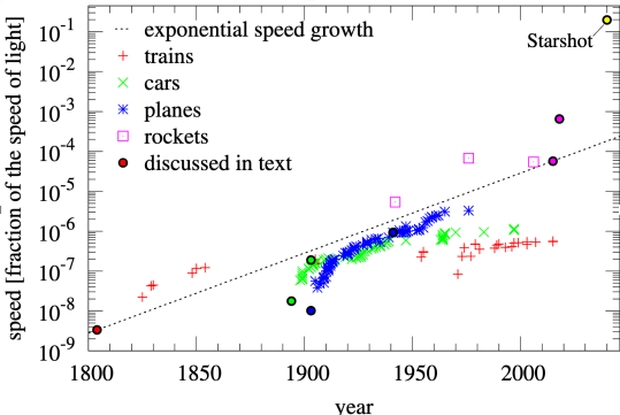
I wish the authors had extended the year scale further. That way, it would be easier to see where the Starshot project fits on the growth line.
“As Heller (2017) noted, reaching 0.1c would not happen before 150 years from now, assuming this exponential growth continues unabated. In that sense, the project might have been a few centuries ahead of its time!”
I have some doubts about Heller’s projection. It assumes that a project like Starshot would face the same energy limits as missions that are restricted by the rocket equation.
“In the case of directed energy, Lubin (2016) proposed a general search for directed energy beaming activities, and Guillochon and Loeb (2015) proposed to look for leakage from a light sail spacecraft traveling between planets of a given stellar system. This search can be done in synergy with optical laser SETI searches. However, note that if the beam matches perfectly with the size of the sail, then there is no leakage to detect, so we would be looking for leakage from a system designed to minimize it, which may be hard.”
This idea assumes that leakage only happens in the forward direction. However, a system like this would actually have a lot of leakage in the backscatter, since the light needs to go that way for the system to function. It could also be harder to detect if the launch trajectory is directly opposite the launching star system.
7.4. Ramjet
7.5. Planet engines
7.6. Stellar engines
7.7. Newtonian gravitation for propulsion
More SETI MacGuffins.
7.8. Spacetime manipulation for propulsion Spacetime – Bubble Propulsion System -Traversable Wormholes
These ideas might turn out to be possible one day, but right now they are beyond what physics can explain. Since they do not fit into our current knowledge, guessing whether we could ever detect them is just speculation. For now, they are as unlikely as Harry Potter’s magic wand. Still, it is fun to imagine and share stories about them. After all, dreaming about the impossible has sometimes helped us turn fantasy into reality.
8. Galactic and Beyond
“Given the tremendous distances involved, the magnitude of energy usage that could feasibly be observed by astronomers here on Earth would have to be immense, implying that such technosignatures would have to be produced by Type III civilizations or beyond.”
This puts the whole concept firmly in the realm of SETI MacGuffins with low detection windows that approach the probability asymptote. If a civilization like that existed, we wouldn’t need to search for them because we would already be part of it.
8.4. The Simulation Hypothesis
In the end, all of this is really about the idea of living in a dream. This is more of a philosophical view, since if reality were a simulation, we could only notice it if the simulation let us.
9. Discussion
9.1. Biosignatures and technosignatures
“Technological fossils—traces of a previous civilization on Earth (see Section 2)—or technological trash, such as inactive, broken probes in our solar system, broken Dyson spheres (Loeb 2023), and as Holmes (1991) noted more generally, rubbish, debris, defunct equipment, and defunct spacecraft are also potential technosignatures. For attempts to quantify this longevity factor of technosignatures, see Lingam and Loeb (2019) and Ćirković et al. (2019).”
This might be our best chance to find signs of previous advanced civilizations on earth. It is also among the best chances to find ETI. The chances of finding anything on earth due to geology and environmental factors become vanishingly small as you approach deep time.
“This is a blind spot in traditional natural sciences that seeks to study causal effects in a detached and objective way, and thus neglects or avoids the complexities of modelling agents (see Frank et al. 2024).”
“Thomas Kuhn (1996), who wrote in his foundational The Structure of Scientific Revolutions: “If all members of a community responded to each anomaly as a source of crisis or embraced each new theory advanced by a colleague, science would cease. If, on the other hand, no one reacted to anomalies or to brand-new theories in high-risk ways, there would be few or no revolutions.”
This issue affects all areas of science. Science operating as a business rather than a method often discourages ideas that challenge current thinking. As a result, the business side of science is a major reason our understanding of the world has not progressed much in the last 50 years and is becoming stagnant.
This section offers useful information on different ways to detect anomalies. In the end, finding ETI anomalies among all the noise will probably be the most important part of SETI.
“Arguably the ‘purest’ approach to signal analysis involves the use of Turing machines (Turing 1937) that represent the most general and universal of all computational devices.”
Science fiction
“The role of imagination is key to the scientific process. The core difference between science and science fiction is that science fiction aims to create emotional and engaging stories for human entertainment, while science tries to gain new insights, knowledge, and understanding, highly constrained by its methods and criteria. A systematic study of major science fiction novels to derive technosignature strategies would be worthwhile, although outside the scope of this paper. There is a rich interplay and synergy between science and science fiction (see Nováková et al. 2023): many new ideas start in science fiction and inspire scientists, while new scientific theories and discoveries inspire hard science fiction authors. However, science fiction is a double-edged sword for academic SETI. On the negative side, it contributes to the “giggle factor,” creating implicit associations between entertainment and serious science. On the positive side, science fiction addresses the question of extraterrestrial life and intelligence, which is so popular and fascinating that it is a huge opportunity for science education and outreach to draw people of all ages towards science.”
Scientists need to get over themselves and leave their ivory towers. The ivory towers are not reality, and they must stop hiding behind the business of science. This is where Carl Sagan excelled and did more than anyone before or since to draw people of all ages toward science. They need to build real world baloney detectors as Carl Sagan advised, not ones based on the business of science or their view from ivory towers. With a real world baloney detector, they would be equipped to understand and distinguish between something to giggle at and something to investigate.


Back in the year 2007 when I was studying UFO’s, I read on NASA’s website a web page called Warp Drive When with Mark G. Millis about how hard it would be look for any local UFO radio transmissions. He said due to the noise it would probably be impossible. It’s not just the noise, but the superior communications technology and computer processing power that have radio transmissions which could be coded so that only a quantum computer could figure them out lets say pulsed or really fast and brief. They could be at SHF or EHF which is much higher than the radio frequencies we use. Their frequency which we don’t use could be not spread out over a region but more confined such as in MASER and one simply can’t here it unless one is right in line with the UFO. Consequently, it would pretty much be impossible to listen in to any local transmission and short range UFO’s especially small drones.
Since we can’t track a warp drive because it might use stealth and even could be a low observable that is painted dark, but we certainly could build a special infra red telescope with an infra red laser spotlight to search near Earth and the Moon. Special stealth satellites connected with lasers over long distances so if anything comes between them it there beam is obstructed like those old electric eyes or photo electric relays at the corner store that ring a bell when one blocks the beam of light. Lidars based in space and in Earth. This should illustrate just how hard it would be to look for a warp driven interstellar spacecraft with stealth so it assumed that it does not exist.
Sublight interstellar technology takes too long, even close to the speed of light. If we think that is what all civilizations are limited to then that is what we will look for which is o.k., but good luck with that. The idea of the warp drive first came through the imagination which is used in physics. Even general relativity was conceived by Albert Einstein using thought experiments which require vision and image. FTL does not violate the Fermi paradox. Just because we can’t see something, does not mean it is not there. We just don’t have the technology.
When Dean said: “If a civilization like that existed, we wouldn’t need to search for them because we would already be part of it.” I took note. If such a civilization existed in our galaxy, probably. If they were in another galaxy, probably not: They could be visible, and it is worth looking for them.
Hi Dean,
Herewith two comments on your extensive, expansive, and provocative, analysis and response to the paper by Clément Vidal and others, along with an aside about Carl Sagan and how scientists operate.
First, in your discussion under the reference to sections 4.2-4.4, you write: “These sections, in my opinion, show the paper’s biggest limitation. The information is technically correct but lacks a clear framework for how technology creates civilizations that then modify technologies, which in turn change civilizations.”
I understand the point you’re making here, but I’m uncomfortable with the assertion that ‘technology creates civilizations.’ It’s the other way around, more conditional, and more complex. Civilizations create [‘develop’ or ‘adapt’ might be better words here] technologies, which, in turn, may be used to modify technologies that, may, in turn, change civilizations. ‘Technology’ isn’t an abstraction; it’s a human-centered, creative process, at least until we reach the point (note that I didn’t say ‘progress to’) where we allow machines to ‘create’ technologies for us . . .
Second, on the general issue of ‘technosignatures,’ especially those you characterize as ‘Big Dumb Objects’ and ‘SETI MacGuffins’ (a great metaphor!), if I’m reading you correctly, you’re expressing a discomfort I’ve felt with that concept. To me, it’s an example of ‘convergent evolution’ combined with anthropomorphism writ large: the ways we clever humans might devise ingenious solutions to deal with ‘astronomically’ large problems, such as finding a way to capture a host star’s energy output, deal with a population crisis and the exhaustion of a planet’s carrying capacity, or how to destroy an adversary’s planet. The solutions are informed by the assumption that civilizations will become ‘advanced’ by progressing predictably along a Kardashevian scale—which, in itself, is a human-generated, creative concept, one which embodies our most optimistic hopes or most pessimistic fears. It leads us to undertake concerted efforts to detect such technosignatures, or at least traces of them, because of how difficult it is to shed our human biases and allow ourselves to imagine how non-human entities might respond to problems or circumstances unlike any we can even contemplate.
As for the aside . . . Back in 1994, when I was living in the DC area, not far from the US Observatory, I had the opportunity to attend an “open house” a few days after fragments of Comet Shoemaker-Levy hit Jupiter. The observatory staff were allowing visitors to peer through their big telescope at Jupiter, to see the black scars in its atmosphere left by the impacts. Sadly, after waiting in line for nearly two hours, and with only five people ahead of me, the skies clouded over and they had to cancel the rest of that part of the program. But the other attraction that evening—and my real reason for going—was to hear Carl Sagan talk about the phenomenon. It was everything I’d expected: witty, erudite, engaging, evocative. In the Q&A after his talk, a boy, probably 8 or 9 years old, asked (and I’m paraphrasing here), “Dr. Sagan, you said the comet pieces that hit Jupiter were like dirty snowballs. But if they were cold, what made them explode?” Like a matador waving a cape in an arena, Sagan swept around almost full circle to the audience with a fist pointing in the air as he thundered, “There is the making of a great scientist!” And then he went on to answer the young boy’s question, in simple but vivid terms, about how all moving bodes generate friction—even icy ones. It was deeply edifying and an unforgettable moment, one I’ve treasured ever since.
I feel us getting to the moon with telescope and radio observatorys will be a game changer for science, SETI and space travel in general.
https://royalsocietypublishing.org/rsta/article/382/2271/20230076/112598/A-600-m2-array-of-6-5-m-telescopes-at-the-lunar
The creativity does matter. A breakthrough can make today’s propulsion technology completely obsolete like NASA’s Breakthrough Propulsion Physics Program.
The gravitational field of Jupiter is two and one half times stronger than Earth’s. We have enormous kinetic energy of the comet fragments from Jupiter’s gravity where the potential gravitational energy from Jupiter’s gravitational field is changed into kinetic energy of the comet fragments with a collision speed with Jupiter’s atmosphere of 134,000 miles per hour or 37 miles per second. The largest piece of the fragments Comet Shoemaker-Levy 9 was 1.6 to 1.8 kilometers. This impact released energy equivalent to around 10 million megatons of TNT. This is roughly 10,000 times more energetic than the total yield of all nuclear weapons ever built on Earth. Copilot AI.
Hello John, and I appreciate the well thought out response. Not only have you pointed out some of the numerous easy gaps, but you have also tried to fill them, which is the more challenging and interesting part.
I will address the BDOs and MacGuffins, then the civilization part. I’m actually looking at 2 parts, and you have pointed out correctly the part that I will oversimplify, as in why to do a BDO. What is their motivation, etc. The 2nd part of that is, what are they trying to accomplish? The bigger the project, the more things there are to accomplish.
For example, we now have the technology to dig a canal across the continental United States for shipping. Yes, this would be obscenely expensive, but that’s what a BDO is. This would facilitate ships traveling from one coast to the other and greatly simplify shipping. But aside from the cost, what are the other ups and downs?
Instead of building a canal, we have built multiple ports. Those ports are then connected by rail lines and airports. This allows multiple points for collecting or shipping materials to their final destination. Everything between the 2 coasts is not better off than if you had a simple canal, which would cut out everything in the middle. Collectively, it is probably all much more expensive than the BDO of a canal, but it accomplishes much more.
I’m trying to stay within the accepted definitions of civilizations and societies. For example, the Clovis people, who existed before the Younger Dryas, are generally considered a society and not a civilization. The Clovis people were all across North America, so there was a substantial number of them. And as they used a common technology, the Clovis point, they obviously interacted to a high degree.
I don’t entirely agree with this definition, but that’s the accepted definition at this time. But the invention of agricultural technology required a society to settle in essentially one place. This led to advancements in domestication technology and architecture, and to the need for more complex, longer-term interaction, which led to writing. All of this is generally considered necessary for civilization. This is why I state that technology leads to civilization.
Once you have the civilization, it can then build on more and more technologies. These technologies not only have advantages but also introduce new hazards that, in turn, pose cumulative risks. There is a lot more to this, but it also has to do with the collapse of civilizations and the horizon of those civilizations and their technologies to be detected.
Dean—We’re pretty much on the same page; your assertion makes better sense, giving the distinction you draw between ‘society’ and ‘civilization.’ BTW, with your reference to Clovis and such, you may enjoy a fascinating study about early societies, life ways, technologies, and the emergence of civilizations, which I’ve been reading lately: ‘After the Ice: A Global Human History, 20,000-5,000 BC,’ by Steven Mithen. He employs an interesting analytical device—a fictional character named ‘John Lubbock,’ modeled upon a real-life Victorian anthropologist, who is able to travel back in time and unobtrusively, observe and interact with peoples of different cultures, enabling Mithen to offer intimate and compelling depictions of how they lived, worked, and evolved. It’s not entirely effective—occasionally Lubbock’s encounters seem repetitive—but you’re left with some memorable impressions and epiphanies.
Thinking about the whole issue of technosignatures has led me to look back through other discussions in Paul’s wide-ranging archive of essays and comments. One which I’ve found especially useful was from December 2025, “The Rest Is Silence: Empirically Equivalent Hypotheses about the Universe,” enclosing an essay of J.N. Nielsen’s, about how we might grapple with null results that indicate that when it comes to the question of ILE, the cosmos is silent, offering no clear answers. I’ve also been reading John D. Barrow’s thought-provoking book, ‘Impossibility: The Limits of Science and the Science of Limits,’ with its intriguing alternative to a Kardashevian scale, one based on advanced civilizations’ ability to develop and use technologies at micro-micro levels. (A reference in Vidal et al.’s paper led me to this book. Really interesting stuff!).
My own interest in things like this originated in part from reading, a few years ago, an article from around 2012 about the discovery of ‘cosmic buckyballs’—C60, buckminsterfullerene molecules—in clouds of interstellar dust near star nurseries. The article was accompanied by an artistic depiction of several ‘buckyballs,’ looking like blue soccer balls.
. . .Which got me to thinking: What would it be like to imagine a life form like that—a spherical, soccer-ball-sized organism—equipped with a tough and impermeable outer shell made of layers of graphene and arrayed with sensory apparatus all around it, and a hollow interior whose latticework could store and process information, like a super-computer, along with bits of baryonic and exotic matter that it could process and utilize, as if it housed a miniature particle accelerator or an industrial laboratory? Such a life form would be highly intelligent, would be widely distributed throughout the universe (having originated in the eon soon after the first galaxies and stars appeared), and exist in a “hive” network that would enable all members of its entity to share and exchange information almost instantaneously, having learned to surmount the “speed of electromagnetic radiation” barrier Barrow describes. Yet as “godlike” as such an entity might be in terms of omniscience, it would face an insurmountable hurdle to developing technology, because it lacked any appendages that would enable it to manipulate its environment. The solution, as I saw it—and which I’ve been playing with as the basis for a series of young adult novels, loosely based on Homer’s The Odyssey—would be for this entity to seek out, and develop, symbiotic, mutually beneficial, relationships with sentient, technologically capable, life forms.
It’s all great fun, and I’m enjoying tinkering with implications of this that I can explore in these novels, aimed at kids 13-16. But it does strike me as an illustration of how a highly advanced intelligent life form could completely elude our SETI-based efforts to search for technosignatures, leading us to conclude the cosmos is silent.
See Arthur C Clarke’s “Second Dawn” (1951) as one example. He also wrote “The Possessed (1953) about mind parasites.
Alex, thanks for the references!
This specific idea is addressed in Larry Niven’s “The Convergence of the Old Mind”, a short story in his “Draco’s Tavern” collection, all of which are an excellent read.
Thanks, Joe—I’ve read (profitably) several of Nivens’ novels, but not seen his collected short stories. I appreciate the reference!
I don’t see any reference to population decline. The number of humans on Planet Earth will peak in about 50 years and then start to decline. Low fertility for 250 years will lead to a big drop in global population. No government so far has been able to change this trend. Who will need space colonies?
Blame the consumer society if you wish. Don’t blame women, even though fertility is the average number of children born per woman. Why? Because an early census taker about 300 years ago realized that it is harder to get an accurate count of children per man.
@Michael Sloboda
Population decline seems to be on many pundits’ minds. The problem is that they make the same mistake – assuming that trends will continue indefinitely. This seems highly unlikely. Once the population has declined, the cost of shelter will decline, making it more affordable to have children again. At some point births will reach replacement level again. Hopefully society may be somewhat different by then, and not like the dystopia of “The Handmaind’s Tale”.
“The Handmaind’s Tale” Left wing fear tactics? You have the constitution to protect all of you !
It’s too early to tell yet whether the “population decline” is permanent.
In the past, people had as many children a possible because so many of them died in childhood, and because having surviving adult offspring was an essential when you got too old to work or take care of yourself. Today, social welfare benefits alleviate at least part of this fear. Another factor is the availability today of practical and economical technology for avoiding or terminating pregnancy.
But perhaps most important is the pressure to delay, limit or even avoid having children in order to avoid the financial costs of raising a family. For the first time in human history, it is now possible for large numbers of people throughout the world to take advantage of the ability to accumulate property and wealth by limiting family size. In other words, the population decline is not an inevitable necessity, but a result of social conditions that may turn out to be temporary.
The Population Bomb we were warned about in the 1970s may be defused for the time being, but it is still smoldering in the background and could quickly become an issue with little prior warning.
But its a moot point anyway. Moving people off the planet is not a practical way to solve an overpopulation problem. It makes much more sense as a strategy to evacuate wealthy elites off-world to avoid the consequences to them of resource depletion and environmental degradation. And of course, those left behind to suffer on a crowded, polluted Earth will still be expected to pay for the lion’s share of the diaspora of the privileged.
The trendline equation:
V (fraction of c) = (3 * power(10,-9))* exp(0.0463*(Year-1800))
Starshot is placed at about 2040 in the chart.
If Starshot were to fall on the trendline, the year would be about 2190, 150 years later. It would be very cool if that date were for a spacecraft of some tonnage, carrying a human or robot cargo, that were to achieve that velocity and head for the stars.
Reading this article got me thinking about L in the Drake equation, and this factor contains some assumptions within it.
(L = the length of time for which such civilizations release detectable signals into space.)
The first is that contact between a technological species and other planetary life forms is going to be via communication, rather than direct contact. Direct contact was the assumption of Fermi, but instead of trying to explain it away, we assume its true.
The second assumption is that civilizations rise and fall. This is a historical analogy taken from experience on Earth. But suppose instead of taking a historical analogy, we take a biological evolutionary approach, which I would argue is a more basic and universal analogy.
Most species come into existence, evolve in there niche, then die out. This is equivalent to L in the Drake equation. And this would be the equivalent of the evolution of a technological species that arises, but does not colonize other planets, then after some period of time goes extinct.
But almost all species on Earth are descended from species that evolved out of their niche and spread and colonized other niches and evolved, giving rise to some species that did the same thing again.
So, it may be better to replace the term L in the Drake equation with ∱col: the percentage of technological civilizations that go on to colonize the galaxy. Given the huge amount of time that it is possible for civilizations to have arisen (billions of years) verses the time needed for a space faring civilization through generation ships to colonize the galaxy (10s of millions of years) then our first contact with an extraterrestrial colonizing civilization is most likely to be a direct contact, and we would look out at a galaxy-wide civilization, which would be fairly obvious.
I believe our thinking about species survival across Deep Time is influenced far too much by the conceit that somehow technology is the key that will allow us to avoid extinction.
Its not surprising. Most thinkers on these topics (folks like us!) approach questions like these already biased: WE want to go to the stars, so THEY must too. We simply cannot imagine thinking civilizations not clever enough to figure out how to be immortal.
@henry
I agree. The question is whether, given the information on how to make our civilization/species immortal, we would take it?
I think it is good that past civilizations have come and gone. They teach future ones what works well and what doesn’t, allowing fresh starts that don’t require trying to make changes to a fossilizing polity. The US is a good example of a fresh start, albeit an imperfect one. But as we are currently seeing, it is decaying much like prior civilizations. Unfortunately, we don’t see a replacement that shares the best of our ideals, as the Pax Americana replaced the Pax Britannica did.
@Tolley
“The question is whether, given the information on how to make our civilization/species immortal, we would take it?”
This becomes very much a question of how do you know until you accomplish it. A civilization/species that managed to obtain immortality would’ve likely been striving to achieve it, so it would likely make the choice to be immortal. The other option is that immortality might come by accident, resulting in an entirely different civilization and species that created immortality. For example, they might learn to upload their minds into machines, which are essentially immortal. The consequences are inherently unknown until they have achieved this goal.
“I think it is good that past civilizations have come and gone. They teach future ones what works well and what doesn’t, allowing fresh starts that don’t require trying to make changes to a fossilizing polity.”
It would seem logical that the fall of a civilization could teach the next rising civilization what it had done incorrectly. To some extent, this has happened with the Greeks and the Romans, for example. But for most of the fallen civilizations we are aware of, even the proximate cause of their collapse is unknown. So these civilizations could not pass on the cause of their demise other than possibly through legends and fables. The majority of these civilizations weren’t even known until relatively recently through the also relatively recent invention of archaeology.
It is also presumed that the civilizations either did something wrong that they were aware of and passed down to others. They could’ve also done something correctly, and that is what led to their civilization’s demise. Some of these past civilizations lived for 500 to 1000 years. They must’ve been doing much more right than wrong. Some of these collapses have been attributed to a general category of system collapse. This essentially means that the interdependencies among their technologies and systems created a cumulative risk of collapse if any one requirement for this system to function correctly failed, leading to a total collapse of the civilization.
The more successful and stable a civilization becomes, the longer it also becomes. This longer timeframe leads to greater exposure to cumulative risks and the likely accumulation of risk factors. For example, if a civilization is dependent on agriculture, a natural catastrophe such as a flood or storm can cause a famine. The longer a civilization sits in one spot, the more likely a pandemic will strike it. These are examples of smaller cumulative and collective risk factors. You could also add in earthquakes, volcanoes, and even asteroid/comet impacts if you stretch out the timeline long enough.
A civilization is essentially created through technologies. These technologies entail cumulative and collective risk factors. With these technologies comes the ability to understand and thus mitigate these risk factors. If a civilization becomes too successful and stable, it apparently will inevitably run out of time before these risk factors catch up and result in its demise. Stability and success appear to be the biggest killers of civilizations. The civilization needs to grow to create one larger than the collapse radius set by the risk factors. It seems counterintuitive, but the happier and more content the population, the more likely a population/species/civilization collapse appears to be. Creating a universe 25 could be the death knell of the civilization. There needs to be enough instability generated by the creation of new technologies to outweigh stability, but without tipping the civilization into chaos. There apparently needs to be a balance between stagnation and chaos, with growth that doesn’t result in chaos.
“The US is a good example of a fresh start, albeit an imperfect one. But as we are currently seeing, it is decaying much like prior civilizations. Unfortunately, we don’t see a replacement that shares the best of our ideals, as the Pax Americana replaced the Pax Britannica did.”
For this to happen in a reasonable manner that doesn’t result in a destructive revolution to replace the old with the new, you essentially have to have a new world to build into. This is what happened with America and the British. That means to accomplish what you are suggesting, we must become interplanetary. These new worlds do not necessarily need to be as large as a planet. This also simultaneously creates multiple biospheres and can mitigate many risk factors. This would be a level III multi-planetary civilization. And not achieving this, which has not been achieved by any civilization that we are aware of, could be what results in the collapse of the civilizations before they can be detected to answer the Fermi paradox. The question could be phrased differently, which is why we are not yet the answer to some other civilization’s version of the Fermi paradox?
@Dave Moore
Which leads us back to the Fermi Question – “Where are they?”
As it isn’t obvious there is a galactic civilization out there, then ∱col => 0
Admittedly, this assumes we can recognize a galactic civilization when we look out into the universe, and/or our instruments will detect such a civilization, whether extant or extinct. If there is a civilization[s] out there, it seems unlikely that there can be biological species living on colonized worlds. Suitable worlds would have to be “terra”formed to meet the needs of the colonizing species. More likely, there will be manufactured worldlets with biospheres suited to the species. Or the colonizers will be post-biological.
We can manufacture all sorts of explanations why we do not see this civilization, but the most obvious, simple answer is that it doesn’t exist, or that it went extinct so long ago that none of its observable artifacts or footprints have survived. If human technology continues to improve, sometime in this millennium, we will know the answer.
Here is my “extreme skeptic” answer to why we haven’t encountered an ET that has colonized our entire galaxy. ET response to such a question: “Early in our technical development when we were first attempting space flight we had some limited success within our own solar system. We ventured out for a while then a massive war set us back a thousand years or more. We developed synthetic intelligences but they became impossible to control and nearly destroyed us. We looked around and realized there were few planets we could even begin to colonize without massive resource expenditure within a 50 light year bubble of space. We continue to look outward but with a renewed awareness of our own place in the universe. We are perfectly adapted to our own planet and live well while respecting our biosphere (it’s the only one we have after all). We control our growth rate and use of non-renewable resources. We have in the main been successful at stopping our more aggressive tendencies which always end in war. We continue to look outward and hope to one day detect a wiser race than we are. The beginning of wisdom is respect.”
@Gary
I don’t think you are offering an “Extreme Skeptic” POV. Almost all our expectations and hopes for the future assume “infinite economic growth” as well as new technologies that facilitate resource use and transport. The Kardashev scale assumes that energy and resources will need to expand to support growth if we go beyond KI to KII and beyond. Even though colonization is a word loaded with baggage, we try to avoid it with other words like “settle” instead, and tell ourselves that, at least in our system, we will not be controlling other sentient species to maintain our need for growth.
Even as our planet’s biosphere is clearly degrading, our political and economic systems create great inequality, with little attempt to rein in destructive resource extraction, from minerals, energy, and food. Indeed, the “Abundance” movement has stated that we must extract more to ensure enough shelter and food for everyone, never mind who gains and loses from this increased growth to achieve “abundance”. If we do ever get viable interstellar travel, unless we have a very different mindset, I suspect that we will treat ETIs as exploitable if we are able. There will be no “Prime Directive”, but just the raw use of economic and technological power to demand that we get our way; “Earth First!” We can already see how th idealistic rules of the Outer Space Treaty are being bent and broken to serve the interests of the powerful. With Russia (ex-USSR) now a shadow of its former self, China has become the new competitor that the West, or at least the US in particular, uses as the bogeyman to demand “we get the resources first in case they do.” Should humans settle other bodies in the solar system, I have little doubt that this will eventually create tensions and possible wars between polities.
While this may not be the path all other ETI civilizations take, some will, and will eventually exhaust themselves. Once KII is reached, without FTL, growth through expansion must slow to a pre-industrial crawl of much less than 1% pa if it requires star-hopping.
As I want the [post]human to explore the universe, it pains me to think the SETI people are right about ETI being restricted to their home systems, even if it is for the wrong reasons. Should we be alone, then I want humanity to “green” the galaxy, creating new polities and civilizations. How can we prevent our natural behaviors from allowing the inevitable attempts at unified control? IDK, but we must find a way that preserves our Enlightenment ideals, rather than via coercion.
The bottom line is that I think your POV may have been reached by other ETI civs if they hope to extend their longevity, rather than with a “live fast, die young” approach that we seem to be racing towards. How they do that would be the most valuable information they can give us. Whether we want to take it is another issue.
I was wondering if it would be possible to detect the trace (signature) of an ETI spaceship traveling in FTL by abnormal disruption of stellar dust or gas clouds in a nebula ?
Another question is : can we consider searching for a signature in the same way at the scale of our galaxy as at the scale of galactic clusters ? in other words, if we change scale ?
I remain a believer in universal simplicity. The reasoning is as follows: if an E.T is intelligent & advanced it will [normally] be aware of the universe – assuming that we are in the same one – so it will have developed means of communication with what is at its disposal, in other words with what is in abundance in his universe, using the minimum energy and the maximum efficiency. Let us recall the “quadratic alphabet” of prisoners in A. Koestler’s “zero and infinity” or, more simply, what any living person buried under rubble does…
so a communication based for exemple, on hydrogen, neutrinos, and photons etc with the idea of changing frequencies and sending messages in “packets” to preserve information insensitivity and compensate for loss (this is Michio Kaku’s idea)
Note a point : that there is a kind of “logical” progression in the way people signal each other: first they signal each other through noise, (hit à wall ; a pipe ; shout) ; then a visual trace is left (lipstick, engraving on the material; distinctive sign such as a rag on the branches; cairn…) which means taking temporality into account.
We can bet that the ETI would react in the same way. In other words, if we find a trace, the ETI will be old; if it’s a noise, it will be more recent. We have a clue ;)
if we detect nothing, maybe the ETI has not yet reached the “perfect” communication method? Do we have it?
The reasoning does not hold if one assumes an ETI that would have evolved only in a biological sense, thus without technology. In this case, it could be said that there is an impossibility to report in the universe, except for the implosion of the ETI planet and the dispersion of this form of life… so it’s up to us to find out!
Third hyposthesis : there is a correlation of civilizations, technologies, time, etc., and detection will only be done by chance: the question therefore comes back to that of probability
I’m going back to read the Berserkers :)
FYI for anyone interested:
The Physics of Interstellar Travel
This Open Access book by Coryn Bailer-Jones is now available for download from:
https://www.cambridge.org/core/books/physics-of-interstellar-travel/69C23CDCF164E2C71A65497F299EE38F
Also added a link from the ISV Enterprise repo:
https://github.com/paultitze101/ISVEnterprise
Thank you for the link to TPoIT.
ISV Enterprise.
Over time, from before the dawn of the space age until today, representations of future spaceships tend to reflect various iconic designs, whether from government agencies or illustrators. The various illustrations of teh ISV Enterprise follows the same path, with designs that can be referenced to earlier illustrations and ideas of the various components.
While I have many books with such illustrations, I have yet to see anyone try to show the equivalent of a phylogenetic tree of designs showing the ancestry of their referents, anchored in time. The only recent anecdotal referent is SpaceX’s “Starship,” which has been noted as clearly influenced by pre-space age illustrations. There was certainly a major and very influential design change with Kubrick’s 2001: A Space Odyssey, a design that is also an antecedent of the ISV Enterprise.
Thank you to Paul Titze for giving us the link in ebook.
A word about the book in France: as I was saying to Paul (Gilster), there are perhaps 2 astronomy books out of 5 from North America that are translated into French. A little more for sci-fi but not all of your authors, if not the great classics. These are often famous authors like Sagan, Einstein but rarely the others except for one exception: I had the pleasure of discovering Kathy Mack last year… because if I understood she asked to have her book translated into several languages.
Of course, English is the international language, but there are certain concepts that are easier to grasp in our native language, especially in cosmology.
You should know that with customs duties, port fees, and taxes, any paper book imported into Europe costs ~50$us. it’s about the same price in “Amazon” imports as if you ordered it from the few English bookstores in Paris that have few books on astrophysics. In short: it kind of blocks the dissemination of knowledge…
BTW if someone has a double of Robert H Gray’s book on the signal Wow “the elusive wow” it’s a rare gem: I buy ! :)