
Looking for extraterrestrial life in the form of biosignatures will involve peering into the constituents of a planetary atmosphere and identifying out of equilibrium gases that tell us something biological is going on. But here’s the problem, as demonstrated recently in work on the exoplanet K2-18b. We’ve identified dimethyl sulfide at this world, which might just be a life detection. On Earth, dimethyl sulfide comes from dimethylsulfoniopropionate (DMSP), a compound that is produced by phytoplankton and has a clear role to play in marine ecosystems. The problem is that subsequent research on K2-18b has pointed to possible instrumental errors and the relatively low level of statistical confidence in the detection.
Nothing turned up in a SETI check of this world with the Very Large Array (New Mexico) and MeerKAT (South Africa, precursor to the Square Kilometre Array), which isn’t particularly surprising. We’re going to be getting more biosignature candidates in the coming decades as our instrumentation keeps improving, but even with the Habitable Worlds Observatory, the result of any interesting detection is going to be a race to figure out ways to produce the same gases without biology. Microbial life may be all over the galaxy (I suspect that it is), but I’m less and less sure we’re going to get any biosignature detections that anyone will consider ironclad this way.
Emergence of the Technosignature
That makes technosignatures more interesting than ever, especially since there is a good case to be made that any civilization we detect will be substantially older than ourselves, and thus gifted with technological powers we may not be able to imagine. Astroengineering is but one wonderful example of what we might encounter, but would we recognize it? Asking the same about vast structures like Dyson spheres or swarms is a hot topic because we do have current tools for observing them, and also archival data that may just contain evidence of them. But we have to know what to look for.

To that end, a new paper has just arrived that is going to be a touchstone for technosignature research for some time to come. Clément Vidal (Vrije Universiteit Brussel, Brussels, Belgium) and a large team of co-authors have produced the critical review document needed to consolidate what has been done so far and help newcomers to the work orient themselves with the directions that will be needed next. This is a satisfying event, because it also comes at a time when we are about to get the first graduate-level text on interstellar flight, which should itself inspire future careers. We’ve also just had Jason Wright’s first-rate textbook on SETI, which means that we are preparing the way for interstellar issues to become embedded in college and graduate school curricula. And that’s how we get the next generation of scientists.
Image: Philosopher Clément Vidal’s background in logic and cognitive sciences has led him into new formulations for SETI, as in his 2014 book The Beginning and the End: The Meaning of Life in a Cosmological Perspective. The current paper is an in-depth examination of past and present searches for technosignatures, with suggestions on the path forward. Credit: Clément Vidal.
Both these books are splendid, and I’ll have more on each as soon as the former is publicly released (very soon now). For now, though, let’s dig into the Vidal paper, which acknowledges the new Wright text and its coverage of the theory and practice of technosignature science as well as SETI itself. What Vidal and team set out to do is to create a definitive reference for the kind of technosignatures that have emerged thus far in the field, and the methods we might use to detect them. Those of us who think in terms of distant stars as possible sites for technosignatures may be surprised at the spatial scale strategy here, which actually begins with technosignature searching on Earth, then out to the Moon, the inner Solar System, the Oort Cloud and into interstellar space.
As I’m always interested in archival searches, I want to note the work of Beatriz Villarroel and team on plates from Palomar Observatory from the 1950s. This is of course before the satellite era, so it’s intriguing to find a number of unexplained point sources that disappear from subsequent plates. To guard against artifacts of the photographic emulsion, the team found a statistically significant (22 sigma) deficit of transients in Earth’s shadow. In other words, emulsion flaws are unlikely to be the source of the detected transients. Conceivably they could have been reflective objects that disappeared when entering the shadow. The findings are still being debated in the literature, but they point to the prospect of future searches on even older astronomical plates.
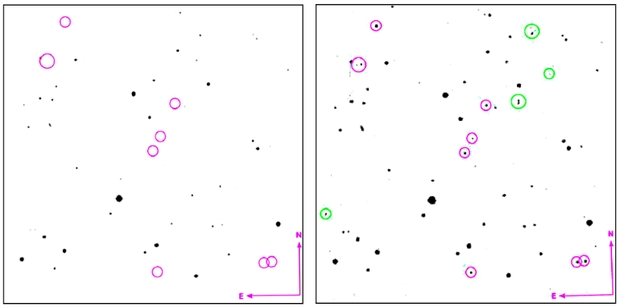
Image: This is Figure 5 of the paper. Caption: Nine simultaneously occurring transients on April 12th 1950, from Villarroel et al. (2021): 10 x 10 arcmin field shown in POSS-1 and POSS-2 red bands. In the POSS-1 image we see a number of objects that cannot be subsequently found, marked with green circles. Purple circles are artifacts during the scanning process. About 9 objects are present in the POSS-I E image (left) from the 12th of April, but not in the POSS-2 image (right) from 1996. One slightly larger circle host two transients. In addition, the 9 objects are neither visible in the blue POSS-1 taken half an hour earlier, nor in a second POSS-1 red image taken six days later on April 18th. The 9 transients are not caused by a difference in depth or spectral sensitivity. The images are based on the DSS digitizations of the Palomar plates.
I won’t go through all the levels the authors mine other than to say that we move from searches for past Earth visitation and current research into Unidentified Aerial Phenomena through the question of ‘lurker’ or Bracewell probes in nearby space and even explore the Solar Gravitational Lens before moving into the kind of exoplanetary and stellar technosignatures that have thus far commanded the most attention in the field. We can’t limit this to our own galaxy because productive work has been done, especially by Wright’s team at Penn State, in examining numerous galaxies for the possible infrared signature of Dyson spheres or other large scale technologies.
Expanding the Already Daunting Search Space
Whereas the original Cocconi and Morrison paper on SETI (1959) assumed a signal deliberately sent in our direction by a species wanting to announce its presence, technosignatures demand no such intent to communicate, and rather than confining ourselves to particular slices of the electromagnetic spectrum, we should consider the possibility of going well past current laser strategies into areas only now coming online. Thus the emergence of low-freqency SETI via the multi-site LOFAR stations in Europe. Or consider the benefits of high-energy photons via X-ray lasers, which can can offer high rates of data transmission. Let me cite the paper on this:
In particular, X-ray lasers are capable of producing highly focused and intense X-ray beams with a very narrow divergence angle which allows for highly energy-efficient interstellar communication. While natural astrophysical sources of X-ray emissions are generally characterized by specific spectral lines, we could search for free electron lasers, which accelerate free electrons to nearly the speed of light, directing them through an alternating magnetic field in a way that produces highly coherent X-ray pulses (see Figure 20). Although above our present technological capabilities, fusion-powered X-ray lasers are another possibility to generate X-ray pulses.
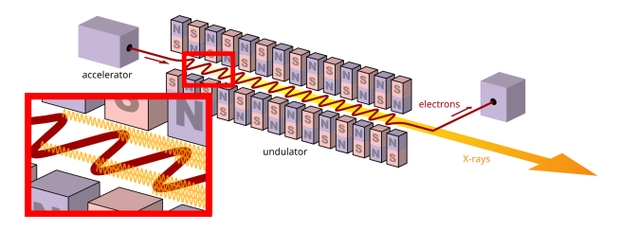
Image: This is Figure 20 from the paper. Caption: Figure 20. A schematic illustration of a X-ray Free Electron Laser (XFEL). An electron gun fires a beam of electrons that are directed through an undulator after being accelerated through a particle accelerator. The beam of electrons then passes through an undulator, which is a periodic arrangement of magnets whose function is to produce the highly coherent X-ray pulses/beam. Diagram courtesy of Wikipedia, based on (Patterson and Abela 2010).
Another advantage: Lower background radiation as compared to radio waves, which make signals in this frequency range easier to detect against natural sources. Finding patterns of X-rays that do not jibe with natural sources would be sufficiently anomalous to catch our attention. X-rays also have advantages over longer wavelengths like radio waves because phenomena like scintillation are far less of a problem. I was interested to see that there have been archival searches through X-ray data. Michael Hippke and Duncan Forgan found in a 2017 paper that 19 candidate signals were present but could most likely be traced to astrophysical causes.
Bear in mind that at our current level of technology, a spectrum via the Chandra X-ray instrument takes five days to build. One suggested path forward is to move toward highly sensitive instruments with the necessary spectral resolution to detect the kind of narrow X-ray emissions such communications would represent. So it’s good to know that beyond Chandra and XMM-Newton we can look toward efforts like the European Space Agency’s Advanced Telescope for High ENergy Astrophysics (Athena), an X-ray telescope armed with X-ray Integral Field Unit (X-IFU) for high-resolution spectroscopy. A NASA flagship mission based on a concept called the Lynx X-ray Observatory made it into the 2020 Decadal Survey but as far as I know is not yet a confirmed mission.
So as we explore problematic options like X-rays (and the paper notes that G-class stars are good candidates here because they do not produce strong X-ray emission lines), we also push into little considered options like gamma rays, perhaps a signature of advanced propulsion. We also find interesting discussion in the paper on expanding the range by looking for communications signals happening within a target exoplanetary system, particularly as we begin to shift our own deep space communications into the laser range. Directed energy systems of the sort we have often considered here would produce a detectable signal, as would planetary radars used for self defense purposes.
Neutrinos, Gravitational Waves and Other Exotica
And here’s an interesting thought. As far back as Philip Morrison in a 1962 paper, neutrino communication has been suggested for an advanced civilization. Neutrinos react only slightly with matter, meaning that most of the Sun’s outer layers would be transparent to them, with only the dense core layers capable of absorbing them. That means the Solar Gravitational Lens effect for neutrinos starts in the range of 30 AU, roughly the orbit of Neptune. A search for a Bracewell probe is thus possible at a distance much closer than a photon-based signature from a probe at 550 AU.
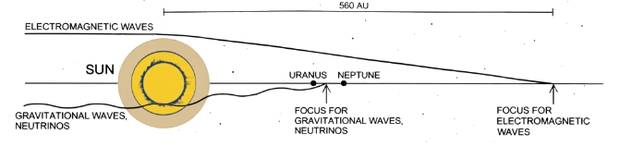
Image: This is Figure 8 from the paper. Caption: The Solar Gravitational Lens (SGL) is a region where gravitational and neutrino radiation starts to focus (respectively at 22.45 AUs and 29.6 AUs) while the focus of electromagnetic (EM) rays starts from 547 AUs. Human or ETI observational or transmitting probes placed at these regions would benefit orders of magnitude of gains. Figure adapted from (Maccone 2009, xxxi). Credit: Vidal et al.
The authors note that neutrinos have been proposed for communications with submarines as well as interstellar uses. From the paper:
Their extremely low interaction cross-section makes them good candidates for interstellar communication, since they rarely interact with matter: they can travel through interstellar dust, gas clouds, planetary and stellar objects, or even strong magnetic fields surrounding pulsars and neutron stars with negligible attenuation. In other words, neutrino emissions are immune to common interstellar communication issues like dispersion, scattering, absorption, or polarization rotation (problems prevalent with electromagnetic signals). This enables neutrino signals to propagate across interstellar distances while maintaining coherence and fidelity.
Supposing an interstellar civilization wanted to create an aeon-spanning beacon of the sort imagined by some SETI advocates, a neutrino signal would have the advantage of standing out as distinctly structured in whatever modulation scheme chosen. The energy demands of a system like this are unimaginably beyond our own, but searching for technosignatures demands thinking in extravagant terms. With neutrinos the senders free themselves from issues of dispersion and scattering, producing a signal that can reach across the galaxy and remain coherent. I also want to mention Centauri Dreams regular Al Jackson’s take on such a technology in A Neutrino Beam Beacon, based on his 2019 paper. Al has also published with Greg Benford on gravitational wave transmitter concepts. It would be startling to find that the actual galactic conversation was taking place via gravitational wave methods.
My talking about X-rays, gamma rays and neutrinos is just a way of opening the window into the range that this lengthy paper covers. Who knew, for example, how much work had already gone into the theoretical detection of a starship? The various angles into the matter include analyzing motivations for starflight itself, the chief of which must surely be the continuing existence of a species. From the paper:
Survival motivations include avoiding a death threatening supernova or migrating towards a nearby star as the home star fades away (Zuckerman 1985; Hansen and Zuckerman 2021). A pioneering study by Hansen (2022) looked for close stellar encounters in the solar neighborhood. The strategy is then to look for active interstellar migration, where “generation ships” are sent during a close encounter window, hitting this window because it would cost orders of magnitude less time and energy than crossing the otherwise vast interstellar spaces. Hansen proposes this method as a way to constrain search targets because a lot of heat or communication signatures might be associated with such migration.
Interesting, to be sure, but look how many starship technosignature ideas spin out of it. Let’s assume two habitable zone planets around the same star, or perhaps in a binary system, so that civilization has expanded to set up technologies on both worlds. Here’s prime fodder for a technosignature search, and indeed TO!-2267 is a recently discovered example. We might then look for both travel signatures as well as communications, a particularly interesting idea when both planets transit.
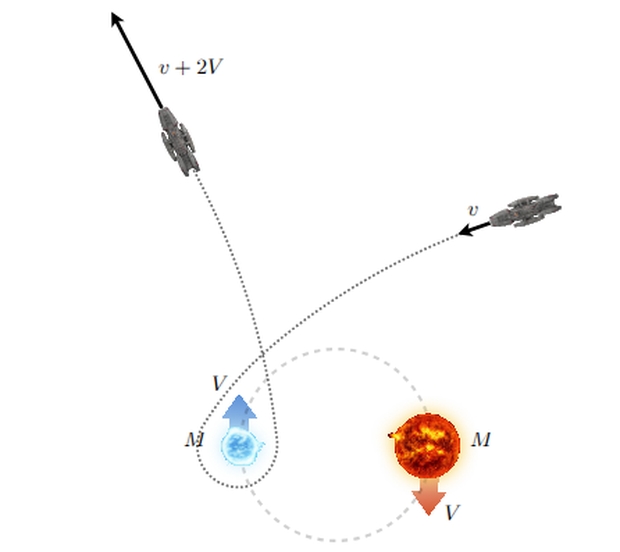
Image: This is Figure 25 from the paper. Caption: Illustration of a gravitational machine (Dyson 1963) for accelerating spacecraft using binary star orbital energy. Diagram based on Mallove and Matloff (1989, p. 141). Credit: Vidal et al.
Researchers have considered three-body interactions that result in high-velocity ejections, or even waste signatures (‘interstellar contrails’), perhaps to be found in archival data. Robert Zubrin has studied cyclotron radiation caused by the interaction of the interstellar medium with a magnetic sail, while Ulvi Yurtsever and Stephen Wilkinson have worked on the interactions of a relativistic spacecraft with Cosmic Microwave Background (CMB) photons.
The list could go on, and I haven’t even gotten into Alcubierre-class ‘warp’ drive vessels and the perplexing technosignatures these might produce. Well, this I just have to quote, as temporal matters have their own fascination. Here the authors are discussing what they call a ‘bi-modal signal’ unique to a warp drive craft, for the bubble of spacetime as we observe it is moving faster than the speed of the emissions it is sending out:
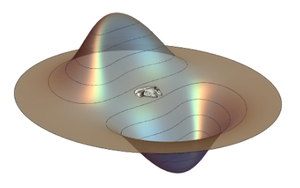
This mechanism is a purely craft motion effect, since the craft is moving super-luminally, essentially outrunning the signals it produced earlier in its path. Thus, a distant observatory would record emissions that occurred at two different times simultaneously. One signal would move in the apparent direction of the craft’s motion, showing the emissions occurring in the correct, forward order in time. The second highly unusual signal would move in the opposite apparent direction, presenting the craft’s emissions in a reversed temporal order. This technosignature is considered a key observable (Lentz and Felton 2024) because there is no known natural phenomenon that could produce such a signal.
Image: This is Figure 26 from the paper. Caption: The York-time representation of an Alcubierre spacetime bubble, showing a localized region of warped space with contracted space ahead and expanded space behind. Credit: Vidal et al.
Getting Technosignatures into the Universities
Whether a lightsail, a ramjet, or even a planetary or stellar engine, the interstellar craft has been examined in terms of observational consequences as what we often call ‘Dysonian SETI’ evolves. The unusual waveform of a starship undergoing velocity changes is worth noting as well, again a matter of developing the future tech in the form of sufficiently sensitive gravitational wave detectors. The authors point out that natural objects are also in the mix. Could ejected rogue planets be carrying interstellar colonists, a huge generation ship that might be identified through analysis of its trajectory?
We should have plenty to work with closer to home with the upcoming availability of the Vera Rubin Observatory and the Nancy Grace Roman Telescope looking for objects on hyperbolic trajectories that may be cometary or conceivably technological debris or even active probes. Anomalous occultations in the outer Solar System are obvious targets for existing resources, and radio searches of the Solar Gravitational Lensing region between the Sun and Alpha Centauri have already been conducted. Given the proximity of the outer regions of the Oort Cloud with what may be a comparable region around the Alpha Centauri stars, technosignature searches here seem warranted as well.
I send you to this paper with enthusiasm. Its 118 pages are packed with ideas and as you can see, hardly limited to what we might detect on an exoplanetary surface, although those settings do of course come into play. Given how exciting it has been to witness the birth of direct exoplanet observation since the mid-90s, the extension and consolidation of new ideas for SETI is moving along a similarly fast track, with the obvious and overwhelming exception that it has yet to uncover the kind of observable its practitioners are hoping to find. The massive upgrade in available data that Breakthrough Listen has provided has resulted in no detections. The notion that we have only begun to search is wearing thin. As Jim Benford puts it, “It is too late to say that it is too early to tell.” Clearly, the Fermi question maintains its vitality, and its implications.
The paper is Vidal et al., “The Search for Technosignatures: a Review of Possibilities,” begun as a collective workshop at the Penn State SETI Symposium (PSETI 2023) and now available as a preprint.


SETA should have the highest priority.
I seem to remember reading where ships often transport computer data in physical form, still.
My rule is there is nothing so big nor so crazy that one out
of a million technological societies may not feel itself driven
to do, provided it is physically possible.”
— Freeman Dyson
A sidebar. Einstein treated gravitational scattering of light by a gravitating body with geometrical optics (1911 and 1915). It is interesting that the magnification on the optical axis , with geometrical optics become infinite. Eshleman in 1979 is the first instance I can find who states that , by way of wave optics , the gain goes like one over the wavelength. After that time there have been several papers rigorously deriving that result.
(I note a lot of effort has gone into a solar lens, see article able.)
Another way is to use a black hole as a lens.
The gain on the optical axis for a solar mass black hole with visible light is 10^11 !
The problem is the spot size is extremely small. An advanced civilization would have to build a constellation of transmitters such that the ‘beam spot’ intercepts a target receiver in a sweep. (see Jackson, https://arxiv.org/pdf/1905.05184)
There might be a more clever was to make a black hole into a lens beacon. Worth thinking about because the amplification is huge.
May be better to use a white dwarf, orbital periods of the transmitter/receiver is quite fast and covering the whole sky would be fairly quick. There is also a useful amount of light to power solar cells at its SFL and move it about, so endless power for the beacon.
Neutron stars also make pretty good lenses. On thing about black holes is that along the focal line there is only absorption by the Schwarzschild radius. But while dwarfs can be used too.
Neutron stars are nasty places to be around and can undergo unpredictable star quakes. Black holes don’t give any energy out,well, not easily anyway. Both neutron stars and black holes are quite rare. White dwarfs can be quite friendly places.
I don’t think the paper is optimistic enough about neutrinos. It considers that, as on Earth, neutrinos might be an accidental technosignature of power production (in this case matter-antimatter propulsion), or else that they might be used for deliberate communication. However, I think neutrinos have a huge role to play in high-tech cooling systems — if a civilization is sufficiently advanced that it is able to catalyze neutrino pair production. If a civilization chooses, for whatever reason, to occupy a conventional planet with a room-temperature surface, the total amount of heat that can be radiated from the surface as photons is limited. If 100% efficient, the amount of energy required to make neutrino pairs would be smaller than the amount of waste thermal heat they could carry, even at room temperature. This type of cooling, also seen in the early development of neutron stars, would form a strong technosignature, almost impossible to suppress, from sources that for the most part are mutually exclusive with Dyson swarms or megastructures.
While I love the idea of looking at pre-satellite images of the sky, I don’t know that I accept Villarroel’s suggestion that “glints” may be non-terrestrial artifacts (NTA). Figure 5 in the 2021 Villarroel paper suggests that there are possibly 9 geosynchronous NTAs, which seems to stretch credulity. That they may be asteroids at greater distances was not sufficiently ruled out. Nor the streak of glints in the 2022 paper.
BTW, Vidal transposes the colored circles in his reproduction of Figure 5 from the Villarroel 2021 paper. The 9 objects (one is a double glint) are circled in green, and the 3 artifacts are circled in magenta. Wright has transposed these, and the caption makes no sense to me.
Figure 7 in teh Vidal paper showing the “geometric shaped” artifacts on the Moon is intriguing. This is exactly what an earlier post on CD about looking for Lurkers was suggesting we look for. I do worry that the shapes are an illusion like Hoagland’s infamous “Face on Mars.” As we know exactly where they are on the lunar farside, it seems to me that a rover might be landed there to take a close-up look. My guess is that they are probably covered in dust and regolith, which have smoothed teh outline of the shapes. A rover may need to be able to penetrate or remove some of that material. This seems like a perfect target for China. And if it proved to be an alien artifact, they might get a technological leap on the West. If they are artifacts, may they not be one of our upper stages? Given the resolution, these are big objects. Note they have impact craters on or very near the objects, further supporting the idea that they must be very old.
Figure 17 in Vidal shows the light curve of Przybylski’s star, the subject of the recent post.
As Vidal states, the best place to site instruments to avoid terrestrial signal contamination is on the lunar Farside. This suggestion has been made repeatedly on CD. Even a small radio telescope might be sited there as a pilot to evaluate feasibility.
There’s a lot of loose debris floating around out there.
As an astronomy grad student in the 1970s, I spent a lot of time looking at decades-old photographic plates through the microscope of a measuring engine (doing astrometric work). The magnification easily showed the granular emulsion’s individual crystals.
The near-ecliptic sky is literally littered with asteroids, which show up as streaks among the stellar image dots due to the long time exposures that created the plates. Under the microscope, the stars look like grainy blobs. The asteroids resemble fuzzy caterpillars. The emulsion defects are there, but extremely rare, and are easily identified as such when viewed under magnification.
@henry
Villarroel’s papers indicate that most of the glints they detect are not moving during the time of the plate exposure. Either they are in geosynchronous orbit (NTAs doing Earth observation?), or they must be much farther away and much larger, or not in free orbits but moving to mimic stationary objects. Or maybe, despite the effort to eliminate them, they are plate defects or artifacts due to the scanning process. It is easy to view the Villarroel papers from the Vidal paper citations, so you can look at the images and their explanations for what they are.
As an aside, back in the 1990s, when inexpensive digital cameras were becoming available, a friend of mine wanted to see if they could be used to take night sky images so that we could analyze star fields. The digital images did show a few bright pixels that we initially thought might be the brightest stars. However, they turned out to be defects in the camera imaging.
@Alex
conversion into an electronic signal on 1 pixel -> algorithmic processing->transcription) I was confronted with the problem when I did a bit of astrophoto with my old Nikon. It’s a good school ;)
The more complex the information processing chain, the higher the quality (technological paradox?) and the greater the risk of stray signals.
In a certain way, the photo plate and its emulsion are technologically more reliable in transcribing information in the way where the light signal directly strikes the emulsion to create the chemical reaction (fewer intermediates)
the *quality* of information is something else. The photo gelatin was granular and did not allow for a certain level of detail, which is what digital technology allows today. The question is therefore to know which technology is best suited to what we are looking for so that it gives us the best possible information?
It is interesting to note that a cuneiform tablet from the Sumerian period is very basic in its shape and material, but the quality of the information it contains is great, precise, and will last over time.
What is the best way to leave a message, to make oneself known, in time? over a short period of time: a castaway at sea will use his mirror (or his distress beacon); in the desert, a fire, etc.; for a few years, lovers carve tree bark; on time scales of the human species, we grave the stone etc… what would be the technology used by an ET civilization for cosmological times? which raises another question: would such a civilization be simply aware of time?
as usual, the subject remains exciting…
he ate the beginning of my text: “some bright spots on camera sensors are not optical defects but hot spots”” which come from the pixel on the sensor: basically, the light signal is [badly] converted into electrical energy and the pixel returns anything (see “hot pixel”)
Pixels will show up in long exposures, but in scanned or normal images, they are essentially invisible. For long exposures, the camera can use dark frame noise reduction to map out hot pixels. Most scanners and consumer cameras use the Bayer system, in which each RGB pixel is formed from multiple colored pixels. The hot pixel is only from one of these multiple pixels, so it can be mapped out with little impact on the final photo.
Even after the fact, these hot pixels can be spotted because they inevitably produce unrealistic RGB values. 255, 5, 5, for example. Sensors used in most scientific telescopes don’t use the Bayer system; instead, they use detectors that capture all colors of light, and filters are placed in front of the sensor to produce an image of a single color. They then do this multiple times to produce a color image. This provides an alternative means of using other algorithms to map out and subtract the hot pixels.
Radiation usually creates signals in both film and digital sensors that indicate the information was generated by a radioactive particle. Unless the radiation is traveling straight in or out of the sensor or film, for example, it will produce a line. Dust on either the digital sensor or the film will produce a different phenomenon, even if it is the source of the radioactive particle. These can also usually be used to distinguish signal from noise.
Back in the day, when I used to develop film in the darkroom, I could use a grain scope to see individual grains on the film. It wasn’t too hard to distinguish between effects from dust or somebody who’d gotten a little overly aggressive with a dust brush. These dust brushes had an alpha-particle emitter that was supposed to charge the dust and help lift it off the film.
Even though the old photographic plates were not available and were only scanned into digital format, most, but not all, radioactive effects should still be distinguishable. I believe that, in the original study, they excluded plates they suspected might have been affected by radioactivity. The remaining pixels are much too large to be from a single radioactive particle traveling through the plate. This leaves a radioactive dust particle that would inevitably create streaks. It is unlikely that the photos provided in the final study are from a radioactive phenomenon.
Good explanation ! To get an idea of the radioactivity on a photo film, I refer to these photos by Igor Kostin about Chernobyl.
https://atomicphotographers.com/photographers/igor-kostin/
@Dean
This is interesting. Does this mean that monochromatic light from a laser might be filtered out unless it is looked for in a spectrograph at the pixel resolution? I am thinking particularly of all-sky surveys, but even high-resolution telescopes might be susceptible to this filtering.
“Geometric shaped artifacts on the moon”. I wonder what Ingo Swann would have thought about this? I just came across his remarkable life story recently. I’m going to try to get his novel Penetration. It’s intriguing and has the added historical benefit of telling us something about the mindset of the CIA in the 60’sand 70’s. Remote viewers were all the rage at the time.
White dwarfs may form the communication hubs of the galaxy, they are on average around 12 light years apart in our neck of the woods. In a globular cluster there are many more, if an alien species got control of a global cluster they would be a force to be reconned with.
This is a particularly good entry and packed with leads (x-ray lasers, binary star gravity assists…). I teach a first-year course at my university called “Life in the universe” and we spend a fair amount of time on SETI and technosignatures. The class is always full. I will incorporate some of this material into the next semester (FYI I frequently reference Centauri Dreams in class).
Always great to hear from you, Ken. Thanks so much for your kind words.
hey Ken, Glad you chimed in. I remember the 2017 workshop we did vividly!
Do not get overly excited or jump to conclusions, but someone is claiming to have identified a lost, derelict space probe, and an existing space mission has been retasked to rendezvous with it. 😊 👽
https://avi-loeb.medium.com/is-the-dark-comet-1998-ky26-the-spacecraft-phobos-1-304169bce8a2
Again, do not get overly excited or jump to conclusions. We will have to see how it turns out.
If it is, it will be Loeb’s first correct prediction since he has been associated with NTAs ;-) At least it isn’t an alien spacecraft, although it would be ironic if it turned out to be a dead “lurker”.
True, that is why I cautioned about being overly excited or jumping to conclusions. But if we don’t look, how will we find? At least he is looking.
Of course. But let’s not forget the costs of looking, and for what reward. In this case, it seems worth it. But if it were to look for an alien artifact, then the probability of success declines appreciably.
In the case of ‘Oumuamua, the cost would be very high, and for what, that it might be an alien craft? In the case of the meteorite, Loeb acquired private funds. AFAIK, they found nothing they were looking for.
Should we look for the “teapot between Earth and Mars” (Bertrand Russell), or the “flying spaghetti monster” in a Martian orbit? Obviously, not.
What about those geometric-shaped objects on the Moon? This strikes me as a good target for a private search, or as I suggested, a nice opportunity for a Chinese rover as part of a farside science mission.
SETI is an interesting example. It was started on the assumption that there were thousands of ETIs transmitting in the galaxy. The lack of success has reduced that assumption to “very few” or even none. SETI’s ATA design was based on the idea that it was better to piggyback signal analysis off other radio astronomy research, rather than tying up telescope time looking for signals. At this point, while the claim is that SETI has sampled very little of the em spectrum and teh sky, the reality is that the idea that there are many civilizations transmitting signals in the “waterhole” bandwidth, that any ETI is being far less profligate, perhaps sending signals intermittently, perhaps in bursts, and in frequencies we hadn’t considered before. We may be looking for the proverbial black cat in a dark basement…that isn’t there. Perhaps more like religions looking for ways to connect with their G*d. IOW, ehile the returns might be spectacular if there is success, the probability of success is becoming ever lower, and therefore the risk/reward balance is tipping towards more risk.of wasted effort. Obviously, if we don’t search, we cannot hope to find. But the cost needs to be considered and the lost opportunity cost needs to be considered. That public funding is directed to looking for life, rather than intelligence, makes sense. It is harder with current technology, but the probability of success appears far higher. We might even be the only technological civilization in our “light-cone.” Sad perhaps, but a great responsibility too. If that is the case, I hope we can rise to that challenge.
Interestingly, jumping to conclusions is exactly what is occurring with the conservative perspective on extraterrestrial life (ET). According to recent views, demons are among us; a demon is defined as an evil or malevolent supernatural entity. This is what we need to confront and analyze, as it is relevant today. Are we still living in the 1600s, when Giordano Bruno was executed by the Roman Inquisition for his cosmological and theological beliefs?
We are living in a time when there’s a propaganda machine funded to the tune of billions of dollars to keep people ignorant, afraid, and controllable.
We need to distinguish criticism with intent to improve from ridicule with intent to disparage.
“It is not the critic who counts… The credit belongs to the man who is actually in the arena, whose face is marred by dust and sweat and blood; who strives valiantly… who at the worst, if he fails, at least fails while daring greatly, so that his place shall never be with those cold and timid souls who neither know victory nor defeat.”
Excerpt from Theodore Roosevelt’s 1910 speech, “Citizenship in a Republic”.
We need to develop an individual Baloney detector kit.
Widespread unfamiliarity with baloney detection, critical thinking, and the scientific method.
This is not something that can be given to you; you must make and use it yourself.
The Demon-Haunted World: Science as a Candle in the Dark by Carl Sagan.
What did Carl Sagan mean in the title of his book?
There are some clues within the book itself.
Demon Haunted World.
Demon means “knowledge” in Greek.
Science means “knowledge” in Latin.
Haunted: having or showing signs of mental anguish or torment.
Candle: a small light in the dark or a standard of light (illumination) to measure light against.
Ubi dubium ibi libertas: Where there is doubt, there is freedom.
LATIN PROVERB
When you change the words around, how does it change the meaning of the title?
So do you have doubts? If you do, then you also have freedom.
Looks like a failure to communicate (by Google translate):
(demon in Greek) δήμων => municipality. As the root of democracy, that seems more likely. Reverse translation of demon => Greek gives δαίμονας, My Greek is non-existent. I can only sound out the Cyrillic alphabet at best.
Wikipedia helps: https://en.wikipedia.org/wiki/Daimon
The Greek word is now δαιμων. I assume this is the word you used for demon (daimon).
Interesting interpretation of “Demon Haunted World”. I always assumed it implied that the knowledge of the world was very poor, and therefore “dark”. Demons are often depicted as being hidden in the dark to capture or torment the unwary. A candle provides a dim source of light, allowing for limited illumination to push back teh darkness. This forces the demons to retreat from the light, but not that far. The candlelight, therefore, acts as a protective field to illuminate the path, exposing knowledge as the holder advances.
Not his best book, but certainly an increasingly appropriate one as the “demons” creating mis- and disinformation increasingly pollute the world of knowledge. Can we depict RFK Jr as a horned demon? (Even the current administration’s cabinet as a cabal of demons?)
@Michael C Fidler
About 70% of Americans also believe in angels. They may be good angels supporting humans, or they may not. The US is still unexpectedly religious compared to other countries of comparable wealth. Even today, there are certainly enough movies that have angels in the plot, although “It’s a Wonderful Life” is perhaps the best.
How many people believe aliens are amongst us, like the lizard people in the TV series “V”?
I would have to say, the only devils I have seen are the lowly humans…
Washington archbishop removes priest as exorcist after comments on UFOs and demons.
The Catholic archbishop of Washington has removed a well-known priest who said UFO sightings were the work of demons
ByDAVID CRARY Associated Press
June 4, 2026, 7:16 AM
https://abcnews.com/US/wireStory/washington-archbishop-removes-priest-exorcist-after-comments-ufos-133569828
An interesting article on using stars as relays.
https://iopscience.iop.org/article/10.3847/1538-3881/ac2820/pdf
Would it not be better to use two Oberth manoeuvres, one for each star. AI gives some interesting results for Oberth manoeuvres around dense objects.
I still don’t understand Fig. 5 from the paper. It is supposed to show 9 transients within green circles. I only see 5 at most with one circle enclosing 2 transients. Where are the other 4 hits or am I missing something obvious? Thanks.
@Gary
See my comment on May 31. I would look at the original Villarroel (2021) paper. That Figure 5 image makes sense. ;-)
Reminds of a recent report I saw about the “gravitational wave background noise” that the next generation of detectors would be able to hear. We’ve all read stories about not being admitted to the Galactic community until we learn to hear their communications. It would be hilarious if Vernor Vinge was right about Interstellar USENET.
Oh I see, sorry about that. As Alex says the hits are within the magenta circles, although the right hand plate seems to be overexposed relative to the left hand plate which complicates things.
The occupants inside the Alcubierre warp drive cannot send any radio signals because they simply won’t go through the space warp which completely surrounds the entire ship when we look at this from a three dimensional perspective. The Alcubierre warp drive is completely inside the pocket of local space being carried with it if we look at this three dimensionally and not crude analogy. All radio signals and electromagnetic radiation will be blocked, absorbed or reflected back to the transmitter. The ship is in hyperspace which is a subspace and not inside the visible, detectable universe, but still in the universe. This completely solves the space debris problem, because because there is no dust, gas, asteroids, planets and stars in hyperspace. One goes around them. but makes the Alcubierre Warp drive the ultimate in stealth technology because when in hyperspace, not anyone can see it coming or going not even those who have this technology until it comes out of hyperspace. We certainly can’t see the gravitational radiation which it uses when it comes out of hyperspace since it is too low energy and our gravity detectors are very primitive. All we really need is the ordinary biosignatures of spectra like oxygen, water vapor, nitrogen, etc, and we still don’t have a telescope that can do that very well considering Earth like planets in the goldilocks zone. We cannot in any way tell the difference between a civilization which which was on million years more advanced than us with an Alcubierre warp drive or one that was one humdred million years behind us in its dinosaur age. The both have biosignatures. We have carbon monoxide or smog. We might be able to see one at our level of advancement, but that window is closing.
This is what I have been saying for years, we need to look a lot closer to home …
Evidence Earth’s Closest Exoplanets Have Enormous Magnetic Fields Revives Prospects For Life On Proxima b
https://www.iflscience.com/evidence-earths-closest-exoplanets-have-enormous-magnetic-fields-revives-prospects-for-life-on-proxima-b-83722
https://arxiv.org/pdf/2605.22925
I have a feeling this may be a Jupiter Io analogue. There may be a current loop set up between them that leads to the timed out bursts. There is a known infrared excess in the system as well which may part of the process.
The Io flux tube creates an aurora footprint near Jupiter’s magnetic poles. There have been indications that Red dwarf flares may be closer to the magnetic poles. Could the flux tube cause vorticity in the fully convective red dwarf? Red dwarf stars possess vastly stronger magnetic fields than Jupiter, and planets between Earth and Mars in mass do not exist in our solar system. Modeling these planets may be difficult, but many of them orbit red dwarf stars. How they evolve may give us clues to a new demon-type planet.
The star Proxima Centauri’s flares are flux tubes, so what would happen when the flare’s CME follows the flux tube down to the magnetic poles of Proxima d?
“Flares from the red dwarf Proxima Centauri are highly energetic eruptions that emit radiation across the electromagnetic spectrum. Spectroscopic observations of these outbursts reveal distinct elemental and atomic transitions, particularly Hydrogen (Balmer lines like (Ha), Helium (\(He I lines), Calcium (Ca II H&K), and Sodium (Na I D, D}_2 lines), alongside numerous transitions from heavier ionized metals during superflares.”
Could this create and maintain an atmosphere on Proxima d, and could it also act as a fuse to protect Proxima b from the flare’s devastating effects?
Maybe Proxima b is where all the demons live? This is where “Hell” really is, not in the subterranean Earth, or even on Venus. When our probes get there, Lucifer will be there to greet them. ;-)
Alex, As you get older you can’t help but think hell is other people !
A starshade for the JWST would be helpful. A telescope with a good coronagraph which blocks all light from the star is needed. The idea is to get the point of light from the exoplanet which we can take its spectra. Starlight from the exoplanets star will be polarized, but light from the buildings from cities on the night side would be not polarized. We could distinguish these with a telescope with light polarization techniques.
We first have to find an Earth twin with the strong spectra of biosignatures like oxygen, etc. I can’t imagine such an advanced civilization without city light, but space stations might not be necessary since a warp drive would be one. It could land when they wanted to fix it I still like the idea of a space station since that might show up as a small light orbiting the exoplanet as a variation in light. Direct imaging would require an enormous space telescope with great light gathering power and large mirror.
Excuse me. The starlight from the exoplanet is not polarized, but the starlight scattered in the exoplanets atmosphere is polarized, but city light is not polarized so we might be able to distinguish these. Our city lights won’t be seen from one thousand light years away because that long ago we did not have any city lights. It’s different for a civilization which is a million years more advanced than us.