
We’ve come a long way since the days when interstellar space – and even the environment of our own planetary system – was considered empty. Dust and gas between the stars factor into deep space thinking in many ways given their potential uses and dangers, from hydrogen clouds serving as fuel for a Bussard-style ramjet to the perils of impact with dust grains that can degrade or even penetrate a hull. It’s also clear that a true interstellar map would have to chart such features as the Local Interstellar Cloud, mostly made up of hydrogen and helium, itself inside the ‘bubble’ created by an ancient supernova.
Collecting data on the LIC is enabled by spacecraft like the Interstellar Boundary Explorer and the Voyager probes, the latter of which have long demonstrated the utility of resources outside the heliosphere. Moreover, even as we monitor the LIC, a kind of interstellar turbulence is ahead. Our Solar System nears the LIC’s edge, a crossing that in several thousand years will see us transitioning into the G-Cloud, where changes to the size and shape of the heliosphere due to these boundary crossings could affect the protective screen that shields us. Galactic cosmic rays are threats to biology, elevating cancer risks and damaging DNA. We need the heliosphere’s magnetic bubble.
I’m intrigued by recent work out of the Harvard & Smithsonian Center for Astrophysics, which has found a new way to analyze this turbulence over much longer timeframes and distances. The notion here is that ionized gas and electrons throughout the galaxy can be detected by analyzing the radio signature of distant objects as it passes through this material. What is new here is the insight into the structure of the turbulence as it scatters light.
To make this analysis happen, the authors of the new paper in The Astrophysical Journal Letters have been examining a decade of archival observations from the Very Long Baseline Array (NSF VLBA), which cover the findings of ten radio telescopes located across the United States. The quasar TXS 2005+403, perhaps 10 billion light years away in Cygnus, provides the bright radio source whose wavefront moves through a region considered one of the most turbulent and strongly scattering regions of the galaxy.
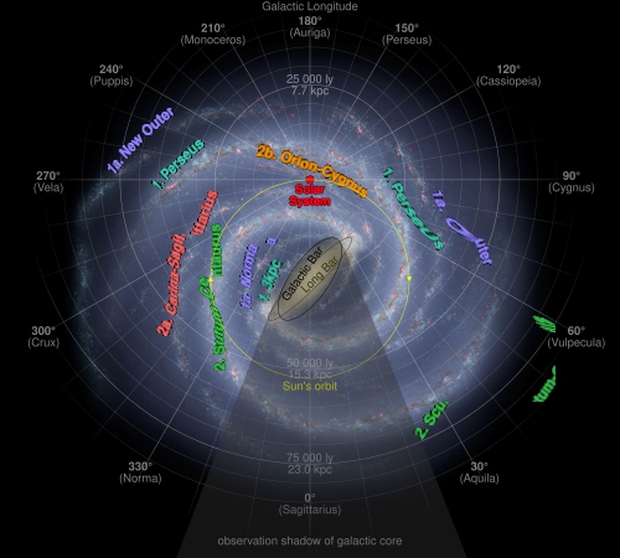
Image: Artist’s conception of the Milky Way galaxy as seen from far Galactic North (in Coma Berenices) annotated with arms as well as distances from the Solar System and galactic longitude with corresponding constellation. Note the Sun’s galactic orbit in the image. Credit: NASA/JPL-Caltech/ESO/R. Hurt derivative work: Cmglee/Wikimedia Commons.
What is particularly useful here is that our viewpoint from Earth takes in the length of the Orion-Cygnus spiral arm, which means we have the benefit of looking through one layer of interstellar material after another. The density of the gas and dust here is the key. Interactions with galactic cosmic rays make the region bright in gamma-ray radiation, but the area also is useful for studying the compression of these clouds as new star generations are born. The Cygnus Molecular Nebular Complex is one of the largest star-forming areas in the Milky Way, containing numerous clusters and stellar associations.
The persistent patterns found in the VLBA data as analyzed in this paper show the kind of distortions that mark interstellar turbulence. Lead author Alexander Plavin (CfA) explains how the quasar’s light makes the case:
“Most of what we see in the radio data isn’t coming from the quasar itself, it’s coming from the scattering caused by the turbulence in this region of the Milky Way. That scattering and the distortions that come with it are what allows us to study the turbulence and better understand and infer its structure. The most distant pairs of telescopes should not have seen the quasar image, but to our surprise, they clearly detected its signal, or faint glow. It can’t be explained by simple blurring or by the quasar itself, and it behaves the way turbulence is expected to, which is how we know we’re seeing the effects of interstellar turbulence.”
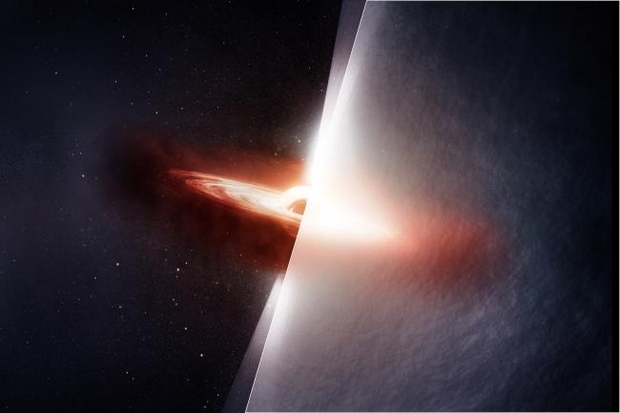
Image: Radio light from quasar TXS 2005+403 travels roughly 10 billion light-years to reach Earth, traversing the Cygnus region, one of the most turbulent and scattering environments in the Milky Way Galaxy. On the left, this artist’s conception shows the quasar as it truly appears, with a bright accretion disk and jets blasting into the galaxy like a beacon through the darkness. On the right, we see how turbulent gas distorts scientists’ view of the quasar in much the same way heat haze from a fire warps our view of the objects behind it. In a new study led by astronomers from the Center for Astrophysics | Harvard & Smithsonian (CfA), scientists have for the first time directly detected how interstellar turbulence distorts light from a distant quasar, revealing the structure of that turbulence. Credit: Melissa Weiss/CfA.
Thus the quasar TXS 2005+403 proves to be a helpful indicator, refining our understanding of the interstellar medium. From the paper (the italics are mine):
The source combines several crucial properties: (i) high flux density (∼2 Jy), enabling detections with routine VLBI; (ii) compact intrinsic structure on milliarcsecond and submilliarcsecond scales, necessary for scattering to dominate the observed morphology; (iii) structural stability on timescales of months, unlike Sagittarius A*, where intrinsic variability complicates interpretation; and (iv) strong scattering due to its location behind the turbulent Cygnus region. This detection suggests that similar AGNs in other strongly scattering regions could be identified…enabling systematic studies of Galactic turbulence and magnetic field structure across the sky. Improved understanding of scattering properties from sources like TXS 2005+403 would directly inform efforts to mitigate scattering artifacts in Event Horizon Telescope images of the black hole in the center of the Milky Way, where scattering limits image fidelity, and would help interpret propagation effects in fast radio bursts.
And what of the gas and dust our own system continues to pass through? I have my eye on a paper in Physical Review Letters that meshes nicely with the CfA work. Here, an international team coordinated its efforts through the Helmholtz-Zentrum Dresden-Rossendorf (HZDR). This German research organization maintains the DREsden Accelerator Mass Spectrometry (DREAMS) package, which allows scientists to work with radioactive isotopes that result from our Solar System interacting with the interstellar medium. Their latest work studies Antarctic ice and deep sea sediments in a range of 40,000 to 80,000 years ago in search of iron-60, which is produced in core-collapse supernova events. This radioactive isotope is a kind of smoking gun for such explosions.
The concentration of stardust graphed over time in the different layers of ice cores offers a timeline that allows us to understand our planet’s journey through different parts of the Local Interstellar Cloud. The Sun moved into the LIC several tens of thousands of years ago, and will exit it in a few thousand more. The paper makes the case that stellar debris from supernovae can persist over long timeframes within the cloud. Less iron-60 reached the Earth 40,000 to 80,000 years ago than reaches it today. As Dominik Koll (HZDR) says, “This suggests that we were previously in a medium with lower iron-60 content, or that the cloud itself exhibits strong density variations.”
The authors consider this evidence for the LIC as what they call a ‘cosmic archive’ for the iron-60 produced in supernovae explosions. Its varying levels show a changing interstellar environment over the last 80,000 years. Koll adds:
“Our idea was that the Local Interstellar Cloud contains iron-60 and can store it over long time periods. As the Solar System moves through the cloud, Earth could collect this material. However, we couldn’t prove this at the time. This means that the clouds surrounding the Solar System are linked to a stellar explosion. And for the first time, this gives us the opportunity to investigate the origin of these clouds.”
To perform their analysis, the team used ice cores from the European ice drilling project EPICA (European Project for Ice Coring in Antarctica). They moved 300 kilograms of ice to the Dresden laboratory for processing, checking their sample against the radioisotopes beryllium-10 and aluminium-26, whose abundances in the ice are well known. The Heavy Ion Accelerator Facility (HIAF) at Australian National University was then used to separate out the iron-60 atoms to detect the signature of supernovae that occurred millions of years ago.
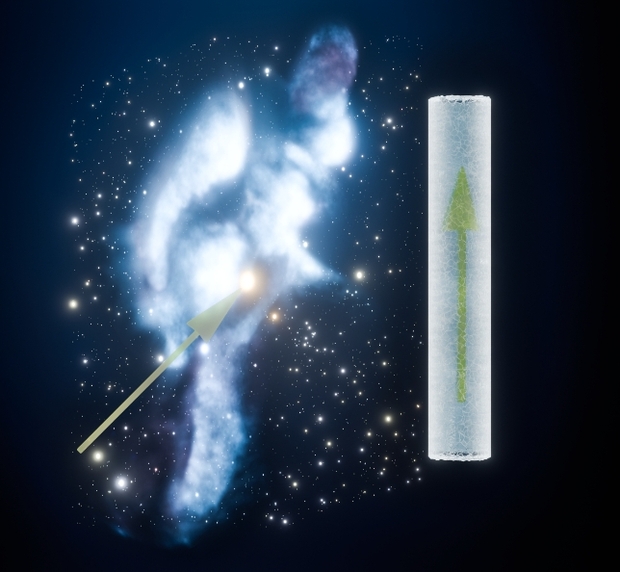
Image: Path of the solar system through the Local Interstellar Cloud. The cloud’s profile is preserved as an interstellar fingerprint in Antarctic ice. Credit: B. Schröder/HZDR/ NASA/Goddard/Adler/U.Chicago/Wesleyan.
The timescales here are striking, giving some idea of the capability of interstellar clouds to affect the stellar systems that move within them. Analyzing ice cores dating from before the Sun’s entry into the Local Interstellar Cloud is an objective for the team’s next round of measurements.
Science fiction buffs will likely recall Stephen Baxter’s writing on the matter of interstellar dust, especially in the novel Manifold: Space (Voyager, 2000). Here, dust and radiation waves kicked up by high-energy astrophysical events act to disrupt biology, a kind of galactic ‘reset’ that goes a long way toward explaining why interstellar civilizations have never been observed. The answer to the Fermi question in this novel is a non-malevolent but devastating natural phenomenon. Each of Baxter’s three Manifold novels, incidentally, offer different takes on the Fermi question, which continues to drive its own wavefront of SF plot ideas.
The paper on interstellar turbulence is Plavin et al., “Direct Very Long Baseline Interferometry Detection of Interstellar Turbulence Imprint on a Quasar: TXS 2005+403,” Astrophysical Journal Letters Vol. 1003 No. 1 (13 May 2026), L4 (full text). The paper on dust and cloud structure is D. Koll et al., “Local Interstellar Cloud Structure Imprinted in Antarctic Ice by Supernova 60Fe,” Physical Review Letters 136 (12 May 2026), 192701 (full text).

I think this part about interstellar travel is not thought about enough. Dust and gas are serious threats to high velocity craft. Luckily however there are a few remedies that would help not only small craft but large ones as well.
With a craft that relies only on ballistic travel, the challenge goes beyond just surviving the trip. Over such long distances, even a tiny error could easily cause the craft to miss the entire star system. Has the Starshot project taken this into account? If not, this issue might make the whole project unworkable.
I think there was a plan to use the ISM to change course direction a little over time by deflection, there is plenty of energy there to do it.
Good point.
The vehicle will need course corrections along the way. The destination is moving too (along with potential hazards that might lie along the way) and it is not possible to get highly accurate data on its position and speed from distant Earth. Hopefully, updated information could be obtained by observations from the spacecraft itself as it approaches its destination, or improved position determinations can be made exploiting technological advances on the home world made subsequent to launch.
It would also be desirable if the mission were planned so several destinations could be flown by, the spacecraft making course adjustments and slingshot maneuvers at each encounter to line it up for the next fly-by. A typical mission would be planned to fly by several targets, arrayed in a more or less slightly curved line and at increasing distances from earth. If the destinations were properly selected and positioned only a small amount of delta-vee would be required to hop from each to the next. This all implies that the probe would be massive enough to carry aboard propulsion and navigational capabilities, and sufficient artificial intelligence to exercise them without instruction from the home world.
I fantasize a future where at any one time mankind has multiple interstellar probes
operating and new ones departing frequently, each targeted on destinations of great interest, but also including other stars, rogue planets, and brown dwarfs along the way. These probes may have different capabilities, depending on the level of human technological advancement when they were launched. This also implies an administrative infrastructure capable of monitoring and communicating with all these spacecraft, perhaps for hundreds of years.
Right now, I’m not too optimistic this will unfold as I would like.
Just wondering if this interstellar gas could be useful to produce power for space sails going to the stars. Asking AI and you get 18 to 180 Watts at 20% c to proxima per sq meter. I suppose its whether the extra mass to capture and convert it would be worth it though.
@Michael
If the craft extracts energy from the ISM, wouldn’t that violate the Law of Conservation of Energy if the probe’s velocity is not reduced?
Where is that energy coming from – impacts of the ISM on the probe’s sail (if the probe is not reoriented to be edge-on to the motion during cruise)?
As an aside, it is possible for a land-based vehicle with a wind turbine to travel downwind faster than the wind, which seems counterintuitive but is proven. The same vehicle has also shown that it can travel upwind faster than the wind. In both cases, it relies on being able to push against the ground. Jeff Greason’s Q-Drive concept claims to do something similar; accelerating while heading into the ISM ( Introducing the Q-Drive: A concept that offers the possibility of interstellar flight. Within the solar system, it should therefore be able to outrun the solar wind, traveling faster than the SW outbound, and accelerate towards the sun on an inbound flight.)
Alex. The sail slows down but there is so much kinetic energy in the sail the velocity is reduced only slightly.
Thanks for this reminder bout the Q-Drive
I am somewhat puzzled by the idea that the LIC maintains some record of the various SN explosions, like ripples in a pond. With teh K-T event of the asteroid strike, the iridium layer in teh rocks is very sharp. A SN event will create a shell of debris moving at different velocities, which we can see with images of the Crab Nebula, as an example. Less a ripple than a long wave in the medium. In addition, there may be some turbulence, mixing the medium to increase its homogeneity.
If so, how much of a record is that within the LIC?
The sediment data in the Phys Rev. Lttrs paper does show that the high 60Fe signal is not a narrow layer in the sediment (also with potential mixing in the ocean before sedimentation, but the signal does seem to correspond to 2 ice ages the earth has experienced, as a general impact of the SN debris darkening the skies to reduce insolation.
I am reminded of other work suggesting that the galaxy (universe?) has evidence of various events reverberating through space (and time), that could be detected by instruments. The ISM could show the ripples of various major events as they spread out and echo after impacting stars and other media, offering a record of teh past if we can decode the ripples.