

While I’ve been going through early extraterrestrial ideas like those of Ronald Bracewell I’ve run back into that most unpronounceable of stellar objects, Przybylski’s Star. This one is worth a return look and I was reminded of it by author and futurist John Michael Godier on his Event Horizon podcast. I do few interviews but I’ve always admired John and Ross’s work on Event Horizon so much that I made an appearance last week. It was John who summoned up Przybylski’s Star as we moved into the broader topic of technosignatures.
Image: Antoni Przybylski in the early 1960’s. Credit: Mike Bessell (via Charles Cowley’s site).
David Kipping does a gallant job of pronouncing Przybylski in one of his Cool Worlds videos, and Wikipedia recommends pʂɨˈbɨlskʲi, which is itself a challenge. Try jebilskee, which is what University of Michigan astronomer Charles Cowley heard when he asked Przybylski himself how to say his name way back in 1964 (the reference is now offline, as Cowley unfortunately passed away in 2024). In any case, suppress the initial ‘p.’ I can’t resist reprinting an old pre-X Twitter post on the matter:
PRZYBYLSKI'S STAR (HD 101065) Blue dwarf with a peculiar spectrum showing an almost complete absence of vowels.
— FSVO (@FSVO) November 22, 2012
This star is more than a curiosity. As a matter of fact, if I were to declare the one most intriguing object in the technosignature hunt, it’s this one, although I’ll hasten to add that we’d need a lot more evidence before making that call. Przybylski’s Star is roughly 350 light years out in Centaurus, discovered in 1873 but gaining attention in 1961 when the Polish astronomer Antoni Przybylski examined its spectrum to discover that it didn’t fit our normal stellar classification scheme. I’ve seen it pegged as an F3-class star but also as an F0p, with the p standing for peculiar. If we go by effective temperature, we come up with early F-class, but its spectrum separates it from all else in that category.
It’s also referred to as an Ap star (this is Kipping’s preference), and whereas F0p is a designation based on temperature, Ap refers to stars larger and hotter than the Sun and possessed of intense magnetic fields and slow rotation rates. What to make of the star’s spectrum? It’s laced with oddball elements like europium, gadolinium, terbium and holmium. Moreover, while iron and nickel appear in low abundances, the stellar atmosphere shows the presence of short-lived ultra-heavy elements like actinium, plutonium, americium and einsteinium.
The latter were identified in 2008. Called actinides, these are elements with atomic numbers from 89 to 103 on the periodic table. They force the question of how radioactive elements with half-lives on the order of centuries or even decades could be there. How are these reactions being sustained on the surface of a star? The reference here is an important if strangely obscure one. The work of a Ukrainian team under V. F. Gopka, the paper is “Identification of absorption lines of short half-life actinides in the spectrum of Przybylski’s Star (HD 101065)” (citation below). David Kipping (on an earlier Event Horizon podcast) and Jason Wright (Penn State) have both mused on the lack of follow-up to it, even though the work seems solid and has implications in terms of technosignature searches.
We also have a 2017 paper by Vladimir Dzuba (University of New South Wales) that offers an interesting solution. The idea is that the short-lived actinides in Przybylski’s Star are the result of undiscovered superheavy elements (a theoretical ‘island of stability’ on the periodic table) which can survive for millions of years. In this model, it is the decay of these elements that produce lighter ‘daughter’ products that are found here, including such things as plutonium and uranium. A possible origin for such superheavy elements is a nearby supernova explosion whose shockwave would have fed this matter directly into the forming star.
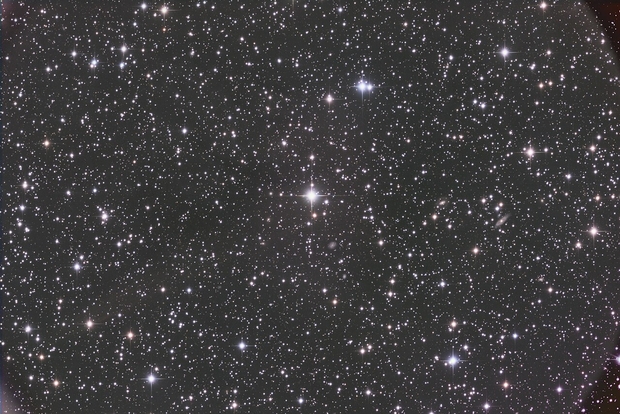
Image: Przybylski’s star, image center. By Vizzualizer – Own work, CC BY-SA 4.0,
What we’ve seen in intervening years is discussion of whether the spectral data have simply been misinterpreted, or whether a nearby neutron star might be bombarding the atmosphere of Przybylski’s Star, but there is no observational evidence for such a companion. The island of stability idea has yet to be confirmed in the laboratory, although this work continues. I’ll also mention the star HD 25354, another ‘peculiar’ star, this one in Perseus, which is now being investigated. It contains unstable radioactive elements in its upper atmosphere.
So we have an ongoing mystery, one with tantalizing reminders of a 1980 paper from Daniel Whitmire and David Wright called “Nuclear waste spectrum as evidence of technological extraterrestrial civilizations.” Here the concept is using a star as a repository for radioactive waste. The authors homed in on A stars as being likely candidates. I suspect they were thinking about Sagan and Shklovskii in their book Intelligent Life in the Universe (Delta, 1968), where the authors speculate on the possibility of ‘salting’ a star to call attention to it, a kind of interstellar beacon. Look, a civilization is saying, there is intelligence near this star.
I mention Sagan and Shklovskii pointedly because while both are frequently fused into a single entity in later descriptions of their era, the duo had profound disagreements on a lot of things, especially the kind of SETI embodied in the Drake Equation. On the matter of ‘salting’ a star, it’s Sagan who references Shklovskii as well as a separate Drake paper on the concept, not claiming it for himself. From the book:
Drake and Shklovskii envision the dumping of a short-lived isotope – one which would not be ordinarily expected in the local stellar spectrum – into the atmosphere of the star. In any case, the material of the marker should be of a type that is difficult to explain, except as a result of intelligent activity…. Remarkably enough, the spectral lines of one short-lived isotope, technetium, have in fact been found in stellar spectra… This example illustrates one of the difficulties with such a marker announcement of the presence of a technical civilization. We must know a great deal more than we do about both normal and peculiar stellar spectra before we can reasonably conclude that the presence of an unusual atom in a stellar spectrum is a sign of extraterrestrial intelligence.
So could the spectrum of Przybylski’s Star actually be a technosignature? You can see how difficult this problem is considering the rarity of this kind of star. Even so, a look at The Catalog of Ap, HgMn, and Am Stars reveals over 8,000 ‘peculiar’ stars, ranging across the temperature scale. I dug into the catalog with AI to learn that Ap and hotter Bp stars are the largest subgrouping, both characterized by unusually strong magnetic fields. There is much work here for aspiring graduate students because we need to learn whether the actinides at Przybylski’s Star are simply a rare natural phenomena or a technical marker.
Przybylski’s original paper on the star is “HD 101065-a G0 Star with High Metal Content,,” Nature Vol. 189, Issue 4755 (1961) 739 (abstract). Jason Wright’s three-part essay on Przybylski’s Star is well worth your time. The paper identifying actinides in this star is Gopka et al., “Identification of absorption lines of short half-life actinides in the spectrum of Przybylski’s star (HD 101065),” Kinematics and Physics of Celestial Bodies Vol 24, Issue 2 (April 2008) 89-98 (abstract). The Whitmire and Wright paper is “Nuclear waste spectrum as evidence of technological extraterrestrial civilizations,” Icarus Vol. 42, Issue 1 (April 1980), 149-156 (abstract). Vladimir Dzuba’s paper is “Isotope Shift and Search for Metastable Superheavy Elements in Astrophysical Data,” Physical Review A 95 (30 June 2017), 062515 (abstract).


Perhaps the star was caught in a neutron star merger beam which shot gunned the star with these heavy metals. If I can remember F type stars have very poor to no convection so elements would stay in the outer reaches for a very long time.
The concept of extra-terrestrial cultures deliberately announcing their presence by seeding stellar atmospheres with short-lived radio-isotopes has always intrigued me. Even if natural mechanisms can be suggested to explain these bizarre spectra, it is still obviously worth following up.
Has anyone calculated the amounts of these substances that would have to be introduced to a star’s atmosphere to exhibit these displays? How often would these materials have to be supplied, and by how much? How long after the seeding is stopped will the spectral signature still be detectable?
I suspect these anomalous signatures have a more conventional astrophysical explanation, but that they might be technosignatures, either deliberate or accidental, cannot be ruled out. This is precisely the sort of thing we should be looking for!
And in the event no BEMs or LGMs turn up, the effort will not be wasted. Its still very good science that needs to be done. Its a lot easier to get SETI searches funded if they can be justified as conventional legit research.
Hi Paul
Przybylski, it’s pronounced simply “pchee bill skee”…it’s a grandson of Poles who tells you so :)
A first reading of your article suggests two things to me: are we assuming an ETI that brings materials to the star or is the ETI modifying it ? one could then suppose two levels of technology of this civilization: in the first case, mass production of this matter; in the second, a very advanced ETI to the point of being able to modify a star…
Thank you for that pronunciation lesson, Fred. Much appreciated, and clearly coming from one who knowsl
I searched info about Przybylski star from time to time. It’s remarkable, but really it is much less bizarre considering it is an extreme case of known extreme population, Ap stars. Photo-levitation in a calm atmosphere makes all susceptible elements float up from the stellar bulk and concentrate in the thin atmosphere, so there could be insane abundances of them. Other elements likely sink below and concentrate in the stellar core, making them seem depleted. The slower is the stellar rotation – the more it is efficient, and Przybylski’s star is an exceptionally slow rotator (although there are some ambiguities). It is indeed difficult to infer bulk composition from atmospheric data for these stars, even basic properties become ambiguous.
Technetium in stellar spectra is well-documented case, but it has enough half-life to be photolevitated from the edge of stellar core where it is created from neighboring elements; there is nothing unexplainable about it.
I took a look at Przybylski’s star spectrum in several articles; it’s jungle on a swampland, lines upon lines upon lines. The bottom line is that short-lived actinide detection is very unreliable and all other peculiarities are explainable. We have only the most basic knowledge of einsteinium lines in the stellar atmosphere conditions, and candidates are completely swamped by lanthanide lines, many of them likely not documented. It’s needle in the haystack packed with other needles.
I’d love to know how MUCH of a short-lived actinide one would have to drop into a star in order for it to have visible spectral lines across interstellar distances. Are we talking about a few hundred tons — something you could do with existing rockets if you talked the right tech baron into backing the project? Or does this require planetary masses of the stuff?
I’d like to know the answer to that too. Would depend on the size of the star as well, and probably other stellar characteristics.
What if there is a miniature black hole orbiting inside the star? Its small size and high momentum would keep it orbiting for a long time, and unusual fusion reactions could take place in its accretion disk.
A major problem with the alien speculation is this star is only 0.1 Gyr old meaning insufficient time for life to have evolved on any planet in orbit.
I’d check that again. What I’m seeing is 1.5 Gyr plus or minus 0.1 Gyr.
The ETI doesn’t have to be located in that star’s system, any more than we put landfills in our cities. While it could be a good place to dump such “refuse” for some reason, transporting it across interstellar distances does seem rather wasteful. I doubt that such an explanation is warranted.
I don’t find any of the explanations very plausible.
As we have seen with stars consuming rocky planet debris that generate the relevant spectra, it takes a lot of material to create the signal. The relatively short half-lives of some of the identified elements suggest that ETI is nearly “constantly” adding material to the star. Is this material so valueless that it is worth doing this, rather than its decay products? For example, Uranium decays down to lead. Wouldn’t this be obvious in the spectrum, too?
That many other stars have similar spectra seems to rule out ETI, unless the galaxy has many such civilizations all doing the same thing. That would seem highly improbable.
What about a nova or supernova creating these elements? Unless these explosions are very common, this would seem to rule out this as a phenomenon unless all the stars with this spectrum are close by, rather than scattered throughout the galaxy.
What about the idea of relatively stable elements decaying to shorter half-life elements? I was hearing about the “stable island” of elements since I was in school in the 1960s. Despite all our efforts, creating any of these elements has not been achieved. There may even be issues with the modeling that suggest such a stable set of high-mass elements exists. It would be excellent if advanced technology or stars could create them. However, we do not know what their spectra would look like, so there is no way to test their presence currently.
One issue is whether there is a possibility that the elements have been misidentified. This has happened before and may well still be happening.
We should try to rule out natural phenomena before reaching for ETI explanations. How do we do that? Alternatively, how would we detect ETI activity seeding the star[s] with the detected elements?
It seems to be a puzzle, although I would bet on a natural phenomenon being the correct explanation.
A super nova explosion has to be within thirty light years in order for the element to get there in the necessary amount of time. The actinides are “daughter particles of a longer decay chain of radioactive elements. Thorium, Uranium, Plutonium. These could have been in the stellar nebula which formed Przybylski’s star. They were already very old and ready to decay. They the actinides decayed in the right time inside the star and will still decay into other elements stable and unstable?
In other words one does not need a nearby supernova explosion for actinides to be in stellar spectra. There were from long lived radioactive isotopes created in supernova explosions, kilonova explosion billions of years earlier and part of the gas clouds of interstellar space which made Przybylski’s star
Excuse me, it’s not the half life of the actinides, but of the parent nuclides which are long lived were already in the star.
It occurs to me that if there is some natural process making very heavy elements in large amounts . . . we really ought to learn more about that! Might be the first time astronomical research produced something patentable!
And evidently making them near the stellar surface, where temperatures shouldn’t be sufficient to allow this. Could be interesting indeed in terms of new technologies here on Earth if we can figure out what’s happening.
The idea of stars manufacturing super-heavy elements is reminiscent of Samuel Delany’s novel, Nova, where the energy source Illyrion is collected from stars that go nova.
Not the first time.
Isaac Newton based all classical physics on astronomical research (the laws of gravitation were inspired by the orbiting moon, not by falling apples). Fortunately, the business majors never figured out how to patent that either.
There is a theory that there is a neutron star in orbit around it, but there is no known x-ray or gamma source near it. Perhaps it is an old neutron star with rocky material occasionally falling onto it. The material then gets shot out and hits the star every now and then.
It would be a spetroscopic binary and have center of mass which would be detectable through radial velocity and astrometry including the x rays from the neutron star. There is no such reported evidence, but its worth a look.
It seems to me that the key-question is : “what provides sufficient energy to the star to create these heavy materials? (E=MC2 ;)
does it come from the inside via the very slow rotation of the star? from the outside via magnetic fields or a combination of both? we can also add the idea of supernova residues which I like…
I lean rather towards a natural phenomenon because of the specific characteristics of this type of star.
That’s a great question. All elements heavier than iron can only be created in with the excess energy of a supernova explosion or a Kilonova explosion, but not in stars through fusion. Not any metals heavier than iron can be created because iron does not liberate energy, but only absorbs it. Large stars have layered cores with elements heaver than oxygen, like neon, sulfur, silicon, but stop with the fusion of iron. The iron core builds up until it becomes the size of Earth and then implodes and rebounds blowing of the outer layers of the star in a type two supernova explosion. Iron core is compressed under high temperature 100 million k and iron atoms absorb neutrons which than decay into extra protons and we get cobalt 57. The other heavier elements beyond iron are formed the same way through neutron capture and decay into extra protons. Copilot AI, but also Filippenko, Ingliis, Astronomy Magazine.
@Geoffrey Hillend
Any mechanism (insufficient energy, etc.) that apparently prevents the high atomic number superstable elements from forming? Or do they form, but we have no way of detecting them, as we have no matching spectra?
Atoms and molecules have to be exited so they emit or absorb radiation in order for use to see it as spectral lines. If the atom is not excited then there is no way to detect them. This is called absorption when the light is missing which looks like a black line on the rainbow spectrum where some of the color the light is blocked, or emission spectra where the lines which is EMR. These are the actual energy levels in the quantum jumps of the atoms. In Stars these would be emission lines.
With the electron of a particular atom absorbs energy it makes quantum jumps to a higher level to make absorption spectral lines. When the electron falls back down it emits light or EMR at the exact same wavelength called emission lines which is what happens when we heat up an atom. The heavier the atom the more the lines because these are the actual energy levels in the quantum jumps, the ground states and the higher jumps. Therefore every atom has a unique spectra which is recognizable.
So you are saying that a spectrum to identify such stable heavy elements can be computed and therefore recognizable. Why don’t we see those spectra?
Which gets me back to the first part of my question. Why do we not find/see these stable elements? Shouldn’t they exist somewhere, even in tiny quantities? Is the energy needed to create them insufficient, even from a supernova? Or is the stability just a relative term as a number of the created high atomic number elements decay in a fraction of a second? Oganesson (atomic # 118) decays in less than a millisecond.
This Wikipedia page suggests that the half-live lengths might be quite short for the elements in the island of Stability. But nobody knows for certain. If short, then this explains why there are no detected stable super0heavy elements, and only their decay products.
Island of Stability
We don’t see the actinides with a ordinary, visible light spectrometer. We have to use an ray spectrometer since the actinides are heavy elements and they absorb and emit x rays in their inner electron shells which are core electron energy levels which are higher energy. X ray spectrometers still show spectral lines due to the electron shell energy levels just like ordinary spectrometers, visible light. We can’t see x rays with our eyes or an ordinary spectrometer which is in the invisible part of the EM spectrum.
Thanks Geoffrey. Okay for the external energy supply from a supernovea, but could it be that an internal mechanism at the heart of the star has initiated the process? what do we really know? I am not a specialist; I remember my chemistry classes on electronic layers, but I wonder…
I believe the reason being is the binding energy between protons drop with Iron so energy is not liberated but absorbed. Ibid. Neutrons also have not charge so they aren’t affected by the electromagnetic repulsion of like charges of protons since like charges repel
https://ui.adsabs.harvard.edu/abs/2002ASPC..279..351K/abstract
This article shows that the heavy elements in the star can “simply” have a mechanical explanation: its stable or moving inner layers; its pulsation; the powerful magnetic fields around it and a rather high temperature generate these elements. Why not? In a way, it recalls a bit the idea of creating high-temperature plasma by confining matter in high-intensity magnetic fields. Would these rare stars have a specific “role” in the universe?
If I read correctly despite my poor English (too many draw in english lesson ;) the controversy comes from the fact that our astrophysicists can’t agree on the data because the star doesn’t fit well in “our drawers”… but it’s good: if we knew everything, it would be too easy :) (the dialogue of the 1975 symposium is funny)
The ETI hypothesis is attractive, but once again, I find it hard to believe with HD101065: at random: how would the ETI “salted” the star with its “dump truck” spacecraft through its powerful magnetic fields?
PS: I would have liked to see the star’s spectrum but I didn’t find it
Where is Stanislaw Lem when we need him?
Maybe I missed this in the above: Przybylski’s Star rotational rate appears to be one of its anomalies. About 3.5 km/sec. That would get you Mars easily enough from Earth orbit, but among stars that is really slow.
At “birth” here is an estimate:
Km/sec
O5 190
B0 200
B5 210
A0 190
A5 160
F0 95
F5 25
G0 12
The sun rotates at about 2 km/sec these days. Which makes P’s star unremarkable in comparison – at first glance.
It could be that the braking mechanism, whatever it is, provides the anomalous products. Compared to the sun Przybylski’s Star is relatively young, but has done a fine job of slowing itself down. (Cough, cough).
This observation does not necessarily solve the problem, but maybe it re-states the issue in a form which allows a narrower range of hypotheses or less need for
ET’s intervention. Unless they somehow were on the brake pedal since the star’s formation.
Miłego dnia!
Beyond the notion that the retarded rotation rate and the presence of strange trace elements are detected in the atmosphere are connected, it would suggest the next question that arises is whether Przybylski’s star has a significant convective region close to the surface. A convection region, basically, would be a “boiling” region of given radius, away from the center and perhaps detectable at the surface. The obvious argument for the convective region in this case is the presence in the upper stellar atmosphere ( or visible surface) the odd isotopes in question. Main Sequence stars of A spectral properties should have such – though this could be an exception. But if so, then the anomalous isotopes observed might be drawn up via convection to the surface – and also be related to the braking mechanism – whatever that is. Convection speeds the circulation of isotopes of the interior to the surface, but human lifetimes could pass between the start of the radial upswing and the observation. But still, in the process of stellar rotation, some kind of mechanism appears to be dragging its feet and generating a lot of strange isotopes to send up to the surface. Sounds a little like repeating the obvious, but it is a case against LGMs disposing wastes from their activities in the vicinity.
As deGrasse Tyson pithily said in another context (UFOs, but I think it applies here as well):
Hello, AT.
Since it is heartening to think that stellar internal processes might be on the right track here, I wondered whether I should rock the boat with some contemplation of deGrasse Tyson’s dictum. I
According to the Wikipeidia naturalists confronted with the problem of the platypus after its discovery in 1798,
” A pelt and sketch were sent back to Great Britain by Captain John Hunter, the second Governor of New South Wales. British scientists’ initial hunch was that the attributes were a hoax. George Shaw, who produced the first description of the animal in the Naturalist’s Miscellany in 1799, stated it was impossible not to entertain doubts as to its genuine nature, and Robert Knox believed—because it arrived in England via the Indian Ocean—that it might have been created by Chinese sailors. It was thought somebody had sewn a duck’s beak onto the body of a beaver-like animal. Shaw used a pair of scissors to check for stitches.”
So, I’m holding out for a platypus or two out there, assuming that most of the skeptics were pleasantly surprised to discover that the specimen was genuine.
Best regards,
wdk
Of course there have been many hoaxes too. The Fiji Mermaid, Piltdown Man, and most recently, the “Alien body” supposedly recovered from a crashed UFO. There was the claimed yeti skin that was simply mistaken. There have been several washed up “sea monsters” that were known species when properly analyzed. I doubt there are lake-bound prehistoric reptiles like the infamous “Nessie” that draws tourists to Loch Ness.
I once knew a neurologist, a self-proclaimed dinosaur expert, who claimed those feathered dinosaurs found in China were fakes. Sometimes reality is difficult to accept if they are counter to accepted experience. We know so little about life in the deep oceans, that we are bound to find new species that look very strange to our eyes. Unexpected animals like the platypus may well still be out there in remote places waiting to be discovered.
Fortunately it is much harder to fake specimens today given the tools we have. The “Fiji Mermaid” would be detected as a fake very quickly today, using X-rays or DNA analysis. An alien body, even an artifact, can only be faked on images and video. Once the body or artifact is physically subjected to analysis, a fake would be rapidly exposed. If a UFO is shot down, then let’s have the remains subjected to analysis. Just showing the video as a teaser is pointless. It proves nothing. We have science and instrumentation at our disposal today. Teasing us with no access to objects and dead speciments is deliberate misinformation.
Going back to the convection zone and the bubbling up of rare isotopes for spectral detection, I have tried to get some quantitative picture of a normal main sequence A star’s convective zone properties. No success so far – other than that they are features of them. But there could be some investigative opportunities assuming that these short lived isotopes are bubbled up to the surface.
For one thing, since they are short lived, then there is the question of how long it takes for materials to traverse the convective zone. And that’s not an easy question to answer. This star has a radius greater than the sun, maybe a time and a half which makes the radius greater than a million kilometers. The speed of sound in an atmosphere might be kilometers/sec, but convection “bubbles” cycle to the surface. If the convection zone is 500,000 kilometers deep, it’s a longer trip than from Earth to Moon lengthened by driving around in dozens, hundreds, or thousands of circles. That decaying, unstable isotopes make it to the surface in detectable quantities, it gives clues about the convection process too, perhaps the length of the trip from the radiative zone below.
…Maybe someone is running the equivalent of an NMR scan?
“Remarkably enough, the spectral lines of one short-lived isotope, technetium, have in fact been found in stellar spectra… This example illustrates one of the difficulties with such a marker announcement of the presence of a technical civilization.”
Assuming that usage of “Stellar” refers to Sol, one possibility that should be considered is that some interstellar civilization injected some into the sun, perhaps as some form of marker maybe to say “already visited” or “They know their planet is starting intense global heating, and how to try to prevent it, but are too greedy or too stupid to do it.
Wouldn’t a simple orbiting beacon be a better and more informative approach for such a warning? We put up warning signs rather than spraying bright dyes, paints, or radioactive matter onto dangerous or contaminated areas.
Maybe ETIs have a common warning sign language like HAZMAT signs, but for a wide variety of situations. Where information needs more detail, there may be extra information in various common lingua francas of the galaxy.
[Maybe those stars with heavy element signatures also have beacons warning the perpetrators to remove their “trash” or there will be consequences.]