
Watching Artemis lofting skyward I relived the Apollo launches, experiencing feelings that no subsequent missions ever engendered. Artemis involves taking humans back into exploration mode with our spacecraft. Getting people out of low-Earth orbit again is a thrill despite the astonishing cost of the SLS launch vehicle. Obviously finding alternatives that would make more frequent flights possible has a major place on the agenda if we are to contemplate a continuous presence on the Moon, not to mention Mars. But for now, what a kick to see that big bird climb.
The distance between actual goals and dreams sometimes shrinks, and we saw recently that Breakthrough Starshot has made serious progress in developing the engineering concepts for an interstellar flyby. Both Artemis and the evolving Starshot design remind me that while most of the population in any era does not venture far from home, there are always a few who do, and those few change the shape of their civilization. Spaceflight obviously demands hardware and missions. Just as obviously, it demands scientists working on ways to push the envelope to attain still more distant goals. And it demands informing the public about where we are.
Be aware that Jim Benford’s recent interview on the matter is now available online. It’s part of a series of presentations offered by Paul Davies, Sara Walker and Maulik Parikh from the Beyond Center for Fundamental Concepts in Science at Arizona State University. This interview powerfully makes the case for funding Phase 2 of the Starshot program and developing early prototypes. The public needs to know about what has been accomplished and what steps lie ahead.
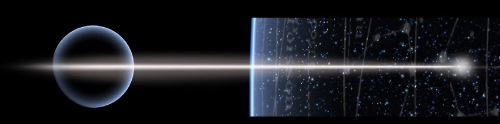

Having seen Jim Benford’s presentation and the questions David Blair had on that presentation, I watched Blari’s presentation on the “impossibility” of starflight.
My sense is that he used rather strawman arguments to support his points, most of which could be addressed or sidestepped with possible engineering. A good example was his claim that the radiation intercepted by the front of a starship (the size of a Breakthrough Starshot?) would destroy the vessel. However, this can be almost entirely circumvented by rotating the craft to cruise edge on, nassively reducing the surface for particles to impinge on teh surface. For larger ships, a shield can be deployed, much as Clarke’s Magellan used a huge seawater shield to be eroded by the particles in The Songs of Distant Earth. I will leave others to watch Blair’s rather lame reply on this.
Blair does use Bracewell’s findings to introduce his case, although I am not clear how relevant this is, and I believe he misrepresented Bracewell’s chart on the numbers and longevity of civilizations and the distance between them. The Kepler data he uses to support Bracewell’s claim has nothing to do with civilization, of course. [Ref The Galactic Club – Intelligent Life in Outer Space (1976), Fig 9, p62 ]
Bracewell has a chapter in his book: “Twelve: Is Interstellar Travel Possible?”
He accepts that a shield may solve the radiation issue Blair raises. His main argument is the famous racket equation, and the needed mass ratios to reach 99% of c. Yet he then finishes the chapter with the Project Orion concept and a slower travel time, which bypasses his main arguments! Methinks Blair might have read to the end of that chapter before being so reliant on the radiation issue. I thought it was a relatively weak talk, so dismissive of what is a very difficult technological and engineering project, even when machines are doing the mission, not humans.
Blair’s talk for the series is “Interstellar Travel is Bunk!”
The intersection of bubbles can form a flat plane…perhaps alternate polarisation can have the beam pass through to clear the path ahead….bubbles forming some protection.
Here is perhaps a way to stop beam firehosing:
https://phys.org/news/2026-04-compact-flat-lens-generate-nondiffracting.html
The usual media articles on “Why are we going back to the Moon – didn’t we already win that race before?” are tedious. We could have made the same argument when Amundsen reached the South Pole before the ill-fated Scott expedition. Yet today there are many national bases in Antarctica, doing research in a myriad of sciences. If we can get past the race meme and understand that there is exploration and science to be done with a lunar base, and possibly commerce too.
As expensive as the SLS is for the first Artemis missions, it is almost a rounding error compared to the costs of our military spending (and the budget increases requested), and a fraction of what has been spent on just a month of war in Iran. There is no social ROI from war; only the arms manufacturers like war to boost their bottom line. Over the longer term, the Artemis missions will generate a better ROI for society than war.
I’m very pleasantly surprised by the public reception the Artemis mission is getting; it seems a great many people find space exploration inspiring and hopeful in these troubled times. All is not yet lost.
Some of the SLS hate is waning.
Lunar Starship is nowhere in sight, and yet another Raptor has exploded:
https://m.youtube.com/shorts/ILsUTgpsN3A
SLS is the Sport Ute rich uncle Ted bought you, when you wanted a coupe.
It might be so he could show off this or that…but it doesn’t matter.
What you do is say “thank you” instead of kvetching because you might wind up with 100% of nothing instead.
Meanwhile, there is good news on the laser propulsion front:
https://phys.org/news/2026-04-parabolic-flight-lasers-propel-graphene.html
https://advanced.onlinelibrary.wiley.com/doi/10.1002/advs.75050
Trust me, Americans need a positive boost these days. They will take it wherever they can get it.
This also explains to reaction and reception to Project Hail Mary. Even fake aliens that look like rock spiders are welcome.
Gossamer structures can have great strength
https://techxplore.com/news/2026-04-bio-impact-resistance-energy-absorption.html
But I understand some junior Trumps made suspiciously timed investments in arms companies.
Though I love the idea of a laser sail or laser system for that matter a particle beam propulsion is not given as much attention. Surprisingly the divergence of a 100 gigawatt lead ion beam with a frontal surface area of 1sq meter and a time dilation factor of 7500 as in the LHC allows very little beam divergence (magnetic field ignored). This beam can then be concentrated to cause fission or fusion in a much larger craft or just interact with a magnetic field. I put the numbers into the AI mode and it looks sound enough.
@Michael
Over what distance is the particle beam accelerating the craft? Are there any issues with interacting with gravity, making tracking difficult? Is it a neutral beam or a charged beam also subject to magnetic fields?
Do you have a pros and cons list?
Gravity would affect the ion beam just the same way as with light as its going close to it in velocity. Its a positively charged beam and will interact with a magnetic field but it is going so fast the deflection would be small, its time dilation is 7500. The beam can be over very large distances but will interact with gases and electrons in the medium and diverge more.
The discovery of Saturn’s lopsided field an the immense power of Jovian superbolts needs looking at.
Upward superbolts can end as Blue Jets here.
There is a MASSIVE new laser development
https://phys.org/news/2026-04-megawatt-optical-vortices-array.html
Info inputted to AI mode
What is the mass of lead needed to have the kinetic energy of 100 giga joules and a time dilation factor of 7500 (this will give a 100gigawatts if continuous)
Answer 0.148 micrograms
What spacing of lead atoms of 0.148 microgram spread within a cylinder of length 300000 km and a frontal area of 1sq meter
Answer 0.00887m
What is the outer surface ions final velocity of singularly ionised lead of 0.148 microgram spread within a cylinder of length 300000 km and a frontal area of 1sq meter and with an atomic spacing of 0.00887m
Answer~278m/s
If we use the dilation factor of 7500 it hardly deviates over the second it takes to go through 300 000km of space.
I know AI can make mistakes but I cant see it this time, the method it uses looks ok.
@Michael
Can you explain this metric?
The value cannot be the velocity perpendicular to the beam, as it would indicate that the beam disperses far more than the area of the target. What is it exactly?
The particular particle accelerator has to be far out in space, well away from any residual atmosphere that would disrupt the beam. What sort of accelerator would be needed – something the size of the LHC to get to near c velocity? Would it be best placed (and built) on the Moon? Any sense of the cost of such an accelerator?
The particles themselves would have the impact and radiation of the ISM particles that Blair indicated was a showstopper for interstellar travel. Would the craft survive the impact of the particles or vaporize from the impact, especially when the velocity differential is at its highest at the start of the acceleration ramp?
Imagine the rod stream of charged particles expanding outwards due ion repulsion but the time dilation is very high, which reduces the expansion by that amount. It would probably be a mix of LHC and a linac but high time dilation is required to slow the dispersion. By increasing the waist of the accelerator to10sq also reduces the dispersion. The power of the beam say 100gigawatt in 1sq would simplify blow a hole in the ISM and it would need building in space.
Its going to be big and expensive but dispersion is not a limiting factor as much as people think. For 7.5 TeV linac it will be thousands of kilometres long but increasing the waist dramatically lowers the dispersion and therefore the time dilation required (lower length). Catching the particle beam will have to be with superconductors and highly charged plates.
The vomit comet is already hard at work:
Parabolic flight test shows lasers can propel graphene aerogels in microgravity.
https://phys.org/news/2026-04-parabolic-flight-lasers-propel-graphene.html
It’s amusing to read this paper from the UAE where they move a very light sail material under weightless conditions propelled by a very small laser power to move 2 inches!
They don’t know the literature on this subject at all. They seem oblivious to the fact that my team did far more than that under one gravity 26 years ago: On April 5, 2000, we achieved first flight of a beam-driven sail, at JPL. Sails of carbon micro-truss, driven by a microwave beam, were accelerated up to 13 gravities. That same year, on December 8, the Leik Myrabo team, using a carbon-dioxide laser, flew molyebdenum-coated carbon sails at 1 gravity above liftoff, giving velocities up to 3 m/sec.
I had noted the results in the paper, but I hadn’t twigged on the source being predominantly the UAE. The Gulf states are doing a lot to wash their poor reputations, from sports franchises to attracting filming of TV shows and movies. The UAE is especially attractive to the wealthy (although the current Gulf War, with attacks on Dubai, may put a dent in that last).
While it is a Wiley imprint, the predominant submissions and readership are from China, which may be relevant. Journal metrics
About Artemis: I followed part of the launch with emotion, obviously thinking about Apollo 11. However, if the theory of the flight is the same, technology has changed a lot. So it’s an exploit first of all to succeed again this type of mission while integrating new things.
Seen from France, the launch made only one comment in the media, but was quickly forgotten. Only a few specialized magazines mention it (the equivalent of “sky & telescope” mag)
To have a global idea: 90% of the population here never looks up at the sky and is not interested in space; we are 8% passionate about it; 2% remain scientists.
What captivated the world in 1969 – and created a true planetary communion for the first time in human history – is now only “consumable” that we look on social networks to quickly move on. Sensationalism isn’t sensational enough, so we’re not looking any further. People do not realize the incredible difficulties – and risks – that they have to overcome to send these rockets, even with the experience gained.
Worse: I’m sad to have heard again: “What’s the point of sending people ‘to’ the moon; aren’t there more ‘urgent’ things to do?” ; all that is money thrown out the windows, etc. I’m not even talking about the comments saying that Apollo 11 was just a huge studio rigging done with S. Kubrik… I read it here in 2026 ! All this is very sad and socially, it reflects a lot of things…
The launch of a rocket – with human crew – has become completely commonplace among the population in France, perhaps because of the “Arianne-Espace” launchers but also because our astronauts are not raised to the rank of “superheroes”. (unlike the staging of Artemis :) I remember Patrick Baudry who still made us dream in the 80s, but today Thomas Pesquet, even if he has a small reputation, or Sophie Adenot, currently bording on the ISS, are almost unknown. Astronautics has lost some of its magic because the power of the media prefers to look for sensational material elsewhere, which does not develop vocations. The spirit of adventure and what it can bring is no longer with us :(
if I were talking about the solar sails propelled by laser here, I would immediately be taken for a madman :)
I wait for the return of the Artemis crew, passing on the sentence from JFK in his speech by Rice in 1962…
The French don’t look up at the Moon? Well, this has punctured one of those traits that I thought the French had. ;-(
Hi Alex
A few numbers overall: France: population 67 million in 2026. ~ 70,000 “curious about the sky” or 0.104% (you can find anything in this category); ~3,000 equipped amateurs (0.004%); 300 amateur astronomer-researchers; <1,000 astrophysicists. There are no official figures, but this gives an idea.By comparison, there are more than 2 million football licenses in France, or <3%
I’m sure that if we interview 10 people here on the street, 8 don’t know S. Hawking or C. Sagan and maybe H. Reeves.
Only one major mainstream astro magazine (https://www.cieletespace.fr/)
Only one major online forum. (the "webastro" website doesn't work this morning !) where there's I didn't found not really some thinking but mostly some comparison beetween equipment : what is the best teslescope…the rest are quarrels over whether public lighting hinders astronomy or not ! …boring.
~500 amateur clubs but many have only less 50 members. The best known and oldest club is the French Astronomy Society (S.A.F).
The Paris Observatory offers high-quality public information https://lte.observatoiredeparis.psl.eu/?lang=en
I was just writing to Paul that few of your cosmologists' books are not translated into French, except for the most well-known ones (Hawking, Reeves) The days of Jules Verne and our engineers who built the "Véronique" rockets are long gone… they’re at MIT;) Many people in the world have an image of France that is no longer at all what it was. The country is in a catastrophic state and we are sad about it.
Honestly, I’m bored in France and if the world wasn’t so unstable, I might prefer to live in the USA or Canada… that’s why I’m reading CD :)
You’re always welcome over here, Fred! Your comments on France are disheartening, to say the least, especially for someone like me with so many wonderful memories of Provence and the valley of the Loire.
@Fred
Haven’t film star George Clooney and his wife, Amal, moved more permanently from the USA to France, including getting French citizenship? Granted, they have a lot more money than most people, and Amal may be subject to a refusal of entry to the USA due to her association with the ICC that POTUS hates. From what I read, politically, the French are splitting into a similar right vs. left in the countryside and cities as in many countries. Macron is not popular, and Le Pen, or a proxy, is hoping to win the presidency in a few years. Boring? Maybe in terms of doing things in space. As elsewhere, isn’t France caught up in the apocryphal Chinese curse, “May you live in interesting times”?
Politics can be annoying but it needs to be solved really before we can get together to go other star systems. And BTW the UK bans figures entry as well already, free speech…when it suits them…
I don’t want to go down the politics path, but I do want to correct what I think you have said.
The US is blanket-banning groups from entry, especially Muslims. It is also targeting people for deportation, en masse. Sanctioning and banning people from entry for a variety of reasons, but mainly because the POTUS doesn’t like what they do to his friends (ICC wanting to try Netanyahu for war crimes) is about as bad as it gets. AFAIK, the UK only bans entry to individuals for saying and doing things that are unacceptable in the UK. Anti-Semitism is one such, and that is why Kanye West was denied entry to the UK.
General comment:
Having said that, there has been a sorry authoritarian drift in the UK, most notably regarding what and how protests can be staged, which is unrecognizable from the situation when I was growing up in England. I don’t want to see a return to openly fascist movements in the UK, like Mosley’s British Union of Fascists in the early 1930s, and being attempted again under a “free speech” banner, or a law enforcement response to protests like the Peterloo massacre in 19th-century Manchester. The US seems to be retreading the path to the American Revolution, with the federal government acting like the British troops in the 18th century, whose actions helped foment the war that eventually broke out. It is remarkable how similar the actions of the POTUS and his advisors are to those of King George III and his advisors at that time. I’m not a historian, yet I find it remarkable how easily we seem to repeat the same mistakes of the past. Is it just ignorance, or more like in finance, “This time is different.”?
Well it is not the ‘right wing’ that’s throwing the Schicklgruber salute about, its the left wing along with their antisemite rhetoric. How these political and religious differences will affect space travel I am not sure about but it is not a non zero value.
Hello, Fred.
These are reflections on Artemis as much as starshot ventures, n’est pas?
Well, in that spirit I would like to reminisce as well with various tie ins.
One would think that going to the moon we had undertaken something akin to heading to another star – at least in the intervals involved between mission sets.
In 1968 for Apollo 8, I was a serviceman in Germany and the mission captured my imagination so much that I dreamed of it many times in the weeks before. The Life and Look magazine accounts left some sort of shortfall in my mind – so much so I searched for the more detailed descriptions of the vehicle and preparations in Paris Match and maybe L’ Express, obtained at kiosk at the Frankfurt rail station. A century after Jules Verne it appeared to me that la France still enjoyed the idea of les voyageurs a la lune. But subsequently, in the barracks and in the day room on the day of landing there were crowds of us watching and recording. My own initial reaction watching Neil Armstrong and Buzz Aldrin at local time around 3 am was, “Take that shovel and dig in!”
A couple more years and I was back in the States and taking aerospace engineering classes. The crew of Apollo 15 arrived at the campus for football Homecoming day since they had ties to the school. A strange feeling back then to have watched someone ride a buggy on the moon and then to shake hands with them a few weeks later.
Professor Harm Buning (my favorite instructor and adviser back then) taught several classes and one of them was the astronautics that detailed lunar flight.
I signed up for it and, there was a surprise toward the end that December of 1972. Since he taught the same class more or less on temporary duty or sabbatical to astronauts in Houston, he had scored tickets for the class to the Apollo 17 launch. After a day’s drive in car pools and sleeping on the beach we arrived and edged all the way up in the viewing area to the last cordon between observers and Pad 39. The genuine VIPs sat in bleachers half a mile behind us.
With solid rocket motors on Shuttle and SLS, the barriers have been moved back some, in part due to fumes. So such a view would be difficult to repeat. Viewing of Shuttle flights was further back, I discovered later, and they climbed quickly on SRB ruby hued fires, observing a neighbor’s ride on Endeavour.
But Apollo 17 was a clear midnight launch. You could see the Pleiades. So dark, but I can’t recall the whereabouts of the moon. There was a false start that almost canceled the launch and then a restart. Now and then there was an announcement from “Apollo Control” ( I remember a similar identification from Mercury). In height Saturn V was about as long as a football field, and duly observed. A helicopter flying by could illuminate the area of three. And so the wait would go on these occasions, observing the armadillos and manatees and application of the era’s unit of measure. If we had asked, the football distance to the moon might have been available.
This was with a yellowish flare and an enormous rumble. Should I have been surprised? It was LOUD and the F1 engines very, very bright too. In back of us there was a rumble like off the Vertical Assembly Building like an enormous flock of crying birds, crows or raptors. The engines were reverberating off the VAB.
A moment’s temptation to cover ears and close eyes? “Now wait a minute!..” 24 hours in the driving car pool and sleeping on the beach… No, eyes wide open. Professor Buning was busy with movie cameras anticipating the viewing party just before Christmas break – and exams.
Saturn Vs did not climb fast compared to the Shuttle. The solid rocket boosters made the difference, as one might note, from the behavior of Artemis II. But the whole first stage ascent was visible, and then there was the staging.
The yellow blaze near a hundred kilometers down range changed from yellow to white, something like an oversized moving planet Venus. For a while you could discern five engines there too. And then somewhere in the midst of all this the thunder was gone.
Getting away from the Kennedy Space Center in the pre-dawn was a traffic jam of buses worthy of the occasion. Lunar trajectory insertion probably occurred while this fleet was still idling or crawling toward the grounds exit.
In the midst of all this as well, the impression of a launch vehicle and spacecraft shimmered between solid, liquid and gas. Such an enormous release of energy to convey a bus size craft to the moon and less of it back, much dispatched at sea or wandering in space.
Another professor who taught engineering mathematics, when I tried to convey that impression, he looked toward a future where a reusable Shuttle might do such tasks with less trash pickup and more recycle.
Even after decades, having trouble doing justice to this event. In the same spirit, I wondered if inviting someone along, with Professor Buning’s permission. There had been an exiled poet on campus, Joseph Brodskij, given refuge from the Soviet Union. Buning’s first reaction was “What!?”, but he was also generally encouraging about experiment or “give it a try!” Or I wouldn’t be here now. So with his permission I did. Brodskij declined. No hexameters resulted. A full schedule just getting out of the USSR. But he got the Nobel Prize for Literature later anyway.
After many things intervening over the years. I got involved with the return to the moon efforts in 2005, closer to Artemis than Apollo in time. My proof is a coffee cup and some trajectories here and there on spreadsheets. It was brief, especially in comparison to the interregnum that has prevailed before (33 years ) and after (21). There were other ways I have been involved with spaceflight, etc., as I suspect many others can say as well. But in observing this, I or we, have observed so many ways that this project has morphed before it finally flew off with a four person crew.
Now and then there was a review or an issue I got to study or give feedback.
But for the most part the lunar transportation system has morphed so much that documenting it would be like buying a hardcopy encyclopedia set, updated yearly with new volumes. An irony of this was that while working at one contractor one day while strolling through the halls past recycle bins, I had passed something like that from the Apollo program in the early 1970s. I dusted a few off and took them home: Apollo Guidance, Navigation and Control. They came in handy now and then. Plus they were signed editions…
Then, of course, life goes on in other ways working or living close to the space program. Lunar astronauts as well as other varieties turn up in the neighborhood or professional events from time to time. In One instance while several of “us” were staring at the replica of a Lunar Lander in Building 2 of the Johnson Space Center during a Lunar and Planetary Science Conference, astronaut-geologist Harrison Schmitt turned up and explained some of the finer features we were puzzling about. It only dawns now that his launch was the only moon mission I had actually ever witnessed, should doubters confront me about there reality.
If we could just arrange a few more coincidences like that, we might just get to Alpha Centauri.
One other note on the Apollo 15 expedition and the invitation to poet Brodsky.
With his arrival in Michigan he gave a public reading and there was one among several poems that remained at the back of my mind. That was “Odysseus to Telemachus”. The impulse to invite Brodsky to Apollo 17 launch might have had something to do with that particular poem. English translation of Russian poetry does something flattening to it, since in the original, which I follow badly, often sounds like a recitation of “City of New Orleans”, an incantation. And the reason this poem grabbed in particular was not so much for going to the moon or the stars – but an in between closer to home, to Mars.
What with opposition or conjunction missions of about the same endurance save that Mars ground time and spacecraft time are traded, finally coming home from Mars could resemble an absence like the Trojan War. Brodsky, so we are told or surmise, wrote “Odysseus to Telemachus” as a metaphor about his exile from his homeland. Thinking of it or having it lurk in my head in terms of interplanetary flight, it seems much more literal, like sf almost done, and quite apt.