
I’m always interested in how work on interstellar concepts gets funded. After all, although the Nancy Grace Roman telescope is now ready to fly, with a launch some time this fall, there was a real chance the project might get canceled along the way. Trying to predict what will happen to NASA’s budget is harder now than ever. Thus I followed Marshall Eubanks and team’s work on swarm technology missions to Proxima Centauri with interest, learning in their new paper that their NIAC funding continues along with a grant from Breakthrough Starshot’s Communications Group. That last is itself interesting, as communications was, I’ve been told, the toughest nut to crack in setting up swarm strategies for tiny sailcraft – a few grams each – for Proxima Centauri b. Some of this work was performed at the Jet Propulsion Laboratory as well.
Imagine our swarm as consisting of 1000 lightsails launched in a one-month window, boosted by the kind of laser array Breakthrough Starshot has advocated, an Earth-based installation high in the Chilean desert. The research team refers to these sailcraft as ‘coracles,’ a nod to a traditional bowl-shaped boat common to the northern British isles and Ireland. Reaching a velocity of 20 percent of lightspeed, the probes are to be assembled into a coherent swarm using drag from the Interstellar Medium (ISM). At these velocities, this flow of neutral and charged particles can shape them into coherency on the order of 100,000 kilometers transverse separation; i.e., perpendicular to the path of the swarm.
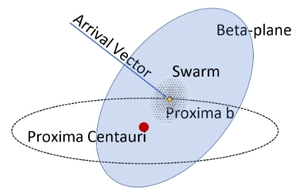
Image: Figure 3 from the paper. Caption: The beta-plane of a swarm flyby of Proxima Centauri b, with the swarm shown lying in that plane. (Note that the planned swarm dispersion is much smaller than is indicated in this artist’s impression, and that in practice the swarm will not be exactly centered on Proxima b’s position due to ephemeris errors.)
The individual probe is currently envisioned at 4 meters in diameter, and on the order of 10 mm thick (aerographene is a leading material candidate). The total probe mass is 3.6 grams, 2.6 of which is allocated to the laser sail. Instrumentation is placed directly on one side of the sail, a phase-coherent array of metamaterial flat optics. As shown below, it contains spaces for 169 smaller 200-mm annular apertures, although not all of these are necessarily used depending on the profile of the mission being flown. These optical apertures when combined produce the light collecting area for a single coracle approximating a 0.5 m telescope.
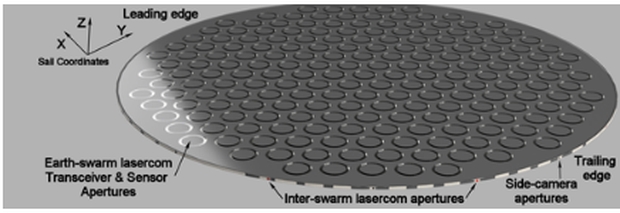
Image: This is Figure 4 from the paper. Caption: Oblique view of the top/forward of a probe (side facing away from the launch laser) depicting an array of phase coherent apertures for both imaging and for sending data back to Earth. Credit: Eubanks et al.
An earlier Centauri Dreams article Reaching Proxima b: The Beauty of the Swarm gives background particulars, but the concept is now being brought forward with a great deal more detail. Swarm concepts are useful because the high number of probes heightens the chances that some of the probes may move past both sides of the target for maximum coverage. It’s noteworthy that the authors, taking into account launch as well as voyage and encounter losses, assume only 300 of the original 1000 will be left for communications back to Earth. As we’ll see, some of the probes are to be ‘sacrificed’ as they serve the communications needs of the mission.
Working with the Medium
But let’s get back to the question of the interstellar medium. Each of the probes is to rotate 90 degrees at the end of the boost phase, the idea being to reduce erosion during the cruise phase by traveling edge-on. We have to get through the comparatively dense interplanetary zone before exiting into interstellar space – here it’s interesting that given the direction of Proxima Centauri from the ‘nose’ of the heliosphere, the movement through the heliopause should occur at roughly the same distances experienced by the Voyagers – 125.6 and 119 AU. We’re moving, of course, considerably faster, and at .20 c, exit the Solar System in less than four days. It took Voyager 2 41 years to make this passage. From the paper:
It is not possible to increase speeds with drag from the ISM wind caused by the probe’s velocity; we use ISM drag to implement a velocity on target technique, slowing down the later launched probes so that velocities come to match as probes approach each other. Once the solar system risk zone is passed this technique will be initiated by rotating swarm members into a “face-down” sail-side up configuration, increasing the drag by having the sail-side face into the ISM wind. In the face-down configuration, the main communications lasers on the instrumentation side will be facing the Earth, enabling high-bit-rate communications without exposing the instrumentation and electronics to ISM wind damage. Note that the first probe launched will not have to enter a facedown configuration, and the later launched probes will advance to join it.
So we have differential thrust between edge-on probes and face-on probes, the result being a swarm that is gradually assembled over 2.79 years. Remember that the plan is to boost the entire swarm into space in a period of no more than one month. The swarm begins to coalesce after launch because the launch velocity of each new probe is increased, allowing later-launched probes to catch up with earlier ones. The probes all return to an edge-on configuration after swarm assembly, coordinating communications through six lasers per probe.
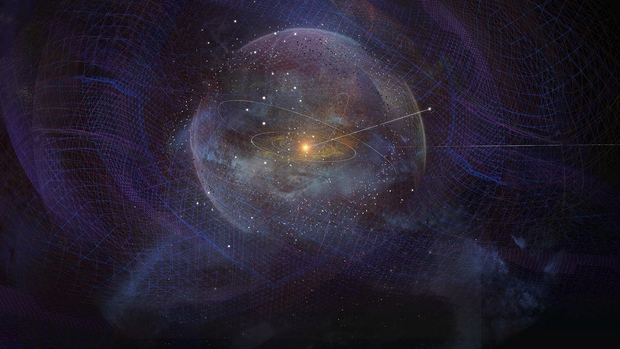
Image: Leaving the heliosphere, we move into the interstellar medium’s gas, plasma, dust, cosmic rays, and magnetic fields. Can we use this ‘interstellar wind’ to shape the Proxima Centauri swarm? Credit: JHU/APL.
I mentioned above the attrition of the swarm along the route, which is not entirely due to encounters with material in the ISM. The authors also turn individual probes into a face-down configuration to manage data communications with Earth, creating higher drag that pulls them out of the swarm. Meanwhile, the 30 percent of the swarm thought to be remaining at the Proxima Centauri system can target Proxima Centauri b or break into sub-swarms, perhaps targeting other planets in the system. One week before the encounter, the first probes will rotate their instrument side into the forward direction of motion, relaying observations to the rest of the swarm. The entire swarm will go face-down after the encounter for relaying data to Earth. The data return phase is assumed to require no less than a year.
Bringing the Data Home
The communications problem vexed Breakthrough Starshot designers, so the solution posed here catches the eye. Among the options are having probes return data independently or, far better, creating a time-coherent swarm which sends communications pulses that arrive at Earth simultaneously. More challenging but perhaps the most worthy of future study is to create a sparse phased array for communication, one that allows swarm antennas to act as a single higher-gain antenna. The thin, ultra-lightweight optical elements are phase-locked to achieve a synthetic aperture of considerable size, but one that demands maintaining probe positions at the nanometer level. From the paper:
The advantage of this latter approach is that the synthesized beam pattern in the main lobe at Earth is equivalent to that of the single transmission reflector with area equal to the sum of the areas of all the probes, although this would be a sparse array and the beam shape would not be the same as the beam formed by a solid antenna with the same extent. Note that this approach would require maintaining the positions of the probe members at the few 100 nm level or better, roughly 6 orders of magnitude better than the time coherent swarm approach. We do not consider this last sparse phased array approach further in this paper due to the extreme difficulty of phase coordination across the swarm.
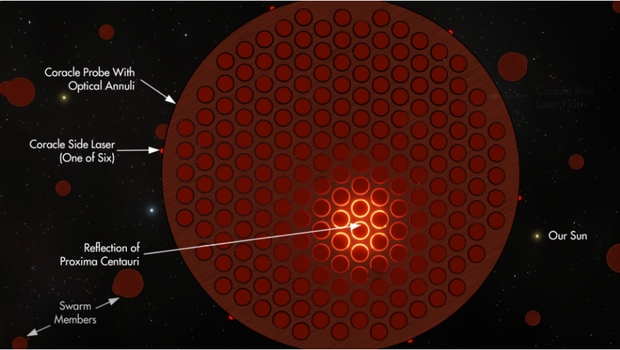
Image: This is Figure 2 from the paper. Caption: Artist’s impression of a Coracle approaching Proxima b (and reflecting the light of Proxima Centauri). The 12,000nm intra-swarm “Side Lasers” (see Subsection 6.3) are for intra-swarm probe-to-probe communications. Each round ring on the top (instrumentation) side of the sail visible here is the 200 mm annulus aperture of a folded optic camera (see Figure 6 and discussion) shared between imaging and communications with Earth at 432/539-nm. Conceptual artwork by Mark Garlick. (Note: Seeing other probes apparently nearby at encounter is artistic license!)
Data broker ‘agents’ can be used to filter and select data from the many terabytes collected during the flyby, managing the data return to Earth. In this way redundant data can be filtered out of the data flood, using what the authors call Observe-Evaluate-Select-Flood (OESF) loops, in which the swarm is essentially divided into nested sets of probes. This part of the concept deserves more attention than I can give it here, but it’s essentially applying an AI approach not only to managing collected data but also to analyzing imagery for further consideration. Even so, this statement pulled me up short:
Although the techniques of developing swarm coherence and agent-based data selection certainly require work, there seems to be no fundamental limitation to the return of gigabytes of data over interstellar distances with large swarms of laser-sail spacecraft.
I believe the statement is true insofar as we can come up with a solution consonant with physics to make this happen, but gigabytes of data with this particular mission concept seems too much to hope for. That’s the judgment of a layman, however, and it will be fascinating to see how these communications concepts play out in the literature as this project continues to be refined. The concepts here are ingenious, even startling, and deserve further investigation.
Moving into the Proxima Centauri System
The prospect of instrumentation in the Proxima Centauri system is exciting indeed. Given the number of probes entering this zone, the authors believe at least one is likely to pass within a single diameter of Proxima b, which would provide spectroscopic analysis of the planet’s atmosphere as well as imaging in considerable detail. Mapping of the surface on the day side of the planet would allow us to search for the so-called ‘vegetation red edge’ and any biology there. The search for biosignatures and technosignatures could get down to the level of features like coral reefs or even night-time city lights.
High-velocity flybys pose huge imaging challenges, given the needed length of exposure time and the movement of the planet in the field of view. The result: enormous image smear. To attack the problem, the authors point to Time Delay Integration (TDI), Velocity Shift Integration (VSI) and high dynamic range imaging (HDR), three techniques explained in the paper. The close flyby of Proxima b itself will last less than a minute. Note the ramifications of this not only on data return but the necessary computational resources of the swarm:
In 0.01 s the spacecraft would move ∼600 km, which, at a distance of 10,000 km… would cause noticeable distortions of the images being stacked; these are predictable and can be removed. Iterative HDR can remove rotations of the spacecraft during the image, correct for ephemeris errors during imaging, and also correct smearing due to objects with different relative velocities in the image plane. In a 10 second flyby with 106 mega-pixel images per second per aperture a single probe with multiple aperture arrays might obtain billions of images, mostly greatly underexposed. This will form the raw material for searches for small bodies and unanticipated features in the Proxima system. It will never be possible to send all of this raw material back to Earth; extracting as much useful information as possible from it after the encounter will be a major computational task for the probes in the swarm.
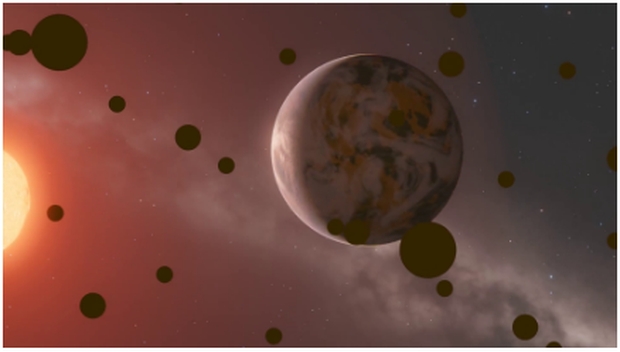
Image: This is Figure 1 from the paper. Caption: Artist’s impression of the approach of a swarm towards Proxima b; at this point, a few seconds before closest approach, the swarm could be examining the planet’s nightside for techno- or bioluminescence. (This image is based on the artistic work of Dr. Mark A. Garlick.)
Orienting the probes after the system flythrough to communicate with Earth, the swarm will be able to observe the Proxima system as it recedes and observe the interactions of the star’s heliosphere with its local interstellar medium (and recall the New Horizons imagery of Pluto after that spacecraft’s encounter). Moreover, a distant encounter with Proxima A and B will occur about a year after the Proxima Centauri event, although the approach as conceived here would be on the order of 10,000 AU. Planets in the habitable zone of both stars should be observable from this distance. Much better, of course, to have a separate Centauri AB flyby mission, but for now one system at a time.
Navigation will be difficult given that we need highly accurate ephemeris information – in other words, we have to know exactly where Proxima Centauri b is, an obvious point, but it’s problematic because given current data from Gaia, the possible error in the star’s proper motion amounts to a 260,000 kilometer error over the mission’s flight time. A better determination of Proxima b’s orbit is also critical, which is why the authors consider a possible precursor mission several years before the first swarm mission to improve the ephemeris.
I won’t list all the authors of this paper but many will be familiar to Centauri Dreams readers, including Jean Schneider and Pierre Kervella (Paris Observatory), Andreas Hein (I4IS/University of Luxembourg), Robert Kennedy (I4IS), Slava Turyshev (JPL) and Philip Lubin (UC-Santa Barbara). The kind of investigation mounted by this team is how we move the ball forward in interstellar studies. Drawing on recent work including the deep investigations of the Breakthrough Starshot scientists, Eubanks and colleagues have enlarged the speculative space especially in terms of communications and swarm computational options, all making an interstellar crossing in decades rather than centuries possible. This paper should be studied by anyone seriously following our increasingly refined strategies for making such a crossing happen.
The paper is Eubanks et al., “Science from the In Situ Exploration of the Proxima Centauri System,” available as a preprint.

Cool concept! I have to wonder, though, if a 1 gram laser can send any message all that way, much less gigabytes, while so close to a star.
I have this image in my head of simultaneously balancing 1000 well-sharpened pencils on their tips, and having them stay that way for several days.
Hello;
I’ll be glad to answer questions, but first off, people might be interested in the video we had made that shows the Proxima b flyby in real time. (We used some of the frames as illustrations in the paper, and you can see those here.) I’ll put the link in our website page.
Lasers effect on angular momentum
https://phys.org/news/2026-05-atoms-vibrate-circular-paths-unexpected.html
More
https://www.secretprojects.co.uk/threads/solid-state-laser-news.9380/page-38#post-905947
I suspect an error in the units, I think you mean nanometers.
Although it will be a long journey to get to Proxima there is plenty for the swarm to do. Such as parallax measurements, line of sight improvements for planet transits and it will pass through the SGL line so will be able to see in immense detail stars and objects in the opposite direction to Proxima.
Reading these Starshot articles with great interest. Interested in learning more about time-coherent and sparse phased array techniques and what makes the ‘up’ side apertures a phase-coherent array of metamaterial flat optics.
1000 sails is a lot of energy, I suppose one day if we converted the far side of the moon into a giant solar cell and laser system we could do a lot more. Perhaps we could use a space cable on the far side as well to anchor a huge reflector to give more peak power.
Just as with Earth-centric space-based solar power, orbiting SPSs beaming their power down to the surface may be the way to go for a continuous power supply. Unlike on Earth, there is no need to diffuse the beam to avoid animal deaths or to tailor the beam to penetrate an atmosphere. Or as you suggest, reflectors to direct sunlight onto the surface PV system, but using multiple orbiting reflectors to maintain the energy.
If He3 fusion actually works, maybe the best use is not shipping it to Earth for fusion reactors, but using it with lunar fusion reactors. The near-vacuum on teh lunar surface makes the reactor design cheaper, eliminating the need for a near-vacuum condition in the reactor.
If the cable on the far side can he used as a anchor. Then very large reflectors can be used to concentrate light onto the surface of the moons solar cells. The lagrange point on the farside of the moon is very large been thousands to hundreds of thousands of kilometres in diameter. That would put a staggering amount of power on the moon. Station keeping would come from that power.
I ran the numbers for solar cells on mercury, 1000 to 10000 times humanity’s total output. And if a mobile cable with large reflectors anchored on it could be used then the numbers become astronomical. Though cooling would be an issue.
And what if 2 grams of probe, traveling at relativistic speeds, hits a planet, maybe a populated one?
0.002 kg x 1/2 x (6 x 10^7 m/s)^2 ~ 3.6 x 10^12 J ~ 0.9 kilotons of TNT equivalent.
(The probes are a little more massive, and the correct value is ~ 1.5 kT.)
A real bad day if one hits you in vacuum, but we have meteorites with this energy hitting the Earth’s atmosphere on a regular basis.
I asked AI if you had 20% efficient solar cells covering the sunlit side of the moon it would produce 2.58 petawatts, that’s around 100 times the power used by humanity ! Although the far side of the moon does go into shadow that’s still a huge amount of power. With a large reflector on the end of a cable it would be a staggering amount of power.
The amount of concept work seems very impressive. Whether it can be achieved in practice, IDK. But it seems worth trying, especially as the laser array from propelling the 1000 sail probes has other, more immediate uses, such as planetary defense.
Interesting that the original flexible sail shapes have been abandoned in favor of rigid sails that have dynamic, rather than passive, stability.
I do like the various imaging options to get the data back to Earth, each option being a fallback in case of failure of the more difficult one.
Almost all the proposed design and science is based on optical sensors – imaging, spectroscopy, etc. Detection of hidden bodies by gravitational effects. Section 10 includes a mention that antennae could be used to detect radio emissions, whether from a technological species or from natural sources.
Are the antennae to be added on some sails, or a possible future mission?
For the imaging to use multiple sail probes, the probes need to be close to each other in distance from Earth. I may be wrong, but it seems that the absolute distance differences from Earth over 4.3 ly need to be within 0.35 meters. If this is correct, how will ~10 probes be able to ensure that the distance differential is kept within those bounds? The probes will be “buffeted” by Proxima’s radiation and particle wind differences caused by differences at the source and modified by planets in the system. As the text states:
What are the possibilities of testing some components within our system, for observation of the outer planets, KBOs, and Oort cloud objects?
Could a low-power laser push these probes at a lower velocity to test swarming, coordination, combine data for higher-resolution images, and orientation using the solar wind? Even if interstellar missions prove too difficult to achieve, the technology could be very useful for inexpensive flyby monitoring of planets, moons, and small bodies. It would be a good way to image interstellar comets on short notice. It could have other uses, e.g., emergency deployment for communication, rescue imaging, and other purposes requiring rapid deployment and short travel times to the destination. Another idea is extensive, high-resolution imaging of every planet, moon, and asteroid surface for mapping, science, and detection of “lurkers” as a piggyback function, much as the ATA can analyze data for ETI signals while engaged in mainstream radio astronomy.
Within the solar system, can these probes be pushed by microwave beams instead of lasers? These may be cheaper and do not have to be tuned to avoid atmospheric absorption. These may be more of an “off-the-shelf” solution for early deployment and testing of the probes. [There is so much more exploration to do in our system that a low-cost approach to return optical data without needing long planning horizons and mission times, but just using standard probes that can be selected and released at the target would make this so much easier, equivalent to oceanographic use of small buoys for current data, and atmospheric use of weather balloons, to name two.]
I can imagine seversl million probes that assemble in space into a exploratiry space craft/robot to land onthe surfaee.
Alex: You are surely right in saying that microwaves or millimeter-waves are a far cheaper and more readily available technology than lasers for near-term beam-driven sail missions. I’ve been saying for years. Lasers are a couple of orders of magnitude too expensive for missions now. Microwave system costs are stable and millimeter-waves costs can readily come down in mass production, as their technologies are already proven and are being widely used to heat fusion experiments. Near future real-world beam-driven missions will surely have to use these technologies.
There is no reason why both can not be done in parallel as they will use the same electrical power. Once lasers are more affordable the lasers can then simply replace the microwave system over time. The microwave system can still throw less demanding probes around as well so it is still very useful.
The comments about the amount of power involved in the array and the risk of hitting something do make me wonder… is there any rational way to speculate about what threshold at which a “probe” would be more likely to be perceived as a violent attack? For the sake of argument, let’s suppose the aliens don’t live on planets but have a swarm widely dispersed throughout the system, and the array of probes passes through in what works as a perfect time-on-target attack, and somehow the aliens remain oblivious to the lasers used to launch them. Is there a way to argue for a particular upper limit to the total energy that should be used in the hope that the aliens wouldn’t promptly swat us like an annoying pest?
@ Mike
Our reactions to impacts may be instructive. The recent Chelyabinsk meteor exploded in the atmosphere with a 400-500 kilotonne TNT equivalent. No one put their strategic nuclear weapons on alert for an alien attack.
The 1908 Tunguska event was far greater – 3-50 megatonnes TNT equivalent – H-bomb and greater class. No panic about a Martian invasion a la Wells, “War of the Worlds”. Of course pre-WWI armaments would have been useless against such an attack.
Had there been a meteor that broke up and pelted teh earth with multiple impacts, maybe there would be more concern today, but I doubt it.
An ETI civilization would either be so lacking in technology that they would treat it as a fearful natural phenomenon or a war between the gods, or advanced enough to recognize that it was not an attack. A really advanced civilization might detect such a probe swarm and rejoice that there was evidence of another ETI trying to explore their system, and any on a collision course with populated worlds deflected or destroyed. What would be interesting is whether we would interpret these probes lost in the system as unlucky accidents or ambiguous evidence of an advanced civilization capable of such actions.
@Alex: Your comparison of kinetic energy is valid, but I’m not sure kinetic energy is the right quantity to compare. The missions humans can do will not stand out from typical interstellar objects in terms of kinetic energy or mass. And Starshot probes would at least still be slower than “O-my-god particles”. But I think it might be appropriate to work out a metric that encompasses several of these qualities together to represent the anticipated threat posed by a mission. This could include the energy released and the suddenness of the release (thus the power), the area potentially impacted, but also the response time, so it might be something like J m^2 / s^2. I put a vague calculation in this Perplexity thread, but I don’t trust my own logic nor the AI’s response so far.