
‘Big dumb objects’ (BDOs) appear to great effect in science fiction. They come in all manner of sizes and shapes and they fulfill a wide range of functions. An early favorite of mine was Cordwainer Smith’s “Golden the Ships Were Oh! Oh! Oh!,” which I snagged on a long ago trip to a Chicago newsstand, where it appeared in an issue of Amazing Stories. It’s probably found most easily these days in The Rediscovery of Man: The Complete Short Science Fiction of Cordwainer Smith (NESFA Press, 1993), a collection that should be on every science fiction fan’s shelf.
Smith (a pseudonym for Paul Myron Anthony Linebarger, whose life was as remarkable as his fiction) goes to work on structures that are millions of miles long. I won’t say more for fear of spoiling the story for newcomers. More recent BDOs are better known, Dyson spheres and Dyson swarms are no strangers to these pages, and have been the subject of intense scrutiny by Jason Wright and his colleagues at Pennsylvania State University. The G-HAT (Glimpsing Heat from Alien Technologies) project scanned data from the Wide-field Infrared Survey Explorer satellite looking at tens of thousands of galaxies for the waste heat signature of possible Dyson spheres. The idea that megastructures might interest a hugely advanced civilization is reasonable, but we have yet to find evidence that Dyson spheres exist.
Larry Niven’s Ringworld posits a structure that circles an entire star but does not encompass it. A transit signature might give this one away if ever found; imagine the lightcurve. Niven and Gregory Benford later come up with the ‘shipstar’ concept that Greg described some years back on Centauri Dreams. This was an unusual re-thinking of the original ‘Shkadov Thruster,’ a device that could be used to move an entire star. See the Bowl of Heaven trilogy for more.
The work of Russian physicist Leonid Shkadov in 1987, the thruster design used asymmetric light pressure from a huge mirror to move an entire planetary system to a new destination. The physics works, but we’re moving at slow speeds, on the order of 20 meters per second after a million years. On the other hand, a truly long-lived species might find waiting a billion years to reach 20 kilometers per second, with a whopping 34,000 light years shift in position, to be plausible. Shipstar would be able to move considerably faster.
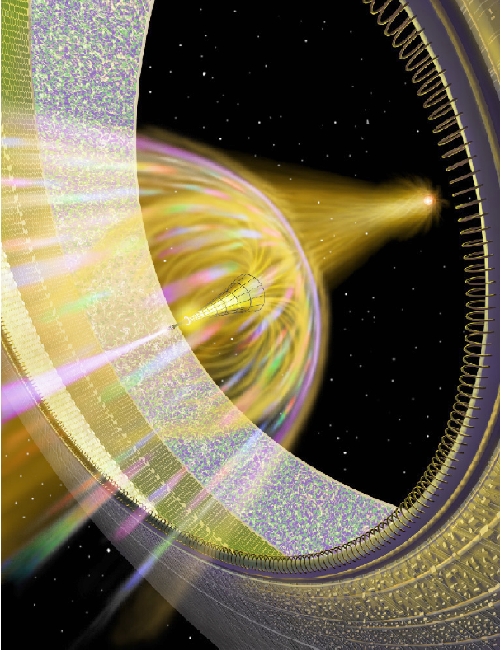
Image: An artist’s conception of the Benford/Niven ‘shipstar’ concept. Think of the ‘bowl’ as half of a Dyson sphere curved around a star whose energies flow into a propulsive plasma jet that moves the entire structure on its journey. Here the notion of living space may remind you of Niven’s Ringworld, that vast structure completely encircling a star, though not enclosing it. The difference is that in the ShipStar scenario, most of the ‘bowl’ is made up of mirrors, with living space just on the rim. Credit: Don Davis.
In conversations with Benford about his shipstar concept a few years ago, I learned that a solid Dyson sphere is unstable, and would need constant adjustment to maintain its position. Concerns over stability plague BDOs. Colin McInnes (University of Glasgow) looks at the problem in a recent paper, noting this about the Shkadov design:
In its simplest form a stellar engine can be considered as a single ideal ultra-large rigid reflective disc in static equilibrium above a central star… As the disc accelerates due to radiation pressure from the star, the centre-of-mass of the gravitationally coupled star-reflector system accelerates, leading to a displacement of the star.
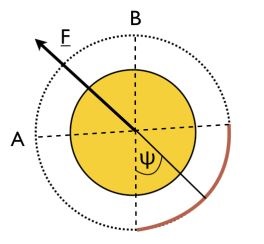
Image: This is Figure 1 from a paper by Duncan Forgan (citation below). Caption: Diagram of a Class A Stellar Engine, or Shkadov thruster. The star is viewed from the pole – the thruster is a spherical arc mirror (solid line), spanning a sector of total angular extent 2ψ. This produces an imbalance in the radiation pressure force produced by the star, resulting in a net thrust in the direction of the arrow. Credit: Duncan Forgan.
That seems straightforward, assuming a civilization so advanced that it could build mirror structures of the needed size. Here too, though, we have stability problems. The McInnes paper is highly interesting, examining megastructure concepts and the possible ways of stabilizing them. While a uniform, rigid reflective disk proves unstable as a star-moving engine, a disk with its mass concentrated at the edges can be stable. Instead of a flat disk, we are looking at something much closer to the shape of a ring. Here passive stability is what we want – i.e., the object does not need continual adjustment by other technologies to maintain its position and function.
In the case of the Schkadov engine, we have this consideration:
…for an ideal reflector subject to gravitational and radiation pressure forces the gradient of these forces across the reflector will induce stresses. While the direction of the radiation pressure force is always normal to the reflector, the direction of the gravitational force will vary across the reflector moving from the centre to the edge. Therefore, while the component of the gravitational force normal to the reflector can in principle be balanced by the radiation pressure force, there will be an in-plane component of the gravitational force which will generate a compressive stress. A thin reflector will clearly be unable to support such compression. However, in principle a zero-stress reflector can be configured for a non-homogeneous, partially reflecting rotating reflector…
The math for a stellar reflector and a stellar ring are laid out in the paper’s appendices.
McInnes thinks that stability is useful as we investigate possible technosignatures in our SETI work, whether they be star-moving thrusters or energy-gathering Dyson objects. The assumption is that passive stability will be sought after because it is efficient and economical, not requiring control systems that must continually adjust position. Remember, too, that in searching for technosignatures, we have the possibility of finding megastructures like these that have survived the demise of their creators. Passive stability is essential for these objects to remain intact and detectable.
What McInnes calls a ‘Dyson bubble’ can likewise be stabilized. Here we’re talking not about a solid Dyson sphere but a constellation of discs, a ‘power swarm’ that allows a civilization to exploit most of the output of its star. The terminology can be confusing but bear with me. The author distinguishes between a cloud of small reflectors in orbit around the central star – huge in number, these form a so-called ‘Dyson swarm’ – and a ‘Dyson bubble,’ by which he means a smaller number of large reflectors in ‘statite’ configuration, so that instead of orbiting, radiation pressure exactly balances gravity. In other words, the ‘bubble’’ components stay stationary relative to the star.
Self-stabilizing techniques are challenged not only by gravitational and radiation pressure but also collisions between the myriad orbiting disks as well as outside perturbing forces. Over large timeframes, passing stars can disrupt the gravitational dance, while interstellar comets, whose numbers are likely to be huge, present a similar risk of disruption. Even so, there are ways around this:
…the Dyson bubble can remain stable when its self-gravity and a simple model of a diffuse background of scattered radiation are included in the dynamics defined in Section 6.4. However, there are now regions of the parameter space where instability can occur, primarily at the edge of the Dyson bubble driven by the diffuse background radiation. In addition, it has been shown that the self-gravity of the Dyson bubble is in itself sufficient to ensure passive stability in the absence of the diffuse background radiation, and indeed it enhances the stability of the Dyson bubble when the diffuse background of scattered radiation is included.
A Dyson swarm if properly implemented can also ensure passive stability. Reflectors must always be configured ‘normal’ (perpendicular) to the central star “…using slighting conical reflectors with the centre-of-pressure displaced behind the centre-of-mass.”
So there are ways of doing these things as long as we abandon the Shkadov concept of a uniform reflector disc in favor of a ring supporting the reflector, or in the case of the two Dyson options McInnes looks at, a dense cloud of reflectors stabilized through orbital mechanics, or a smaller assembly of reflectors in static equilibrium with radiation pressure from the star exactly balancing gravity. But here I’m more interested in the consequences in terms of hunting for technosignatures:
A Dyson swarm can be expected to generate a different technosignature to a passively stable Dyson bubble discussed above. For example, the motion of the discs in a swarm would imply a flickering of the observed luminosity of the central star, with a larger variation expected from a small number of ultra-large discs relative to a large number of small discs. Finally, while an orbiting swarm of reflectors will be susceptible to collisions (B. C. Laki 2025), collisions within a Dyson swarm could in principle be minimised using families of displaced non-Keplerian orbits, where the orbit planes of the reflectors can be stacked in parallel rather than being inclined relative to each other (C. R. McInnes & J. F. L. Simmons 1992).
And what of Shipstar? A recent conversation with Jim Benford reminded me that his brother Greg had worked out a way to stabilize the induced flare on the central star through intense magnetic fields, but as far as I know, this concept has never been rigorously investigated. From the technosignature standpoint, McInnes’ paper reminds us that stability problems can be overcome should an advanced civilization choose to build Dyson-class structures, or undertake star-moving of the Shkadov variety. How to engineer the stability of BDOs should continue to provide insight into possible technosignatures, even if the lack of any trace of Dyson structures despite intensive work at G-HAT remains puzzling. Next week I want to look at an even more recent stellar engine concept as presented by Illinois State University’s Michael Caplan.
The paper is McInnes, “Stellar engines and Dyson bubbles can be stable,” Monthly Notices of the Royal Astronomical Society 546 (2026), 1-18 (full text). The Shkadov paper is “Possibility of Controlling Solar System Motion in the Galaxy,” presented at the 38th Congress of the International Astronautical Federation (IAF) in Brighton, UK. An English translation of the original paper was published in the Journal of Solar System Research Volume 22, Issue 4, pp 210–214 under the title “Possibility of Control of Galactic Motion of the Solar System.” The Forgan paper mentioned above is “On the Possibility of Detecting Class A Stellar Engines Using Exoplanet Transit Curves,” Journal of the British Interplanetary Society, Vol. 66, no. 5/6, 2013 pp. 144–154. Preprint.

English translation follows the message below:
Comment *
Avevo letto, non di recente, che erano rimasti due- tre casi, di possibili”Sfere di Dyson” da esaminare, dopo averne escluse, una decina, di cui, era stata trovata una spiegazione, naturale.
Si sa qualcosa, di questo piccolo residuo, di possibili “Sfere di Dyson” rimaste, da verificare?
E, anche se esco un po’ fuori tema, anche del centinaio di segnali radio, possibilmente artificiali, esaminati dal Radiotelescopio cinese “Fast”.
Un saluto a voi tutti, da Raffaele Antonio Tavani
From Google Translate:
I had read—though not recently—that only two or three potential “Dyson Sphere” candidates remained to be examined, after about ten others had been ruled out because a natural explanation had been found for them.
Is anything known about this small remaining handful of possible “Dyson Spheres” that still await verification?
And—though I am straying slightly off-topic—is there any news regarding the hundred or so potentially artificial radio signals examined by the Chinese “FAST” radio telescope?
Greetings to you all, from Raffaele Antonio Tavani.
How thick will the bowl of shipstar be? If it hits a snowball or even a grain of sand at 300 km/sec, only 0.1% c, how much damage will it cause? When 1 gram of something hits the moon at 30 km/sec, that’s about 75 grams of TNT, a small hand grenade.
Cordwainer Smith’s “Golden the Ships Were Oh! Oh! Oh! appears in Amazing Stories April 1959:
https://archive.org/details/Amazing_Stories_v33n04_1959-04_cape1736/mode/2up
Great story and very short.
Gliese 710 is something we could hitch a ride on as it passes:
New carbon fiber advance
https://techxplore.com/news/2026-04-ultralight-carbon-fiber-lattices-aluminum.html
Impressive. I would expect this technology to be first used where mass reduction is far more valuable than cost, so space systems seems an obvious target, just as PV was used on satellites many decades before it was cheap enough for widespread use.
I would hope that other considerations were taken into account before it was applied to airframes in civil aircraft, especially after the carbon fiber problems that emerged in Boeing’s airliner. If there is damage to the structure, is it repairable, or does the whole component need to be replaced, and how easy is that to do?
Certainly a technology to watch to see if it is adopted, where and how.
The stability of Niven’s Ringworld* is a major part of the first sequel, of course. The Engineers chose to use what you refer to as “other technologies”, fusion thrusters fueled by the solar wind. They also cleared out the star system of all other bodies to reduce, but not eliminate, the chance of collision.
*Oh, the Ringworld is unstable,
Oh, the Ringworld is unstable,
Oh, the Ringworld is unstable,
And it’s good enough for me!
I recently re-read Ring World after a few decades, some bits have aged quite well, others not so much.
What I’ve come to realize, is that Ring World is the canonical example of “Spherical Cow Hard SF”.
Case in point, part of the story is an impact from an interstellar rouge moon, which punches through the super-super strong material the Ring World is made of, forming a thousand mile high mountain. In the book only the mountain and the impact are described. With no consideration of secondary effects like displacement, vibrational modes, damping, mass balance etc.
In the book, the impact event is called the “The fall of the Cities”, which sounds quite bland compared what any sentient around at the time would have experienced. Names like “The day the Sun moved” (its stationary on Ring World), or “The dancing of the gods upon the arch” are much more descriptive of what such an impact would have looked like IMHO.
Anyone look at Nuclear Salt Water Rockets—for gun launch?
On the Moon only—sabot protects the heavy payload—crew capsule catches up to the payload with capsule launched by Falcon Heavy.
There may be a way to use an atmosphere to slow a spacerock without heating it:
https://www.secretprojects.co.uk/threads/artemis-moon-program.32471/page-63#post-900430
Windstorm in lunar caves as a jake brake.
Plasma coatings
https://phys.org/news/2026-04-plasma-spray-technique-tungstencopper-coatings.html
Engineers have developed a new high-performance tungsten–copper metallic coating in one step using plasma spray, for future high heat flux (HHF) plasma facing components (PFC), specifically in the divertor target plate. The work is published in the journal Surface and Coatings Technology….o overcome this, the Nottingham research team engineered a functionally graded coating in which the composition gradually transitioned from copper-rich at the base to tungsten-rich at the surface. Rather than stacking distinct layers, the material changes smoothly across its thickness, reducing stress and improving bonding.
The team successfully produced a coating graded continuously from 0% to 100% weight percent tungsten, achieving a dense and structurally stable material.
Carbon nanotubes
https://phys.org/news/2026-04-carbon-nanotubes-gap-copper.html
In a paper published in the journal Science, researchers describe a method for adding a chemical to carbon nanotube bundles that brings them closer to copper’s ability to conduct electricity…”These fibers are five times stronger and half the weight of conventional overhead cables while remaining stable in dry conditions,” noted the study authors in their paper. “Specific conductivity values reach 17,345 Siemens-meter squared per kilogram, which is superior to that of metals.”
Skyhooks
https://forum.cosmoquest.org/forum/science-and-space/space-exploration/3753426-skyhook-equator-orbiting-rotating-launcher-animator-calculator
I would think any culture capable of building a BDO would have the sense to design it so it would be stable for as long as they needed it to be so. And those who didn’t would probably have had their BDO fall apart long ago.
Even humans generally pretty have been pretty successful at building things that survive their planned life. Sure, a bridge or building collapses unexpectedly every now and then, or succumbs to an accident, neglect or war, but as a rule, they hold together long enough to become an eyesore.
Our industrial culture assumes that BDOs must be obviously manufactured, artificial objects. From Dyson swarms/spheres and ringworlds, to Schkadov drives and their variants. But does this need to be so?
Just as the proverbial ants may not comprehend our structures as “artificial”, perhaps objects that could be construed as BDOs may also look natural to us.
On Earth, ancient burial mounds whose entrances have been filled by soil runoff look like low mounds or hills. Without excavation, we wouldn’t know otherwise.
Cosmically, there is the Parenago Effect of older stars having excess velocity compared to nearby younger stars. One fanciful speculation is that the stars are moving themselves. Imagine some drive embedded close to the stellar surface, expelling the star’s material to generate thrust. This would be another version of star-moving, but to our eyes might look entirely natural until we made a close inspection by probe.
Back in the 1960s, it was suggested that the Martian moon Phobos must be artificial, as it was losing altitude faster than it should be. A plain dumb object, or a big one? In the silly movie, Moonfall, our moon is a Dyson sphere that looks natural until the astronauts are inside it. In the “Hitchhiker’s Guide to the Universe”, our Earth was a Magrathean supercomputer construct. Obviously natural to us, but manufactured. If the Hollow Earth theory were true, it might mean that our Earth really was a construct, or at least altered by intelligence. Similarly, Terry Pratchett’s fictional Discworld should also be considered a BDO.
Also to be considered is the suggestion that the Trappist-1 system, with so many rocky worlds clustered about its star, might be an artificial arrangement.
All the above examples should be classed as BDOs, but made to look “natural” to all but the most discerning eye.
The ultimate BDO is the universe itself, if having been made by a “creator”, and the anthropic principle is really due to it being made just for humanity. Stable for 13+ billion years!
Hi Paul,
The idea is attractive like all the graphic representations we see, but I have trouble designing such gigantic structures (I play the devil’s advocate):
firstly because it would take incredibly advanced material technology to cope with mechanical and thermal stresses : diamond? gold? nuclear isotropes with very long half-lives?
then I am willing to admit the stability of such a structure, but would it still be stable in the face of the gigantic forces in our galaxy (galactic rotation; tidal phenomenon…) or would it instead require a flexible structure, adaptive, precisely allowing to adapt to these constraints, which would require a lot of engineering.
finally, on the idea of the “initial energy expenditure/final gain” ratio to build this “thing,” I’m not sure we’ll be able to win, or else we really need to be at bay.
If an ETI is able to build such a system, it is for its energy needs. I can then understand the placement of a Dyson sphere around a star, but if it is capable of building an artificial structure that can move a solar system, the ETI should be able to travel in space and would not bother with this kind of “tinkering”, but that’s besides the point. Well, it’s nice but there’s something a bit “irrational” in all this, but it’s obviously a little humanoid point of view :)
Could we detect the artificial displacement of a star or a system? I think that we do not yet have a sufficiently precise technology for this. Maybe we should measure the energy power of a star, which cannot be done on the scale of a human life.
but it’s dreamy and it’s good :)
Trajectories
https://phys.org/news/2026-04-interplanetary-shortcut-mars.html
How would you repair those structures?
One possible explanation for the lack of observed Dyson spheres: the very strong trend we on Earth today see for technologically advanced nations to have below-replacement birthrates (which appears to cross cultures), is in fact not an unique quirk of ours but a result of generalizable opportunity cost tradeoffs that would apply to any technological culture. Thus, no technological culture ever achieves a population that would allow them to meaningfully make use of a significant proportion of a star’s output.