
Lately we’ve been discussing interstellar probes, the kind that an extraterrestrial civilization might use to explore the galaxy. Ronald Bracewell’s analysis of such probes dates back to 1960 and was all but coterminous with the emergence of SETI. The problem with Bracewell probes is that we would expect to have one in our Solar System if they exist. Rather than using that notion to add stress to the Fermi question, I’m going to point out that there is a lot of real estate waiting to be searched.
Case in point: What might our ongoing study of the lunar surface through images from the Lunar Reconnaissance Orbiter pick up as we use AI models that have already identified human-made space debris from various missions? A closer look at this project reminds us that while the Moon is an obvious place to look for a ‘lurker’ probe, we can’t discount other locations even though earlier work on the various Lagrange points, a good place for long-term observation of our planet, came up empty (see below). Our capabilities are so much more advanced not only in terms of instrumentation but analytical tools that a continued hunt for artifacts is reasonable.
I’m getting picky here given the wide variety of possible probes, tapping the definition that Bracewell used in his original article. That’s a probe we probably would have noticed by now if it were active. In 1960, Bracewell was offering an alternative to the SETI goal of detecting an interstellar radio signal aimed at Earth. His physical probe would arrive in a planetary system to look for signs of life and technology, duplicating any radio signals it heard so as to re-transmit them to the originators, thus establishing contact. Sagan uses the notion in his novel Contact (1979), where Adolf Hitler’s opening speech from the 1936 Berlin Olympics is found embedded within the message, along with much else.
How would we respond to hearing a signal sent back to us from space? Bracewell thinks we would experiment with it to see what would happen next:
To notify the probe that we had heard it, we would repeat back to it once a:gain. It would then know that it was in touch with us. After some routine tests to guard against accident, and to test our sensitivity and band-width, it would begin its message, with further occasional interrogation to ensure that it had not set below our horizon. Should we be surprised if the beginning of its message were a television image of a constellation?
Bracewell’s notions of dispatching a physical object as opposed to sending a radio signal take advantage of the ‘information density’ available to a physical probe. This is the familiar notion that a box of DVDs in a truck moves information at a far higher rate than fiber-optic cable. But of course you have to get the truck to its destination, and in the case of interstellar flight the latency is huge – perhaps thousands of years or more. A long-lived civilization, thought Bracewell, may nonetheless see purpose in seeding nearby stars if the travel time is a small fraction of its likely civilizational life.
Swarming and Reproducing
Bracewell’s ideas jibe nicely with the Breakthrough Starshot concept of swarms of sails investigating nearby stars. We might imagine the descendants of such tiny flyby probes scattered to all interesting stellar systems within, say, 100 light years. With concepts like Bracewell’s entering the literature, it was left to Robert Freitas to run the first scientific search I am aware of for such probes (citation below). Freitas made a series of visual observations of the various LaGrange points in the early 1980s. But in the early days of SETI (and Bracewell was writing even before the Green Bank meeting in 1961 that produced the Drake Equation), other ideas about how interstellar probes might operate had begun to surface. Ancient probes sent by civilizations far more advanced than ours might still be live, waiting and reporting on our activities (Clarke’s sentinel ‘slabs’ from 2001: A Space Odyssey come to mind . Or they might be long-dead relics.
Version 1.0.0
When Michael Hart went to work on this in 1975, he amplified the probe concept and changed the game. He produced, in fact, what Jason Wright (Pennsylvania State) has dubbed “The most influential formulation of the Fermi Paradox…,” one that compresses the conundrum by homing in on the fact that we observe no intelligent beings on our planet, something Hart called Fact A. The fact that they are not observed tells us that despite the amount of time available for long-lived cultures to have colonized the galaxy, none evidently have. This is no small problem, for as Wright calculates in his new textbook on SETI, even a ‘wavefront’ of probes moving outwards from star to star at Voyager-like speeds would have been able to reach every star within 2 billion years.
Move the dial up in terms of speed to, say, 0.5 c and the numbers get considerably shortened. Imagine relativistic ships that close on lightspeed and we find exponential growth saturating the galaxy in 150,000 years, all contrasting with an Earth that is 4.5 billion years old. Hart saw nothing in the laws of physics that prohibited starflight, and he found the idea that ETI was uninterested in Earth to be unconvincing. What David Brin coined the ‘Principle of non-Exclusiveness’ boils down to the idea that alien species will not all behave the same way. All that is needed is for one civilization to decide to send out probes, and by now such probes should have reached every star.
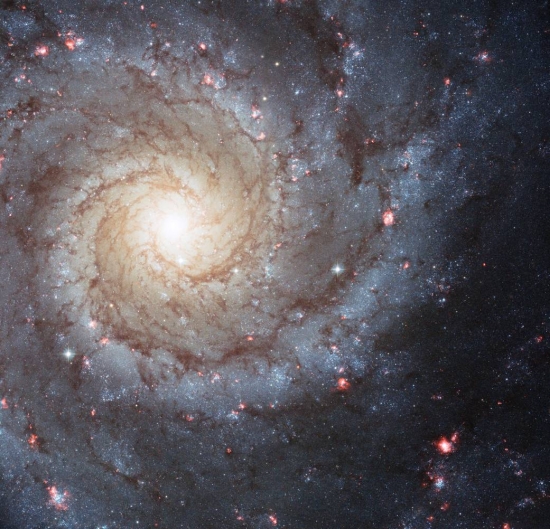
Image: How quickly would a single civilization using self-replicating probes spread through a galaxy like this one (M 74)? Moreover, what sort of factors might govern this ‘percolation’ of intelligence through the spiral? The answers affect our view of the Fermi question, and thus our own place in the cosmos. Image credit: NASA, ESA, and the Hubble Heritage (STScI/AURA)-ESA/Hubble Collaboration.
Advances in computing led Frank Tipler to push Hart’s views even more strenuously, bringing John von Neumann’s work on self-replicating machines to bear. His insight was to ask what would happen if an extraterrestrial culture began seeding stars with self-reproducing probes, each capable of not only studying a new world but building another probe that could reach yet another star, and so on. Here the numbers become even more telling. Such probes could use local resources in each system to build their next generation, thus nullifying the resource problem. Here’s Tipler on the matter:
…if the motivation for communication is to exchange information with another intelligent species, then as Bracewell has pointed out, contact via space probe has several advantages over radio waves. One does not have to guess the frequency used by the other species, for instance. In fact, if the probe has a von Neumann machine payload, then the machine could construct an artifact in the solar system of the species to be contacted, an artifact so noticeable that it could not possibly be overlooked. If nothing else, the machine could construct a “Drink Coca-Cola” sign a thousand miles across and put it in orbit around the planet of the other species. Once the existence of the probe has been noted by the species to be contacted, information exchange can begin in a variety of ways.
As to the cost of such a vast exploration program, Tipler has this to say:
Using a von Neumann machine as a payload obviates the main objection to interstellar probes as a method of contact, namely the expense of putting a probe around each of an enormous number of stars. One need only construct a few probes, enough to make sure that at least one will succeed in making copies of itself in another solar system. Probes will then be sent to the other stars of the galaxy automatically, with no further expense to the original species.
A ‘Catastrophic’ Answer to Fermi?
Tipler suggested a timeframe of 300 million years to fill the galaxy with these devices, in an argument that drew fire from Carl Sagan and William Newman, who argued in 1983 that his approach was ‘solipsistic’ because the idea that we were alone in producing a technological civilization was anti-Copernican. And here we need to pause on a concept that has surfaced repeatedly in SETI studies not just in the western nations but also the Soviet Union. The idea of ‘mediocrity’ troubled attendees at the Soviet SETI meeting at the Byurakan Astrophysical Observatory in 1964, to be discussed again in a second meeting (with American scientists as participants) in 1971.
Do we just take the Copernican principle as a given? Sagan clearly thought so. His ‘co-author’ on Intelligent Life in the Universe, Iosif S. Shklovskii was far less sanguine on the matter:
Since we do not adequately understand the factors leading to the evolution of intelligence and technical civilizations, we cannot reliably estimate the probability that intelligence and technical civilizations will emerge.
Here I’m drawing on Mark Sheridan in his 2023 book SETI’s Scope (How The Search For Extraterrestrial Intelligence Became Disconnected From New Ideas About Extraterrestrials). Sheridan homes in on the philosophical disagreement between emerging Soviet SETI and the ideas in the Drake Equation. At Byurakan, Soviet mathematician A. V. Gladkii challenged the idea, accepted by Sagan, that mathematics could be a recognizable common ground between all intelligences across the stars. And Sheridan quotes Theodosius Dobzhansky, a Ukrainian-born geneticist later working in the U.S., who in a 1972 paper cast doubt on Sagan’s insistence that because intelligence had arisen on our planet, it must arise everywhere life exists. In his view, the principle of mediocrity was being taken several steps too far. Quoting Dobzhansky:
“Natural scientists have been loathe, for at least a century, to assume that there is anything radically unique or special about the planet Earth or about the human species. This is an understandable reaction against the traditional view that Earth, and indeed the whole universe, was created specifically for man. The reaction may have gone too far. It is possible that there is, after all, something unique about man and the planet he inhabits.”
In a fascinating 2009 paper, Milan Ćirković examines the Fermi question in the context of our basic premises about science. As amplified in his later book The Great Silence: Science and Philosophy of Fermi’s Paradox (Oxford University Press, 2018), the Serbian astronomer points to the focus the ‘where are they’ question places upon both Copernicanism and gradualism. In the former, as clearly stated by Sagan as by many other of the early SETI practitioners, the assumption is that we occupy no privileged place in the cosmos, and thus should expect other civilizations to exist, some of which would be far more advanced than ourselves. Yet we do not observe them.

Many answers can be offered to Fermi’s question, of course, but as we continue probing the cosmos, the silence takes on escalating significance. Must we envision a future in which we abandon Copernicanism and assume that we do not, in fact, occupy a relatively common niche in the cosmos, but rather a rather special one?
Or should we give up on gradualism, the idea that geophysical processes proceed in the future more or less as they did in the past? The concept is foundational to 18th Century geology and remains a commonplace in current thinking. But ‘catastrophism’ is an obvious factor in the development of life, as extreme ruptures like the K–T extinction event that ended the era of the dinosaurs make clear. Are there common factors that could affect planets throughout what is thought of as the Milky Way’s habitable zone?
The question is the focus of recent work on gamma ray bursts and implies, as Ćirković notes, a ‘reset’ of the clock. That could explain our lack of detections, as it would imply that living worlds, no matter their geological age, have had only about the same amount of time we have had to develop intelligence. The Fermi question highlights both of these key assumptions, while our lack of a solution keeps the tension tight.
The Bracewell paper is “Communications from Superior Galactic Communities,” Nature Volume 186, Issue 4726 (1960), pp. 670-671. Abstract. On the LaGrange search, see Freitas, “A search for natural or artificial objects located at the Earth-Moon libration points,” Icarus, Volume 42, Issue 3 (June, 1980) p. 442-447 (abstract). Michael Hart’s paper on galactic expansion is “Explanation for the Absence of Extraterrestrials on Earth,” Quarterly Journal of the Royal Astronomical Society, Vol. 16, p.128 (full text). Frank Tipler’s paper on self-reproducing probes is “Explanation for the Absence of Extraterrestrials on Earth,” Royal Astronomical Society, Quarterly Journal, vol. 21 (Sept. 1980), p. 267-281 (full text). Milan Ćirković’s paper on Fermi and Copernicanism is “Fermi’s Paradox – The Last Challenge for Copernicanism?” Serbian Astronomical Journal 178 (2009), 1–20. Preprint.


A 40+ year old paper by Robert Freitas discussing (and dismissing) the Fermi Paradox:
http://www.rfreitas.com/Astro/FermiHowler1984.htm
Hi NS
Thanks for reminding us of Robert Freitas’ important work on the question. He also designed, in some detail, a self-replicating system in the 1970’s which raised the question of von Neumann machines as space-probes from pure speculation to something we’re on track to realise this century.
More on beamed energy
https://phys.org/news/2026-04-route-plasma-based-particle.html
I don’t know about the beamed energy application, although laser energy amplification may be relevant, but regarding the applications that the authors state:
Hmm. Short laser X-ray pulses…reminds me of Reagan’s SGI dream, with X-ray laser satellite and missile killers.
The arXiv version of one of the 2 papers is:
Bright coherent attosecond X-ray pulses from beam-driven relativistic mirrors
Some have argued that the concept of von Neumann machine self-replicating probes spreading across the galaxy poses significant risks to the survival of intelligent life. Additionally, it has been suggested that these machines may not be capable of near-infinite propagation, as inevitable replication failures could result in machines that either fail to replicate correctly or lose their original purpose. Furthermore, there is the issue of whether deploying a von Neumann machine is worthwhile, given that it could return information long after the originating civilization has lost interest or even ceased to exist.
There’s also the idea that not all technology is inevitable to develop, even in advanced civilizations, or that these civilizations need to use a specific technology. A von Neumann machine usually implies the development of a near Turing complete digital computer. An advanced civilization may not develop a Turing complete digital AI computer. This doesn’t rule out the possibility of a probe, as it could still be based on analog computers. These types of computers may offer significant advantages for long-duration deep space probes.
A more pertinent question concerns the relevant time periods and the issue of proximity. For example, how many stars have passed within 10 light-years of the Sun over the past 1 million, 10 million, or 100 million years? If, during any of these intervals, a civilization had sent probes to our solar system, what observable signatures would allow us to detect them? If a probe had successfully landed on the Moon to observe Earth, how much dust accumulation would obscure it, and by what means could we recognize such an artifact? The possibility of a probe landing on Earth and being discovered today appears extremely unlikely, though not technically impossible, even if the landing occurred as recently as 15,000 years ago. Furthermore, if a probe were located on Mars, in orbit around Jupiter, or in a free orbit between Mars and Jupiter, it might be so heavily covered in debris that identification would be nearly impossible without direct physical inspection.
Even if the probe remains functional and is intended to be discovered, it may currently be in hibernation. If its hibernation cycle includes only brief periods of activity, such as checking its environment every several thousand years, it is possible that the present moment falls within one of these intervals. This scenario does not exclude hypotheses such as the Silurian Hypothesis. Surviving probes, given the vast time intervals and proximity considerations, are most likely to have originated on Earth. Detecting such a long-lost and forgotten piece of space technology may be the most likely way to uncover evidence of these civilizations.
However, these Issues do not suggest that the search should not be undertaken. On the contrary, the potential rewards justify continued investigation, although the process may prove more challenging and time-consuming than some estimates suggest.
The published version of Cirkovic’s paper is found at this link in the Serbian Astronomical Journal, which is essentially the same as the arXiv preprint, but with some small changes.
The review of his book on Amazon is rather mixed. Apparently, the editing was terrible, with some unintelligible sentences. Some reviewers found it very hard to read and far too wordy. Maybe stick to the journal paper, though some editing issues are obvious even with a quick skim? [The journal article is 20 pages including the references, whilst the book is 434 pp.]
There has been a breakthrough…a device has been beaming power for 8 hours straight
https://journals.aps.org/prab/abstract/10.1103/z2d3-bhyt
Now, I want to use this not just for sail propulsion by itself, but to induce upward superbolts/blue jets
Lightweight
https://techxplore.com/news/2026-04-liquid-metal-entangled-staple-particles.html
I’m looking forward to reading the paper. My initial 2 cents is that, while Copernicanism is an excellent place to start, it seems like there MUST be something special about us and our circumstances. I think it’s self evident that we have a drive to explore, physically expand our presence, and ask what lies over that next hill. So if you accept that intelligent life is abundant, it just shifts our ‘specialness’ to being the unique (or one of very very few) forms of life that have that drive to explore and expand.
Alternatively you could accept we just live in a very special time at which life has only recently been able to form and develop intelligence (but the Galaxy seems to have been generally calm enough for at least a few billion years for this to not be such a special time). Or perhaps you can just accept that interstellar travel is impossible or prohibitively expensive, but the materials science and physics at our disposal say it’s at least possible (albeit prohibited by our current economic capacity). Given a thousand or ten thousand years of economic and industrial growth (an amount of time equivalent to a rounding error on cosmic timescales) those resources may not seem so insurmountable. Even adding several thousand years to allow the option of bombing ourselves back to the stone age a couple times doesn’t make a dent in the cosmic timescales.
The more I think about self-replicating probes (SRP), the scarier they get. They are essentially an artificial life form, and like all life forms, they must be able to evolve to meet new conditions or unexpected and unanticipated environments. No matter how carefully they are programmed to be benign, eventually they will morph into something totally unlike what their designers intended. Or, as Mr Zierman points out, “inevitable replication failures” could lead to the same result. And like organic life forms, they would probably need some form of sexual interaction amongst themselves to be able to quickly propagate useful adaptations. The mind boggles.
The Wikipedia entry on “Berserker” makes the following observation:
“Saberhagen’s Berserkers have been cited as a possible explanation of the Fermi paradox, which wonders where all the alien life is in a universe so vast. Saberhagen’s concept has been dubbed the Berserker hypothesis. It suggests that a particularly paranoid intelligent species would feel compelled to exterminate any peers it detects in the universe. David Brin summarized Saberhagen’s solution, “We would not have detected extra-terrestrial radio traffic – nor would any ETIS (extra-terrestrial intelligent species) have ever settled on Earth – because all were killed shortly after discovering radio.”[2] The Berserker hypothesis, formed as a possible solution to the Fermi paradox, takes its name from the series.”
The Berserker hypothesis is not only a possible solution to the Fermi Paradox, it also stands to reason any species capable of considering populating the Galaxy with SRP would be so irresponsible their neighbors would quickly exterminate them, and rightly so!
The idea of SRP may have some utility, provided appropriate safeguards could be devised to address these concerns. But consideration of another fictional work, “Jurassic Park”, makes me pessimistic any such solution is worth risking.
Robot probes are feasible as a means of Galactic exploration, but not those capable of self-reproduction. Only a species capable of developing nuclear weapons would be foolish enough to even consider such an idea.
I think the berserker hypothesis is a strong contender. Yet I can also suggest a quib-quib hypothesis, named after the anti-berserker robots in a Saberhagen story. Basically, an advanced and not tremendously enterprising civilization finds an innocent self-replicating Bracewell probe entering their system. Like you, they declare it a future berserker due to inevitable mutation, a threat to the Cosmos. So they create a quib-quib, which they deem to be carefully designed for a very slow mutation rate, which is tasked to go out, find the berserkers, find whoever produced the berserkers, and wipe all those people out in a very berserker-like way. In theory, the total number of quib-quibs is limited because they will stop the berserkers before they spread too far. So there are no self-replicating probes at all to be seen outside of some small sectors of the galaxy, because there are potential quib-quib makers scattered on planets all over.
Honestly, I wasn’t very confident in that idea before, less so now, because it looks like Earth is rushing eagerly to its destruction with no help at all. It gets easier and easier to think that planets with significant technology are simply doomed.
@ Mr Serfas
Barely a century into our evolution as a culture with space-faring potential, we have already allowed our technology to create numerous potential civilization and planet-killing scenarios: nuclear war, resource depletion, economic collapse, political and cultural stresses, overpopulation, environmental pollution, climate change, AI,…need I go on? Every one of these problems has obvious technical or behavioral solutions–which we seem determined to ignore!
Even if other cultures have the wisdom or the good fortune to avoid
these self-inflicted catastrophes, nature itself provides an endless series of unavoidable disasters and plagues–nearby astronomical explosions and radiation events, collisions, geological and climatological changes, solar evolution, runaway breakdowns in the planet’s self-regulatory mechanisms, etc. Earth has already suffered
many of these in its long history and although Life itself has managed to weather them, its doubtful any civilization near our level of technology could.
I will concede there are potential technologies and social arrangements that could save us as a species, the question is how likely are we to implement them in time? It appears that intelligence is not necessarily a survival tool. Its benefits to the species may be far outweighed by its destructive impact on its surroundings.
@henry
If there are sufficient other ETI civilizations, then pure serendipity will ensure that cosmic disasters are far enough apart to allow some of them to avoid those forms of extinction.
As for our self-destructive behavior, is this due to some inherent faults we have, or a necessary component of our success? As Harry Lime (The Third Man) says,
After all, it is war that results in sudden bursts of technological development, at least in some directions. The 20th-century world wars stimulated the development of aircraft, aircraft propulsion, rockets, radar, radio, persuasive messaging, and chemistry, etc. The war in Ukraine has given drone technology a big boost, which no doubt will provide new civilian uses.
Or maybe the “beserkers” don’t destroy us by brute force, but rather by effective mental manipulation, like some version of Asimov’s “Mule” (Foundation trilogy), or something more institutional that drives us to take the self-destructive paths we do, ignoring all the safer paths we could follow.
@Alex
I’m no pacifist, I know wars sometimes have to be fought, either to correct an injustice, or for legitimate self-defense, or because they are provoked by some foolishness, error or accident. Wars can accelerate technological progress, but they also consume resources, devastate the environment and kill the innocent; sometimes even the victors never fully recover. And of course, wars ALWAYS have unexpected consequences.
Don’t forget, Harry Lime was the villain in the piece–a particularly nasty one. His rationalization is exactly what you would expect him to say. Underneath all that charming cynicism, he sold diluted penicillin for enormous profits, and no Renaissances ever resulted from his actions.
@henry
I do not mean to condone wars as a means of technological development. They are horribly destructive in the abstract and awful in that so many people have to die during their execution. I believe it is said that nobody wins in a war; everyone loses, at least to some extent. Most of teh technology is for weapons development, which only benefits society if those “swords can be beaten into ploughshares”. I far prefer civilian science and technology development, particularly because they needn’t be pressed into use before the consequences of their use are known. However, it is a fact that technology does exhibit bursts of development with war. Whether that is good or bad, and what one would have achieved if resources hadn’t been expended in the war, is another matter, for which counterfactuals can be posited, but not proven.
Of course, Lime was a [movie] villain. However, that doesn’t mean that everything he said in the movie was wrong. Bad things and people can result in good things happening, either directly by those actions or inadvertently. WWII was horrific in destruction and lives lost, yet the post-World War II world was far better as a result, at least for the next 30 years or so.
Some bad things, like chemical rockets, proved good. In WWII, the production of V-2 rockets diverted resources away from the German air force, allowing the Allies to prosecute the war in Europe with fewer losses of Allied lives, and bringing VE Day closer.
All the post-WWII space program pretty much started with the captured V-2s, whose performance eclipsed the rockets of the Allied nations and the Soviets. It brought forward the use of space and the manned space program. The Moon landings were more than partly due to the efforts of Von Braun, who was responsible for the V-2 and the horrific use of slaves at Nordhausen during the war. Von Braun was both a villain for the deaths of tens of thousands of people building V-weapons, but a “good person” in ensuring that the US space program succeeded in putting a man on the Moon. A decidedly mixed legacy.
What might have happened had history taken different turns? Had Von Braun and his preferred cadre of rocket scientists been unable to surrender to the US army but had instead been captured by the Russians, would that have resulted in the Russians eclipsing the USA in ballistic missiles and in space, aping the propaganda movies of Russian Cosmism? What if the German Rocket Society had not been funded by the Nazis and their advanced ideas on rocketry had been stillborn? Would the post-WWII world not have worried about the quick delivery of nuclear missiles between the USA and the Soviet Union? Would aerospace have remained mostly the domain of aircraft development, and eventually spaceplanes instead of ELVs and now RLVs? Would the Moon still be pristine, unsullied by footprints and very slowly decaying hardware? Would the resources for the race to the Moon have been used to alleviate problems on Earth, or would the environmental movement have been robbed of that iconic image of Earthrise over the limb of the Moon that stimulated a renewed desire to tend to our planet?
>Von Braun was both a villain for the deaths of tens of thousands of people building V-weapons, but a “good person” in ensuring that the US space program succeeded in putting a man on the Moon. A decidedly mixed legacy.
… So the question is: does the human species have to destroy in order to progress ? If so, is that a common trait in our universe ?
Small remark: it is not Von Braun *alone* who was responsible for the good or bad, but for the political systems of complex societies. There seems to be a correlation between complexity-technology-destruction. If I remember correctly, Sagan said it wouldn’t be good for us if we had contact with a much more advanced civilization…
Hi Paul
Long ago Chris Boyce asked a simple question about von Neumann Machines (vNM’s): how much would they impact the Solar System’s resources over the last 4.55 billion years. Assume a few things – they arrive, they stay and they make daughter probes that move on. No dying probes. So Boyce tried different average arrival rates, different reproduction rates and different masses. A probe massing 10,000 tons, reproducing once every 10 years, and similar probes arriving every 10 years. By now there’s about 455 million of them floating around the Solar System, plus or minus a few million. About 100,000 trillion have been made and sent forth into the Galaxy. Total mass used is about 1/6 the Earth. Assuming a probe mass of 10,000,000 tons – Freitas’s REPRO – and some 600 Earth masses would be consumed.
Potentially noticable, but do we really know how much the Solar System once contained? We wouldn’t know if a Mars mass or less was consumed.
Half a billion vNM’s? Would we have detected any by now? A 10,000 ton vNM with the density of an asteroid rubble pile or comet, about half that of water, means the vNM is about 34 metres across. Beyond one or two AU it’d be practically invisible. Beyond Jupiter we have trouble detecting anything smaller than 2-1 km. And the further out they go, the harder they would be to see.
Fascinating, Adam. I need to get my copy of Boyce’s book back out.Had never run into this calculation before.
I would object to those being called civilisation-killing, much less planet-killing scenarios. Those scenarios all have the potential to cause great harm, and I fully agree that we should be doing more to stop them. But we can avoid using hyperbole when discussing the future.
@Fish
NOT planet- or civilization-killing scenarios? Perhaps not all of them, but any one of them might be, especially if they happen all at once. And every one I’ve listed has become a problem in only one human lifetime, and because of technological advances occurring in the last century. The speed of history is accelerating.
Lets not forget, every one of those problems has been identified, and solutions have been proposed, but we insist on looking the other way because it might be ‘bad for business’, or ‘we can always terraform another planet’.
Besides, discussing the future demands hyperbole, not arrogance. It is dangerous to apply linear thinking to asymptotic processes. The transition from laminar flow to chaotic turbulence is sudden, and always unexpected.
Yes, you’re still using hyperbole excessively. Let’s take the example of nuclear war. If every nuclear weapon detonated together, it would still be 1/10,000 the energy of the Chicxulub asteroid (according to https://science.nasa.gov/earth/deep-impact-and-the-mass-extinction-of-species-65-million-years-ago/). Possibly civilisation-killing, but as history shows, definitely not planet-killing.
AI is also overrated as a threat. Common criticisms of AI today are that it’s not intelligent enough to qualify as artificial intelligence, and that current AI models might not be useful steps towards proper AI.
Multiple scenarios at once has the problem that many of them hinder each other. A humanity facing severe resource depletion and economic collapse would have reduced population, pollution and impact on climate.
@Fish
But that’s exactly my point! The Earth, and Life, have already survived multiple natural disasters (which our planet experienced every few hundred million years). Earth Abides, as Mr Stewart pointed out. The sort of cosmic catastrophe that makes a planet completely uninhabitable is inevitable, but infrequent.
Civilizations, particularly highly organized technical ones, are much more vulnerable to unanticipated suicidal interruptions, and much more likely to generate them due to their environment-altering activities. Granted, sometimes technology can mitigate these disasters, but I suspect that cannot happen without fundamentally altering the character of that civilization. And I suspect that alteration may frequently involve the abandonment of technology itself. And as we have seen in just a few centuries, the runaway increase in industrialization creates the threat of civilization-killing scenarios not just every few million years, but every few decades.
I concede that a mature, wise civilization may be able to manage its technological growth and decrease or mitigate these self-generated hazards, but they still cannot be ruled out. Sooner or later, the odds catch up with you. I also grant that space travel/colonization may allow for the possibility of escaping the consequences of some of these hazards, but I suspect that the survivors, in their safe, pristine, new off-planet outposts, will be a lot less likely to resume their parent culture’s undisciplined expansionism. Perhaps the general pattern is for an advanced civilization to expand off-world but stop its expansion once it has dispersed itself into a handful of independent colonies.
The concept that any civilization is likely to aggressively explore and colonize its surroundings and that its colonies will continue and extend that behavior indefinitely (until the whole galaxy is colonized) is reminiscent of our speculations of the Berserker phenomenon.
Even the Romans (perhaps too late) eventually realized their empire was just getting too big to manage.
@henry It doesn’t seem like either of us will convince the other. I will say that the comparison to the Romans doesn’t much make sense, as (a) the Roman Empire persisted quite well in the east, and (b) even in the west, human civilisation continued after the empire split.
There is a definite need to distinguish between a Civilization Ending Event (CEE), an Extinction Level Event (ELE), and the essentially mythical planet killing Total Extinction Event (TEE). These tend to be hyperbolic and lumped together, making it difficult to have a rational discussion.
There is also a tendency to lump all civilizations together. Different civilizations have different potential collapse radii, with different risks, both natural and technological, and these risks have different cumulative risks and interactions. The following is just 4 of the almost 80 known past civilizations that have ended in the past 12,000 years. Given the many environmental factors, determining whether any civilization existed before the past 12,000 years is extremely difficult but not impossible. There is no known reason why more, possibly many more, civilizations did not exist prior to this 12,000-year horizon.
1. Sumer
• Location: Southern Mesopotamia (modern-day Iraq).
• Timeframe: c. 4500 – 1900 BCE. 2600 Years.
• Significance: Often considered the world’s first true civilization. They invented cuneiform writing, the wheel, irrigation farming, and the concept of the city-state (like Uruk and Ur).
• Demise: They were gradually conquered and assimilated by Semitic-speaking peoples like the Akkadians and later the Babylonians. Their language became a scholarly, dead language (like Latin today).
2. The Hittite Empire
• Location: Anatolia (modern-day Turkey).
• Timeframe: c. 1600 – 1178 BCE. 422 Years.
• Significance: Pioneers of iron-working technology. They were a major military power that rivaled Egypt; the two signed the world’s first known peace treaty after the Battle of Kadesh.
• Demise: They fell during the “Late Bronze Age Collapse,” a period of widespread societal collapse across the Mediterranean caused by a combination of invasions (by the mysterious “Sea Peoples”), drought, and economic disruption.
3. Assyria and Babylonia
• Location: Mesopotamia (Iraq/Syria).
• Timeframe: Varying periods of dominance between c. 2000 BCE and 539 BCE. 1461 Years.
• Significance: The great imperial powers of the ancient Near East. Babylon was famed for its architecture (the Ishtar Gate, the Hanging Gardens) and law codes (Hammurabi). Assyria was known for its highly developed military machine and administrative efficiency.
• Demise: The Neo-Assyrian Empire collapsed due to internal strife and a coalition of enemies (Babylonians and Medes) sacking their capital, Nineveh, in 612 BCE. Babylon was subsequently conquered by the Persian Achaemenid Empire in 539 BCE.
4. Classic Maya
• Location: The Yucatan Peninsula, Guatemala, Belize.
• Timeframe: Peak (Classic Period) c. 250 – 900 CE. 650 years.
• Significance: Developed the only fully developed written language of the pre-Columbian Americas, advanced mathematics (including the concept of zero), and highly accurate astronomy. They built towering city-states like Tikal and Palenque.
• Demise: The “Classic Maya Collapse” in the 9th century is one of archaeology’s great mysteries. Their great cities in the southern lowlands were abandoned. Theories include severe, prolonged drought, endemic warfare between city-states, and overpopulation leading to environmental degradation. (Note: Maya people and culture survived in the north and continue to exist today).
These were not short-lived civilizations, and it could be argued that they have lasted longer than our present civilization. Multiple cumulative risks were undoubtedly somehow responsible. A cumulative risk, for example, might be only 1% per year. But that same 1% over 100 years becomes a 63% probability that the risk occurs. So even a very low risk, given enough time, approaches inevitability.
It has been stated that 99.9% of all species that have existed are now extinct. The extinction of these species does not necessarily lead to the extinction of other closely related species. At present, it is considered that there were between 10 and 15 hominid species. Of these hominid species, only one is known to still exist.
Quote from Dario Amodei’s essay the CEO of Anthropic: “The Adolescence of Technology https://www.darioamodei.com/essay/the-adolescence-of-technology”.
“I think people who don’t build AI systems every day are wildly miscalibrated on how easy it is for clean-sounding stories to end up being wrong, and how difficult it is to predict AI behavior from first principles, especially when it involves reasoning about generalization over millions of environments (which has over and over again proved mysterious and unpredictable).”
Not only do most people not truly understand AI systems, but they also do not understand the interactions between technologies. The general outcome for most technologies is that smaller groups of people can physically accomplish more than larger groups did. This extends to the fact that the individual of today can accomplish much more physically than even large groups of people in the past could. This, in and of itself, brings about a new risk.
In Amodei’s essay “The Adolescence of Technology,” he points out that it could be possible, unless numerous safeguards are enacted quickly, that an individual could create a biological organism that not only could bring about a CEE but possibly an ELE. It’s not the AI itself because it’s too smart; what could bring about this event is that the AI is too dumb to realize what an unbalanced individual may accomplish. Nuclear war is actually a small threat compared to this potential. Nuclear wars are not an all or nothing event. You can have a nuclear war with only a few nuclear detonations, all the way up to thousands of detonations. And as pointed out, even a total nuclear war might be a CEE but not an ELE.
The assumption that a highly advanced civilization could foresee these problems when they had never occurred before in that civilization is not entirely irrational. Some problems emerge from the various interactions between risks and technology within societies. They might be only postulated and not adequately predicted.
Increasing the potential collapse radius for a given event is one of the better mitigation strategies. There are disasters all over the world today that would have resulted in the collapse of previous civilizations if the present civilization had not grown large enough to absorb them. Becoming a level III multi-planetary society is probably critical for society to successfully mitigate the numerous, growing, and cumulative risks. Not succeeding in passing through these multiple cumulative risks might be the answer to Fermi’s Paradox. There might be many intelligent civilizations in the universe, but they keep being reset until an event eventually results in their extinction.
Fact A depends on the aliens’ desire to be detected. They could be here or have been here but have remained undetected due to their advanced technical abilities. It’s an old idea I know but quite compelling surely? Has anyone taken the time to observe our behavior over the past 100 or 1000 years? What highly advanced technical civilization would wish to make itself known to us? They would fear the worst from letting us have access (even accidentally) to their technology surely? The galaxy is too big for us to make generalized statements about the presence or absence of other intelligent beings. We don’t have the technical ability to detect intelligent life on other planets. We don’t know how much expense ETI would go to to make themselves known or how far away they are or what they think about revealing their presence to an unknown race like us, or anything else significant about their psychology for that matter. We can keep making hypotheses (and should) about Contact but we have very little ability to influence such a mind boggling event. Radio transmissions by us and the attempts to receive radio transmissions by ETI are about our only current tools. Stay calm everyone and make sure you have your towel with you.
I don’t understand this part of the article:
homing in on the fact that we observe no intelligent beings on our planet, something Hart called Fact A.
Should it really read “no extraterrestrial intelligent beings,” or is it a variation of the old joke that a species that can prepare to obliterate itself (e.g. with nuclear weapons) is not intelligent?
Good catch! Of course, I should ahve said “we observe no extraterrestrial intelligent beings on our planet,” or something like that. The joke was unintentional but maybe a Freudian slip…
Antimatter production easier?
https://phys.org/news/2026-04-dual-frequency-paul-potential-antihydrogen.html
https://phys.org/news/2026-04-desktop-particle-realms.html
The article about Bracewell got me to thinking , when did Clarke write The Sentinel?
“The Sentinel”, Arthur C. Clarke, written in 1948 and first published in 1951 as “Sentinel of Eternity”.
“The Sentinel” was written in 1948 for a BBC competition (in which it failed to place) and was first published in the magazine 10 Story Fantasy in its Spring 1951 issue, under the title “Sentinel of Eternity”. It was subsequently published as part of the short story collections Expedition to Earth (1953), The Nine Billion Names of God (1967), and The Lost Worlds of 2001 (1972). Despite the story’s initial failure, it changed the course of Clarke’s career.
I don’t see Bracewell reference the Clarke story, no surprise. Wondering, did any other SF writer write a similar “Lurker” story? Or was there any non fiction article like this?
(1948 is a quite a while before Bracewell.)
(That story was the basis for 2001, I know Kubrick had thought of doing Childhood’s End but could not get the option on it , so got in touch with Clarke . Clarke apparently offered several stories and Kubrick picked The Sentinel , which is interesting. Tho one notes the story in 2001 is substantially expanded!)
(One thing about the Sentinel in 2001: A Space Odyssey , it is not conspicuous , it makes its presence known but with difficulty, seems the Monolith Makers only wanted a ‘meet’ a civilization advanced enough to have space flight and fairly sophisticated technology to dig that Monolith up under near vacuum conditions!)
My copy of Bracewell’s The Galactic Club is copyrighted 1974, 1976. One would think that 2001: A Space Odyssey would have been sufficiently well known and admired by then that Bracewell may have included it in his book. He certainly mentions Hoyle’s The Black Cloud and the various works of Velikovsky and Von Daniken. Perhaps he was miffed because he was not on the interview list of scientists for the proposed, but abandoned, intro to the movie?
It is impossible for the “Hard Step” and/or “Rare Earth” hypothesis or rarity in general to create tension with the Copernican principle. Add as many steps or prerequisites as you like; make the assembly of conditions complex enough that only one space faring intelligence emerges in the universe. You won’t create tension until you require a localized fundamental law of nature or the supernatural. Imho and contrary to the more popular opinion, pessimism is far more vulnerable to emotionally motivated reasoning and magical thinking. I would disagree with Sagan, challenging the Copernican principle isn’t solipsism. That would require a way to bootstrap our perspective by invoking our perspective. The challenge is magical thinking.
I have begun to think that the Rare Earth hypothesis may apply, although not in the manner that Ward postulated.
From our studies of planetary frequencies, the most common type of system is one in which similar-sized planets form and migrate inward until orbital resonances bring their progress to a halt. These planets seem to mass in proportion to their primary. Small red dwarfs produce strings of Earth-sized planets. By the time you get a G star, they are Neptune-sized. Frequently, as they migrate inward, gravitational effects scatter them. Perfect systems like Trappist 1 are rare.
As the average size of planets get larger, there is a likelihood that one will become massive enough to accumulate a massive H/He envelope. These frequently scatter with their brethren when they migrate inward producing hot-Jupiters.
Rarely, do they remain in the outer system, cutting off migration of volatiles from the outer system, allowing the condensation of dry, rocky planets around the silicate condensation line as in our system.
If we look at Earth-sized planets in the habitable zone around red dwarfs, they are the outer planets that we have detected and are condensed from the outer system, having a huge percentage of volatiles, resulting in enormously deep oceans over high pressure ice.
If flare activity from the young star strips most of this ocean away, the planet is left with a highly oxidizing chemistry, which destroys the organic compounds necessary for the formation of life.
Life may be common in deep ocean worlds, but for a technological civilization to arise you need at least shallow ocean and/or continents—and if you have shallow ocean, you will almost certainly have land sticking above water.
So, from what we know about planetary formation, planets like Earth are rare.
The probe is monitoring us from a solar polar orbit, waiting for us to form a stable one-world government of federation.
Or
It’s hidden behind a screen of Quantum Gravity tech and will make contact once we advance enough to find it.
Or
There’s a henge the size of Manhattan under the largest ethane sea on Titan. Once we leave Earth and find it’s it’ll give us the tech to join the Galactic com-net.
Or
The physical reality of self-replicating machines is such that a von Neumann wavefront always peters out instead of filling the Galaxy.
Or
Charles Fort was right – we’re property*.
*see Jupiter Ascending.
I can postulate an agrarian sentient species who live peacefully and have become very advanced in terms of their awareness of their own psychology and live very ethical and very environmentally aware lives. They live mostly underground, use energy sparingly, and aren’t spacefaring. They live about 100 light years away. Would we eventually detect them if they use low power radio communication? Also they have kept their population numbers low to avoid heavy environmental impact and aren’t really looking for other advanced races. Would we detect them?
@Gary
Assuming this postulate, an agrarian sentient species did not have an earlier technologically based civilization that could have left detectable echoes in space, then the answer to “would we detect them” is no. Numerous combined risks would eventually cause this society or civilization to become extinct. It is even possible, if not likely, that over a long period—possibly shorter than generally envisioned—it could result in the species’ extinction.
No we wouldn’t. But is this the only other intelligent species in the galaxy? In that case intelligence would still be extraordinarily rare. If they’re not the only ones, but this energy-sipping tendency is the status quo for all/most of them, then why are we so special to be the only ones who seem to naturally want to expand, use and seek out more resources, transform the land and atmosphere of our planet (unintentionally and to our detriment often), etc.?
Drew,
There’s intelligence and then there’s intelligence with the use of technology. I think that our type of species is very, very rare indeed and I only think it would be possible on worlds that have enough oxygen. I suspect as someone put it on a past CD post, there is loads of algae matt worlds out there.
@Drew B
We are a young species, and we haven’t learned those hard lessons yet. Lessons, by the way, which often kill before they can be fully learned.
My uncle Cheto used to be a crabber in Old Tampa Bay. I went out with him on his skiff while he recovered and baited his traps. He collected his catch, but he always threw the females back in, keeping only the males. He claimed this was how he ensured there would always be crabs in the Bay for future generations of watermen to harvest.
To this day, I don’t know enough about crab biology to know if this was an effective conservation method or not, But at least he was trying to be responsible about it. And until recently (within my own lifetime) the crabs were so common in the Bay they were a nuisance to anglers; they would pull the bait off your hook before the fish could find it. But not any more.
With all our technological wisdom now, and full knowledge of the life cycle of the creature, the strategy today is to clean out the crabs as quickly and efficiently as possible, then switch to another species or other waters when they eventually become too scarce to catch. And the crab, which used to be a food staple for poor families, is now a delicacy affordable only to the wealthy.
Lawmakers pass regulations to try and mitigate the damage today, but the crab is no longer a man’s livelihood, it is a commodity to be ruthlessly exploited and marketed.
Advanced technologies can certainly help us manage our resources more effectively and utilize them more efficiently, but this is not always what will happen. The lure of short-term profits and the expense of long-term management programs tend to favor destructive exploitation, not disciplined expansion. We haven’t fully learned that lesson yet because nature has blessed us with plenty of fossil fuel we can use to attack other environments in ever more wasteful ways. Other worlds may not have that advantage.
Proponents of unrestricted technological expansion usually employ “economic” arguments to justify their policies, as if alien cultures had already chosen between Karl Marx and Adam Smith. Maybe they’ve never heard of either one.
@henry
Fisheries are often managed for “maximum sustainable yield”. It does require quotas and enforcement. This can be done in territorial waters and exclusive economic zones. The open ocean is another matter.
It does seem that “economic” arguments often override management ones. Witness whale harvesting by Japan and Norway, krill harvesting by Russia, and squid harvesting by China as examples. Fishing methods are also a problem, from dragging the sea bottom to using vast gill nets that capture and kill unwanted species.
Even in managed areas, other factors are a problem. The Gulf of Mexico is so polluted by farm runoff that there are dead zones that have ended shrimp fishing. (Was that the cause of your crab losses?)
Ocean fishing requires international agreements, which can be ignored. For example, there are massive Chinese fleets to capture the squid. The ships turn off their transponders to try to avoid detection.
[One of the results of Brexit was a change in quotas of fish nations in the EU that can catch in British waters. The British fishing industry gained locally, but this reduced the French quotas (IIRC).]
One myth of the industry was that Hardin’s “tragedy of the commons” was a universal phenomenon, and therefore, external regulation was needed. Research has now shown that this model (based on game theory?) was incorrect. Communities were very good at enforcing quotas. I suspect your crab story was one aspect of such local enforcement. However this does require a community. International fishing fleets are not part of a community.
regulation to keep their fishing boats in business. Back in the 20th century, Iceland used naval force to protect an exclusion zone to try to prevent British cod fishing fleets from depleting their stocks, the “Cod Wars”.
In my lifetime, there has been a remarkable change in the price of different fish. For example, cod, once almost a trash fish, is now more expensive than salmon, which was an expensive delicacy, because overfishing depleted cod stocks, whilst salmon farming increased salmon availability.
[Before salmon fishing became important, workers in Industrial Revolution-era Glasgow had to be protected by law from being fed salmon, on more than a few days a week, because it was so plentiful in the Clyde river.]
My understanding is that fish quotas remain too high generally, plus added illegal fishing is causing a general decline in many fish stocks. As with so many resources, business seems to trump sensible management of this renewable food source.
Agricultural runoff and pollution are major factors in the loss of marine productivity in the Gulf of Mexico, but perhaps even more important has been the loss of estuarine and mangrove habitat due to coastal development (where many commercial species breed and shelter during their larval and juvenile stages).
I guess my main point would be that we will likely never have a galactic sentience census. In my view there will be at least several other intelligent specie existing in a similar time frame as us. These species will vary wildly in levels of technical expertise, attitudes towards philosophy, attitudes toward their environment and so on. None of this will be known to us completely. An intelligent, low population agrarian species with other attributes of intelligence is as valid as any other and they should be able to pass whatever sentience screen we can apply to them (unless in my view we cheat and demand high levels of industrial technology and expertise). We will likely never know with certainty how many ETs there are but the idea that the answer is one in this galaxy seems the least likely answer of all to me.
@Gary
I would first question whether these ETIs are particularly advanced. Did they pass through a more profligate phase before ending up as they are? Do they build any subsurface artifacts, such as underground buildings or transport tunnels that could be detected by ground penetrating radar? Do they have any above-ground artefacts, from aircraft to satellites? Do they use any oceanic resources that can be detected? Are there any manufacturing sites that must expel heat that can be detected? If they have subsurface transport, can that be detected by sound from the surface? If they have none of the artefacts of technology, then they may be no more advanced than medieval monks, but living in burrows, rather than temples.
If our cetaceans are like this speculative ETI species, then clearly we would have difficulty determining if they are advanced intelligences.
I’m not entirely certain that Bracewell probes can be made to work. I would argue that a learning from Biology is the likely sticking point. There is almost no such thing as a faithful reproduction – even in asexual reproduction. There are always mistakes and this leads to divergence. Divergence from the base programming is likely inescapable – especially if we are talking billions/trillions of units and millions of years.
The irony would maybe be that consciousness would/could eventually result….
@tesh
biological copying has varying error rates. Prokaryotes have about 10x the eukaryote copy errors. While small, copy errors are required for evolution to work. Perfect copies would result in stasis, probably at about the same time the DNA molecule was used to store the organism’s instruction set.
Computer copying is vastly more accurate. If it weren’t, all those large video files would have glitches and errors. But checksums and other methods to ensure copy fidelity reduce the errors to very low probabilities. Having said that, hardware failures, will introduce errors over time. Bear in mind that most errors are fatal or reduce functionality. Very few errors enhance an organism’s “fitness”, although random drift in sexual reproduction can change the distribution of alleles.
I would expect Bracewell probes to have very low errors. Like cancer cells caused by mutations and other effects on the cell’s DNA, the error destroys the organism. Bracewell probes may simply “die” and if self-reproducing like Von Neumann replicators, simply fail to reproduce. I would expect even our technology could create stable probes that could theoretically replicate without errors over millions of years, and with the means to self-destruct if errors do occur.
Perhaps more of a problem is non-deterministic probes, where learning is part of its function. There would be no way to ensure that the probe doesn’t go “off its mental rails” and become a rogue agent acting against its original design. We see this with our AIs. How could we design a growing mind to maintain its “alignment” with its designers’ intent?
I agree. I question the premise of reproductive probes. Survival being more important than reproduction because such complex probes are difficult to make without industry and therefore makes no sense other than giving them living qualities that only works for living things that have a complexity that is energy dependent on environment. Small probes can’t have very much in them so at best they are short range or disposable because that way technology can’t fall into the hands of technologically less advanced civilizations.
I would disagree that “allowable” error is required for evolution and that geography is the key driver. Allowable mistakes make little sense and ultimately allows for diseases more so than evolution.
Eukaryotes may have less error rates but not no error rates. We have cancer and other diseases that are a direct result of error prone DNA replication and or cell division.
Digital copying can be more accurate but over trillions of cycles exposure to radiation or magnetism or other circumstances will lead to drift.
@Hitesh
Evolution requires some variation. Usually, this is due to the DNA being modified.
Let’s start with prokaryotes. Reproduction is by copying and producing 2 cells from the parent. Ignoring horizontal gene transfer, there are only 2 ways of creating the variation:
1. Copy errors
2. External mutagens, e.g., radiation, mutagenic compounds.
As you note, most errors are deleterious, so the bacterium with an error will likely die. But a few do not.
Prokaryotes in a controlled culture environment will evolve. In the absence of mutagens, the needed variation is by copy errors.
Now Eukaryotes. Reproduction can be both by replication, e.g., the cells in the organism. Or it can be by sex. This latter involves the swapping of bits of each chromosome and combining them from the 2 sexes. This swapping can generate almost all the needed variation. Because eukaryotic genomes are larger than bacterial ones, they have evolved a higher fidelity copying system.
Eukaryotes also have other means of gaining variation that overcome fatal copy errors. Genetic sequences can be copied and added to the genome. Unless both copies of the gene are damaged, one will maintain the organism, while the other can slowly change, creating a new gene. Eukaryotic genomes also have many more controls in the genome that can be altered, as well as alternative gene splicing to mix and match functional sequences in a protein. Humans have around 25k-30k genes, but around 250k different proteins. As with prokaryotes, copy errors can lead to a slow senescence of the body. Copy errors of the gametes simply only allow viable embryos to mature to reproductive age, although some genetic diseases, like Huntington’s, will be passed on as death usually comes after reproduction.
So I maintain that copy errors, whether point changes in teh DNA that are not repaired, or gene copying, are important means of driving evolution. The error rate has to be consistent with the balance between stability to maintain a viable lineage and sufficient variation to create the needed differences to drive evolution. Sexual reproduction is another means of driving evolution, but unless it generates sufficient changes for macroevolution to occur, it will only improve the population’s fitness by selecting the best mix of alleles, which will stabilize across the population.
Environmental changes will ultimately change the mix of alleles. This is the classic adaptation of the finches that Darwin observed on different islands.
I think you try to strawman my comment by implying that I say that eukaryotes don’t have copy errors, or that digital copying doesn’t have errors.
Self-replicating probes may have copy errors for various reasons, but that doesn’t mean that they will evolve as a result. The error rate may be so low and the reproduction rate so slow that even the age of the universe may be too short to result in any evolution. IMO, the variation will be in the components that are designed to change, which means that the probe acquires and integrates new information to alter its responses. Over the lifetime of an organism that has a brain that can learn, its genome doesn’t change, but its brain and hence mind do. That is where the danger of advanced probes lies.
“Self-replicating probes may have copy errors for various reasons, but that doesn’t mean that they will evolve as a result.”
I guess that is my take home/strawman. How are you sure that it wont lead to evolution – over trillions or replication cycles and millions or years? Particularly as there is no way to control every possibility once the cat is out of the bag.
Back to genes and replication. I would argue that biology is at the limits of what is possible with biochemistry and the local geography. Augmentation will have to be engineered.
@tesh
That isn’t what I said. What I said was that evolution will not take place if the error rate is low enough and/or the time for replication is very long. Evolution works because the parallel production of small changes in the offspring can test the changes for improved “fitness”. If the error rate is zero, there will be nothing for evolution to work with. Similarly, if the replication time is a fraction of the age of the universe, there will be insufficient time for evolution to operate. If the error rate to make those changes is extremely small, then the probability of a successful improvement is extremely low. Similarly, if the replication time is very long, the lineage will not find the beneficial changes. Evolution will end. Error catastrophes will dominate instead as each generation acquires small, less than useful changes.
I think we can’t know a priori what types of intelligences are out there and they won’t necessarily be “noisy” so we can find them. It’s a big galaxy with an almost limitless number of opportunities for life to arise and evolve. Talk of us once again being a special species on a special planet just doesn’t meet the smell test for me.
Fascinating comments :)
an article by Bracewell found yesterday that he had published in Nature in 1960
https://lweb.cfa.harvard.edu/~loeb/Bracewell1960.pdf
if the error rate in the reproduction of probes exceeds a certain threshold that does not allow their proper use, one could imagine that they are designed or programmed to end their duplication or that they self-destruct so as not to become Frankeinstein’s creatures, or rather from Bracewell :)
So we would have objects that would have a limited *voluntary* lifespan. Since there is room in the galaxy, this could explain why it hasn’t been detected yet or why the designers haven’t yet found a way to duplicate it properly over long periods of time (which would give us a clue about their technologies and civilization ?)
Note that this programming would define a radius of action from their starting point and why not, a target, if the probe is also programmed to search for certain specific criteria ? Either the earth is inside or it isn’t…
Now let’s take the problem in reverse : if we detect a probe from the earth or Voyager, could we determine its starting point by evaluating its duplication error rate ?
Regarding Hart’s “Fact A”, the fact that we observe no intelligent beings on our planet … the fact that they are not observed tells us that despite the amount of time available for long-lived cultures to have colonized the galaxy, none evidently have.
In looking for possible analogs — as we really have no others — can we draw any conclusions in considering our Earth and the distinct possibility that there likely is no single species of anything — plant, animal, simple cellular — that have “colonized” or taken advantage of every region of Earth in its 4.5 billion lifespan?
If this is a viable analog, what conclusions can be drawn that may be applicable to the “where are they?” conundrum and how biological organisms spread on our own planet? Vast distances, inhospitable environs and extreme timespans put a deterministic limit on interstellar travel, but are there possibly other limitations, possibly universal in nature, that limit expansion by a species?
Alternatively, if we look at human expansions of the past, conquering and expansionistic cultures, all have been short lived when one considers a cosmic scale and myriad obstacles and issues seem to ultimately undo the expansions.
Rare Earth
https://www.youtube.com/watch?v=i80_N8CPWHk
Get Ready (1969)
Stick around for the end. It’s worth it.
I had the LP…big time with Pink Floyd but my favorite to travel between galaxies is Tangerine Dream ;)
Here, Professor Kaku discusses Von Neumann probes and refers more specifically to nanotechnologies that could enable accelerations approaching the speed of light. Do we really have to look for “CD cases” ?
https://www.youtube.com/watch?v=BN-FU8VPoOc
It also reminds me of trees with spherical canopies: the branches grow from the trunk using the least amount of material to occupy the maximum volume…
Note, no matter how well the probes were programmed against mutation, I suspect they would eventually mutate into a device that would maximize its self replication if there were enough of them.
The first mutation would be a breakdown in the self correcting mechanism allowing mutations. This is the first step in the development of cancerous cells. Then the next step would be a break down on the limitation of copying. What you would have is the galaxy filling up with probes, a lot of them defective, but gradually you would get some that were ever more effective at copying themselves.
This would most probably lead to is star systems filling up with probes as its a lot easier to reproduce vast numbers of probes in a system than expend your energies going between systems. As resources got scarce, some probes may become predator probes devouring other probes.
One way the creators of these probes might use to prevent their probes mutating is to send killer probes out that destroy non-standard probes, much like the white blood cells in our body destroy defective cells. Of course, if those probes mutated.
Incidentally, white blood cells in our body are time limited with a self-destruct mechanism to prevent this happening; although, occasionally this breaks down and you get a form of leukemia.
Do we see any cases of our existing code managing to avoid checks on its code to ensure it has not been changed, and “escaping” to freely mutate?
All cells in the human body have a mechanism called Apoptosis, which is programmed death for the cell because it is defective or because it is no longer needed. The first step in cancer cell formation is the breakdown in this mechanism. The body the deploys a second mechanism to prevent cancer: the immune system, which detects non-standard proteins on the outside of the cell then tags and destroys said cell.
The human body has 30-40 trillion cells, and each day the adult human body looses 60 billion cells to Apoptosis, so we are looking at numbers approximately 100 times the numbers of stars in our galaxy–and if the Bracewell probes were picky about the stars they went too–a thousand times the numbers of probes.
Note, nature can extend the life of any complex organism by expending more energy on error correction because any particular organism is a balance of factors to maximize its reproductive fitness.
So while there is a potential for Bracewell probes to go rogue, the error correction system may be sufficiently robust to make this a low probability but non zero event.
It would be interesting if we could use engineered designs to mimic the mechanisms of apoptosis and the immune system to destroy defective cells in a spaceprobe. This would seem to require a probe designed more like the cellular basis of complex life. If a probe were a monolithic object, in effect a single cell, it could only do the equivalent of apoptosis. The external immune system control would be missing. It wouldn’t work by just adding systems, as they could become defective too. It works in complex organisms because the defective cells are a tiny fraction of the total cells of the organisms, allowing the organism to control the tiny fraction of cells that are senescent/defective, but fail to self-destruct and need the immune system to deal with the failure, which only works imperfectly in humans. Some animals, like mole rats, seem not to get cancer.
We are moving in that direction
https://phys.org/news/2026-04-polymer-physics-reveals-dna-loops.html
Another reason to support space solar power and microwaves:
https://techxplore.com/news/2026-04-microwave-energy-fuel-graphene-faster.html
Now countries with waste but no infrastructure can benefit.
This tech may help open up Titan?
That–not Mars–should be Elon’s focus for Teslabots and Starship.
Alex, I was considering that if your could limit the number of probes needed this would limit the problem as well as have other advantages. And this lead me to consider combining Bracewell probes with gravitational lensing.
A probe arrives in a system and builds radio telescopes at the antipodal points for all the nearby stars that could possibly harbor a technological civilization. If it does detect one, it builds an optical telescope to monitor the civilization. Also transmitter/receiver pairs built at antipodal points would allow a low-powered network to send information back to the origin planet.
We could be been monitored by a Bracewell probe, but it could be lurking 20 ly away.
I vaguely recall that such a network was proposed to reduce the number and inter-node length of the transmissions.
It always remains a tradeoff between latency and resources. Latency delays responses, both of discovery that needs handling, and any 2-way communication. Von Neumann replicators avoid this latency by being capable of replicating and sitting in all systems, but with the possible loss of control due to the replication.
The above reminds me of our means of control in a variety of domains. For example, if we want to control a mosquito outbreak, we can either expend resources to spray areas with insecticide, killing many insects as well as mosquitoes, and potentially creating resistance. Or, we can use gene drive technology to “surgically” reduce the mosquito population, use few resources, but with the risks this entails. We see it in organizations with the tension between central control from headquarters and local control from branches or satellite offices.
Technology may well influence which strategy is dominant. Humanity is currently under the sway of economics, so we naturally think of resources and costs. We want to minimize both. If we can deploy microscopic machines at near light speed, then sending a probe to every system might be the best way to maintain tight control of the emergence of technology. Replicators can achieve the same cost by other means. If travel is slow, then perhaps it is better to create a network and leverage the speed of transmissions. Perhaps you do both over time.
A probe 10s of ly away would be out of our reach, but still have the potential of a viable 2-way communication if desired.
I have been rereading Bracewell’s “The Galactic Club: Intelligent Life in Outer Space”.
It is remarkable that he addressed everything we are still speculating and arguing about…50 years later.
As with O’Neill’s space colonies, Bracewell’s arguments for probes rather than radio communication with ETI, many ly distant, remain impeccable and still true today.
Almost nothing has changed regarding technology, other than proposals for tiny beamed light sails, and SGL possibilities to reduce the power demands for interstellar communication.
The issues of what can be communicated between species remain the same. As is the idea that robotic intelligence may solve the issue of discrete, intelligent beings travelling between the stars. AI was still an active research domain when he wrote the book, with the expectation that AGI might be achieved by the end of the century, perhaps like 2001:ASO’s HAL 9000. We are still working on that, although the current technology would need a bigger computer and a larger ship than the Discovery.
The Cyclops project was never constructed, although the ATA is a partial implementation, as is The VLA in New Mexico, and Arthur C Clarke used the concept in at least one of his novels, IIRC.
So overall, a remarkably relevant book even after half a century later.
“It is remarkable that he addressed everything we are still speculating and arguing about…50 years later.” … “Almost nothing has changed regarding technology…”
I would say that what’s remarkable is that this isn’t at all remarkable. Interstellar communication and travel are challenges that technology is poorly equipped to address. Our constraints are baked into the laws of physics, our understanding of which has, in broad terms, progressed little over those decades.
To truly crack these challenges will likely hinge on physics that we have yet to discover. That is, if there is something of direct utility to be discovered. Until then we speculate, and play within the small sandbox of currently known possibilities. For the time being that is all we can realistically accomplish.
You are correct that teh underlying physics hasn’t changed, and this narrows the communication concepts. However, physics is not the only issue – there is the sociology of communication, whether there should be communication, the costs, whether ETI is common or rare, and whether different species would be able to understand each other. etc., etc.?
All these other ideas and issues are thrashed around today, yet they are no different from the questions he raised all that time ago. We certainly know that exoplanets are common, which was unknown in 1974. We know a lot more about planets and biology since then, but we have not yet progressed much with the questions that we want answers to, so we are still in the speculation mode.
At least that is how it seems to me.
Light propulsion
https://phys.org/news/2026-04-powered-propulsion-space-exploration-possibilities.html
One issue with such nano-scale engineering is the very high cost of building the sail material. Even a 1 m^2 sail would be prohibitively expensive unless orders of magnitude cheaper fabrication methods can be created. Compare the costs of microelectronics fabrication to make quite small computer chips that have a huge volume and decades of development behind them. TSMC is the only major manufacturer in the world, and it uses ASML’s technology to maintain its lead.
The article doesn’t explain how the metamaterial is controlled to change its direction of thrust in flight. Do you know how that is done?