
How exoplanets emerge from circumstellar disks has always intrigued me, and many open questions remain, including the precise mechanisms behind the fast growth of gas giants. When the topic swings to so-called ‘rogue’ planets, formation issues seem to be the same, since we’ve assumed most such worlds have been ejected from a host system through gravitational interactions. But is there another formation path? We are learning that rogue planets are capable of feats not seen in conventional star/planet systems.
Research out of the National Institute for Astrophysics (INAF) in Italy is provocative. Using data from the European Southern Observatory’s Very Large Telescope (VLT) as well as the James Webb Space Telescope, Víctor Almendros-Abad (Astronomical Observatory of Palermo) and an international team of astronomers have found a large rogue planet (five to ten times as massive as Jupiter) that continues to form, accreting gas and dust from a surrounding cloud. No circumstellar disk required here. Growth comes in waves, now about eight times faster than just a few months before. We’re talking about accreting six billion tonnes per second, and a growth phenomenon hitherto restricted to young stars not yet on the Main Sequence.
Given this, we might consider Almendros-Abad’s comment an understatement:
“People may think of planets as quiet and stable worlds, but with this discovery we see that planetary-mass objects freely floating in space can be exciting places.”
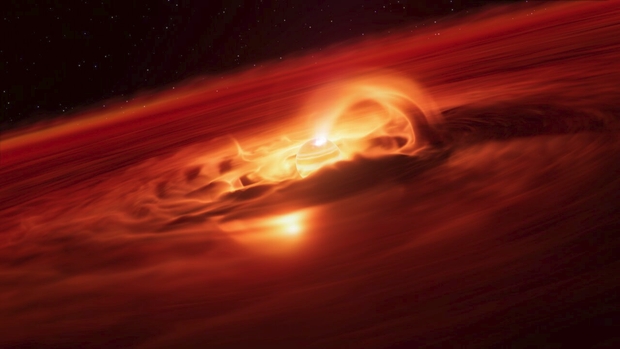
Image: Astronomers have identified an enormous ‘growth spurt’ in a so-called rogue planet. Unlike the planets in our Solar System, these objects do not orbit stars, free-floating on their own instead. The new observations, made with the European Southern Observatory’s Very Large Telescope (ESO’s VLT), reveal that this free-floating planet is eating up gas and dust from its surroundings at a rate of six billion tonnes a second. This is the strongest growth rate ever recorded for a rogue planet, or a planet of any kind, providing valuable insights into how they form and grow. Credit: ESO.
The rogue planet in question is dubbed Cha 1107-7626, some 620 light years out in the direction of the constellation Chamaeleon. This is one of those deep southern sky constellations announced in the early 17th Century by Dutch navigators. How they ever found a chamaeleon shape in its dim stars is beyond me, but this niche of the sky holds, interestingly enough, one of the closest star-forming regions to the Sun. It is now home to what is considered the strongest accretion event on record for an object with the mass of a planet.
So we have an instance of a rogue planet that behaves in some respects like a star, with the current burst of accretion mediated by magnetic activity. Strong hydrogen alpha (Hα) emission picked up in the spectroscopic data is considered “a hallmark for channeled, magnetospheric accretion,” and the size of the change in the hydrogen lines is what flags the dramatic increase in accretion rate. Finding it in a planet-mass object is highly unusual. A major tool for astronomers, the hydrogen alpha line is emitted when an electron moves from the third lowest to the second lowest energy state in the hydrogen atom.
Looking into the paper (just published in The Astrophysical Journal Letters, I learned that bursts like this are well studied in young stars:
In particular, such events can have a significant effect on chemical and physical evolution of the disk (P. Ábrahám et al. 2009; S. A. Smith et al. 2025), and potentially on the early stages of planet formation. Our target is the lowest mass object observed thus far that is going through an accretion burst, and by far the lowest in the EXor category [young stars pre-Main Sequence]. Detailed studies of accretion variability have in the past helped to illuminate the interactions between young stellar objects and their disks, including the role of magnetic fields. Similarly, the observations presented here provide a glimpse into the nature of accretion in planetary-mass objects.
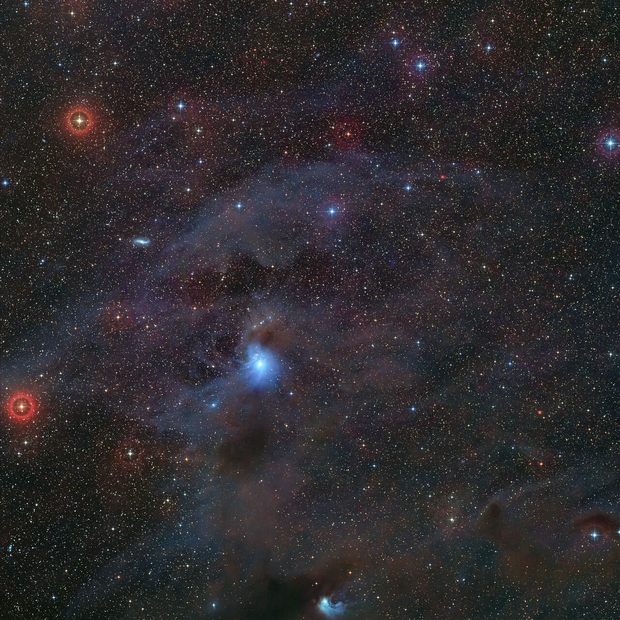
Image: This visible-light image, part of the Digitized Sky Survey 2, shows the position in the sky of the rogue planet Cha 1107-7626. The planet (not visible here) is located exactly at the centre of the frame. Credit: ESO/ Digitized Sky Survey 2.
The belief that rogue planets are invariably the result of ejections from a planetary system is challenged by these findings. From my reading of this paper, we seem to be looking at a ‘star-like’ formation of a gas giant through accretion, hinting at a variety of formation scenarios in free-floating worlds. Surely we will find more, but for now I can see why the authors call Cha1107-7626 “the poster child for disk accretion in the planetary-mass domain.”
The paper is Almendros-Abad et al., “Discovery of an Accretion Burst in a Free-Floating Planetary-Mass Object,” Volume 992, Number 1 (2 October 2025), L2 (full text).


An alternate source for the featured paper in this CD article:
https://www.eso.org/public/archives/releases/sciencepapers/eso2516/eso2516a.pdf
Discovery of an Accretion Burst in a Free-Floating Planetary-Mass Object
V. Almendros-Abad, Aleks Scholz, Belinda Damian, Ray Jayawardhana, Amelia Bayo, Laura Flagg, Koraljka Muˇzic´, Antonella Natta, Paola Pinilla, and Leonardo Testi
And this related recent paper:
https://arxiv.org/abs/2509.13513
Astrometric Methods for Detecting Exomoons Orbiting Imaged Exoplanets: Prospects for Detecting Moons Orbiting a Giant Planet in Centauri A’s Habitable Zone
In the full article was the estimated age of the object mentioned? How much more growth is expected? The upper estimate of its mass of 10 Jupiters is approaching the lower end of the Brown Dwarf range of 13 Jupiters. Maybe we’re actually looking at the birth of a Brown Dwarf.
That’s a good point, Mike. The age estimates are uncertain, and we can’t know how much farther the accretion process might go.
We seen to be getting into the fuzzy region of defining a planet and a star. This object is in the Brown dwarf mass category. It is understood that an object less than 13 jupiter masses cannot initiate fusion, perhaps the limit of a minimum star mass and the maximum of a planet, albeit a hot one.
This object appears to have an accretion disk, but is consuming it. Is the disk of sufficient mass to make this a star or not?
There is no information on how this object was born. Supposedly, a gas cloud has to have sufficient local density to gravitationally collapse to form a star. Is this a case of a high enough local density to initiate further mass accretion, or was this an ejected planet that was able to attract enough material to generate an accretion disk?
It is interesting that the spectrographic data indicate both silicates and hydrocarbons, suggesting that the accretion disk is not differentiated as it would be around a star, and in ordinary circumstances would be forming a planet.
While speculation about brown dwarfs often centers around whether they could be habitable, I would wonder if they could become a large resource for expanding civilizations. If not undergoing fusion, and not too hot for mining, they might be excellent sources of many compounds needed to support life/beings and new structures. Are there enough scattered throughout the galaxy to act as stepping stones, like Pacific islands? Unlike cometary material, they have abundant heavier elements needed for physical objects. Gravity would seem to be a problem in extracting those resources unless the BD was shattered first.
And to go all Avi Loeb, is it possible these objects are artificial, examples of an ETI “genesis project”?
I saw this the other day and wonder if it could improve Astrometric and imaging planets and moons around Centauri A’s Habitable Zone?
The Rubin Observatory’s upcoming images may stack up to space telescope ones. Here’s how
https://www.space.com/astronomy/the-rubin-observatorys-upcoming-images-may-stack-up-to-space-telescope-ones-heres-how
I agree with this idea, the in situ formation of gas giants instead of their ejection due to the rarity of such evens as well as the size. Only another gas giant or larger could eject a gas giant which are usually what makes the ejections like Jupiter in our solar system.
This object is near to the boundary of star and planet, and to the deuterium burning limit. Both limits, and the observed mass itself, still seem to be a bit uncertain. Deuterium burning also weirdly paces itself with a sort of homeostatic feedback — and nature has just delivered a solid “thump” to this star, with a ten-millionth of a Jupiter mass of matter per year. Is there a chance that some small sort of deuterium flash could soon make itself apparent? I wonder if data from this star might help with human efforts to make nuclear fusion productive.
@Mike
It does occur to me that a gravitationally ignited fusion of a super-Jupiter of ~13 Jupiter masses might be a lower limit for a Shkadov thruster. It should be far easier to build such a device for such a star compared to our G-type star. The longer wavelengths of such a brown dwarf might allow lighter “sails”, with perforated reflecting films. The relatively low temperature of the star would allow direct attachment of refractory cables to the star. Such a star burning for trillions, if not quadrillions of years, might be an impractical spaceship, but perhaps a very long-lived probe to navigate the universe until near its end. If, like a gas giant, it has a rock core, this material can be used to build and repair the drive as it deteriorates on its travels.
@Alex
I’m surprised how much we differ in our expectations for fusion and transmutation. I was hoping an astronomer looks up, sees some wavelength of absorbed or emitted light, or works something out about the pattern of magnetic field lines in the star, and fusion plants become practical even sooner than they would otherwise. You’re picturing that people willing to wait trillions of years will still care whether a gas giant has a rocky core – in other words, that transmutation will simply never be possible. I would hope that if civilization survives a thousand years or two, that people can just say, “Let there be praseodymium!”… and there will be praseodymium.
@Mike
You may well be correct, but I see that as using “magic pixie dust” which allows any technology, such as FTL. The “Cold Fusion” debacle was a cautionary example of hoping for a miracle, like a Mr. Fusion appliance in Back to the Future II, set in 2015.
You may recall that SciFi still assumes that only titanic energies, such as supernova explosions, will create new heavy elements.
It may be that what we think are the immutable “Laws of Physics” will prove false, much as the Victorians thought that all of physics was known. What they didn’t know changed the world in a century. We may be in the same situation. I often use that analogy when suggesting that we are very much grounded in contemporary beliefs and that science and technology will likely change before some grandiose ideas can be carried out, like massive, interstellar generation ships.
Some technology that I think will happen may prove to be wishful thinking, such as we will be able to fully design new organisms from scratch, using genomic sequences. [But we are just starting to do that with viruses. How long before we can do that with bacteria, single-cell eukaryotes, and then complex eukaryotes? (I believe this will be the “Biological century” – aided with computation and AI).]
Avi Loeb was chasing after a meteorite that could be an alien spacecraft that was made of superdense materials. IMO, this was a fantasy based on inaccurate math calculations. It assumes that what we know about superheavy elements is wrong. I remember from my 1960s schooling that it was thought there would be an “island of stability” at some element masses. 60+ years later, we have not be able to make such stable elements. Samuel Delany’s novel Nova(1968) has a plot based on a power source element “Illyrion” that is manufactured in a nova. This is just fantasy. More prosaically, Clarke thought that Sakharov’s Muon-catalyzed fusion would solve fusion power and rocket propulsion 2061: Odyssey Three(1987). That was a bust. Earlier, he assumed microscopic black holes could be used to heat hydrogen as a rocket propellant (Imperial Earth(1975)). But we [think we] know that Hawking radiation would invalidate that idea.
Right now, we are grappling with signs of extraterrestrial life. We know so little beyond terrestrial biology that we can speculate about alternative biologies that range from small changes to vastly different ways things can be “living”. Allied with that, we are already being confused about what intelligence is as AI mimics our intellectual capabilities and teases us that it is truly intelligence. While I don’t doubt the latter will eventually arrive, I remain skeptical about some of the expectations of truly extreme biology. But I will keep an open mind, and wait for evidence to be presented (but I very much doubt there is life on Venus, even in the temperate atmosphere).
Clarke is probably correct that very advanced technology will seem to be magic. I have lived through the invention of such technologies – and I still marvel that 2 people can talk over portable video phones half a world apart while both are traveling rapidly.
Until the discovery of restriction enzymes, later CRISPR, and knowledge of genes and their sequences, the only way to quickly change an organism was to bombard its eggs/seeds with neutrons to create random changes. There were experiments to develop new wheat strains that way. We can transmute elements that way too, but what we need is exquisite targeting methods to transmute one element into only one (or a few) other elements that is stable. Then you can make elements on demand, such as praseodymium, and make it as common and cheap as you like.
I suspect some of the technical obstacles might have already been surmounted. Generating ultraheavy transuranic elements basically means being able to build a nuclear weapon the size of a disposable pen that could blow up a skyscraper. There are lots of published data for anything heavy without a lot of neutrons, but past a certain critical ratio there’s no data. Maybe it’s just hard…
Earth spoiled us for chemistry, because we had seen that living organisms could generate complex compounds. If we had gone looking on Venus or Mars, would we have imagined carbon compounds were capable of such complexity? But Earth is just as lifeless when it comes to nuclear reactions – nothing here has evolved to that level yet. Our technology is a set of hard-luck stories: can’t generate or focus a neutrino, can’t stabilize a muon, can’t provably induce gamma emission with the right wavelength of light, can’t detect or interact with dark matter… but sooner or later, someone will get lucky. In theory, I think groups of high energy photons could be focused onto each nucleus (in a multi-photon approach to reach an excited state) in order to make each one do pretty much whatever you want.
The first image reminds me of Yin/Yang and the flux tubes of Io orbiting Jupiter.
Magnetohydrodynamics (MHD) influences brown dwarf formation by describing how magnetic fields interact with the ionized gas that collapses to form them, impacting the structure, fragmentation, and accretion process. MHD simulations track the collapse of turbulent clouds to reveal that magnetic fields can play a role in dictating the initial core mass, angular momentum, and overall evolution of nascent brown dwarfs, potentially even contributing to episodic outbursts and the birth of circumstellar disks.
Role of Magnetic Fields in Brown Dwarf Formation
Gravitational Collapse: Magnetic fields influence the collapse of molecular clouds by affecting the amount of turbulent compression and the resulting structure of nascent brown dwarfs.
Structure and Evolution: MHD simulations show that magnetic fields are a key factor in determining the structure and evolution of proto-brown dwarfs, alongside factors like the initial core mass and angular momentum.
Disk Formation: The magnetic field’s interaction with the accreting gas can influence the birth and evolution of circumstellar disks around forming brown dwarfs.
Simulations and Observations.
3D Radiation-MHD Simulations: Researchers use advanced simulations to model the collapse of low-mass cores, incorporating radiative transfer and non-ideal MHD effects to study the entire process of brown dwarf birth.
Episodic Accretion/Outbursts: Magnetorotational instability in the inner disk can trigger episodic accretion outbursts, leading to phases of high and low accretion rates that significantly affect the brown dwarf’s formation and evolution.
Observational Evidence: Observations of radio emission and shocked gas knots in young brown dwarfs suggest that episodic accretion events, possibly linked to magnetohydrodynamic processes, do occur.
Brown Dwarf Formation Mechanisms
Starlike Formation: Brown dwarfs may form similarly to low-mass stars through the gravitational collapse and fragmentation of molecular clouds.
Fragmentation: During the collapse of turbulent molecular clouds, dense cores can fragment, leading to the formation of brown dwarfs. These objects can then be ejected from the dense gas before reaching stellar mass.
Ejection: In some cases, brown dwarfs form in gravitationally unstable circumstellar disks or collapsing filaments, and are then ejected from the dense gas.
“So we have an instance of a rogue planet that behaves in some respects like a star, with the current burst of accretion mediated by magnetic activity”
Magnetism, maybe hot plasmas, rotation, who knows what else? And in our own system, Jupiter is known to be an emitter of microwave radiation; perhaps the other gas giants as well? This may be solely due to solar-magnetospheric interactions, but at least we have one nearby example of a cool gas giant shouting into the radio aether. Perhaps a search program
using radio astronomy could be devised to help search for these objects?
Are they (the rogue planets) bright enough at those freqs, or close enough, or common enough, to make it feasible for us to listen for them?
Mass accumulation by planets in orbit around red giants should occur as well, this should also affect the planets in our solar system. Once they gain more mass they could destabilise the outer planets to the point of ejection creating rogue planets.
On account of this news, went to check back at the Orion molecular cloud where a lot of stars are either forming or newly born. I am not aware of any similar cases there, but it would seem with such a large population of newly forming stars, there ought to be traces of such phenomena there too.
In lectures decades ago, provided by stellar modelers in the astronomy department, another mass limit for coalescing bodies was invoked, which was right around the 0.08 hydrogen fusion limit. Which did dismay exoplanet enthusiasts but didn’t bother stellar evolution modelers at all. Especially since they did not expect its luminosity to be conducive to observation anyway.
Since I can’t even find the namesake of the limit, it is difficult current day to evaluate its evidently not so solid argument.
But since there are scant explanations anyway, how about this: The object began its life as a good sized Herbig Haro object? Back in the days before exoplanets there were not many suspects to point to as possible exoplanets. But H-Hs were observed around newly formed stars and headed away to interstellar space.
“Formed when accreted material is ejected by a protostar as ionized gas along the star’s axis of rotation.” One millionth of a stellar mass is the presumed upper end. but that might explain why more such wandering accreting exoplanets are spotted. Not sure I believe this myself, but some of the E-M evidence might suggest something like that.
Looking at heir characteristic mass, it
They are called polar outflows which dump angular momentum. When they hit other material they could compress it to the point of forming planets. Great place for an intelligent species to experiment with planet building.
It has always seemed to me improbable that that there should be any connection between the dividing line between masses that are big enough to form on their own (i.e., being the primary object in a proto-planetary disk) and the dividing line on masses big enough to support nuclear fusion. Those have totally different physics. Since we see stars form on their own all the way down to the fusion limit, that has always strongly suggested to me that at least some planets can form on their own.
Why do the authors of these kinds of papers so seldom consider the possibility that residents of red dwarf systems, globular star clusters, and so forth might not be natives to these locations?
We are well into the 21st Century – get out of the 1960s mindset that detectable aliens are just versions of us sitting on Earthlike worlds around Sol-type stars transmitting radio waves altruistically into the galaxy to become friends with other species.
https://astrobiology.com/2025/10/solar-hegemony-m-dwarfs-are-unlikely-to-host-observers-such-as-ourselves.html
Solar Hegemony: M-Dwarfs Are Unlikely to Host Observers Such as Ourselves
By Keith Cowing
Status Report
astro-ph.IM
October 7, 2025
With no firm evidence for life beyond our solar system, inferences about the population observers such as ourselves rests upon the Earth as a single input, at least for now.
Whilst the narrative of our home as a ‘humdrum’ system has become ingrained in the public psyche via Sagan, there are at least two striking facts about our existence which we know are certainly unusual.
First, the stelliferous period spans ~10Tyr – yet here we are living in the first 0.1% of that volume. Second, over three-quarters of all stars are low-mass M-dwarfs, stars with no shortage of rocky habitable-zone planets – and yet, again, our existence defies this trend, previously dubbed the Red Sky Paradox.
Two plausible resolutions are that a) stars below a certain mass, Mcrit, do not produce observers, and, b) planets have a truncated temporal window for observers, Twin, negating the longevity advantage of M-dwarfs. We develop a Bayesian model that encompasses both datums and jointly explores the two resolutions covariantly.
Our analysis reveals that 1) the hypothesis that these observations are mere luck is disfavored with an overwhelming Bayes factor of ~1600; 2) some truncation of low-mass stars is indispensable, lowering Twin alone cannot well-explain the observations; and, 3) the most conservative limit on Mcrit occurs when fixing Twin=10Gyr, yielding Mcrit>0.34M⊙ [0.74M⊙] to 2σ [1σ]. Our work challenges the tacit assumption of M-dwarfs being viable seats for observers and, indirectly, even life.
David Kipping
Comments: Submitted to AAS Journals
Subjects: Instrumentation and Methods for Astrophysics (astro-ph.IM); Earth and Planetary Astrophysics (astro-ph.EP); Solar and Stellar Astrophysics (astro-ph.SR)
Cite as: arXiv:2510.01215 [astro-ph.IM] (or arXiv:2510.01215v1 [astro-ph.IM] for this version)
https://doi.org/10.48550/arXiv.2510.01215
Focus to learn more
Submission history
From: David Kipping
[v1] Fri, 19 Sep 2025 08:15:13 UTC (3,183 KB)
https://arxiv.org/abs/2510.01215
Astrobiology, SETI
While still true up to a point, we also look for technosignatures that are not necessarily associated with species only living on Earth-like worlds.
However, the failure to date in detecting a radio signal from space narrows the probability that there is a galaxy full of communicating species in a “galactic club”. This supports the theory that technological, communicating species are rare, and that we need to keep looking to find them…eventually. We hope it isn’t a snipe hunt.
We may be in the same mindset with the “easier” search for life. First, we look for biosignatures in the most Earth-like of worlds, where Earth-like includes its parent star. If we cannot find life there, no doubt we will look at M_dwarf systems, like Trappist 1, but this may feel a bit like an act of desperation, especially if biosignatures are not detected there either.
Based on our views of technology development, influenced by Dyson, it also appears that there are no KIII civilizations in other galaxies, nor in ours, and not, so far, any signs of a KII one either.
This seems to strengthen the Fermi question, if we include that our searches beyond UFOs on the WH lawn come up blank, too. The most parsimonious answer becomes…we are alone (as a technological, communicating species, within our space-time period). This hypothesis would be strengthened if biosignatures prove elusive as well.
Humanity has invoked gods in all historical civilizations. Modern humans have added advanced technology aliens to that pantheon, especially as we seem unable to solve our problems, and want or hope for some sort of “parental” help. Our media just prefer to show abusive aliens over benign ones, possibly supporting our view of ourselves.
Conversely, if we do detect biosignatures and confirm they are true proxies for living worlds, the more abundant they are, the more likely there are ETIs out there, and we are back to the many explanations of why they don’t seem visible to us.
Humanity’s outlook and future may well depend on whether the universe appears dead or living. We are living at a time when an answer to that question could be provided soon (at least for a living universe).
As an aside, I recommend the linked short story collection, “The Ross 248 Project” by Johnson and Roy. It is about the colonization of the M_dwarf star Ross 248 that is provided with a Trappist 1-like collection of rocky worlds.
Quoting from the above paper, the level of caution here borders on timidity, if not going right over to it…
“We have somewhat deliberately avoided dwelling on exactly how one defines “observer” in this work, but strictly the implicit assumption throughout is that our experience is a representative example of “observers”. Exactly how one interprets who is and is not representative dives into metaphysical questions beyond this author’s skill to answer. Nevertheless, we argue that our work only formally applies to self-aware, reasoning observers such as ourselves, as not life in general.”
And then this quote…
“Certainly, an exclusive focus on such stars would be folly, intelligences beyond our own may be colonizing M-dwarfs for other purposes (Lingam et al. 2023), but again the simplest interpretation would be to de-weight them.”
First, I am surprised they use the word “colonizing” considering its negative connotations these days. Since the author dared to bring up the suggestion, why not give M class star systems a look? Explorers and mining operations in such systems would probably be MORE likely to transmit messages than any native civilizations due to the nature of their business.
If there are not many technological civilizations, in particular the kind that can travel to other star systems, then the chances for a SETI success would already be very low. However, if we assume the Milky Way galaxy is busy with advanced species, the red dwarf systems are just as likely sources of transmissions than any other similar dwarf stars – more, in fact, if as the author states there are few native intelligent societies present, then all the more reason that others would want to explore and exhume resources from these systems – transmitting their findings to interested parties in the process.
No, they probably would not be aiming transmissions in our direction except by chance, but again, since they have larger reasons to send messages into interstellar space, that would be all the more reason not to leave them out of any SETI surveys.
In contrast, we have this paper from 2020 where the author thinks that white dwarf star systems – presumably even less likely places for life if we think traditionally about the subject – would be dandy places to look for them…
https://arxiv.org/abs/2001.00673
And certain astronomers just conducted a SETI survey of the famous TRAPPIST-1 system, which has an ultra-cool red dwarf at its center…
https://arxiv.org/abs/2509.06310
Note this quote from the abstract:
No credible technosignature candidates were identified within the searched parameter space. Nevertheless,TRAPPIST-1 remains a compelling target for future SETI efforts. We plan to extend our search to other signal types, such as periodic or transient transmitters, and to carry out broader surveys of nearby exoplanetary systems with FAST.
China has the largest radio telescope on Earth. Arecibo is a pile of scrap metal sitting on the ground in Puerto Rico. Chinese astronomers have stated publicly that one of the purposes for their radio observatory is to conduct SETI and become the first nation to detect alien intelligences. Whereas Arecibo spent most of its time trying to pretend it wasn’t interested in SETI despite a few famous moments in its history…
https://www.centauri-dreams.org/2009/11/18/%E2%80%9Crubisco-stars%E2%80%9D-and-the-riddle-of-life/
https://www.centauri-dreams.org/2009/11/19/rubisco-stars-part-ii/