
Rosetta makes its reappearance at just the right time for me. The spacecraft, making its second Earth swing-by on November 13, will use its gravity assists past Earth and Mars to reach Comet 67P/Churyumov-Gerasimenko in 2014, deploying a lander onto the nucleus and spending two years orbiting the comet. The close approach produced the memorable image below. I thought I was too under the weather today to post anything, but Rosetta’s composite shot of Earth by night offers a short, memorable subject. Look at those city lights!
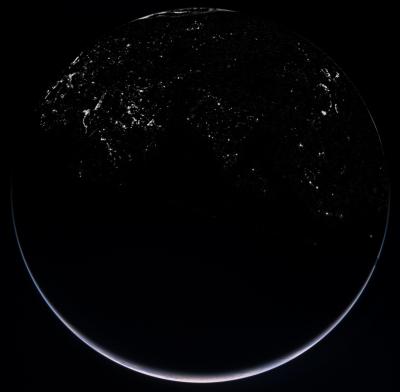
Image: This is a composite of four images combined to show the illuminated crescent of Earth and the cities of the northern hemisphere. The images were acquired with the OSIRIS Wide Angle Camera during Rosetta’s second Earth swing-by on Nov. 13. This image showing islands of light created by human habitation was taken with the OSIRIS WAC at 19:45 CET, about 2 hours before the closest approach of the spacecraft to Earth. At the time, Rosetta was about 80,000 km above the Indian Ocean where the local time approached midnight (the angle between Sun, Earth and Rosetta was about 160°). The image was taken with a five-second exposure of the WAC with the red filter. This image showing Earth’s illuminated crescent was taken with the WAC at 20:05 CET as Rosetta was about 75,000 km from Earth. The crescent seen is around Antarctica. The image is a color composite combining images obtained at various wavelengths. Credit: ESA ©2005 MPS for OSIRIS Team MPS/UPD/LAM/IAA/RSSD/INTA/UPM/DASP/IDA.
Of course, what gets my attention is that this is what a technological civilization — the only one we know exists — looks like by night to an approaching spacecraft. Will we one day have interstellar probes that can make a Rosetta-style pass around a world like this in another solar system? For that matter, will we ever have the kind of spectacular close-up images that could result from advanced sunshade concepts like New Worlds, showing us the lights of alien cities? Let’s hope the answer is yes, and that our technologies will one day find signs of extraterrestrial intelligence. If that doesn’t happen, those city lights Rosetta found on Earth begin to look like a reminder of how fragile sentient life may be.
Addendum: More Rosetta images, including Europe at night, available here.


Always a beautiful picture when a probe or satellite does this.
That petal shaped star-shade looks like it could work. The trick would be getting the distance and attitude correct. Almost like using an old eclipse filter to study the solar corona, only in space-based.
For those who want to see what the entire Earth looks like at night, you can see NASA’s composite of the Earth’s city lights from space inside Google Earth. Just turn on the layer under “Gallery->NASA->Earth City Lights”.
I’ve created a placemark which simulates the shot taken by Rosetta which you can see (after you turn on the above layer in Google Earth) and by loading this placemark:
http://www.gearthblog.com/kmfiles/rosettasim.kmz
Open up the placemark loaded for details including the Rosetta photo for comparison.
Frank, thanks for this terrific tip. I always count on you when it comes to drawing out the best from Google Earth! Hope everyone will take a look at this.
i’ve never really bought into that frank, that “this is what earth looks like at night”. It’s either IR or light data multiplied/exaggerated like WOAAAAA and then overlayed over a tweaked blue marble dataset.
I’m prettysure earth at night right-now looks closer to what it did 10,000 years ago, than that overly exaggerated lightmap composite. To the naked untrained eye you can still barely tell we live here.
Good point re overlays etc., Roid, but the point still holds: Assume an interstellar probe approaching an inhabited terrestrial world and you’re looking at a spacecraft that should be capable of teasing out city lights just as Rosetta did. You may well be right about this not being what the naked eye would see, though — does anyone have a further take on that? I frankly don’t know.
Wonderful post… what was so spectacular for me was looking at one of the images (this one: http://esamultimedia.esa.int/images/rosetta/Europe_by_night_filtere5_1.jpg )
and armed only with the knowledge that I was looking at Europe…being able to identify most of the major cities/metropolitan areas. Kind of a cross between cognitive and geo-spatial disciplines.
City lights are visible from orbit with the Mark I Eyeball, see here for some descriptions. The Rosetta pictures are probably not too bad a representation of what you would be able to make out with your own eyes were you in the same position.
I note that it was a long exposure shot, and i expect it to be zoomed in as well.
I can take photographs of my backyard on long exposure, it’s significantly brighter than what my eyes see.
http://eol.jsc.nasa.gov/scripts/sseop/photo.pl?mission=ISS006&roll=E&frame=22939&QueryResultsFile=1048138731408.tsv
I am relatively unfamilure with photographic termanology, does it say somewhere on this page how long the exposure was, and how “zoomed in” it is?
It is noteworthy what the ISS passengers say, that they CAN see the Earth city lights from ISS’s orbital height, this is quite close. But from a distance where the whole Earth can be fit into one photograph, could you see anything? i have my doubts (you’d want to be completely in Earth’s shadow).
All this being said, i am interested at what distance from Earth the city lights DO become visible to the naked eye. It seems to be visible from ISS orbit height, but they do not seem visible from the Earthrise images taken from the Moon. I wonder just how close unaided or aided human, alien, or technological eyes would need to be to notice that humans are living on Earth – and how likely is it that those eyes (if alien/technological) will ever venture into that required distance.
True colour images of Earth as seen by Rosetta’s OSIRIS
camera are now available. The pictures were taken on 13
November during the swing-by, and on 15 November, as
Rosetta left on its way to the outer Solar System, after the
swing-by.
More at:
http://www.esa.int/esaSC/SEMRYE63R8F_index_0.html
The latest Pale Blue Dot, this time from MRO.
Quoting from Spaceflightnow:
Another notable HiRISE image released today shows a
blue crescent Earth and its moon, as seen by the Mars
Reconnaissance Orbiter. The west coast of South America
is visible in the photo. Still other images allow viewers to
explore a wide variety of Martian terrains, such as dramatic
canyons and rhythmic patterns of sand dunes.
The camera is one of six science instruments on the orbiter.
The spacecraft reached Mars in March 2006 and has returned
more data than all other current and past missions to Mars
combined.
Image here:
http://spaceflightnow.com/news/n0803/03avalanches/earth.jpg
Lunar Eclipse from Orbit
http://earthobservatory.nasa.gov/Newsroom/NewImages/images.php3?img_id=17963
Check out these cities as seen from space at night –
it looks pretty until you realize how those artificial lights
have killed the real natural beauty for those urban areas:
http://earthobservatory.nasa.gov/Study/CitiesAtNight/
The efforts of one astronomer to save Flagstaff, Arizona
from encroaching light pollution:
http://altairvi.blogspot.com/2008/04/wes-lockwood-saves-universe.html
National Geographic – November, 2008:
“Our Vanishing Night”
Excerpt:
“In most cities the sky looks as though it has been emptied of stars,
leaving behind a vacant haze that mirrors our fear of the dark and resembles
the urban glow of dystopian science fiction. We’ve grown so used to this
pervasive orange haze that the original glory of an unlit night‹dark enough
for the planet Venus to throw shadows on Earth‹is wholly beyond our
experience, beyond memory almost. And yet above the city’s pale ceiling lies
the rest of the universe, utterly undiminished by the light we waste‹a
bright shoal of stars and planets and galaxies, shining in seemingly
infinite darkness.
We’ve lit up the night as if it were an unoccupied country, when nothing
could be further from the truth. Among mammals alone, the number of
nocturnal species is astonishing. Light is a powerful biological force, and
on many species it acts as a magnet, a process being studied by researchers
such as Travis Longcore and Catherine Rich, co-founders of the Los
Angeles-based Urban Wildlands Group. The effect is so powerful that
scientists speak of songbirds and seabirds being ‘captured’ by searchlights
on land or by the light from gas flares on marine oil platforms, circling
and circling in the thousands until they drop. Migrating at night, birds are
apt to collide with brightly lit tall buildings; immature birds on their
first journey suffer disproportionately.”
More … and photos:
http://ngm.nationalgeographic.com/2008/11/light-pollution/klinkenborg-text
One-fifth of us have lost sight of Milky Way
Tuesday, 9 June 2009
by Heather Catchpole
Cosmos Online
Comparison showing the effects of light pollution on viewing the sky at night. The southern sky, featuring Sagittarius and Scorpius. Top image shows the sky from Leamington, Utah (population 217). Bottom image shows Orem, Utah (metropolitan area with a population of around 400,000).
Credit: Jeremy Stanley/Wikimedia
SYDNEY: Light pollution has caused one-fifth of the world’s population – mostly in mainland Europe, Britain and the U.S. – to lose their ability to see the Milky Way in the night sky.
“The arc of the Milky Way seen from a truly dark location is part of our planet’s natural heritage,” said Connie Walker, and astronomer from the U.S. National Optical Astronomy Observatory in Tucson, Arizona.
Yet “more than one fifth of the world population, two thirds of the U.S. population and one half of the European Union population have already lost naked eye visibility of the Milky Way.”
Star-free night
The phenomenon, caused by the reflection of manmade light by the Earth’s atmosphere, impacts astronomical research and can even affect human health, warned Walker, who will present her research on Wednesday at a meeting of the American Astronomical Society in Pasadena, California.
The effects of light pollution on human health can be as mild as the disruption of the circadian rhythm leading to problems sleeping, but it can also be serious, she said.
Full article here:
http://www.cosmosmagazine.com/news/2797/one-fifth-us-have-lost-sight-milky-way
Crescent Earth from the Departing Rosetta Spacecraft
Credit & Copyright: ESA (MPS for OSIRIS Team), MPS/UPD/LAM/IAA/RSSD/INTA/UPM/DASP/IDA
Explanation: Goodbye Earth. Earlier this month, ESA’s interplanetary Rosetta spacecraft zoomed past the Earth on its way back across the Solar System. Pictured above, Earth showed a bright crescent phase featuring the South Pole to the passing rocket ship.
Launched from Earth in 2004, Rosetta used the gravity of the Earth to help propel it out past Mars and toward a 2014 rendezvous with Comet Churyumov-Gerasimenko.
Last year, the robot spacecraft passed asteroid 2867 Steins, and next year it is scheduled to pass enigmatic asteroid 21 Lutetia. If all goes well, Rosetta will release a probe that will land on the 15-km diameter comet in 2014.
Full article here:
http://antwrp.gsfc.nasa.gov/apod/ap091123.html
Earth as seen from LRO
http://www.nasa.gov/mission_pages/LRO/multimedia/lroimages/lroc-20100916_earth.html
http://www.nasa.gov/images/content/482574main_20100916_1b.jpg
As LRO orbits the Moon every two hours sending down a stream of science data, it is easy to forget how close the Moon is to the Earth. The average distance between the two heavenly bodies is just 384,399km (238,854 miles). Check your airline frequent flyer totals, perhaps you have already flown the distance to the Moon and back on a single airline! Contrast the current image with the NAC view taken last June, which revealed much of central Asia.
The Moon is a spectacular sight in the nighttime sky. Now imagine the Earth from the Moon, four times larger, a delicate blue, and it doesnot rise nor set. To astronauts, the Earth is a constant companion, at least on the nearside. Of course, on the farside you can never see the Earth.
From the Earth and Moon (and Russia) With Love
by Nancy Atkinson on March 30, 2011
This stunning picture of the Moon and Earth was taken by Russia’s new Elektro-L spacecraft, a weather-forecasting satellite that launched in January 2011.
This is the first major spacecraft developed in post-Soviet Russia, and it is designed to give Russian meteorologists the ability to watch the entire disk of the planet, thanks to the satellite’s position in the geostationary orbit 36,000 kilometers above the equator.
The clarity of the images is fantastic, as you can see in another image of just the Earth, below. The Elektro-L is designed to last at least a decade, and will enable local and global weather forecasting, analysis of oceanic conditions, as well as space weather monitoring, such as measurements of solar radiation, properties of Earth’s ionosphere and magnetic field.
Full article and images here:
http://www.universetoday.com/84498/from-the-earth-and-moon-and-russia-with-love/
http://www.technologyreview.com/blog/arxiv/27302/
City Lights Could Reveal Civilisations On Other Planets
Earth’s biggest cities are visible from space at night thanks to street lighting. ET’s probably are too, say astronomers
kfc 11/01/2011
The various pictures of Earth at night have become iconic images of humankind’s impact on the planet. The giant metropolises of Tokyo, the East and West coasts of the US and much of northern Europe light up our planet like a festive bauble.
Today, Abraham Loeb from Harvard University in Cambridge and Edwin Turner from Princeton University in New Jersey point out that its entirely reasonable for civilisations on other planets to have lit up their cities too. Any intelligent life that evolved in the light from its nearest star is likely to have artificial illumination that switches on during the hours of darkness.
This light will be different from natural illumination. On Earth, artificial lighting falls into two types: thermal lighting in the form of incandescent light bulbs and quantum lighting in the form of LEDs and fluorescent lights. “The spectra of arti?cial lights on distant objects would likely distinguish them from natural illumination sources,” say Loeb and Turner. “Arti?cial illumination may serve as a lamppost which signals the existence of extraterrestrial technologies and civilizations.”
But how easy would it be to spot a city on another planet? Clearly, this light will have to be distinguished from the glare from the parent star and Loeb and Turner suggest a way to do this. Their idea is to look at the change in light from an exoplanet as it moves around its star.
Given that its orbit will be elliptical, the amount of reflected light will change with the distance from its star. But the amount of artificial light will remain constant. So the total flux from a planet with city street lighting will vary in a way that is measurably different from a planet that has no streetlights.
There’s a caveat, however. “For this signature to be detectable, the night side needs to have an arti?cial brightness comparable to the natural illumination of the day side,” say Loeb and Turner. That seems rather unlikely given that Earth’s night time illumination is some 100,000 times less its day time lighting.
But it’s early days for this entirely new form of SETI. Other techniques for spotting cities as they blink on and off in the extraterrestrial night will surely emerge.
There is another search that could be done closer to home. With the help of some back-of-the-envelope calculations, Loeb and Turner say that today’s best telescopes ought to be able to see the light generated by a Tokyo-sized metropolis at a distance of about 50 AU, that’s roughly the distance to the Kuiper belt.
So if there are any cities out there, we ought to be able to see them now. “Arti?cially-lit Kuiper Belt objects might have originated from civilizations near other stars,” say Loeb and Turner who suggest they could have been ejected from their own systems and ended up here. They may even have passed near Earth on their way through the Solar System before the age of telescopes.
For that reason, they argue it’s worth studying the spectra from Kuiper belt objects, just in case.
Perhaps. Either way, Loeb and Turner have dreamt up an exciting new take on the search for extra terrestrial intelligence.
And not a moment too soon. SETI badly needs an injection of new ideas. Earth’s radio signature has been in dramatic decline as communications have switched from the airwaves to fibre optics. This has begun to pull the metaphorical rug from the radio-based rational for SETI.
But with exoplanets being discovered by the bucket-load, it’s becoming increasingly clear that ET civilisations could reveal themselves in other ways.
And as Loeb and Turner point out, light pollution seems as promising a signature to search for as any other.
Ref: http://arxiv.org/abs/1110.6181: Detection Technique for Arti?cially-Illuminated Objects in the Outer Solar System and Beyond
The (not so) pale blue dot
Here’s a wonderful image of Earth from NASA’s Suomi satellite:
http://whyevolutionistrue.wordpress.com/2012/01/26/the-pale-blue-dot/