by Paul Gilster | Nov 22, 2023 | Exoplanetary Science |
How extraordinary that the nearest star to Earth is actually a triple system, the tight central binary visually merged as one bright object, the third star lost in the background field but still a relatively close 13000 or so AU from the others. Humans couldn’t have a better inducement to achieve interstellar flight on the grounds of these stars alone. We get three stellar types: The G-class Centauri A, the K-class Centauri B, both of which are capable of hosting planets, perhaps habitable, of their own.
And then we have Proxima Centauri, opening up M-class red dwarf stars to close investigation, and we already know of a planet in the habitable zone there, adding to the zest of the venture. If extraterrestrial beings in a system like this would have even more inducement to travel, with another star’s planets perhaps as close to them as our own system’s worlds are to us, we humans are also spurred to undertake a journey, because 4.2 light years is a mere stone’s throw in the overall galactic distribution.
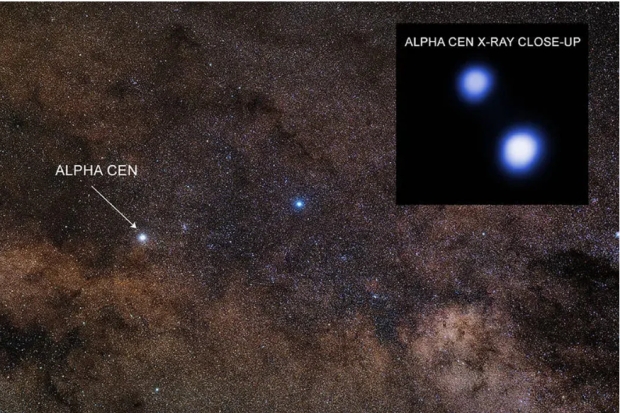
Image: The central binary at Alpha Centauri, with the two stars only resolved in the x-ray image. Credit: X-ray: NASA/CXC/University of Colorado/T.Ayres; Optical: Zdenek Bardon/ESO.
I like this image, used by Dirk Schulze-Makuch to illustrate a recent popular science article, because it includes the Chandra X-Ray imagery. That’s how we can separate the central stars, which are at times nearly as close as Saturn is to the Sun while they orbit their common barycenter. Centauri Dreams readers will recognize Schulze-Makuch (Technical University Berlin and an adjunct professor at Washington State) not only as a prolific writer but the author of a host of scientific papers including many we’ve looked at in these pages. He’s played a valuable role in presenting astrobiological matters to the general public, part of the flowering of interstellar investigation that continues as we keep finding interesting worlds to explore.
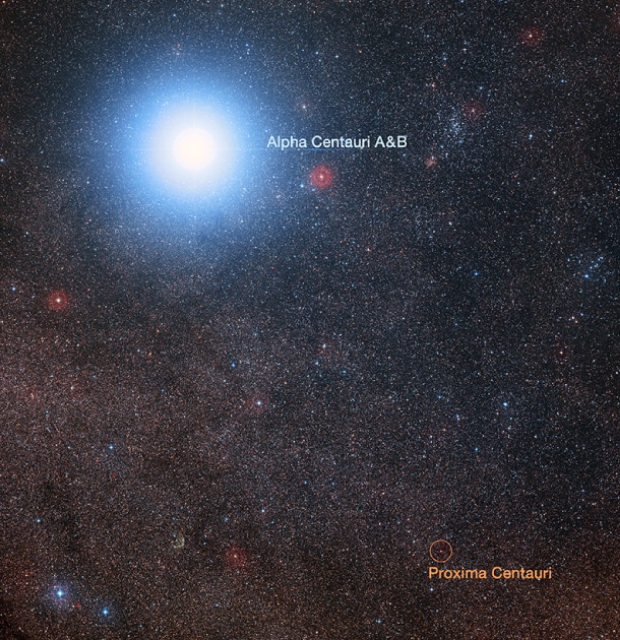
If you’re wondering about Proxima Centauri’s location, the image below flags it. Credit: ESO/B. Tafreshi (twanight.org)/Digitized Sky Survey 2; Acknowledgement: Davide De Martin/Mahdi Zamani).
I like to keep an eye on what appears in the popular press from respected scientists, because they’re bringing credibility to matters that often get distorted by mainstream media attention (not to mention what happens on social media sites). We should always give a nod to scientists willing to explain their work and the broader issues involved given that kind of competition for the public’s attention. It’s interesting in this case to get Schulze-Makuch’s take on habitability at Alpha Centauri. He’s pessimistic about Proxima but is surprisingly bullish on Centauri A and B:
The other two stars in the system are believed to have planets, although they have not been confirmed. (A possible Neptune-size planet was reported in 2021 orbiting Alpha Centauri A at roughly the same distance as Earth orbits the Sun, but this could turn out to be a dust cloud instead.) The apparent lack of any brown dwarfs or gas giants close to Alpha Centauri A and B make the likelihood of terrestrial planets greater than it would be otherwise, at least in theory. The chances of a rocky, potentially habitable planet in our neighboring solar system might therefore be as high as 75 percent.
The Proxima Centauri problem is, of course, the X-ray flux, although Schulze-Makuch also considers tidal lock a distinct negative. The Chandra data (citation below) revealed a relatively benign influx of X-rays for Centauri A and B, making them fine hosts for life if it can develop there. But Proxima is deeply problematic, receiving an average dose of X-rays some 500 times greater than Earth’s, and some 50,000 times as great during periods of flare activity, which M-dwarfs are particularly prone to in their younger days.
Here the word ‘younger’ is a bit deceptive. Recall that this kind of star can live for several trillion years. That’s a bit humbling, considering that the universe itself is thought to be 13.8 billion years old. In that sense all M-dwarfs are ‘young.’
Just as we can zoom in via X-ray to see the central stars, we can also take a look at Proxima Centauri’s movements via spectroscopic data, which we’ll examine next time, along with a fascinating speculation on the origin of Proxima b.
For more on the X-ray environment at Alpha Centauri, see Ayres, “Alpha Centauri Beyond the Crossroads,” Research Notes of the AAS Vol. 2, No. 1 (January, 2018), 17 (abstract). The possibility of a ‘warm Neptune’ at Alpha Centauri is discussed in Wagner et al., “Imaging low-mass planets within the habitable zone of α Centauri,” Nature Communications 12, Article number: 922 (2021). Full text. We’ll be talking about this one a bit more in coming days.
by Paul Gilster | Mar 17, 2023 | Exoplanetary Science |
The problem with Alpha Centauri is that the system is too close. I don’t refer to its 4.3 light year distance from Sol, which makes these stars targets for future interstellar probes, but rather the distance of the two primary stars, Centauri A and B, from each other. The G-class Centauri A and K-class Centauri B orbit a common barycenter that takes them from a maximum of 35.6 AU to 11.2 AU during the roughly 80 year orbital period. That puts their average distance from each other at 23 AU.
So the average orbital distance here is a bit further than Uranus’ orbit of the Sun, while the closest approach takes the two stars almost as close as the Sun and Saturn. Habitable zone orbits are possible around both stars, making for interesting scenarios indeed, but finding out just how the system is populated with planets is not easy. We’ve learned a great deal about Proxima Centauri’s planets, but teasing out a planetary signature from our data on Centauri A and B has been frustrating despite many attempts. Alpha Centauri Bb, announced in 2012, is no longer considered a valid detection.
But the work continues. I was pleased to see just the other day that Peter Tuthill (University of Sydney) is continuing to advance a mission called TOLIMAN, which we’ve discussed in earlier articles (citations below). The acronym here stands for Telescope for Orbit Locus Interferometric Monitoring of our Astronomical Neighborhood, a mission designed around astrometry and a small 30cm narrow-field telescope. The project has signed a contract with Sofia-based satellite and space services company EnduroSat, whose MicroSat technology can downlink data at 125+ Mbps, and if the mission goes as planned, there will be data aplenty.
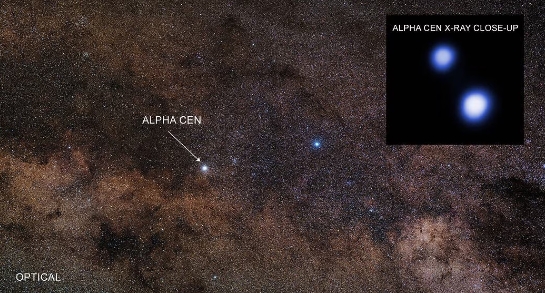
Image: Alpha Centauri is our nearest star system, best known in the Southern Hemisphere as the bottom of the two pointers to the Southern Cross. The stars are seen here in optical and x-ray spectra. Source: NASA.
The technology here is quite interesting, and a departure from other astrometry missions. Astrometry is all about tracking the minute changes in the position of stars as they are affected by the gravitational pull of planets orbiting them, a series of angular displacements that can result in calculations of the planet’s mass and orbit. Whereas both transit and radial velocity methods work best when dealing with planets close to their star, astrometry is the reverse, becoming more effective with separation.
Finding an Earth-class planet in the habitable zone around one of these two stars requires us to identify a signal in the range of 2.5 micro-arcseconds for Centauri A, an amount that is halved for a planet around Centauri B. Not an easy catch, but the ingenious TOLIMAN technology uses a ‘diffractive pupil’ to spread the starlight and increase the ability to spot and subtract systematic errors. I’ve quoted the team’s online description before but it usefully encapsulates the method, which has no need of field stars as references because it uses the binary companion to the star being examined as a reference, making a small aperture suitable for the work.
With the fortuitous presence of a bright phase reference only arcseconds away, measurements are immediately 2 – 3 orders of magnitude more precise than for a randomly chosen bright field star where many-arcminute fields (or larger) are required to find background stars for this task. Maintaining the instrument imaging distortions stable over a few arcseconds is considerably easier than requiring similar stability over arcminutes or degrees. Alpha Cen’s proximity to Earth means that the angular deviations on the sky are proportionately larger (typically a factor of ~10-100 compared to a population of comparably bright stars).
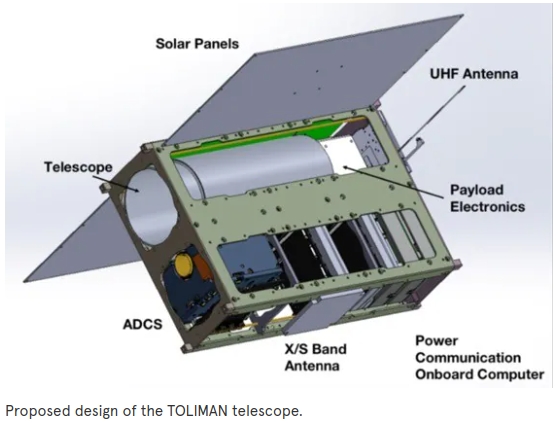
Image: Telescope design: The proposed TOLIMAN space telescope with a candidate telescope mirror pattern known as a diffractive pupil. Rather than concentrating the starlight into a tight focused beam as is usually done for optical systems, TOLIMAN has a strongly featured pattern, spreading starlight into a complex flower pattern that, paradoxically, makes it easier to register the fine detail required in the measurement to detect the small wobbles a planet would make in the star’s motion. Credit: Peter Tuthill / University of Sydney.
You can imagine the thermal and mechanical stability issues involved here. Doubtless Tuthill’s experience in the design of NIRISS (Near-Infrared Imager and Slitless Spectrograph ) and the aperture masking interferometry for the instrument on the James Webb Space Telescope will inform the evolution of the TOLIMAN hardware. As to EnduroSat, Raycho Raychev, founder and CEO, has this to say:
“We are exceptionally proud to partner in this mission. The challenges are enormous, and it will drive our engineering efforts to the extreme. The mission is a first-of-its-kind exploration science effort and will help open the doors for low-cost astronomy missions.”
A successful TOLIMAN mission could lead to what the team has referred to as TOLIMAN+, a larger instrument capable of detecting Earth-class worlds around both 61 Cygni and 70 Ophiuchi. But let’s get the Alpha Centauri results first, perhaps leading to detections around a target whose planetary signals would be much stronger than those of these other systems. We’ve seen how larger instruments like those aboard HIPPARCOS and Gaia have used astrometry to upgrade our view of vast numbers of stars, but it may be a small, dedicated mission with a unique technology that finally settles the question of planets around the two nearest Sun-like stars.
For more on TOLIMAN, see two previous posts: TOLIMAN Targets Centauri A/B Planets and TOLIMAN: Looking for Earth Mass Planets at Alpha Centauri. Also see this useful backgrounder.
by Paul Gilster | May 14, 2021 | Exoplanetary Science |
Is there any chance we may one day find technosignatures around the nearest stars? If we were to detect such, on a planet, say, orbiting Alpha Centauri B, that would seem to indicate that civilizations are to be found around a high percentage of G- and K-class stars. Brian Lacki (UC-Berkeley) examined the question from all angles at the recent Breakthrough Discuss, raising some interesting issues about the implications of technosignatures, and the assumptions we bring to the search for them.
We’re starting to consider a wide range of technosignatures rather than just focusing on Dysonian shells around entire stars. Other kinds of megastructure are possible, some perhaps so exotic we wouldn’t be sure how they operated or what they were for. Atmospheres could throw technosignatures by revealing industrial activity along with their potential biosignatures. We could conceivably detect power beaming directed at interstellar spacecraft or even an infrastructure within a particular stellar system. One conceivable technosignature, rarely mentioned, is a world that has been terraformed.
All this takes us well beyond conventional radio and optical SETI. But let’s take the idea, as Lacki does, to Alpha Centauri, which we can begin by noting that in the past several years, Proxima Centauri b, that promising world in the habitable zone of the nearest red dwarf, has found its share of critics as a possible home to advanced life, if not life itself.
Michael Hippke noted in a 2019 paper that rocket launch to orbit from a super-Earth would be difficult, possibly inhibiting a civilization there from building a local space infrastructure. Milan ?irkovi? and Branislav Vukoti? asked in 2020 whether the frequent flare activity of Proxima Centauri would inhibit radio technologies altogether. Whether abiogenesis could occur under these kinds of flare conditions remains unknown.
Alpha Centauri A and B, the central binary, offer a much more benign environment, both stars being exceedingly quiet at radio wavelengths. Moreover, we have known since the 1990s that habitable orbits are possible around each of them. We have no knowledge about whether the evolution of life would necessarily lead to intelligence; as Lacki pointed out, this is an empirical question — we need data to answer it.
The Drake Equation points to further unresolved issues. In what portion of a star’s lifespan would we expect technological cultures to emerge? Our own civilization has used radio for about a century — one part in 100,000,000 of the lifespan of the Sun. Hence the slide below, which is telling in several ways. Lacki refers here to temporal coincidence, meaning that we might expect societies around other stars to be separated in time, not just in space. Hence this simple graph of a very deep subject.
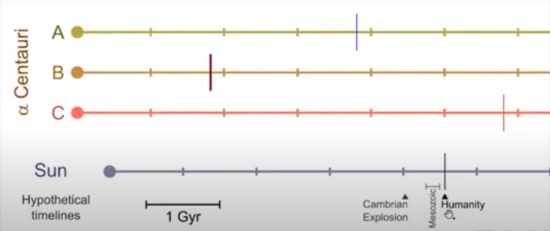
Deep time always takes getting used to, no matter how many times we think we’ve gotten a handle on figures like 4.6 billion years or, indeed, 13.8 billion years, the lifetimes of the Sun and cosmos respectively. I stared at this figure for some time. Lacki has arbitrarily placed a civilization at Centauri B, as shown by the vertical line, and another at Centauri A and C. Our own is shown in its known place in the Sun’s lifetime, except for the striking fact that the thickness of humanity’s timeline on the chart corresponds to a lifetime of 10 million years. If we wanted a line showing our 100 years of technological use — i.e., radio — the line would have to be 100,000 times thinner.
The odds that the lines of any two stars would coincide seem infinitely small, unless we are talking about societies that can persist over many millions of years. But here we can begin to turn the question around. We might want to rethink nearby technosignatures if we remind ourselves that what they represent is not the civilization itself, but the works it created, which might greatly outlive their builders. Objects like Dyson spheres would seem to fit this category and would exist at planetary scale.
Small artifacts can also last for vast periods — our own Voyagers will be intact for millions of years — though finding them would be an obvious challenge (here it’s worth thinking about the controversy over ‘Oumuamua. If a piece of dead technology were to pass near the Sun, would we be able to recognize its artificial nature? I simply raise the question — I remain agnostic on the question of ‘Oumuamua itself).
But can we be sure we are the first intelligent technological society on Earth? It’s worth considering whether we would know it if an advanced culture had existed hundreds of millions of years ago, perhaps on Earth or a different planet in the Solar System. Looking forward, if we go extinct, will another intelligent species evolve? We don’t know the answer to these questions, and the depth of our ignorance is shown by the fact that we can’t say for sure that intelligence might not evolve over and over again.
If interstellar flight is possible, and it seems to be, we can consider the possibility of intelligence spreading throughout the galaxy, perhaps via self-reproducing von Neumann probes. Even with very slow interstellar velocities, the Milky Way could be settled in relatively short order, astronomically speaking. Michael Hart pointed this out in the 1970s, and Frank Tipler argued in 1980 that at current spacecraft speeds alone, self-replicating probes could colonize the galaxy in less than 300 million years.
Sending physical craft to other stars may be difficult, but there are advantages. So-called Bracewell probes could be deployed that would wait for evidence of intelligence and report back to the home system, as well as carrying inscribed messages intended for the target system. This is Jim Benford’s ‘lurker’ scenario, one which he proposes to explore by searching nearby objects in our own system including the Moon. After all, if they might exist elsewhere, there may be a lurker here.
We don’t know how long a probe like this might remain active, but as a physical artifact, it remains a conceivably detectable object for millions, perhaps billions of years. Finding such a probe in our own system would imply similar probes around other stars and, indeed, the likelihood of a civilization that has spread widely in the galaxy. We might well wonder whether a kind of galactic Internet might exist in which information relays around stars are common, perhaps using gravitational lensing.
In other words, the question of technosignatures at Alpha Centauri doesn’t necessarily imply anything found there would have come from a civilization that originated in that system. The same civilization might have seeded stars widely in the Orion Arm and beyond.
All of these ‘ifs’ define the limits of our knowledge. They also point to a case for looking for technosignatures no matter what our intuitions are about their existence at Alpha Centauri. A lack of obvious technosignatures in our system would imply a similar lack around the nearest stars, but we haven’t run the kind of fine-grained search for artifacts that would find them on our own Moon, much less on nearby smaller objects.
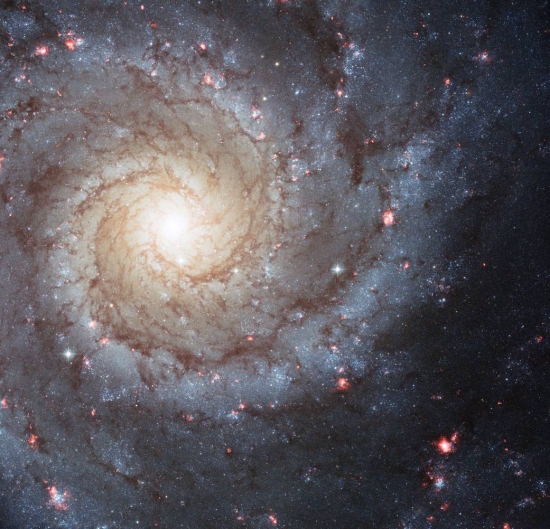
Image: How quickly would a single civilization using self-replicating probes spread through a galaxy like this one (M 74)? Moreover, what sort of factors might govern this ‘percolation’ of intelligence through the spiral? We’ll be looking further at these questions in coming days. Image credit: NASA, ESA, and the Hubble Heritage (STScI/AURA)-ESA/Hubble Collaboration.
Intuition says we’re unlikely to find a technosignature at Alpha Centauri. But I return to the chart on civilizational overlap reproduced above. To me, the greatest take-away here is the placement of our own civilization within the realm of deep time. Given how short the lifetime of technology has been on Earth, I’m reminded viscerally of how precious — and perhaps rare — intelligence is as an emerging facet of a universe becoming aware of itself. That’s true no matter what we find around the nearest stars.
by Paul Gilster | Apr 30, 2021 | Exoplanetary Science |
Why the renewed focus on astrometry when it comes to Alpha Centauri (a theme we saw as well in the previous post on ALMA observations from the surface)? One problem we face with other detection methods is simply statistical: We can study planets, as via the Kepler mission, by their transits, but if we want to know about specific stars that are near us, we can’t assume a lucky alignment.
Radial velocity requires no transits, but has yet to be pushed to the level of detecting Earth-mass planets at habitable-zone distances from stars like our own. This is why imaging is now very much in the mix, as is astrometry, and getting the latter into space in a dedicated mission has occupied a team at the University of Sydney led by Peter Tuthill for a number of years — I remember hearing Tuthill describe the technology at Breakthrough Discuss in 2016.
Out of this effort we get a concept called TOLIMAN, a space telescope that draws its title from Alpha Centauri B, whose medieval name in Arabic, so I’m told, was al-Zulm?n. [Addendum: This is mistaken, as reader Joy Sutton notes in the comments. It wouldn’t be until well after the medieval period — in 1689 — that the binary nature of Centauri A and B was discovered by Jesuit missionary and astronomer Jean Richaud. The name al-Zulm?n seems to be associated with an asterism that included Alpha Centauri, though I haven’t been able to track down anything more about it. Will do some further digging.]
The name is now fixed — a list of IAU-approved star names as of January 1st, 2021 shows Alpha Centauri A as Rigel Kentaurus and Centauri B as Toliman, so what goes around comes around. Centauri C’s name, according to the IAU, remains the familiar Proxima Centauri.
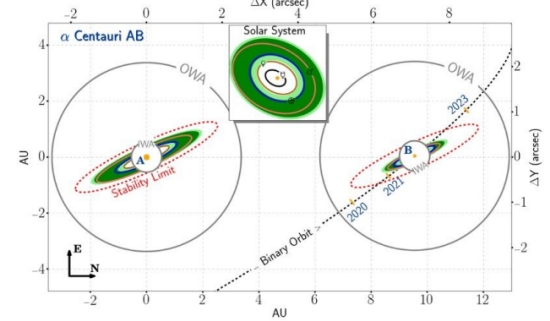
Image: This is Figure 5 from an online description of this work. Caption: Habitable zones of Alpha Cen A (left) and B (right) in green, along with dynamical stability boundary (red dashed line), 0.4” and 2.5” inner and outer working angles (IWA and OWA) of a small coronagraphic mission. The inset shows the Solar System to scale. Planetary systems of Alpha Cen A & B are assumed to be in the plane of the binary (the likeliest scenario) and orbits of hypothetical Venus-like, Earth-like, and Mars-like planets are shown. Credit: Tuthill et al.
The TOLIMAN Technology
The TOLIMAN mission is designed to use astrometry by means of a diffractive pupil aperture mask that in effect leverages the distortions of the optical system to produce a ‘ruler’ that can detect the changes in position that flag an Earth-mass planet in the Alpha Centauri system. Tuthill’s colleague Céline Bœhm presented the work at the recent Breakthrough Discuss online.
In TOLIMAN, we actually have an acronym — Telescope for Orbit Locus Interferometric Monitoring of our Astronomical Neighborhood — but at least it’s one that’s applicable to the system under study. According to Boehm, there are certain advantages to working with nearby binaries. Astrometry normally uses field stars (stars in the same field as the object being studied) as references, making larger apertures an essential given the faintness of many of these reference points and their distance from the target star, and requiring a wide field of view.
But a bright binary companion 4 arcseconds away, as we find at Alpha Centauri, resolves the problem. Now a small aperture telescope can come into play because we have no need for field stars. The TOLIMAN concept puts a diffractive ‘pupil’ in front of the optics that spreads the starlight out over many pixels, a diffraction caused by features embedded in the pupil. Here stability is at play: We’re trying to eliminate minute imperfections and mechanical drifts in the optical surfaces that can create instabilities that compromise the underlying signal. The pupil mask prevents the detector from becoming saturated and reduces noise levels in the signal.
The astrometric ‘ruler’ used to measure the star’s position is thus created by the light of the stars themselves. The diffraction pattern cast by the pupil positions a reference grid onto the detector plane, which registers precise stellar locations. As a 2018 paper on the mission puts it: “Drifts in the optical system therefore cause identical displacements of both the object and the ruler being used to measure it, and so the data are immune to a large class of errors that beset other precision astrometric experiments.”
Narrow-angle astrometry, where the reference star is extremely close, makes for greater precision than wide-angle astrometry, and angular deviations on the sky are larger. Boehm makes the case that TOLIMAN’s diffractive pupil technology should be effective at finding Earth analogs around Centauri A and B, with a more advanced mission (TOLIMAN+) capable of finding rocky worlds around secondary targets 61 Cygni and 70 Ophiuchi.
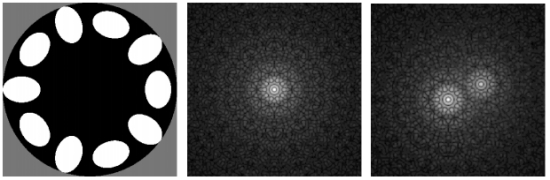
Image: This is from Figure 3 of the online description of TOLIMAN referenced above. Caption: Left: pupil plane for TOLIMAN diffractive-aperture telescope. Light is only collected in the 10 elliptical patches (the remainder of the pupil is opaque in this conceptual illustration, although our flight design will employ phase steps which do not waste starlight). Middle: The simulated image observing a point-source star with this pupil. The region surrounding the star can be seen to be filled with a complex pattern of interference fringes, comprising our diffractive astrometric grid. Right: A simulated image of the Alpha Cen binary star as observed by TOLIMAN. Credit: Tuthill et al.
Astrometry and Earth-like Planets
Unlike both transit and radial velocity methods, the signal generated by a potential planet increases with the separation of planet and star, which makes astrometry an ideal probe for habitable zones. We should also throw into the mix the fact that radial velocity detections vary depending on the spectral type of the star, which is why we have had pronounced radial velocity success at Proxima Centauri and Barnard’s Star, but face a steeper climb in doing the same around G- and K-class stars. Astrometry becomes more sensitive with rising luminosity of the host star even as we wrestle with the tiny distortions that a planet like this would produce.
Both HIPPARCOS and Gaia have shown what can be accomplished by moving astrometry into space, and we saw yesterday that Gaia is likely to produce gas giants in the thousands, but the idea behind TOLIMAN is that astrometry now needs a dedicated mission to get down to rocky planets in temperate orbits. Tuthill and team have pointed to Alpha Centauri as an ideal target, one that would yield signals potentially 2 to 10 times stronger than the next best systems for study.
The researchers believe their work yields the optical innovations needed to acquire astrometric data on habitable-zone rocky planets with a telescope with an aperture of 10 cm. To explore the concept further, a CubeSat mission called TinyTol is scheduled to fly later this year, serving as a pathfinder to demonstrate astrometric detection. The full-scale TOLIMAN mission is funded and under development, with launch planned for a 3 year mission in 2023. TOLIMAN+ is envisioned as a 0.5-meter aperture telescope capable of sub-Earth class detections at Alpha Centauri and Earth-mass planets at both 61 Cygni and 70 Ophiuchi.
The most recent paper I know of on this work is Tuthill et al. “The TOLIMAN space telescope: discovering exoplanets in the solar neighbourhood,” SPIE Proceedings Vol. 11446 (13 December 2020). Abstract.
by Paul Gilster | Apr 26, 2021 | Exoplanetary Science |
At some point, and probably soon, we’re going to be able to identify planets around Alpha Centauri A and B, assuming they are there and of a size sufficient for our methods. We may even be able to image one. Already we have an extremely tentative candidate around Alpha Centauri A — I hesitate even to call it a candidate, because this work is so preliminary — which could be a ‘warm Neptune’ at about 1 AU. One of the pleasures of the recent Breakthrough Discuss meeting was to hear film director James Cameron on the matter. Cameron, after all, gave us Avatar, where a habitable moon around a gas giant in this system plays the key role.
Despite his frequent protestations that he is not a scientist, Cameron was compelling. He’s obviously well-enough versed in the science to know the terminology and the issues involved in the ongoing deep dive into the Alpha Centauri system, and he’s done wonders in fixing the public’s attention not only on its possibilities but also on presenting a starship concept that, using hybrid propulsion methods, makes a bid for most realistic starship ever in film.
I imagine Kevin Wagner thinks about the Avatar scenario now and again, given that his work on Centauri A has turned up the observation he refers to as C1. Let’s put it in context (and I’ll also send you to Imaging Alpha Centauri’s Habitable Zones, which ran here in February), delighting in the fact that we have more than one habitable zone to talk about.
Wagner (University of Arizona Steward Observatory) and team run NEAR (New Earths in the Alpha Centauri Region), which thus far has been a full-on 100-hour attempt to look into the habitable zones of Centauri A and B. It’s fascinating to realize that these stars are close enough to us that with technology like Hubble, we can actually observe the habitable zones, for these are at separations we can see, at about 1 arcsecond, which is resolvable with large telescopes. Think Sagan’s ‘pale blue dot’ when you imagine the ultimate goal of actually imaging an Earth-like world, although it will take future instrumentation to get us to that level of sensitivity.
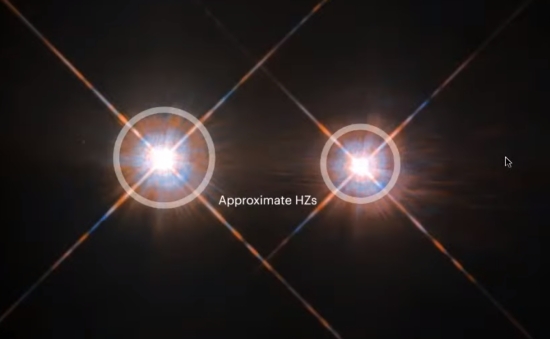
Image: This is a familiar image from Hubble showing Centauri A at left and B on the right. Kevin Wagner superimposed the circles showing the size of the habitable zones. The image was captured by the Wide-Field and Planetary Camera 2 (WFPC2), and is drawn from observations in the optical and near-infrared. Credit: Kevin Wagner/ESA/NASA.
NEAR, whose first 100-hour run is complete, used an adaptive secondary telescope mirror working in combination with light-blocking and masking technologies in the mid-infrared to suppress light from each of the binaries in sequence. The NEAR equipment is mounted on the Very Large Telescope’s Unit Telescope 4 in Chile, and the key, according to Wagner, is the deformable secondary mirror, which maximizes adaptive optics without adding warm optics downstream in a tertiary mirror that would degrade the infrared signal. About 1600 magnetic actuators zone out atmospheric distortion even as the coronograph nulls out star light.
Imaging something on the order of a pale blue dot around another star is quite a goal. We’ve only imaged a dozen or so exoplanets thus far, and all of these have been young and massive gas giants that still radiate brightly, no more than tens of millions of years old. Mature planets like those in our own Solar System are much cooler, and if we are after a planet like the Earth, we have to look in areas where the infrared signal is swamped by our own atmosphere. Adds Wagner:
“The earth is a 300 K black body. Here the primary radiation is at 10 microns, which is where we have to look at more mature exoplanets. And the problem is that the atmosphere of our own planet is what we have to look through, and it also radiates at about 10 microns. The sky, the telescope, the camera, everything is glowing at us.”
I ran the figure below in February, but I want to introduce it again, as it shows not only the C1 observation but also, on the left, the systematic artifacts that have to be removed to come up with what the astronomers hope is a clean image. Remember, we are in early days here, and when discussing C1 as a possible planet, we have to keep in mind that other explanations are possible, including distortion in a not yet recognized effect within the equipment itself.
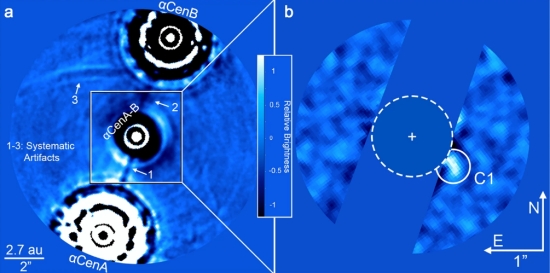
Image: This is Figure 2 from the paper. Caption: a high-pass filtered image without PSF subtraction or artifact removal. The α Centauri B on-coronagraph images have been subtracted from the α Centauri A on-coronagraph images, resulting in a central residual and two off-axis PSFs to the SE and NW of α Centauri A and B, respectively. Systematic artifacts labeled 1-3 correspond to detector persistence from α Centauri A, α Centauri B, and an optical ghost of α Centauri A. b Zoom-in on the inner regions following artifact removal and PSF subtraction. Regions impacted by detector persistence are masked for clarity. The approximate inner edge of the habitable zone of α Centauri A13 is indicated by the dashed circle. A candidate detection is labeled as ‘C1’. Credit: Wagner et al.
The C1 candidate looks, says Wagner, like what the team’s simulated planetary sources look like, but it could also represent, in addition to a systematic error, dust in the habitable zone, bearing in mind that while the Sun has its own zodiacal light from such dust, the Alpha Centauri system is known to have 50 times more dust. We could be looking, in other words, at dust that is off-center simply because of the orbital perturbations within the binary. “We can’t attribute this to any of the known systematics,” says Wagner, “but we don’t know all the systematics in this new system.”
What’s truly newsworthy in the NEAR work is the sensitivity of the dataset, which demonstrates that a habitable zone planet somewhere between Neptune and Saturn in size is detectable around the Alpha Centauri stars. NEAR is, in other words, sensitive to planets smaller than Jupiter at about 1 AU, and thus we can expect further work to find out whether C1 can be verified as a planet. This could be done through imaging using the James Webb Space Telescope, or through another observing run with NEAR, or via astrometry (about which more in a day or so) or even time-tested radial velocity using the hugely sensitive ESPRESSO.
The current limit on radial velocity detection around Alpha Centauri is on the order of 50 Earth masses in the habitable zone, Wagner added. NEAR itself is not currently in operation but could be reinstalled at UT-4 on the VLT, and of course on top of the other options, we have the next generation of ground-based telescopes coming, extremely large instruments that could accomplish within a single hour what it took the NEAR instrumentation 100 hours to do.
NEAR has demonstrated a technology, then, that is apparently capable of imaging mature Neptune-class planets in this system. Ramp its sensitivity up four times and we get to ‘super-Earth’ detection capability. We’re not yet at Earth-like planet imaging, but within decades, the ELTs should make it possible. We can consider NEAR a pathfinder experiment that has demonstrated the limits of the possible and shown us the way forward as, step by step, Alpha Centauri yields its secrets.
For more, see Wagner et al., “Imaging low-mass planets within the habitable zone of α Centauri,” Nature Communications 12: 922 (2021). Abstract / full text.