
A recent conversation with a friend who works the futures markets has me thinking about the nature of daydreaming. This is a guy who tracks fast-breaking numbers all day long so as to avoid getting a freight-car’s worth of coffee beans or some other commodity delivered to his condo. His numbers, he says, are all business, and allow no time for daydreaming. Whereas the numbers I study have no deadline, and give me plenty of time for reflection, moments of gazing off into the distance and just letting thoughts run. Today, for example, I’m troubled about what we know about the age of the galaxy.
If daydreaming sounds abstract, consider that this is an issue that has a bearing on our own standing in the cosmos. We have a pretty good read on the age of the Earth, and can peg it at around 4.5 billion years. Various sources tell me the Big Bang occurred some 13.8 billion years ago, with the formation of the Milky Way beginning not terribly long thereafter. Let’s say for the sake of argument that our galaxy is 13.6 billion years old, a figure that NASA recently cited.
So when did worlds like the Earth – terrestrial planets – began to appear? I think I’ve been writing about this question since Centauri Dreams first appeared, as it draws upon the work of Charles Lineweaver (Australian National University), who in 2001 landed on the figure of 9 billion years ago. The problem is immediately apparent: The galaxy seems to be stuffed with many a planet that is older than our own, and in many cases considerably so. Lineweaver’s work found that the median age of terrestrial planets is on the order of 6.4 billion years.
Here we tug again at the Fermi question – ‘Where are they?’ – since these numbers suggest that the opportunity for civilizations to emerge was robust long before our planet began to coalesce. Since that seminal 2001 paper, which I’m surprised is not cited more than it is, Lineweaver has continued to explore the numbers, and they are likewise massaged in other subsequent papers, but rather than going into the details, let’s just say that we’re still left with a galaxy far older than our planet. Give an extraterrestrial civilization a 2 billion year head start and you might think they would be visible to us in some way, or maybe not. Maybe civilizations don’t live all that long?
See Stephen Webb’s wonderfully readable If the Universe is Teeming with Aliens, Where is Everybody? (Springer 2015), the latest edition of which offers 75 answers to Fermi that range from the preposterous to the ingenious. I also send you to Milan Ćirković’s absorbing The Great Silence: Science and Philosophy of Fermi’s Paradox (Oxford, 2018), which mines the depths of a question that many do not consider a paradox, and others find deeply troubling no matter what the name. And Paul Davies is also a reminder of how rich the literature on Fermi is. See his The Eerie Silence (Mariner, 2010) for still further insights.
Thinking about a culture that was around in the days when the first signs of life began to appear on Earth is indeed cause for daydreaming. I notice this morning that Avi Loeb, in his lively publishing venture on Medium, is looking at how long-lived civilizations might cope with the problems raised by their longevity. It’s one thing to consider our own fate when the billion years or so we have before the Sun gets too hot to deal with completely dwarfs our species’ scant time on Earth. But what would we do if we actually survived for that billion years? Would we go elsewhere, or find a way to move the Earth to an orbit that would provide habitable conditions for millions, even billions of years more?
This is pretty lively stuff, for it opens up the possibility of terrestrial-class planets orbiting far outside what was once their habitable zone. It also brings into question the matter of white dwarfs, which could still sustain life for a species that insisted on staying within its natal stellar system. An ETI that can move planets might move one again, this time back in toward the Earth-sized remnant of its former red giant star. I would assume interstellar relocation would make more sense, but no one can know what alien minds might think of this.
Loeb has worked on these issues before:
In 2013, I co-authored a paper with Dani Maoz… which showed that during a transit by an Earth-mass planet across a white dwarf, the transmission spectrum of the planet’s atmosphere would show prominent bio-markers such as molecular oxygen absorption at a wavelength of ∼ 0.76 micrometers. We calculated that a potentially life-sustaining Earth-like planet transiting a white dwarf would be detectable by the Webb telescope in about 5 hours of total exposure time, integrated over 160 two-minute transits.
The method is familiar, one that we’ve discussed here often ever since the first transmission spectroscopy results began showing us what could be found in a hot Jupiter’s atmosphere. I love the idea of expanding the search for habitable worlds into environments as seemingly bizarre as these, although the limitations on telescope time (demand is high!) would make such searches lower priority than, say, a close look at a nearby red dwarf’s habitable zone planet. Here again we have more SF story material, though. All the possible planets around white and red dwarf stars make for fertile hunting for story crafters.
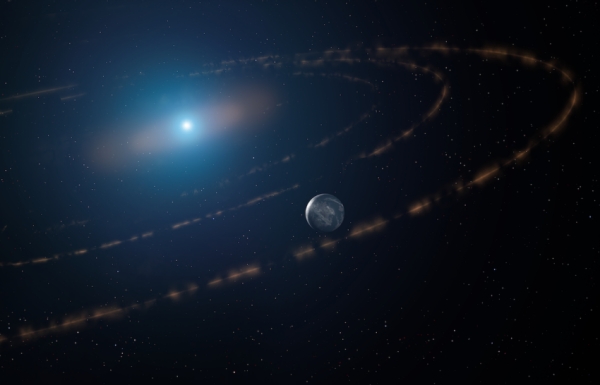
Image: Artist’s impression of a still unconfirmed planet around the white dwarf star WD1054-226 orbited by clouds of planetary debris. Credit Mark A. Garlick / markgarlick.com. License type Attribution (CC BY 4.0).
Loeb also mentions a paper I had missed in earlier discussions of stellar ages. In 2019, Nicholas Fantin (University of Victoria, BC) and colleagues extended the Lineweaver work I led this post with to include white dwarfs, considering them as age markers that help us trace the development of the galaxy. The bare bones of this method are described here:
We develop a new white dwarf population synthesis code that returns mock observations of the Galactic field white dwarf population for a given star formation history, while simultaneously taking into account the geometry of the Milky Way (MW), survey parameters, and selection effects. We use this model to derive the star formation histories of the thin disk, thick disk, and stellar halo.
Skipping the details, I just want to cite a few results that back up the interesting point about the relative youth of the Sun. According to this model, the Milky Way’s thick disk began forming stars 11.3 ± 0.5 billion years ago. The growth rate peaked at 9.8 ± 0.3 billion years ago. A slow decline in starbirth is traced that eventually became a constant rate that persists until now. Heavily reliant on results from the Gaia mission, the data set is dominated by disk stars in the solar neighborhood. A larger sample size will eventuate through surveys like Pan-STARRS DR2, the LSST, as well as data from WFIRST and Euclid.
Again we face what Tennyson called ‘the long result of time.’ So much time, in fact, that civilizations in their multitudes would have had the chance to form. Cirkovic notes in The Great Silence just how much deeper the Fermi question becomes when we consider it in light of such findings. He points out that the original Fermi statement (WeakFP) could be taken to ask why we have seen no evidence of extraterrestrials on Earth or in the Solar System. Keep extending the search outward, though, and the issue gets more and more puzzling. Take the entirety of our past light cone as your canvas and the lack of signs of extraterrestrial activity despite the billions of years civilizations could have existed escalates in impact. This is why Webb’s book is as long as it is.
All this is occurring even as we continue to rack up exoplanets of all descriptions including those of terrestrial mass, and even as the prospect of interstellar travel is now under serious investigation, as we’ve just been reminded by Jim Benford’s work with Breakthrough Starshot. We have developed, says Cirkovic:
Improved understanding of the feasibility of interstellar travel in the classical sense and in the more efficient form of sending inscribed matter packages over interstellar distances. The latter result is particularly important since it shows that contrary to the conventional skeptical wisdom shared by some of the SETI pioneers, it makes good sense to send (presumably extremely miniaturized) interstellar probes, even if only for the sake of communication.
Just where to send such probes? The nearest stars are obvious candidates, with Proxima Centauri b leading the list, but fleshing out a target roster – today an exercise in theory more than planning – may take in destinations we have only begun to consider. That’s assuming our early work on interstellar probe technologies continues to develop options for ever more distant targets. Imagine ‘swarm’ flybys of interesting systems, a capability we may well be able to deploy some time late in this century.
The nearest white dwarf to the Sun, by the way, is Sirius B, some 8.6 light-years out. The closest solitary white dwarf is van Maanen’s Star, about 14 light years distant. The closest red giant is Pollux in Gemini, at about 34 light years distance
The paper is Fantin et al., “The Canada-France Imaging Survey: Reconstructing the Milky Way Star Formation History from Its White Dwarf Population,” The Astrophysical Journal Vol. 887, No. 2 (17 December 2019), 148. Full text. Charles Lineweaver’s 2001 paper is “The Galactic Habitable Zone and the Age Distribution of Complex Life in the Milky Way,” Science Vol. 303, No. 5654 (2 January 2004), pp. 59-62, with abstract here.

Mercury could be used to move the Earth and moon system via a stream of matter from it, there is plenty of mass and energy there to move them. The matter could then be collected elsewhere in the solar system for future use.
@Michael
Cixin Liu’s “Wandering Earth” series has the background of moving Earth to a more habitable location. With “Project Hail Mary”, we have the 2nd movie about restarting the sun.
Or we could build a new Earthlike planet further out and transport just the surface material with all the biosphere to the new planet. Doctor Who episode “The Pirate Planet” was about moving the surface of a planet to surround mineral-rich planets.
Hi Alex
“Project Hail Mary” was about the Sun’s output being captured by a natural partial Dyson Swarm – Astrophage was exponentially growing and “eating” the Sun’s light.
That makes for an interesting question. If such a biological process were possible, what would the observational signature be? Absent the quasi-magic of Astrophage, the “clouds” around WD 1054-226 are suspiciously periodic, which might be more a sign of Life than mere Physics.
Adam
Maybe we’re going about this all wrong. Perhaps what we need is a new Drake Equation, with new factors for additional probabilities. These probabilities do not replace those already in the Drake Equation, they are added to them.
First, we need a planet orbiting a suitable star that will provide all the resources and conditions required to support a technology capable of giving its inhabitants the ability to build space ships or communications devices that can make contact with other civilizations.
Second, this world must evolve a species capable of developing a technology that will eventually lead to space travel and/or communications devices. I’m not just talking opposable thumbs here, but the whole suite of characteristics, physical, biological, cultural, psychological and social, which will allow this species to organize the effort needed to send probes or messages past its gravity well.
Third, this civilization must WANT to do this, it must be motivated to undertake this enterprise and follow it through to its ultimate conclusion. And I don’t mean a handful of dreamy-eyed hobbyists and dilletantes, but sufficient general enthusiasm
to maintain this project going until it yields results.
And lastly, conditions on this star and planet and culture must remain stable enough for long enough for all this to happen. Stars and planets evolve, as do civilizations, we need time, at least several billion years. We know quite a bit about stellar evolution, but not so much about planets and very little about civilizations; Earth may not be typical. And even the most suitable and stable stellar system may be snuffed out by some cosmic catastrophe we don’t even know about yet.
AND…as Dr Drake anticipated, we don’t know if civilizations are, as a rule, capable of avoiding self destruction due to unresolved social stresses.
I’ve already stated my own suspicions about this (although I will be the first to concede I may be mistaken). Microbial life is probably common, multicellular life is not, cooperative, tool making and communicative species may be extremely rare, and the desire to go seek out their neighbors and populate the Galaxy probably rarer still.
We know that interstellar travel and communication will be difficult, but not impossible. After all, we need not invent any exotic new science or discover any more laws of nature to do so.
But just because something is possible does not mean it must happen, and certainly not that it has happened many times before.
I cannot add any plausible numbers to help quantify these speculations. I’m aware that many of the factors in the Drake Equation were originally considered as pessimistic, and recent research has shown them to be quite reasonable. But we should always let a healthy skepticism and caution guide us. After all, our primary goal is to devise observing programs that might yield results, not scenarios based on wishful thinking.
@henry,
The problem with a number of those ideas is that to lock down the probabilities we really need good samples of stars for this to be in any way helpful. When you look at the Drake equation, all the variability in the equation is in teh last few terms, of which we have no data. Adding new terms to adjust terms won’t make any difference to the “accuracy”. Now if we have an interstellar program where archaeologists can determine the phistory of planets and whether there ever was a civilization[s] and how long they lasted, and whether there is/was an advanced civilization[s] that might have/had interstellar flight, then maybe this would be useful. Otherwise…
@Alex
Like the Drake Equation, my modification to it is meant to be a way of organizing our thought, NOT actually calculating a result. I agree that my new probabilities are of conceptual value only, we have no real data available to plug into those variables.
But that’s precisely the point I am trying to make! We have subconsciously loaded too many of our prejudices and assumptions into our analyses, based primarily on the psychological mind-set of thinkers who grapple with SETI issues. We are science weenies who are desperately trying to prove “we are not alone” and we are fascinated by the potential of alien life and intelligence in the universe. Maybe THEY are NOT like that.
Perhaps they don’t care whether or not they are alone. Maybe they care but are terrified to give away their location or vulnerabilities. Or maybe they are so familiar with other species already that they have no need or desire to add any more to their Rolodex.
We don’t know technical species are necessarily expansionist and prone to exploration. I’m not even convinced WE are, perhaps only those of us who gravitate to astrobiology websites are really motivated to pursue these studies.
We cannot use examples from our economics or politics or religion or arts to predict their behavior or activity. Even our
Consider the surveyors platting our landscapes, shooting bearings and taking notes and dragging chains and transits around with them. They simply have no reason to be interested in the campers and hikers and wildlife that share their little piece of wilderness with them. They have an entirely different agenda. Consider the remote sensing techs scrutinizing satellite imagery looking for submarine pens or missile silos, they simply have no reason to be interested in any of the other cultural paraphernalia on the imagery–except in how it pertains to their task.
We focus on technological civilizations in our speculations because those are the only ones we are likely to encounter in our searches. If they don’t have technology, or if it is very different from ours, we will probably never contact one another because those are the only ways we know how to study them. We argue abut which frequency to monitor because electromagnetic radiation is the only way we can conceive of communicating with them. We don’t know what alien motivations and priorities are. Neither can we guess what their psychology, sociology or cultural anthropology is like.
As a child, I once asked my grandfather (a highly educated, cultured and intelligent man born in the 19th century in another country) “What if war broke out tomorrow and simultaneously, astronomers reported in the press there was proof of alien civilizations on other worlds; which of those factoids would capture the imagination of the public?” His answer was that “only the former would matter to anybody”. Not only were we both of the same species, we were members of the same family, speaking the same language.
@henry
I understand what you are saying, but consider this condition you offer:
Does this really help in any way to even think about the f_sub_i term in the DE? To me it just opens up a host of questions that cannot be answered, and does nothing to aid the search for ETI.
And this condition:
The DE uses teh rate of star formation. As a rough guide, assume births = deaths, then teh equation simply indicates the number of stars and planets still around. It only becomes a problem if the assumed longevity of civilizations is longer than the period during which stars are still alive. This number is usually a small fraction of the star’s lifetime. My beef with the equation is that it assumes all civilizations are bound to their home star system. It becomes meaningless if they can achieve star travel and colonize other star systems. As has been made clear by a number of calculations, any sublight flight allows a civilization to colonize every star system in teh galaxy with a million years or so. If that is possible, the galaxy would be full of communicating systems based on only one star having achieved a star-faring civilization in all of time. We may even prove to be that civilization.
I do agree that our arguments over which radio frequency to use may be just a refined version of looking under the streetlight for our keys, as this is where the light is. However, we are at least using other means to detect life, which we assume is a requirement to at least precede the arrival of intelligent life.
No life => no intelligent life.
My interpretation of the original meeting was to ensure that the calculations would provide favorable support to use radio telescope time to look for ETI signals. Motivated reasoning, if you will. The lack of any detections has just resulted in expanding the search – more stars, more frequencies. Really, no different than “God will show himself if we just pray harder and more loudly.”
I see no reason not to expend some resources in the search for ETI, even if the probability of success is low. OTOH, life may be far more ubiquitous than ETI. It is worth expending more resources to look for life than ETI. The probability of success is higher if we have the right tools. Here, the issue of what life might look like is worth thinking about, so that we don’t get trapped in assuming it must be like terrestrial life at some stage of evolution. Earth appears to have had life almost from its birth. Complex life for 1/9 of its history. Life on land for perhaps 1/10 – 1/12 of history, hominids for 1/1000, and advanced technological civilization with radio communication for 1/3.6 of the Earth’s history.E7 of Earth’s history. Even if humans remain advanced for 1 million years, that represents 1/4500 of Earth’s history. Clearly, the probability of life on an exoplanet is far higher than technological life. But back in the 1960s, there was no hope of doing spectral analysis of exoplanet atmospheres, let alone the speculations on viewing megapixel images of exoplanets in the next century or so. Radiotelescope reception of ETI emissions and signals was the only possibility. So, looking for life was off the table, whereas now that is not the case. Detecting life is one thing, but realistically, we won’t get to do any close-up sampling, cataloging, and investigating the biology of exoplanet life for centuries in the future, unless we are lucky and it comes visiting one way or another.
My two choices would be a probe to Gliese 710, in case we actually see the scenario from WHEN WORLDS COLLIDE.
47 Ursae Majoris is my other choice
A moon of a bigger gas giant, closer to its star..that is brighter than our Sun.
Imagine Europa ‘s conditions if Jupiter is where Mars is now.
A moon like Europa (or basically any moon less massive than about 0.5 Earth) is not going to survive for long in the HZ of a star once it starts heating up.
Atmospheric escape is… inescapable for a small world. The maximum mass of a moon seems to be related to the mass of the planet, so you’ll need something close to a brown dwarf before you start seeing Earth sized moons.
True, but nothing say that system’s Europa can’t be bigger.
The current record holding exo-moon
Kepler-1625b-i
@jeff
The probability of detecting a “When World’s Collide” at the exact moment of the flight in the deep time of the event, and with a civilization able to achieve that heroic effort, seems vanishingly small. Sending such a probe, unless it is one that can loiter in the system, seems like an expensive effort with a minuscule probability of success. I love the movie, but it only works because it is set on Earth, and a suitable planet exists that is worth travelling to.
Do you guys really think that such civilizations would still live on planetary surfaces, let along their home world? I would think they would be space-based (O’neill style but with more advanced technology) where they could live in any solar system, not just ones with habitable planets. Civilized, gentile people live in space. Barbarians live on planets. No body is going to be messing around with planets at this point of time.
For that matter, do you really think they would still be living as their original biological form? They would most likely be some kind of nanotechnology, or if impossible, some king of bio-nano.
Planets would be for all other creatures, they may not want to go into space.
And they may be in earlier stages of development.
There is a zone of protection near us:
https://phys.org/news/2026-03-earth-magnetic-field-previously-undetected.html
https://www.science.org/doi/10.1126/sciadv.adv1908
Life is inherently expansionistic, intelligent life especially so. This is a law of nature. They would not remain confined to planets. The apparent absence of Dyson swarms or clouds (in the case of nanotechnology hive mind) suggests we are alone. William Martin’s and Nick Lane’s eukaryogenesis also suggests we are alone.
it raises an interesting idea: what is the home of a (advanced) civilization: is it everywhere in the universe and looks towards planets or is it on one or more planets and looks towards the universe? the totality or a part…it changes the point of view…but it makes one dream :)
They aliens may have a home planet and communicate with out going habitats, they would be hard to detect because we would not be looking for them between the stars.
@Abelard
When Gerry O’Neill was pushing the idea of space habitats, Asimov wrote that this reset the idea of “what is the most suitable habitat for humans?” It has been expanded to create arcologies to maintain ecosystems that we increasingly understand are needed for human life. Inflated asteroids seem one useful way to create the hulls of such habitats. If that could be made to work, that would be preferable than moving the Earth or building new planets as suggested upthread.
However, unless these asteroids are relatively sparse, we have already looked for Dyson Swarms and not detected anything. With more sophisticated instruments, we might detect excess IR signals from bodies in the ystem that should be cooler.
Until then…
Which tells me they do not exist. We are alone.
@Abelard
We seem to end up with the same conclusion via different assumptions. I would say that I am an agnostic for the last few percent of this conclusion, to leave open the possibility that other intelligent life is out there, just not currently detectable or so rare that it will take a long search to find them.
Actually, I do think they exist but are very far away, like billion light years or more from us. So for all practical purposes (Milky Way) we are alone.
It is William Martin’s and Nick Lane’s eukaryogenesis theory that convinced me of this. It is clear that eukaryogenesis is the so-called “great filter”.
@Abelard
One issue I have with the apparent near-simultaneous appearance of all the components of eukaryosis in a cell is that it starts to get dangerously close to ID or irreducible complexity. Where did all the components come from, including sexual reproduction, and separate organelles, and why does LECA “suddenly” appear? It isn’t nearly as simple as engulfing a bacterium that can also use O2 in metabolism and slowly reducing that bacterium’s genome so that it becomes a symbiotic mitochondrion of which there are many in a cell, and which are separated into 2 roughly equally sized sets during cell division, whether in mitosis or meiosis.
It almost as if this was created by design (ugh!). Did ETI do the engineering from the materials at hand, using genomic and cell engineering to create the eukaryote package? Of course, simultaneity might be an illusion. Just as with LUCA, there may have been many variants, each evolving separately, but with the most successful variant replacing all the others to become the crown clade.
But if so, then its “specialness” is not so improbable, and undermines the idea that eukaryotes and more importantly, complex life derived from them, are rare. From this, intelligent life may be more common than we think, and the great filter is not behind us, but in front.
My POV is that despite 4+ billion years of evolution, with the Cambrian explosion of body types, only the vertebrate clade ever reached intelligence (unless one believes in the Silurian hypothesis), and only after mammals and then primates evolved to give rise to the hominids, of which H. sapiens proved to be the only species that eventually had a culture that gave rise to advanced technology. During all this time, no other species managed to gain this sort of intelligence, even just to copy what we achieved. No beavers built log cabins, or bears created nets to trap prey, especially spawning salmon. Apparently, H. neanderthalensis didn’t seem to manage to copy human technology, or at least sufficiently to prevent their extinction.
So maybe the path dependency to get to our culture is so difficult and improbable, and therefore potentially unique in the galaxy, even the universe, despite perhaps having gazillions of habitable planets with complex life, but none managing either to reach advanced technology, or able to avoid extinction once they achieved some level of it. We can speculate that some ETI have managed to pass through that last, but have they? How many tried every million years and fail?
Advanced civilisations might live on both planets and space habitats. Planets (as well as large moons) have advantages as well, like being far more resilient to damage.
Imo, the discussion of Fermi’s question would benefit from a scale describing the volume space referenced by the question. It would be based on estimates for the emergence of space faring intelligence and travel time for light or matter. Within a radius of 1 billion light years, there could be 500 million billion stars; within 10 million light years, hundreds of billions to a trillion.
The number of filters needed to achieve a “Fermi volume N” of 1 would be directly proportional to the volume. The impact of observer selection effect would be inversely proportional; the smaller our view the more likely we are to have a rare view. Perhaps these two values cancel and what remains important is the volume’s finite size.
The GHat program looked for KIII status of galaxies – emitting more IR than expected. The result was no detection. All that tells us is that KIII civilizations do not seem common enough to detect in surveys, or that our way of thinking about very advanced civilizations is wrong.
If I had to bet, I would guess that very advanced civilizations that stay biological would try to remain as simple as possible in their use of mega engineering. We might not recognize them as technological until we get a close look at them.
Stapledon, Clarke, and others assume that advanced civilizations become transcendant minds. Again, not detectable by our current methods.
Thanks, Paul, for once again treating us to a thought-provoking, if not provocative, essay. I generally agree with most of the sentiments expressed so far, but especially with those offered by Henry Cordova, which closely mirror my own thinking.
I’m not sure whether anyone else has noted it or not, on this site or on others, but 2026 happens to mark the 75th anniversary of a book which stimulated my dreaming and wondering about such questions back when I was growing up in the 1960s: Arthur C. Clarke’s classic, The Exploration of Space. With both humility and prescience, Clarke speculated on the possibility that humans might one day encounter life elsewhere. In words that could have been written today, he observed how “We consider that our planet is ‘normal’ simply because we are used to it, and judge all other worlds accordingly.”
“Yet it is we who are the freaks [Clarke continued], living as we do in the narrow zone around the Sun where it is not too hot for water to boil, and not too cold for it to be permanently frozen. The ‘normal’ worlds, if one takes the detached viewpoint of statistics, are the Jupiter-type planets with their methane and ammonia atmospheres. . . . We know, of course, practically nothing about the laws which govern the appearance and the evolution of life on any planet. [We should avoid] the danger of generalizing from the solitary example of our own Earth, and trying to produce laws applicable to totally alien planets. It is illogical to be depressed because the other worlds of the Sun are so different from our own that we cannot hope to find familiar forms of life there. These very differences will make their exploration all the more interesting. After all, interplanetary travel would lose much of its point if all the other planets were simply new editions of Earth!” (quotes from pp. 139 and 141)
Rather than foreclose our thinking, Clarke, visionary that he was, urged us to remain open to possibilities and never lose our senses of humility and wonder. We can, I hope, all support that sentiment.
Humility seems particularly in order when there’s still wide disagreement over basic questions such as “What is the definition of life?” or “Will we recognize it if and when we encounter it elsewhere?” Considered in that regard, tempting though it may be to suggest our favorite target planet(s) to direct a probe to in search of habitability (having written the first draft of a sci-fi novel recently, I’d favor Kepler 452-b, even though it’s some 1400 to 1800 light-years away), I’d advocate for something else instead: a search focused closer to home. Taking a cue from the Humboldtian era of biological survey work that began in the mid-19th century, continued through the various “International Years” of scientific discovery in the mid-20th century, and is still being conducted, to a certain degree, even today, perhaps we humans will one day agree (inconceivable as that thought is right now!) on the goal of collaborating to undertake and complete, by the end of the 23rd century, detailed surveys of every body in our Solar System larger than, say, 100 miles in diameter (give or take), for potential signs of life. Not just all the planets, but all their larger moons, along with Inner Belt asteroids, Jovian and trans-Jovian Trojan planetoids, and minor planets out to the outermost reaches of the Kuiper Belt. And not simply the surfaces of these bodies: the atmospheres, for those that possess them, interior oceans (ditto), and sub-crustal regions down to, say, 5 or 10 miles beneath the surface. And one more stipulation: not just signs of current life, but any traces of past life.
Such an audacious undertaking would establish some meaningful baselines for possible comparisons with known exoplanets, even as the search would continue on Earth for signs or hints of biological activity or possible technosignatures beyond our Solar System. It would provide a firm basis for developing testable hypotheses about the likelihood of encountering life elsewhere across a broad spectrum of potential environments and econiches. It might enable us to refine our search for extra-solar life down to a few candidates, with the prospect (or at least the expectation) that by the year 2200 (assuming, of course, we’ve survived until then), we humans will have developed the propulsion, life-support, and other systems and technologies that will make interstellar travel truly feasible.
. . . And, at the very least, it would prove outstanding opportunities for both humility and wonder to flourish, for who knows what might be found out there, in realms distant yet still close to home.
I’m reasonably certain that Arthur C. Clarke, were he alive today, would welcome, even applaud, such an undertaking. To paraphrase a title from another classic of his, it might well bring about the end of our childhood and ring in the era of our adolescence as aspiring spacefarers, truly ready to embark upon the even more audacious task of exploring the vast and limitless expanses beyond.
@John C. Rumm
Your reference to Clarke’s observations of life in TEoS depends partly on the edition. Later editions only have the p139 reference.
Note that Clarke talks about life on Earth, Mars and Moon as 1 hit, 1 probable, and 1 possible. In reality, it is now 1 hit, and 1 possible (but only in the subsurface).
Clarke’s novels often assume some form of life elsewhere in teh solar system, perhaps culminating in the short story A Meeting With Medusa (1971) with the life in Jupiter’s atmosphere, and the later novel 2010: Odyssey Two (1982), where that Jupiter life is sacrificed for the life in the Europan subsurface ocean. Clarke still believed life on Mars was possible as demonstrated at a NASA discussion on the closeup pictures of Mars in the early aughts, when Clarke on a video link stated that the “tree-like” forms on the surface were evidence of life. (He was wrong, but it shows his hopes for Martian life were still evident a few years before his passing).
However, you make a good point that we tend to view life through the lens of terrestrial life. It seems to me that this often implied complex life on land, rather than just prokaryotic life in the oceans. or even in the lithosphere.
Our own life’s origins have been pushed back from the fossil evidence of about 3.5 bya, to the genomic estimate of 4.2 bya for LUCA, which means that the fuzzy point when non-life became life preceded that date. This suggests that either life appears very quickly on a suitable world, implying that life of some sort is possibly ubiquitous, or that it arrived from elsewhere, also implying that it may be ubiquitous, and possibly more so as the hypothesized requirements for abiogenesis are not needed, just a suitable culture environment.
The private Morningstar missions to Venus are intended to look for life in the temperate zone in the Venusian atmosphere. The assumption is that this remains a refuge for life after the runaway greenhouse made the surface inhospitable. Even Clarke ruled out Venus, as he could not envisage life as not being complex and living on the surface.
Alex—Thanks for the page reference to a more recent edition of Clarke’s Exploration of Space; I had my 1956 copy at hand when I quoted from it.
One of my favorite fictional speculations by Clarke about life forms on Mars came in his Lost Worlds of 2001, in which he offered early chapter drafts and material deleted from 2001: A Space Odyssey. In it, he “recounted” how a rover was traveling across the Martian landscape when it approached a field of boulders. Much to the amazement and consternation of mission controllers back on Earth, one of the “boulders” lifted itself up on stumpy legs and moved out of the way. It left an indelible impression in my mind and I was sorely disappointed when none of the rovers that traversed Mars ever encountered anything like it. So it goes . . .
In my remarks about an audacious effort to look for signs or traces of life on every Solar System body larger than 100 miles in diameter, I forgot to allude to the oft-quoted line of Michael Crichton’s that “Life will find a way.” There’s ample evidence to support that assertion on Earth, where lifeforms have been found occupying—and even thriving in—seemingly hostile and inhospitable environments: deep-sea thermal vents, upper reaches of the atmosphere, even inside rocks. If an arduous search for life across and throughout the Solar System fails to find any extraterrestrial life, that should humble us and give us great pause, if only to appreciate how precious our home planet is.
It’s hard to imagine life not existing elsewhere. Recent studies confirm the presence of amino acids and other biological precursors in meteorites, interstellar dust clouds, and seemingly everywhere we look. We yearn for answers, hoping each day, or surely the next one, will be the day in which the announcement comes, confirming that yes, Earth is not the only place that supports life. It makes being alive at this point in time incredibly exciting, even if that day doesn’t come in our lifetimes. But here’s hoping it will!
The sun grows brighter at roughly 1% in 100 million years, 2% in 200 million years. If our descendants could increase the orbit radius by 1.5 million km, or 1.5 billion meters, in 200 million years, the solar flux reaching Planet Earth would remain constant. That’s only 7.5 meters per year. Have asteroids occasionally swing past earth the way a probe swung by Venus to reach Mercury? Aim carefully! That might buy us a billion years, until uranium and thorium decay enough to end plate tectonics. Wait and see!
Hi Michael
Using the Moon as a gravity tractor, dragged by a solar sail, can do the job, without the collision risk.
Well, there’s a lot to contemplate here, of course. That is, where is everyone hiding or have gone if planets like ours have been producing critters like ourselves since near the cosmic beginning. And if they exist, they are charged, possibly, with being on the lamb for nine billion years.
They must be good at hiding out by now…
But short of that, I would like to examine the case of the home base planet associated with the white dwarf star. How the habitable zone is defined is a significant discriminator for both probability and biological credibility.
To my thinking the HZ notion is stretched too far with white dwarfs. Red dwarfs, the low end of the main sequence have some problems too, but the former, I believe, are worse. And the problem is the distinction between the uncluttered black body radiation distribution for a surface temperature and the presumed similar “uncluttered” distribution at some remove beyond the surface of the star.
For us here on Earth, and maybe Mars, it does not get too complicated. Venus, were its atmosphere of a different nature, it might have defined a border case for the HZ, but its runaway CO2 greenhouse heating could be the exception or could be the rule among terrestrial planets similar to the Earth.
The sun itself has a radiative peak in the visible at about “green” wavelength
Its surface temperature is about 5800 degrees Kelvin. Now if the flux is expanded out to 1 AU where we are located, the surface temperature would be about 400 K.
The difference, for Earth, which is a little above freezing on its surface “273 K + so water circulates in the atmosphere, is lower, for one reason, is on account of being irradiated on one side. And having some reflectance or albedo. Mars behaves similarly further off with corresponding lower surface temperature ( below freezing largely), but Venus has such a lid on everything….
Now with a white dwarf, the star has shrunk from a star likely more massive than the sun to about the size of the Earth. Its surface temperature might be about 100,000 K or tens of thousands of degrees less. It cools down a lot faster than a red dwarf, but it has likely shucked a lot of outer layers to get as far as it did.
For a case like Sirius, an A star with a WD companion, the latter is magnitudes fainter, but about 40 percent as massive.
Now what about the standoff distance? The overall black body temperature at offset equivalent to 400 K might be 400 K, but the black body distribution of the radiation is way over in the ultra violet. This is not going to work for mankind or much of anyone else – unless they need an x ray source.
The corresponding red dwarfs, as illustrated by the case of Trappist 1 and now several other red dwarf systems with as many as 7 planets, in these cases the lower end of the main sequence seems to allow tightly packed systems with several exoplanets near the 400 Kelvin line. And the stellar flux is much nearer to a black body we can tolerate, were it not for the outbursts of charges particles and x rays. But at least the BB curve is not peaked there itself. It is some consolation to say that a Red Dwarf like Trappist 1 is comparatively stable for eons. No novae or supernovae anyway…
Of course, back to where we are. White and red dwarfs and addressed, but we still have stellar systems A, F, G, K on the main sequence. A has a short life and K has a long life compared to the sun, but more recognizable as orbs in the sky. Like Lincoln’s observation about common people, since the creation has so many red dwarfs, the Creator must have liked them. The ratio of Ms to Gs is high. So consequently, it is harder to sample G’s and As even though they are brighter.
And if data is to come in from transits, the temperate zone data will come in more slowly (longer periods or years) than with Trappist 1 systems and fewer examples.
So, treading water on this topic although exoplanet collections by category are being compiled rapidly. But it would appear that with so much of the data collected biased toward red dwarf systems, there might be problems with many of these systems for life as we know it. The K and G star data rates are slower and more difficult to discern. Just how many do we really have a detailed picture of a habitable zone planet with a habitable surface or what that constitutes? We are wiser about their generic nature than science fiction projections of decades ago, but it is difficult to point somewhere out there with, say, free atmospheric oxygen.
So we are still in a position of wondering where they are – and then how sentient beings would behave. The Kardeshev scaling system would make life detection simpler, but it is something of a tail ( tale?) wagging a dog. The assumption is that a great civilization would build high energy devices visible from far off. But stars are better suited for that sort of thing than we ourselves are likely to devise Maybe if a recognizable “civilization” gets anywhere, it does not necessarily need to engage in such displays. It might be counter productive. Our early civilizations did some irrigation projects and pyramids, but some of these civilizations concentrated as much on sculpture when they had access to durable materials such as marble. If a civilization has a million or ten million years to contemplate space travel, it might be able to come up with something more subtle than the measures our technologies are forced to contemplate for now.
Which reminds me of an old cartoon of a demon showing up in the living room of a NYer reading his newspaper. The retort: “You must be mistaken. I’m an atheist.” Substitute little green men for arrival in a cloud of smoke. Or some other exo-conjecture.
@WDK
For the WD with a peak emission in the very short wavelengths, would’nt the bloclocing of those wavelengths by the atmosphere and water mean that the HZ would be closer to the WD? The effective radiation that reaches the surface to be absorbed might be a small fraction of the total, and therefore to keep the planet within the HZ range it would be closer than if the total radiation is used.
I am assuming that life could exist in the oceans and anywhere where the hard, short wavelength radiation that still reaches the surface would be diminished to allow life to exist. If it doesn’t strip the atmosphere or the oceans, then life could flourish. Worst case, microbial life could exist in the planet’s crust. Once life is established, it is hard to completely sterilize a planet.
@AT,
White dwarfs are significantly different from red dwarfs. A WD shrinks to the size of the Earth and likely started with roughly solar mass. We see the A star at Sirius (Sirius A), but it’s a binary with a less massive partner about solar mass, detected by tracking A but not observed until 1869 or so. The surface temperature is about 25,000 Kelvin or about 5 x solar. Assuming a black body distribution of emission, that would push the peak emission to very short wavelength.
Stars obey black body radiation relations to varying degrees. Neutron stars, I suspect, would be a case where classical thermodynamics approximations are not of much help. But I assume that for white dwarfs the approximations are good enough for our purposes.
For a black body there is an exponential distribution of energy based on temperature and wavelength. But at which wavelength this energy relation peaks is dependent on the overall effective temperature. Simplifying further, there is the Wien relation Lambda_max times absolute temperature equals a constant of 0.290 cm degrees Kelvin. Hence, for the sun, with an effective surface temperature of about 5800 Kelvin, the wavelength for max radiative flux (black body) is about 550 nanometers or the color green.
So, where were we with Sirius B? 4 to 5x as hot on the surface means 4 to 5 x shorter wavelength. 100 nanometers or a little more.
Of course, Sirius B is a rather closer binary partner. The system has a 49 year period and some eccentricity. But ignoring planetary stability due to eccentricity of the two, this type of secondary illumination might have a sterilizing effect on anything in the not so habitable zone for Sirius A.
For a colony linked to Sirius B, there should be all kinds of lethal effects just for dealing with the black body implications. Yet there still might be other E-M problems to deal with that close.
The UV would more than likely strip the atmosphere and water away quite quickly.
In a stellar binary system with a WD there should be a region of increased magnification at the WD’s SFL and it can be quite high.
Maybe it is just too awful for a social species like ours to be alone, unable to communicate or dominate, another?
What if life is abundant in the universe, from microbial life only, to rich biospheres of complex life that have explored a greater range than the feasible space Earth has? What if none has managed to create intelligent life that has developed science-based technology and lasted long enough without disappearing? We can see the problems of technological impact on our contemporary Earth. In cosmic time is would make our civilization just disappear in an eyeblink. Here now, gone almost immediately. One would hope our experience is not universal, and that other civilizations with different characteristics don’t go down this path. But we don’t know. Indeed, that is one hope of ETI communication is that ETI could steer us onto a better path. But what if such civilizations are so rare that even their extended longevity of millions of years implies they will not be close enough to manage even one 2-way communication, let alone more helpful communication? I would think only local Bracewell-like probes could be useful for this mode of communication, so maybe we look for such probes in our system and hope to trigger a communication response…not a destructive one.
A thought from a different perspective occured to me, although I’m still trying to get it clear. There is no reason to assume that abiogenesis is rare, in fact, the more we discover, the more it seems that microbial life should be ubiquitous. So, the first part of Drake equation, up to and including, should be close to 1. For the other part, we have 10**20 – 10**23 planets in our light cone which support natural habitability. The subset of ones which are billions of years older than Earth is anyway the same order of magnitude.
We should then be unimaginably lucky to be the only ones out there – to such extent that the evidence would be necessarily obvious! If we really were _that_ unique, it would be ample even at our current state of knowledge. Something like a truly bizarre Solar System architecture, __plus__ something extremely odd about Earth’s own geologic history, __plus__ something else, and the more we would learn the more astonishing it would become, without bound. By now, it would be enough to completely change our worldview, although possibly still far from the complete picture.
The same holds even if civilizations are rare. In this perspective, even “rare” amounts to quadrillions, while even one per galaxy cluster in it’s entire history would be enough – some of them would get all over the Universe by now even if most are quiet, inexpansive and fleeting. The Drake equation where the first half is close to 1 and the other one is 10**-20 (or even 10-something) is very unnatural compared to 1 and 0, and we know that the other one is not 0. Copernican principle would be long gone if this would be the case; instead, it holds and gains more hold.
If we are just looking for habitability and not ETI, then let’s look using the many ways that our technology can usefully detect. The technology will advance, allowing more approaches, although all for the foreseeable future will be based on electromagnetic radiation. Currently, improvements in spectral analysis seem to be progressing well. Theoretical ideas for where to look advance with computation and better models that also advance with the detection technology. If ETI is transcendent, then unless they manifest themselves with physical effects like destroying systems or rearranging systems to be more aesthetically pleasing, then we have no hope of detecting them, even if they are residing in our system.
Consider, suppose these transcendent minds are telepathically influencing key people to do certain things, good and bad for humanity, perhaps like the idea of good and evil in an eternal battle. How could we detect this with our science? We cannot. We can only be participants, not independent observers, using detection methods beyond physical instruments, perhaps, psychology, maths, and inference. Would a panopticon surveillance system and AI be useful in this case? The “madness of crowds” seems to operate like an infectious disease. Could we detect its formation and dissolution as a natural phenomenon of communication methods? Could we even detect “forcing” by external entities that increase the “infections” beyond the expected patterns? Whether endogenous or forced by ETI, can we apply ways to dampen bad effects and enhance good ones, assuming we can decide which is which?
The comic strip artist and writer imagined such a scenario in his Jeff Hawke story “Sitting Tenants”, where powerful aliens want to remove humans from the Earth to redevelop it. They set up invisible machines to transport humans to another world. Hawke enlists the help of the ancient god, Pan, to use his powers to stymie the aliens and destroy their machines. [That might have helped with the Vogons… ;-P ]
I hope that the FP is what it looks like. We are the sole talkative civilization in our light cone. The silence is due to ETI not being extant, or at best, being quiet with sustainable, low technology. However, life is abundant everywhere we look on habitable worlds, exceeding even Darwin’s elegant phrase in On The Origin of Species “…endless forms most beautiful and most wonderful,”
It seems interesting to speculate about the form that the care packages from an advanced civilization might take. Data inscribed at the molecular level has some limits. For example, ordinary ice is disordered at the molecular level. If you follow a ring of six water molecules making hydrogen bonds, they could each be either O – H … H or O … H – H, thereby allowing a bit of information. Since each oxygen has two covalent bonds and two hydrogen bonds, in concept you could store about a zettabyte of information per gram. To be sure, that is a significant contribution, but humans are already in the “Zettabyte Era”, without even a single accurate brain archive to add to the pile. (There is also the problem that sending this as a Starshot probe would be much like writing the message on a nuclear bomb if it reaches the target planet’s atmosphere)
Can we envision ways that advanced civilizations could encode communications in probes without resorting to sending large amounts of matter?
You could use deuterium as part of the hydrogen encoding, that would up the bit storage.
@ Mike S, Michael
Or you could encode carbon chains of the type -C=C-C=C, where the use of Carbon12 = 0, and Carbon 13 = 1.
Or use alkanes CH2 (n) where both H = 0, and either is D = 1.
In both cases, as the Avogadro constant ~= 6.10^23, and using a 6-bit character set (64 characters), you have a pretty large message for around 14g.
I would make the starshot probe able to decelerate in some way at the target star, send out a signal, to inform teh locals I have arrived, and make sure they didn’t destroy the message before being able to read it in some way. How to do that? I would go for bitmap images. There are a lot of 1000×1000 6-bit pixel images in the payload. A simple code for the bits and a character can produce a grayscale image using the characters as we used to do with the old printers back in the dinosaur age of computing.
@Alex – I really like this idea for the CH2, which is more stable. In 14 g/mol, you encode the C13/C12, and one bit for each of the two prochiral hydrogens. That stores twelve times more information than what I was thinking! The recipients are also less likely to melt it down and report that they were sent absolutely pure water from space. :) I don’t think an order of magnitude is nearly enough for advanced civilizations, but it’s a step in the right direction.
Unlike my scheme which was pretty hypothetical, yours is a straightforward, if extreme, application of routine organic chemistry. Starting from an array of every possibility for two carbon precursors, biological pathways of fatty acid synthesis and beta oxidation could assemble and decode the message. I can picture spy agencies putting secret messages on these compounds (though more than a single copy) into the mix for a common plastic water bottle, then separating them by some sort of organic phase gel electrophoresis, and then characterizing them by some sort MS/NMR. (Some sort I don’t know how to do, to be precise) Even isotopic analysis of the water bottles wouldn’t turn it up. Talk about a “message in a bottle” … I might never look at one of them quite the same way again. :)
>Data inscribed at the molecular level has some limits
is there any research on this coding of information at the molecular scale in space?
Dyson swarms, the Kardeshev scale, and mega-structures in general are what physicist build to milk dairy cows. The most capable beings reality can deliver are reduced to paper clip optimizers. Their approach reference the chalkboard, not reality. There is no evidence that natural selection favors traits that increase population cap or density, or that it favors particular niches. Imho, the expectations of Dysonian SETI are based on the assumption that natural selection has a goal and compels individuals to do what is best for their species. Pseudoscience.
The only first principle needed for natural selection is “competitive advantage is rewarded”. Civilization demonstrates the power of positive sum competition. With collaboration, we can access and explore the entire probability space for traits. Civilization can supply a bounty of agency but it is still competitive; the stone lifestyle displaced the wood, the copper the stone, etc.
When modeling body plans and modes of living for SFI (vs ETI assumes a threshold for intelligence and tool making) we have to modify our assumptions. We need to replace random exploration of biological traits with systematic search of a much larger probability space that includes every body plan and mode of living allowed by reality. We also need to replace the ad hoc, path dependent assembly of body plans and modes of living with conscious choice. Our models should assume Lamarckian improvement and intelligent design. We should assume SFI selects for the body plan/ mode of living that provides the highest balance of competitive advantage against the environment, its peers and conscious experience. The footprint of SFI won’t be the extravagant tree of life provided by random mutation and natural selection.
A space faring intelligence eventually reaches a point where every member of that people can choose between eventual death, living a long, possibly immortal, life dependent on infrastructure for survival or becoming, at the safe end of speculation, a space ship person that can spend the rest of time exploring the universe.
Dysonian expectations aren’t safe, well grounded models.
Harold-
I strongly agree with your first paragraph. Over the years I’ve grown skeptical of the idea that advanced scientific knowledge grants God-like, galaxy-shaping power.
Your second point, about future development deliberately exploring the possible configurations of “people” seems to point towards those stories where we’ve fractured into a variety of incompatible post-human clades.
The “head start question” is very much in line with my own thinking about Fermi Paradox. How much earlier we could appear if we were more lucky, or how much head-start had the first ones before us? In our light cone, there are billions of trillions of terrestrial planets, so the luckiest of them are indeed lucky. The oldest known stars with near-solar metallicity seem to be 11 GYr old, so the oldest true Earth analogs in the observable Universe may be 12 GYr old. We evolved in 4 GYr, taking our time during iron oxidation in oceans and later through Boring Billion, so the Universal Record from the planet formation to a native civilization may be 1.5 GYr or even faster. The First Ones, then, are likely to be 10-11 GYr old. But what really matters is not precise numbers but that the orders of magnitude which are billions of years and billions of billions of biogenesis attempts. Be it 3 or 11 GYr, it’s enough to colonize a whole galaxy cluster, using thermonuclear propulsion only. So there are only two options: they all cease to be expansive, or they evolve far beyond our current comprehension. The latter seems more and more reasonable. What technosignatures could be inferred, processed and used by a bacterium which lives on a speck of dust inside a server in a data center? Can it make something at all of it? Well, the answer is not strictly “none”. Bacteria, just like us in this way, are self-reproducing information-processing entities. They gather information about their habitats, and how to interact with them, in their genetic code, and refine it through evolution. They can adapt to living in artificial environments, which means getting some information about it in their DNA, like coding metal-fixing or plastic-breaking enzymes. But it takes billions of years just to be able to understand more!
The idea of other terrestrial planets having been able to house other intelligent life forms before the appearance of the earth is troubling. I think the subject poses the problem of consciousness:
if the ETI exist – or if they existed before the appearance of earth in our galaxy – were they aware of themselves and of the universe?
Let’s review the ethymology of the word: the French dictionary tells us that the word ‘conscience’ is borrowed from the Latin ‘conscientia’ ‘knowledge in common’, hence ‘knowledge, inner knowledge’. There is a small variation in the English dictionary.
https://www.wordreference.com/definition/conscious
Can one seek to communicate, leave a trace in space or time, or even search for other forms of life if one is not aware that other worlds may exist and the universe ?
The idea of the absence of consciousness could then be an answer to Fermi’s question : if there are other forms of intelligent life elsewhere, perhaps they do not perceive the interest in communication even if they have the technological means, because they have no awareness of the universe.
From this point of view, life would have developed either randomly or by happy circumstances on this planet… but without any purpose than itself ? It wouldn’t make sense [for us]. In this “closed world”, it could only evolve towards self-destruction or towards cycles of growth & decay with a slightly increased longevity but which could probably not last for long periods because knowledge would not be transmitted or very poorly. We would therefore have a self-centered, closed and finite civilization.
Life is one thing; technology is another (visibly specific to the human species ?); consciousness is a third that we forget a little…
the Drake equation is great but it does not take this parameter into account in my opinion important. Remains to define what consciousness is, let’s leave it to the philosophers…
Ask the question differently: a terrestrial planet is formed 2 billion years before Earth in our galaxy; suppose that a form of life follows a development similar to ours and develops technological capabilities…but consciousness does not appear in it (We draw the analogy here with a ‘robotized life’): will this ETI seek to communicate? Why would she do it? how would she react if she received our signals? would she want to leave us a message?
I don’t have the answer to these questions.
You may not have an answer, but you are asking the right questions.
I don’t think philosophers have anything to add after all this time. Dennett’s work on consciousness was based on some EEG(?) experiments. The scientists, however, are at least providing falsifiable hypotheses that can be tested. and that may eventually pin down the phenomenon of consciousness. I don’t believe that this will prove elusive for very long.
Dennett’s book on consciousness is Consciousness Explained
An alternative to moving a planet: build a sunshade in its L1 point, gradually blocking more and more light as the star’s light intensifies. And after the star has become a white dwarf, convert the sunshade into a lens focusing light onto the planet.
The Suns envelope will most likely drag the Earth in unless it can be redirected around it. And it will get one to two thousand times hotter at the Earths orbit at one point. Some materials can handle the heat but will slowly be eroded away and will need redepositing over time. And then there is the shear mass flow outwards, half a suns worth.
Hi Michael
The mass-loss rate is driven by a variety of factors. It’s entirely possible that the Sun will lose next to nothing during the RGB phase. It’s a lively research question yet to be resolved.
Stretching “habitability” quite a bit:
Civilizations at the End of Time – How Intelligence Survives the Death of the Universe
The article indicates that the average age of terrestrial planets is “on the order of 6.4 billion years”, which is more than enough time for advanced civs to arise, which raises the Fermi question of “where are they” and why aren’t they here now if they exist at all, leading many to conclude that “they” do not exist and we are alone.
I think it just means we have the wrong idea about what advanced civs goals are. The idea of colonization comes from the goals of gaining territory and riches, but once a civ becomes truly space faring, then entering deep planetary gravity wells to gain riches and/or territory is unnecessary. There are essentially unlimited resources in a single solar system in smaller objects that would be easier to extract. Territory can be built and expanded in space with the specs necessary for survival, such as gravity and atmosphere.
Attempting to gain territory by colonizing a habitable, already thriving planet could also be dangerous in terms of existing pathogens that the colonizers might not be able to handle, along with the danger posed by a civilization that is armed and battling constantly within themselves. The colonizers would simply be another target to aim at.
If we get rid of the colonization assumption, then we are left with trying to detect evidence of much smaller expenditures of energy away from large planetary bodies. Our instruments aren’t sensitive enough for that, we are just starting to look at planets and their atmospheres. It’s therefore not surprising that we aren’t seeing any evidence of advanced civilizations, but it doesn’t mean they aren’t there.
Perhaps the idea that as a civilization advances it requires more and more energy, and we should be able to detect it, is wrong as a basic assumption. What if as a civilization advances, it’s energy requirements become less. What if the civilization has a brief period of rapid and increasing energy use and then if it survives that state, gradually (or quickly) fades out of detection range of lower technological civilizations trying to find evidence of them.
What are the odds that two civilizations in the same galaxy are at that exact stage of development at the same time, and are close enough to communicate with each other? I would say 0 probability, or close to it. I would conclude that yes, we are alone at least in our galactic neighborhood, at this current level of development, at this point in time, and that our chances of finding someone to commicate with is essentially zero.
Where then do we look for habitability suitable for species like us? Recent studies have shown that most of the rocky worlds we detect are around the abundant red dwarf stars, but problems such as flaring, and low energy red light might render such worlds suitable for microbial life only. The best places to look would be in the habitable zones around the orange and yellow main sequence stars. How we look will improve as our intruments get better. We are starting to look at atmospheres of planets, and soon will be taking actual pictures of smaller and smaller worlds. Once we start getting that data, we’ll have a better idea of how common habitable worlds are, and might even be able to answer whether some of them currently have some form of life on them. I hope I’m still alive when that happens.
“A sufficiently advanced civilization would be indistinguishable from nature”.
Phenomena arising from unrecognized advanced civilizations but appearing to be natural could be anywhere and everywhere.
“Phenomena arising from unrecognized advanced civilizations but appearing to be natural could be anywhere and everywhere.”
They might also show up as unnatural objects that appear to break the laws of physics as we know them. We see them, sometimes, but don’t know what they are or how they are doing what they do. They appear to be technological in nature, they react when we chase or shoot at them, but they do not have any technology that we know of. It’s also basically impossible to reach any conclusions about them since they don’t stick around long enough for us to ask any questions, or blast them out of the sky.