
Waiting to learn what next generation telescopes will reveal is tantalizing in the extreme. In terms of space-based instruments, we’re getting close to launch of the Nancy Grace Roman Space Telescope, which has been the subject of many posts here under its former name WFIRST (Wide-Field Infrared Survey Telescope). Part of its remit will be to image nearby planetary systems, assuming it can survive NASA budget battles that have threatened to cancel it. Launch could occur late this year if these issues are resolved.
Needless to say, the European Space Agency’s PLATO mission (Planetary Transits and Oscillations of Stars), with a 2026 launch expected, has my full attention. Here we have a focus on terrestrial exoplanets in the habitable zones of their stars, to be followed up with ESA’s Ariel (Atmospheric Remote-sensing Infrared Exoplanet Large-survey), designed within a few years to be launched for the study of planetary atmospheres. On the ground, the European Southern Observatory’s work on its 39-metre instrument continues, with first light projected for 2029 and regular observations beginning the following year.
Meanwhile, the James Webb Space Telescope continues to deliver outstanding results. The latest to catch my eye involve the TRAPPIST-1 system, with its seven terrestrial-sized planets orbiting an M-dwarf in Aquarius. At about 40 light years out, this system is close enough to reward intense scrutiny, especially since all seven planets transit the star. In new work just published in Nature Astronomy, we get our first look at planetary atmospheres – or the lack of same – on the two inner worlds, TRAPPIST-1b and TRAPPIST-1c.
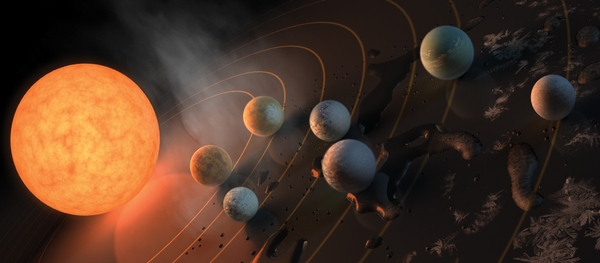
Image: This artist’s impression displays TRAPPIST-1 and its planets reflected in a surface. The potential for water on each of the worlds is also represented by the frost, water pools, and steam surrounding the scene. Credit: © NASA/R. Hurt/T. Pyle.
The question of atmospheres is a fraught one given that the tight habitable zones around an M-dwarf mean that planets there are subject to violent flare activity that can potentially strip an atmosphere entirely. The two inner worlds are not in the habitable zone (TRAPPIST 1-e, f and g are, but are not part of this study). We learn in the paper that no atmospheres can be detected here, but the question of the other planets remains open. This is the first time that astronomers have mapped climate features on Earth-sized planets.
We can continue to speculate on tidal lock, which will be a factor on planets in the habitable zone of any red dwarf star. A permanent day on one side, permanent night on the other are the result, but there are mechanisms that could keep a planet like this able to sustain life. Brice-Oliver Demory (University of Bern), a co-author of the study, comments on the importance of the work:
“The presence of an atmosphere around these tidally locked planets could allow for energy transfer between the day and night sides, resulting in more moderate temperatures across the planet, which would have a significant impact on their potential habitability. Successfully detecting the atmosphere of one of these planets has therefore become a key objective for our community, highlighting the importance of the TRAPPIST-1 system with the JWST.”
Sixty hours of observation with JWST tracked the two inner planets in the infrared through a full orbit, allowing readings of surface temperature to a high degree of precision. What tells the story is the marked temperature contrast between night and day sides, with the inner TRAPPIST-1b at 200 degrees C on the dayside, while planet c comes in at 100 degrees C. The night side of each registers at below -200 degrees C, indicating that thermal energy is not being transferred, a likely consequence of early atmospheres being stripped away.
How far out from the star do we have to go to find a surviving atmosphere? Emeline Belmont (University of Geneva) points to our own Solar System as reason for optimism. Whereas Mercury has been stripped of any atmosphere, both Venus and Earth clearly had no problem forming and keeping their own. That would leave the three TRAPPIST-1 worlds in the habitable zone continuing candidates for follow-up, and eventually spectroscopic study of atmospheric components. Will a future telescope register a biosignature on one of these?
We can expect the investigation of TRAPPIST-1 to accelerate. Out of curiosity I ran a quick check on the Astrophysics Data System (ADS), requesting papers with TRAPPIST-1 in their abstracts published since the beginning of this year. 36 entries came up, some of them only referencing the system, but most homing in on various issues involving it. Today’s paper particularly caught my eye given lead author Michaël Gillon (University of Liège), who led the international team that discovered the system in 2016 and subsequently identified its full extent.
The paper is Gillon et al., “No thick atmosphere around TRAPPIST-1 b and c from JWST thermal phase curves,” Nature Astronomy 3 April 2026 (abstract).


Trappist 1b is still not in the life belt. Hopefully we will get more on the ones that are like d, e, and f. There is still jeans escape which is based on temperature and gravity so maybe the further away, the more chance for an atmosphere?
I am not surprised, Red dwarfs are not known for their mild temperament.
If we just look at Jeans escape, what would the prediction be for the planets b through f? Does the lack of atmosphere on b and c imply that the temperature is sufficient to drive off the atmosphere for the heaviest gas (CO2 ?), or does it require other mechanisms? d & f have Earth-size masses, but possibly are too hot or cold for liquid water to be on the surface. e is located nicely in the HZ, but its mass and surface gravity are between Mars and Earth. What does this predict for the mechanism to retain or remove the atmosphere?
Suppose that all these planets prove to have no atmosphere, and that this is due to the atmosphere being lost due to the thermal Jeans escape (worsened by tidaL locking) or another mechanism that strips the atmosphere, would this reduce the Bayesian prior for life on all M_dwarf systems, and refocusing our searches on F,G,K stars with Earthlike (rocky, mass, & surface gravity) planets?
If Trappist-1 proves to be a reference/model M_dwarf system, with very low probability of a planet maintaining an atmosphere throughout its long lifetime, then we might end our speculations of life on such planets being able to mimic Earth’s rich biosphere despite a spectrum strongly shifted to red and requiring different forms of chlorophyll or analogs that can harbess the lower energy of the incident light at the planets’ surfaces. OTOH, if even the lower mass e planet proves to have an atmosphere, then perhaps M_dwarf systems might make good targets for ease of observations of their planets, and lab experiments to breed or design organisms to harvest the red light of the stars. A breeding program would be the easiest, with the illumination slowly shifted to the cooler spectrum over many generations.
[A Google search using “experiments to breed photosynthetic organisms to live in red light” appears to indicate that photosynthetic organisms may already be able to do this, so breeding may be easier than thought…]
Andrew, by using the interactive gas retention plot (https://astro.unl.edu/naap/atmosphere/animations/gasRetentionPlot.html) Trappist1b should have been able to retain a pretty hefty atmosphere. I used a radius of 7000km, density of 5.4 g/cm^3 and a temperature of 400K. Trappist 1c is similar in size, density and temperature, so it too should have been able to retain an atmosphere.
Since M dwarfs have flares over much of their early history, the Trappist 1 planets must have been directly hit by flares multiple times, which would have raised the temperatures enough to increase atmospheric loss, either through Jeans escape or hydrodynamic escape, which can cause the loss of heavier gases that would normally not escape.
Sputtering and other non-thermal effects could also be at play, since the planets are so close to their star.
Evolution may also be a factor; young M Dwarf stars are hotter and more luminous after they form and stay that way for a while. If the planets formed in their current locations (and didn’t migrate in) they would have been exposed to significantly higher temperatures (and greater flare frequency) for millions of years or more. IIRC, there are a couple of papers that simulate the history of Earth-like planets around M dwarf hosts. The results for the Trappist-1 planets so far seem to be in line with some of the more pessimistic assumptions.
TRAPPIST-1c may have a very thin atmosphere, I cant see it all been blown away even with the nature of red dwarfs and then there is the secondary atmosphere process. Maybe it is nitrogen which is hard to detect, CO2 at that day time temperatures goes into rocks quickly.
Optimum Temperatures for Weathering: Research into mineral carbonation of silicate rocks, such as wollastonite, shows that faster, improved carbonation (up to 70% in 15 minutes) can be achieved at higher temperatures of around 200 C and high pressures.
The interpretation is based on thermal imaging, not gas detection. The abstract indicates that Trappist-1c may have an atmosphere up to 1 bar; the authors rule out a dense atmosphere, so it is not a Venus analog (not unexpected).
As for the planets further away from the sun, might the lower illumination make this analysis more difficult? Added to this is the uncertainty of tidal locking of d,e,& f (Wikipedia indicates e is probably tidally locked).
My question is whether any upcoming telescope can determine Trappit-1 planet atmospheres directly, preferably with spectral analysis for gas composition?
This is a very good point because I recall that we could only detect the heat from Venus in the near infra red because it’s thick atmosphere blocks the emission of the mid infra red. Maybe we are only seeing the cool top of the atmosphere which has haze and we think the planet has no atmosphere, especially if we only look at it in the mid infra red. We might also look at the NIR, but if that has already been done, maybe we need more data points over the whole planet to know for sure, i,e., there maybe an atmosphere there. Google AI
We also have the idea of tidal heating which would can replenish an atmosphere. Trappist 1 is 7.6 billion years old and is a over two billion years older than our solar system that might be enough time to loose most of it’s atmosphere through solar wing stripping, but intuitively I find that idea dubious. The thin atmosphere idea sounds like a high probability, but we have yet to see the other planets in the Trappist system. I agree more study of 1b is a must.
Thick atmospheres have also been ruled out for Trappist 1 d by JWST which is not very suprising given its smaller size compared to Trappist 1c and 1e. Although very thin atmospheric conditions are not completely ruled out for Trappist-1 d, they are considered improbable.
Strict Limits on Potential Secondary Atmospheres on the Temperate Rocky Exo-Earth TRAPPIST-1 d – https://iopscience.iop.org/article/10.3847/1538-4357/adf207
Note, JWST is currently studying Trappist-1e. These will be the interesting results as this is the planet in the habitable zone.
Hi Paul
In the back of my mind I was waiting for the result’s from Trappist 1.
Its going to be interesting to see the results from Planets D and E in this system.
I see all these and similar planets have thin exospheres, Hot dry day sides and cold night sides covered in Ice caps.
Interesting comment Alex and I was thinking of the same questions too.
If news on the outer planets pops up please post it up.
Cheers Edwin