
One way to examine problems with huge unknowns – SETI is a classic example – is through the construction of a so-called ‘toy model.’ I linger a moment on the term because I want to purge the notion that it infers a lightweight conclusion. A toy model simplifies details to look for the big picture. It can be a useful analytical tool, a way of screening out some of the complexities in order to focus on core issues. And yes, it’s theoretical and idealized, not predictive.
But sometimes a toy model offers approaches we might otherwise miss. Consider how many variables we have to work with in SETI. What kind of signaling strategy would an extraterrestrial civilization choose? What sort of timeframe would it operate under? What cultural values determine its behavior? What is its intent? You can see how long this list can become. I’ll stop here.
The toy model I want to focus on today is one David Kipping uses in a new paper called “The Eschatian Hypothesis.” The term refers to what we might call ‘final things.’ Eschaton is a word that turns up in both cosmology and theology, in the former case talking about issues like the ultimate fate of the cosmos. So when Kipping (Columbia University) uses it in a SETI context, he’s going for the broadest possible approach, the ‘big picture’ of what a detection would look like.
I have to pause here for a moment to quote science fiction writer Charles Stross, who finds uses for ‘eschaton’ in his Singularity Sky (Ace, 2004), to wit:
I am the Eschaton. I am not your God.
I am descended from you, and exist in your future.
Thou shalt not violate causality within my historic light cone. Or else.
Love the ‘or else.’
Let’s now dig into the new paper. Published in Research Notes of the AAS, the paper homes in on a kind of bias that haunts our observations. Consider that the first exoplanets ever found were at the pulsar PSR 1257+12. Or the fact that the first main sequence star with a planet was found to host a ‘hot Jupiter,’ which back in 1995, when 51 Pegasi b was discovered, wasn’t even a category anyone ever thought existed. The point is that we see the atypical first precisely because such worlds are so extreme. While our early population of detections is packed with hot Jupiters, we have learned that these worlds are in fact rarities. We begin to get a feel for the distribution of discoveries.
Hot Jupiters, in other words, are ‘loud.’ They’re the easiest of all radial velocity planet signatures to find. And yet they make up less than one percent of the exoplanets we’ve thus far found. The issue is broad. From the paper:
…over-representation of unusual astronomical phenomena in our surveys is not limited to exoplanetary science. One merely needs to look up at the night sky to note that approximately a third of the naked-eye stars are evolved giants, despite the fact less than one percent of stars are in such a state—a classic observational effect known as Malmquist bias (K. G. Malmquist 1922). Or consider that a supernova is expected roughly twice per century in Milky Way-sized galaxies (G. A. Tammann et al. 1994)—an astoundingly rare event. And yet, despite being an inherently rare type of transient, astronomers routinely detect thousands of supernovae every year (M. Nicholl 2021), as a product of their enormous luminosities.
That’s quite a thought. Go for a walk on a clear winter evening and look up. So many of the stars you’re seeing are giants in the terminal stages of their lifetimes. Those we can see at great range, but our nearest star, Proxima Centauri, demands a serious telescope for us to be able to see it. So we can’t help the bias that sets in until we realize how much of what we are seeing is rare. Sometimes we have to step back and ask ourselves why we are seeing it.
In SETI terms, Kipping steps back from the question to ask whether the first signatures of ETI, assuming one day they appear, will not be equally ‘loud,’ in the same way that supernovae are loud but actually quite rare. We might imagine a galaxy populated by stable, quiescent populations that we are not likely to see, cultures whose signatures are perhaps already in our data and accepted as natural. These are not the civilizations we would expect to see. What we might detect are the outliers, unstable cultures breaking into violent disequilibrium at the end of their lifetimes. These, supernova style, would be the ones that light up our sky.
Kipping’s toy model works on variables of average lifetime and luminosity, examining the consequences on detectability. A loud civilization is one that becomes highly visible for a fraction of its lifetime before going quiet for the rest. The model’s math demonstrates that a civilization that is 100 times louder than its peers – through any kind of disequilibrium with its normal state, as for example nuclear war or drastic climate change – becomes 1000 times more detectable. A supernova is incredibly rare, but also incredibly detectable.
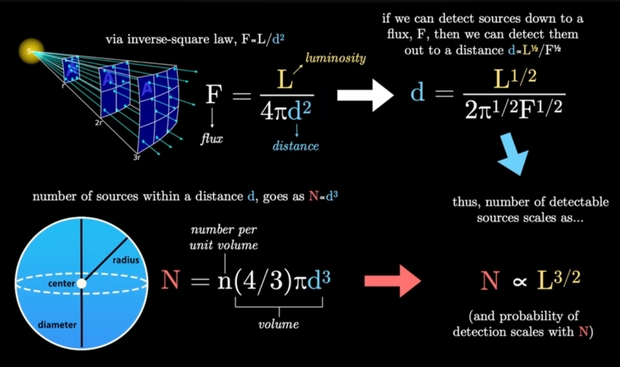
Image: The toy model at work. This is from Kipping’s Cool Worlds video on the Eschatian Hypothesis.
The Eschatian search strategy involves wide-field, high cadence surveys. In other words, observe at short intervals and keep observing with rapid revisit times to the same source. A search like this is optimized for transients, and the author points out that a number of observatories and observing programs are “moving toward a regime where the sky is effectively monitored as a time-domain data set.” The Vera Rubin Observatory moves in this direction, as does PANOPTES (Panoptic Astronomical Networked Observatories for a Public Transiting Exoplanet Survey). The latter is not a SETI program, but its emphasis on short-duration, repeatable events falls under the Eschatian umbrella.
Rather than targeting narrowly defined technosignatures, Eschatian search strategies would instead prioritize broad, anomalous transients—in flux, spectrum, or apparent motion—whose luminosities and timescales are difficult to reconcile with known astrophysical phenomena. Thus, agnostic anomaly detection efforts (e.g., D. Giles & L. Walkowicz 2019; A. Wheeler & D. Kipping 2019) would offer a suggested pathway forward.
I’ve often imagined the first SETI detection as marking a funeral beacon, though likely not an intentional one. The Eschatian Hypothesis fits that thought nicely, but it also leaves open the prospect of what we may not detect until we actually go into the galaxy, the existence of civilizations whose lifetimes are reckoned in millions of years if not more. The astronomer Charles Lineweaver has pointed out that most of our galaxy’s terrestrial-class worlds are two billion years older than Earth. Kipping quotes the brilliant science fiction writer Karl Schroeder when he tunes up an old Arthur Clarke notion: Any sufficiently advanced civilization will be indistinguishable from nature. Stability infers coming to terms with societal disintegration and mastering it.
Cultures like that are going to be hard to distinguish from background noise. We’re much more likely to see a hard-charging, shorter-lived civilization meeting its fate.
The paper is Kipping, “The Eschatian Hypothesis,” Research Notes of the AAS Vol. 9, No. 12 (December, 2025), 334. Full text.


Alastair Reynolds calls it “turnover” in one of his novels. The Chinese know it as the dynastic cycle. Think of it as a product life cycle applied to civilizations. The key is as an amortal, you figure out not only how to survive it, but to profit and benefit from it.
It was “House of Suns”. That’s where the concept of turnover came from. When you’re an amortal, you learn to survive turnover as one of your basic life skills. Integral to that is a growing emotional detachment towards those who do not share one’s commitment to radical life extension.
What is the basis for the claim that most terrestrial-class planets in the Milky Way are 2 billion years older than our Earth?
Abelard, I believe Lineweaver’s first paper on this is here:
“An Estimate of the Age Distribution of Terrestrial Planets in the Universe:
Quantifying Metallicity as a Selection Effect”
https://www.mso.anu.edu.au/~charley/papers/Icarus.pdf
I heard it was older. We could have civilizations from exoplanets which were at our level of advancement before our solar system formed. Imagine one 4.5 billion years more advanced than us. Hard to believe they need to use radio signals to communicate to other star systems. They simply go there to communicate especially if there is FTL interstellar spacecraft. What if our knowledge of the size of our universe is completely wrong. Then our universe could be much older or maybe infinite and eternal and there could some really advanced civilizations in space with technology which gives them much more freedom than us. They could chose or not to chose to contact us and that is really hard to swallow with a worldview limited to the past and today’s technology.
This is such a thought provoking notion… the Eschaton principle applied to SETI. It makes altogether good sense. A stable civilization being indistinguishable from Nature is remarkably obvious, but it had never occurred to me.
I’m reminded of Stephen Baxter’s short story Last Contact. As the increasingly fast expansion of the universe starts to tear apart our galaxy, suddenly, we receive many messages from space as civilizations broadcast their last messages proclaiming their existence with a “goodbye”.
That expansion of space idea could be completely false. Then we would never have to worry about any big rip, etc. it has yet to be proven, but only assumed. Any ET’s with a warp drive could really do some incredible things such as push their planet out of orbit to a safe distance during the red giant phase. The white dwarf phase would be a problem since we get so much ultra violet radiation and not enough visible light so they would have to leave and find another world and the only way to get around a prime directive is to fix a dead world.
For example. Another idea might be engineer a planet. Find an Earth size planet in the life belt around a G class star and then give the planet a fast rotation using the gravitational fields of a warp drive and push a Moon into orbit and Earth 2.0 engineered. No terraforming necessary.
@Geoffrey Hillend
IDK if the expansion of the universe is completely false, but recent measurements suggest that it is slowing down, so no “Big Rip” if correct.
Even assuming the physical details are similar enough, one still has a lot of work to do to make the new planet habitable by humanity. Terraforming is still needed insofar as life must still rework the planet until it is ready to support a contemporary biosphere. How long that will take is uncertain, but millennia are certainly required at a minimum.
It might be easier to just encase the Earth in a shell, add simulated daylight, and use the warp drive to move the Earth and Moon to wherever you want it to be. [The Moon is simply to provide the gravitational tug on the Earth. It isn’t seen directly, just an image displayed on the inside of the shell.] During the cruise phase, the energy is supplied by nuclear fusion or matter-antimatter annihilation. On arrival at a new star, the star’s energy is used to power the Earth and rebuild its energy stores. Because the Earth remains inside a shell, with a projected sky, and stellar field from the vantage of the solar system, the type of star it orbits is irrelevant, as its appearance is not shown, just the projection of Sol inside the shell with the same G3 spectrum.
It would make an interesting SciFi story as scientists with a 19th-century level of knowledge detect discrepancies with their measurements and the projection on the shell, and eventually, that the sky is a shell, and that an orbit is not possible when launching a rocket from the ground. If the shell has to be physically supported, then towers at points on the surface offer access to the shell both inside and outside.
If artificial gravity can be created, then the planet’s surface may only need to be a hollow sphere with the generator and heat supplied inside the surface, reducing the mass to be transported. It would be an inverted O’Neill (or Bernal Sphere) with the surface on the outside rather than the inside, but with the living space sandwiched between the surface shell and the sky shell. [If we are going to posit a warp drive, then a gravity generator seems like a reasonable ask.] With a gravivity generator, the sky shell could be removed if the simulated solar system projection wasn’t needed.
What phenomena would need to be faked? Volcanoes? What would have to be controlled – asteroid strikes deflected to prevent the sky shell breaking?
Century Rain by Alistair Reynolds is the story you are looking for.
https://www.goodreads.com/book/show/89192.Century_Rain
One of his best IMHO.
I absolutely love Century Rain.
Alex Tolley, I agree with you on the terraforming. One could terraform a planet after giving it a fast rotation which would give it a magnetic field and a Moon. That would be the hard part. Terraforming easy since just adding life to it would do the job provided enough water and atmosphere was there. By the time the red giant phase was over deep time that planet would be habitable.
I also thought about moving the planet itself to another star system, but not the shell. The problem is that it would take much too long to get a planet to another star system since one couldn’t make a warp drive that large and therefore be limited sublight speed. It is not that hard to increase a planets rotation with a warped field on it’s surface like anti gravity or expansion of space instead of contraction and a warp drive or many of them could in potential move a moon.
I like the neologism “gravitivity”.
Such a combined department if not machine room might well be useful the Wanderer.
In grad school 60 years ago, all filters of the sort described in this post were said to be observational selection effects, that set limits on the universality of conclusions that can be drawn from observations and included equipment sensitivity in terms of wavelength, time resolution limits (including for very transient and very slowly varying signals), and sampling of cluster stars or stars in the field (RR Lyrae stars vs. cepheid variables). Such limitations clearly affect our searches for extrasolar planets.
This is a nice post.
I wonder if nuclear conflict would be detectable at stellar distances?
No surprise that there are numerous references had you done a search. It seems that people like to ask the question, and quite often. Here is one example I was referred to, but I only read the abstract: https://arxiv.org/abs/1507.08530
In general, no. Nuclear detonations are not that loud. They are also brief so you have to be within ~10 light years and looking/listening at the right time and direction. Aftereffects (heavy isotopes in the atmosphere) will persist although the signal will be weak.
So, if our civilization goes boom nobody is likely to notice.
Maybe not a nuclear conflict, but a guy who did know a thing or two about nuclear weaponry considered using nuclear bombs to get the attention of ETI…
http://lnfm1.sai.msu.ru/SETI/koi/articles/sakharov.html
If we could have used up the stockpiles of H-bombs for this purpose, if nothing else, it might have made the world a safer place once the inventory was exhausted. In reality, the nuclear powers would have kept back some inventory due to the Cold War paranoia of not trusting the other side[s] to use up their stocks. :-(
Still, the reduction in stock piles would have been welcome.
Turn total overkill to just kill. The biosphere would appreciate it, even if we did5
Perhaps visible matter is the special, rare case, compared to dark matter, and is therefore more visible. And the same could occur regarding dark energy. If dark matter can have any kind of small scale structure, perhaps most civilizations are made up of dark matter, whatever that means, and that’s why we did not detect them yet
hummm…not convinced, but I’m not sure I understood very well, I admit :) I do not perceive the relationship between superluminosity related to star dynamics and an ETI civilization & some kind of message (unless it would be type II or III) ?
BTW one question : how would his theory be inscribed in a universe of the ‘big bang’ type whose expansion would not or only slightly be hindered by gravity, so where this expansion would go faster than the speed of light ? (imagine that Andromeda moves away from us quickly – expansion of space-time- ; there will come a moment when the light of this galaxy can no longer reach us, it will then be invisible to us. One could say the same about a supernova etc.
Any supra-luminous object that leaves our Hubble radius becomes invisible to us forever. so what about a possible signal ?
It would go a little slower in the expansion model with gravity (ours ? ) and I would say that we might be able to detect something more easily in a ‘big crunch’… but it should be done quickly :)
Rather than assuming that an advanced ETI becomes more similar to nature in output, perhaps it is more likely that such a civilization dies out, and the planet’s biosphere returns to a low intelligence state that stays in equilibrium as the fauna cannot act as agents that destroy the planet’s biosphere through reckless actions.
If so, civilizations will indeed be transient, with the L term in the Drake equation indicative of the length of time a civilization is high-tech before it disappears. If civilizations are sparse, there is a high probability that there are no civilizations within the light cone where a transmitted signal can be received by another civilization. The sky will remain free of any signal. With 100s of billions of galaxies, if energy were no object, then there may be cases where a signal does reach us, even if the communication is strictly one-way. However, if energy is limited, then these signals will become background noise and undetectable.
We can apply the Drake equation to determine the L term that ensures that at any given time period, there can be a broadcast signal that will be detectable by us, rather than missed like ships alone on the ocean at night, never more than one at any moment.
A gedanken experiment:
What’s it worth to try and receive (with a chance of null) or send an “loud” signal ourselves?
——————————————————-
For listening quietly, sign me up If I were told a project to build a massive radio antenna on the moon facing away from Earth would cost $500B per year X 20 years = $10T
For intergalactic signalling, if I were told a Dyson Shutter (see https://centauri-dreams.org/2016/12/21/citizen-seti/) would cost $200T over 100 years, I think it would be worth it.
And the Benford’s estimated an interstellar radio beacon costing some tens of billions, let’s say $50B, which seems a bargain.
——————————————————–
By way of comparison, here’s some yearly data from simple Google searches:
Current Global Gross Domestic Product is $130T
Global Military spending is ~$2.7T (seems low to me and the USA accounts for nearly half)
Global Healthcare spending is 10% of GDP or $13T
Global Education spending is 4% of GDP or $5T
Yuri Milner donated $100MM to the Breakthrough effort
One 10GW nuclear reactor $10B
Fusion costs since 1950 according to Gemini AI: $10 to $100B with no assured outcome.
AI development and buildout: no good answers but call it $5T
——————————————
From reddit with no due diligence:
Manhattan Project ~$30 billion in today’s dollars
Apollo Program ~$170–$180 billion in today’s dollars
Space Shuttle Program ~$275–$300 billion in today’s dollars (and that was a dead end)
Interstate Highway System, entire decades-long Interstate Highway System buildout, ~$500–$550 billion in today’s dollars (but it destroyed passenger railroads)
—————————————————-
I think the multi decade Interstate highway system, fusion research, and space shuttle programs are comparable cultural efforts as were the 500 years-long Gothic Cathedral projects.
—————————————————–
Anyone have alternate napkin opinions?
Happy Holidays all, there is such pain in the world that I feel the need to look elsewhere!
Scott
Shouting into the dark will not get you anything for 100s, probably 1000s of years if the aim is to get some sort of acknowledgement that ETI is out there. $1/2 Tn per annum seems like a lot of money for no discernible likely return, which at best will be long into the future. This seems like a classic – wait until we have a bigger economy with better technology before we commit to such a program.
OTOH, spending the same on a “Big Ear” placed on Farside seems like a far better idea, as any signal, however distant its origin, will be received as soon as it is turned on. That was the idea behind early SETI. We might want to think about what technology to use. Perhaps many small radio antennas? A good optical, IR, and other wavelengths equipment as well? I would tend to go for a full 1/2 sky monitoring if possible, which would give full sky coverage every month.
For an array of small antennas, like teh SKA project, the size of the array can be increased incrementally, which seems like a good hedge to me. Even better is teh basic metal antenna units can be built via ISRU, with just the electronics transported from Earth. The initial setup might be expensive, but this should reduce the overall cost as the array size increases. The $ 1/2 Tn annual cost would be $2500-3000/yr/capita. That seems like a rather large tax hike to me, although the burden would fall mostly on the very wealthy (maybe).
Alex,
Yes, shouting Beacon-style seems like a waste, if not mistake.
A Big Ear/Eye would be an excellent use of lunar real estate and is amenable to robotic assembly as it is highly modular.
But if we were to be a long-lived civilization and could build Dysonian-scale signalling objects, especially having not heard or seen anything, I doubt there would be a lot to worry about.
If there are Dysonian-scale civs out there, they could easily have sent probes to the solar system already. If they were a “Dark Forest” danger, they could have already ended us by now. (Maybe they are doing that already, given the way we are responding to crises. ;-P )
More likely, we are not reachable simply because the nearest civ is so far away that any c-velocity-limited spacecraft would take so long to reach us, it would be pointless. Indeed, if such a civ was even 10,000 ly away, their remote observations of Earth wouldn’t detect any significant human presence, so no need to end our existence, and again, why bother to send signals our way, or even listen for another upcoming civ from that distance? Our radio and tv emissions are about 100 years old. Radio listening would detect nothing for any civ beyond that distance, even if they had a probe listening locally and beaming a signal back to teh homeworld. It only makes any sense if the civ has FTL communication and possibly FTL spacecraft.
Lastly, any advanced civ is assumed to be at least millions of years ahead of us technologically and stable. That is borderline god-like and may even be a wish-fulfillment longing. [At least the movie “Forbidden Planet” raised the speculation that any such civ, like the Krell, could still self-destruct.] However, as has been suggested by others, any such civ may view our species as we do ants, barely worth paying attention to.
This doesn’t mean we shouldn’t do SETI, even CETI or METI, but it is such a long shot that we shouldn’t expend huge resources doing that. If we are going to spend huge resources analogous to building cathedrals, let us do that for projects with a better ROI. I think the Allen Telescope Array was the rational way to do SETI. Use it for regular radio astronomy, and piggy-back SETI on the collected data, rather than dedicating telescope time to SETI, which has a history, so far, of returning null results.
We have a transient phenomenon that lasts for 25,000 years and is most commonly observed in G-type stars, such as our Sun. Our analysis considers familiar concepts like magnetic fields, binary stars, and our foundational understanding of physics. A Type II Kardashev civilization, also known as a stellar civilization, can directly harness the energy of a star, typically through a structure like a Dyson sphere. But what happens to these G-type stars when their life cycle comes to an end? Could a Type II Kardashev civilization utilize a supernova explosion to send a message into the cosmos? While most planetary nebulae have ordinary explanations, what if a message of fundamental importance to other civilizations were hidden within? Let’s explore some of the truly bizarre planetary nebulae and imagine the possibility of discovering the secret to a soliton warp drive…
https://science.nasa.gov/asset/hubble/the-cats-eye-nebula-dying-star-creates-fantasy-like-sculpture-of-gas-and-dust/
https://cdn.esawebb.org/archives/images/large/weic2508b.jpg
https://www.universetoday.com/article_images/plneb.jpeg
While the paper “The Eschatian hypothesis” offers a valuable approximation, it overlooks several critical considerations within a broader context. To effectively apply the Eschaton principle to the Fermi paradox and the Search for Extraterrestrial Intelligence (SETI), it is necessary to incorporate mechanisms that explain either the process of Immanentizing the eschaton or the reasons for its failure. Furthermore, a comprehensive analysis should address the emergence of civilizations from technology, the emergence of technology within civilizations, the dynamic (chaos-creation) risks associated with technological development, and the cumulative risks that may arise.
George E. P. Box famously stated, “All models are wrong, but some are useful.”
A toy model is a simplified representation with limited accuracy. The use of a toy model in the paper “The Eschatian hypothesis” is both appropriate and commendable. Employing such models should be encouraged, as highly detailed models often create a misleading sense of precision that is not justified by the available data. The practice of oversimplifying models to the point of abstraction should be avoided, as it impedes progress and fails to reflect reality. Simpler models can effectively illustrate the range of issues requiring investigation and may yield more practical insights than overly complex models that lack real-world applicability. An approximately correct model is often more valuable than a perfectly accurate model that offers no practical utility.