
I don’t write science fiction, but I have several friends who think I do simply because I write about distant planets and futuristic ways to reach them. The boundary between SF and science has always fascinated me. I like to poke around in old magazines, most of them from the science fiction field, but a particular interest is magazines like Hugo Gernsback’s Science and Invention and Radio News, early 20th Century venues for fiction that dealt with science and preceded 1926’s Amazing Stories.
Astronomy and fiction have been mingling for a long time, but as we uncover startling exoplanets and posit theories that explain them, I’m usually wondering how quickly an SF writer will pick up on the latest work with a stunning new setting. Today’s paper offers another opportunity, as it presents the possibility that ‘rogue’ planets, wandering in the interstellar dark without a warming Sun, may support biology not on their surfaces but on any potential moons.
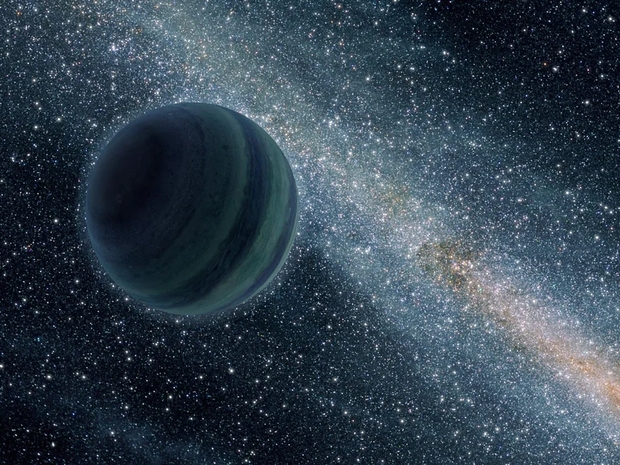
Image: Artist’s rendition of a Jupiter-sized rogue planet moving through interstellar space without any star. Scientists have been exploring the possibility of life on worlds warmed by internal heating alone. A new paper now looks at moons around such worlds and the processes that could keep them warm. Credit: JPL/Caltech.
Scientists involved with the German research network ORIGINS, working with researchers at the Max Planck Institute for Extraterrestrial Physics (near Munich) believe that large moons of free-floating planets can retain liquid water oceans for over 4 billion years because of the twin effects of dense hydrogen atmospheres and tidal heating. That closes in on the amount of time Earth has existed, with the obvious implication that complex life could develop.
Lead author David Dahlbüdding (Ludwig-Maximilians-Universitat Munchen) is lead author of the study:
“Our collaboration with the team of Professor Dieter Braun helped us recognize that the cradle of life does not necessarily require a sun. We discovered a clear connection between these distant moons and the early Earth, where high concentrations of hydrogen through asteroid impacts could have created the conditions for life.”
Recent work has shown that a gas giant ejected from its birth system could retain moons despite the gravitational encounter that would have forced it into interstellar space. Orbiting moons would be nudged into elliptical orbits by the event, but the resulting tidal forces between moon and planet are a blessing in disguise, in that they could generate enough frictional heat to maintain surface oceans. An atmosphere rich in hydrogen can also undergo ‘collision-induced absorption.’ in which thermal radiation is then retained by the atmosphere.
Earlier papers have examined rogue planet atmospheres heavy in CO2, where atmospheric collapse is a probability. But the researchers think hydrogen is far more interesting. From the paper:
The present-day Earth looks much different from the worlds presented here, which, with their thick hydrogen envelopes and possibly deep oceans, resemble a Hycean planet. Although usually in the sub-Neptune range, these worlds are prime candidates for the detection of life (Madhusudhan et al. 2021, 2023a,b). In their case, any tidal heating could conversely narrow the habitable zone (Livesey et al. 2025). Our small-scale Hycean worlds could provide relatively better conditions for life. Due to their (∼ 25%) lower gravity, high-pressure ices between a potential liquid water ocean and the rocky core would be less likely, allowing the ocean to receive essential nutrients (Cockell et al. 2024). Although, as Madhusudhan et al. (2023a) note, this represents only one possible source of these essential biological elements.
What to make of this? Extending the range of possible biology is always interesting, but the natural question is how we might actually observe such a system. Free-floating planets are a difficult enough catch without bringing potential moons into the mix. Gravitational microlensing offers a faint possibility, but here we’re dealing with chance encounters with background stars that are beyond our conceivable likelihood to predict. Although the authors mention transits of the host free-floating planet, this seems quite a reach. How do we know where to look, when their presence is unpredictable? The Roman Space Telescope should detect plenty of rogue planets, but the issue remains – a gravitationally microlensed event is by its nature unrepeatable.
I don’t want to downplay targeted searches for young rogue planets still throwing a good infrared signature in their adolescence. These we might actually detect through direct imaging if we scan nearby star clusters, so it’s not outside the realm of possibility to think we might get a rare transit of a moon. But the unlikeliness of such a detection means we may have to chalk this up as a fascinating theoretical result without observational consequences, at least at the present state of our technology.
Still, what an interesting landscape for a science fiction tale…
The paper is Dahlbüdding et al., “Habitability of Tidally Heated H2-Dominated Exomoons around Free-Floating Planets,” in process at Monthly Notices of the Royal Astronomical Society 24 February 2026 (full text).
Paul,
Just want to say that I think all us readers are lucky that we’ve been here during this era. You founded Centauri Dreams and keep nurturing it and keep bringing us fresh knowledge and insights and questions.
Thanks much.
What a kind thing to say, Erik. Many thanks! In the 22 years of doing this site, I’ve always known that interactions with this audience were the best part of my job. And needless to say, there’s never a shortage of things to write about given the speed of discovery in interstellar matters. I can only imagine what 2026 is going to bring.
The idea that life might be out there but nearly undetectable reminds me of the shadow biosphere theory, though that’s for Earth life. Definitely something that sci-fi ought to explore.
As with the idea of life in teh subsurface oceans of icy moons, the energetics suggests that any life will be anaerobic prokaryotes, with a relatively sparse density. They may huddle around any ocean vents, but teh lack of sunlight reduces the potential carbon fixation, as well as teh available energy for metabolism. Life may even be like the abyssal microbes living in the cold ocean muds, slow-growing due to a low metabolism.
Even if we locate such a world, how do we detect life under those conditions?
But consider. If such worlds exist as rogues, doesn’t this imply that similar worlds with moons could still be attached to stars, but in the shallows of the gravity well, perhaps where we find trans Neptunian planets? While still hard to find with transits and other detection methods, at least the location is known and therefore can be found again using direct visualization in the IR wavelengths.
Though it refers to “small-scale Hycean worlds” the report is vague enough to include exo-moons that are ice covered with an enclosed sub-surface ocean. Either way, I am intrigued by the possibility of life in these environments.
If intelligent life evolved here, what path would their technological development follow? Initial conditions have a profound impact: These beings won’t have fire. Playing with high or low temperatures will be hard to do. You can’t have a forge or blast furnace under water, so metallurgy may be delayed. Even if they observe lightning, learning about electricity will be a LOT harder with primitive equipment in a saltwater environment.
On the other hand, their knowledge of acoustics, math, chemistry, magnetism, perhaps electrostatics, biology and breeding, even light, may surpass ours. Such a civilization could have a thriving, high-tech set of world-spanning cities that emit almost no clues to their presence simply as a side effect of their technology.
How long might it take for such life to become spacefaring? Whether ice-covered or Hycean, imagine the launch of a spaceship. These are beings that don’t live in an atmosphere, they live in a fluid. They need to either build infrastructure on ice in a vacuum, or floating on an ocean with weather and waves they only recently cared about at all. Also, the cost of a “manned” vehicle would be far greater than for us because life-support would weigh so much. The ones that make it to space would have a very skewed technology compared to our own.
It appears that there are nuances that the Drake Equation doesn’t fully address. I suppose it’s a matter of resolution. We need detailed data to make detailed predictions.
Io-like moons of rogue planets, forced into orbital resonances that leave them permanently subject to tidal heating, are very appealing. But I think it is more exciting to tap the geothermal energy locally at hydrothermal vents or geothermal projects, yielding a constant stream of gas and free energy.
The problem with blanketing the planet in a 100-bar atmosphere for insulation is that we lose most of the free energy. To be sure, enough free energy is available at black smokers on Earth for a simple ecosystem, but the insulation in this case seems intended to compensate for the stingy energy budget of a cold moon. Nonetheless, the smokers would be fewer or mere cold seeps, and the remainder of the planet is probably not actually able to provide energy to living things.
The key thing to bear in mind, not discussed in the paper, is that warm tropical islands in a “Hycean” sea cannot sustain palm trees. Not only is there no light; there is also no dark – there is no free energy. On Earth, a photon from the Sun arrives with about 6000 degrees’ worth of thermal energy, all of which might be imparted to a single electron in an accessory pigment of a plant cell. The plant is then free to radiate that heat out into the cold blackness of space, after first making NADPH and ATP with the energy. Earth plants have not been demonstrated, as yet, to function as “anti-solar cells” – though there really is such a thing – but even without that refinement, the potential Carnot efficiency for radiating at 300 K is already 1-Tc/Th, roughly 95%.
But if there is only thermal radiation in equilibrium with a dark all-encompassing sky, that efficiency drops to zero.
But I don’t mean to suggest a pitch black planet can’t ever have trees. On a rogue planet in interstellar space that lacks an atmosphere or has a non-insulating Earth-like atmosphere, it seems at least possible for a warm patch of ground heated by a volcanic vent to be at 300 K, and a vacuum-adapted plant could emit photons at a quite low temperature, closer to 4 K, for energy efficiency more comparable to Earth, even if the “anti-solar power” available per unit surface area is only 5% as much.
An interesting argument, but it assumes no chemical energy (or very little),
A planet with a dense hydrogen atmosphere will still likely have H2 and CO2 seeps that offer free energy for methanogens. Yes, there will not be oxidative metabolism or photosynthesis, although photosynthesis from IR radiation at these vents is possible if it can be captured and harnessed. There will not be complex organisms, especially trees with woody trunks and light-trapping leaves. Any such “plants” would hug the ground near the sources of IR radiation.
As the Earth still has a hot core, and the icy moons are believed to still have hot vents similar to smokers, after 4.5+ billion years, I see no reason why these moons of rogue planets might not have them too.
As Jupiter and Saturn have lightning in their atmospheres, is it possible that such electrical activity might reach these moons via some conductive medium? There also appear to be some terrestrial microbes that harness electrical energy. Can one speculate that this might be an energy source for the life on such moons, even if it is extracted indirectly from the carbon compounds created by the discharges, rather than directly?
This is a good point. While I think of geochemical energy mostly being used near the source, it is true that once the level approaches the minimum exploitable by living organisms, those organisms still capable of using it may be located anywhere they find advantageous. In particular, hydrogen-oxidizing bacteria can be found widely in deserts worldwide.
I do think anti-solar plants would need to evolve supporting stems and leaf analogues. An anti-solar plant in the “shade” of others of its kind cannot effectively radiate photons into space or extract useful work, so it would still evolve into a tree. The leaves might tend to be larger and more horizontal like plants evolved for overcast lighting, and might have other microstructures. (as an aside, I asked an AI, and somewhat terrifyingly, it immediately seemed to ‘understand’ the idea despite minimal available sources. Is that output really produced by filling in the next likely word?)
“As Jupiter and Saturn have lightning in their atmospheres, is it possible that such electrical activity might reach these moons via some conductive medium? ”
Io’s Flux tube comes to mind
https://www.jhuapl.edu/news/news-releases/210215-Io-helps-Jupiter-accelerate-particles
If they could tame that power it would be 2 Terra watts and clean up the system of its intense radiation allowing colony’s in the Jupiter system !
Life and heat engines. Assume that the insulating blanket keeps the ocean and atmosphere at some temperature X Kelvin. Further assume that hot vents are scattered across the ocean floor at higher than X kelvin. An organism can extract energy from the difference between the 2 temperatures. It can do so in several ways:
1. Extend its body from the hot to cooler zones.
2. Create an insulating barrier around the hot temperature to keep the 2 temperature regimes close to each other.
3. Excrete a conductive pseudopod to bring the heat from the vent to the cooler ocean, where the bulk of the organism’s body resides.
Now, how it uses the temperature differential would be interesting. Does it try to create a biological version of a Stirling engine, or evolve some chemistry/biological functions to extract the energy? How it gets from non-living chemistry to living complex organisms seems mysterious to me. ;-P Could some sort of Belousov–Zhabotinsky reaction be harnessed chemically or mechanically to extract energy for growth and metabolism?
These Io type worlds may be very useful for life if their ions and compounds can be ejected into space to fall on other moons in orbit. Sort of negating the ICE capping issues with higher pressures on more massive moons. Such as Sulphur, Oxygen, Sodium, Magnesium, Iron, Carbon and water species like hydrogen peroxide.
Discussions of Hycean and exo-jovian worlds makes me wonder if we are at least overlooking a local laboratory ( or 2 or 3) for exobiology that are more observable and marginally accessible. After all, there has been at least one Jupiter atmospheric probe on the Galilean mission. Subsequent outer planet missions have disposed of spacecraft, but I am not sure they were outfitted for the descent measurements.
But looking a pressure – temperature – depth diagram, e.g.,
https://cdn.britannica.com/98/76398-050-BFAD2217/Profile-atmosphere-Jupiter-accelerometer-data-probe-spacecraft.jpg
at about 5 atmospheres, the ambient temperature was about 0 Celsius and at 22 atmospheres, where the signal ceased, the temperature was about 425 Kelvin.
That is not as bad as Venus surface conditions for sure, but below that I wouldn’t want to hypothesize much about exobiology. But to put it in another perspective, whales do rummage in our own oceans at depths of hundreds of meters, but would surely perish at depths to which the Titanic sunk. And yet they never sit down on something to rest…
It would be difficult for something exobiological entity on Jupiter ( or another jovian exoplanet) to engage in the same sort of space exploration that we are undertaking. Just by the nature of what they would have to climb out of. OTOH, they might be able to exploit the forces of nature in some other way than we are accustomed to due to our own environment. But in addition, what with Jupiters turbulent atmosphere, there is enormous mixing at depths. A chemistry with volume and opportunity for mixing that dwarfs that of terrestrial surfaces. If the exo-biology belt is defined by some range of moderate temperatures related to water at high pressure, the biosphere could be much vaster than that of Earth’s.
It’s hard enough to get a close look at Jupiter on account of gravity and entry velocities, but especially due to radiation belts surrounding the planet. But those difficulties are minor compared to interstellar flight.
Should we ever be able to drop a camera down to those regions, if nothing else, the weather watch would be fascinating. And anything of substance floating by. We tend to think of its atmosphere in thermodynamic terms, and maybe exotic rains, but should we assume that nothing ever sticks together down there?
Every once in a while I just like to put in a plug for this notion.
I can certainly envisage using some sort of balloon or glider to send a camera and other instruments down into the atmospheres of gas giants. Orbiters would capture the signals and transmit them back to Earth.
Cetaceans rest by floating on the sea surface. To ensure they don’t accidentally drown or get attacked by predators, they can separate their brain hemispheres into sleeping and awake states.
I think about the evolutionary complexities associated with the neurotoxins fungi produce that create zombie ants. The complexity of ant behaviors associated with the chemicals the fungi produce are astonishing. The behaviors include the infected ant leaving the eat just before other ants would notice it is sick. The ant then climbs up nearby vegetation near the ant trail and just before dying it clamps its teeth into the vegetation. The fungi then emits a glue like substance that attaches the ant to the vegetation long enough for the fungus to then grow a blossom out of the head of the dead ant. The blossom explodes, contaminating the ant trail. That a blind and deaf and mute fungus can evolve such complex capabilities based solely on chemicals’ impacts on another species means, to me at least, that it is perfectly possible for dark rogue planets with tidally heated moons to evolve life with blind beings with high technology.
@Peter Manos
If you think about it, a blind computer could achieve the same result with an algorithm. The fungus creates many tweaks of its actions by random modifications of its genome, with reproductive success as its global feedback objective function.
Technology is very difficult. It requires the genomic modification of the population to provide the physical traits needed to manipulate objects. Then it needs to co-evolve a plastic brain with culture, reinforcing the needed mental traits that lead to technology. This can be done crudely in a number of animal species, but only humans, AFAWK, have eventually managed to develop technology to the level reached before the Industrial Revolution. The mental plasticity coupled with cultural conditions managed to hit on science as a method of testing ideas and finding out about nature, which then speed runs the Industrial Revolution to reach our current technology in a few hundred years. This whole process from the start of the cultural explosion somewhere between 40-80,000 years ago is a remarkably short time, and the change started by the Industrial Revolution is less than an eyeblink in evolutionary terms. What took a fungus with a very short reproductive cycle, possibly millions of years, would not get us far with our 15-25 year reproductive cycle, tweaking our genomes. It is learning within a lifetime and passing on that gained knowledge that has allowed humanity to reach towards goals that are not based on natural selection.
Great points. Fascinating. An experience I had halfway through watching the movie Arrival comes to mind here regarding your statements about technology. Looking at the black banana shaped vertical spacecraft hanging in mid air halfway through the movie, I suddenly asked myself “what if this spaceship with its occupants inside, were all part of nature on that planet, rather than technology?“ I know it sounds like a crazy question but how much anthropomorphizing are we doing in these discussions? How could we ever know?
@Peter Manos
I wouldn’t divorce ourselves from nature. We co-evolved with other species. We reshape the environment, forcing us and other species to adapt to new conditions. But at some point, we have to acknowledge that our cultural artifacts are largely separate from nature. Beavers have a sort of technology – dam building – that relies on wood, and changes the environment behind the dam. Humans can do the same with rocks and wood. But we also build dams with other materials, and unlike beavers, we can add turbines to create hydroelectric power, something beavers will never do. Indeed, earlier cultures could only extract work from dammed streams that was used to grind grains. Until we used science to develop technology, we really couldn’t progress any further except by serendipity. We rely on a vast industrial ecosystem to build our technological world, something unique and never likely to be even remotely repeatable without intelligence at about our level and a path-dependent series of developments.
So we remain both part of nature and apart from it. If we build intelligent robots that eventually replace us, then I think we will have created a “civilization” that is truly unnatural and a complete break with the natural world.
We do separate the concept of the natural world – physics, chemistry, and biology, from the world we create that mostly gets lumped in the “humanities”, although engineering is usually added to the sciences in academia. But there is a fuzzy demarcation when we look at basic cultural artifacts. If some animals can use and even shape tools, and create “art” and decorative artifacts, then these should perhaps be added to the “natural” domain, like nest building. I would suggest that once the creation of artifacts is no longer something “programmed” by genetics and that there is some individual creativity that decides what to create, then we have a fuzzy domain where these things can be both natural and unnatural. So no bright line, just a region where the natural becomes increasingly “unnatural”. How does the art world regard paintings by animals (also varied opinions)?
Alex Tolley, to your point, I was giving too much weight to the fuzziness in some of the lines we draw between nature and technology. Yes, a log cabin might now seem closer to nature that it seemed centuries ago, but when its mortar and its cast iron door hardware were first developed it was the height of technology. We go through a mental normalizing that makes old tech seem “natural” when new tech replaces it.
If only culture were as benevolently subject to evolution as biology! It is not. In the realm of ideas, humanity faces a big problem. It is a problem we faced before AI. AI is magnifying the problem, however. Basically the human brain is not a truth-seeking mechanism, really. It is a mechanism to keep the human body alive, and it will get by with as a little truth as is needed in order to minimize its caloric requirements. This is why simple falsehoods can be adopted as easily (or even more easily) than complex truths.
If we do not program AI to be better than us when it comes to this issue, we are in big trouble!
Link to NY Times article about. Omlkex evolution of zombie ant fungi: https://www.nytimes.com/2019/10/24/science/ant-zombies-fungus.html?smid=nytcore-ios-share
Food for thought:
Rethinking Where Life Could Exist Beyond Earth.
https://astrobiology.com/2026/01/rethinking-where-life-could-exist-beyond-earth.html
Exoplanets beyond the Conservative Habitable Zone. I. Habitability
Abstract
The Habitable Zone (HZ) is defined by the possibility of sustaining liquid water on a planetary surface. In the solar system, the HZ for a conservative climate model extends approximately between the orbits of Earth and Mars. We elaborate on earlier HZ models and apply an analytical climate model of the temperature distribution on tidally locked planets to extend the HZ. We show that planets orbiting M- and K-dwarf stars may maintain liquid water on their night side, significantly closer to their host star than the inner border of the conservative HZ. We calculate the extended borders of the HZ in the flux–effective temperature diagram. This extension may explain the presence of water vapor and other volatile gases in the transmission spectra of warm Super-Earth-sized exoplanets closely orbiting M dwarfs, recently detected by JWST. We also mention the HZ extension outward, due to subglacial liquid water in the form of intraglacial lakes or subglacial melting.
https://iopscience.iop.org/article/10.3847/1538-4357/ae21d7
After analysing 8,000 systems, TESS shows red dwarfs host a very different mix of planets than Sun-like stars.
https://share.google/zrwKWQ4k3epwC6tX3
I think this may hold true for rogue planet moons. Many of these rogue planets form on their own and may have large moons with different compositions.