
Sometimes I jog my perspective on thorny physics issues by going back to earlier work. At our all too infrequent dinners together, Claudio Maccone used to tease me about this, saying that older scientific papers had inevitably been superseded by recent work which would, in any case, incorporate the early documents. But I find that looking at an idea afresh sometimes means re-living its inception, which puts things in context. It was in that spirit that I recently revisited a key paper by Ronald Bracewell.
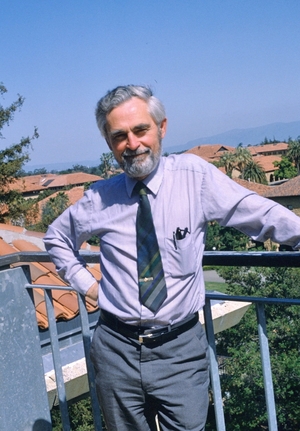
The name Bracewell holds a certain magic, invoking as it does the era when SETI was just beginning and speculations about extraterrestrial civilizations were getting wider circulation outside the science fiction magazines. Bracewell (1921-2007) was Australian by birth, acquiring degrees in mathematics and engineering and joining in work on World War II era radar. Following completion of a PhD in physics at Cambridge, he continued his work in the 1950s with a position as senior research officer at the Radiophysics Laboratory of the Commonwealth Scientific and Industrial Research Organisation (CSIRO).
Image: Ronald N. Bracewell, Stanford, CA, March 1983. Credit: NRAO/AUI Archives, Sullivan Collection. Located through Wikimedia Commons.
Bracewell came to the U.S. in 1954 to lecture on radio astronomy at UC-Berkeley before joining the Electrical Engineering department at Stanford University. His contributions to interferometry and the calibration of radiotelescope instruments to achieve breakthrough results are substantial, as a quick look through NASA’s Astrophysics Data System under his name reveals. I’ve noticed in scanning through this body of work that his interest in interstellar probes was persistent as he continued to contribute to the science of exoplanet discovery.
Nestled within the ADS results from 1960 is the unusual paper titled “Communications from Superior Galactic Communities,” which ran in Nature in 1960. In this early era, we had just had the famous paper from Giuseppe Cocconi and Philip Morrison (citation below) that is widely regarded as the beginning of modern attempts to find extraterrestrial civilizations. Given that this paper ran in Nature, which Bracewell obviously knew well because he was writing for it, we can assume that Cocconi and Morrison triggered his decision to write about the SETI question.
I call SETI a ‘question’ in this case because what struck Bracewell about it was its impracticability. Remember, at this same time, Frank Drake had begun planning (in 1959) for the project that would become Ozma, listening to Tau Ceti and Epsilon Eridani in 1960, and it’s evident that Cocconi and Morrison spurred the conference at Green Bank in 1961 that led to the creation of the famous Drake Equation. So we are witnessing western (as opposed to Soviet, with its somewhat different perspectives) SETI beginning to emerge, and it seemed to Bracewell that its approach was off-center.
This comes across in the “Communications from Superior Galactic Communities” paper loud and clear. Going through the suggestion from Cocconi and Morrison that 1420 MHz was the ‘waterhole’ frequency around which radio-using civilizations in search of an audience would gather, Bracewell then mentions Drake’s plans, and points out how unlikely it is that ETI would find us. After all, we were at that time looking for a radio beacon singling us out:
Let us assume that there are one thousand likely stars within the same range as the nearest superior community. This makes it hard for us to select the right one. Furthermore, if this advanced society is looking for us, we can only expect to find them expending such effort as they could afford to expend on the thousand likely stars within the same range of them. It does not seem likely that they would maintain a thousand transmitters at powers well above the megawatt estimated by Drake as a minimum for spanning only 10 light years, and run them for many years, and we could scarcely count on them paying special attention to us. Remember that throughout most of tho thousands of millions of years of the Earth’s existence such attention would have been fruitless.
The alternative? Send probes to nearby stars designed to attract the attention of technological beings on any planets there. It is indicative of the optimism of the early space era that Bracewell should describe interstellar flight as “…what we ourselves are now discussing and are on the point of doing, probably during this century…” We now look to the possibility of an interstellar probe by the end of this century, but the physics says the idea is doable.
Unlike SETI, where we cope with the inverse-square problem of attenuation of the signal, we would be talking about a probe within no more than a few minutes or hours of communications time from its target. Travel times are obviously lengthy, but with an eye toward science delivery for coming generations Bracewell suggests ‘swarm’ strategies that would deliver probes to perhaps the thousand stars near enough to us to be of interest. Each probe could quickly learn key facts about life and technology on these worlds.
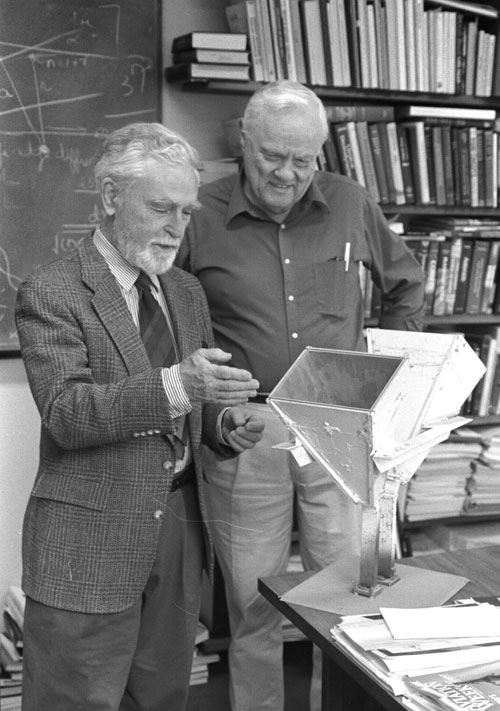
Image: Ronald Bracewell (left), with Stanford’s Von Eshleman, a major figure in early research into gravitational lensing. Here the two are examining the horn antennae that Bracewell used in 1969 to determine that the Sun is moving relative to the cosmic background radiation. Credit: Linda Cicero/Stanford University.
In 1974, Bracewell would investigate the prospect of a galactic ‘network’ of civilizations, one that we could perhaps join, but even here in 1960 he homes in on the idea. He imagines our world joining a perhaps galaxy-spanning ‘chain of communication,’ and thus dealing with civilizations that have been through the contact scenario many times on many worlds. These would, obviously, be superior technologies from which we could learn new science.
Bracewell’s probes, then, are designed for contact, and meant to be identified by ETI. He would expand these ideas in his 1974 book The Galactic Club: Intelligent Life in Outer Space. The version of this title most likely to be available in used book stores is the 1976 printing from the San Francisco Book Company, and it’s a good thing for any interstellar enthusiast to track down.
Here the method reminds us that not long after the time Bracewell was writing, Carl Sagan was negotiating with Russian astronomer Iosif S. Shklovskii to reprint the book that would become in its western edition Intelligent Life in the Universe (Holden-Day, 1966). The story of that collaboration is itself interesting, as Shklovskii didn’t realize Sagan would not just publish his book Universe, Life, Mind in the west, but would also heavily annotate it with his own brand of science popularization. That disharmony apart, Sagan’s awareness of Bracewell becomes apparent given the method of communications that ETI uses with Earth to announce their presence in the novel Contact, the re-broadcast of radio messages from our past.
Bracewell had suggested something similar, though using radio:
Such a probe may be here now, in our solar system, trying to make its presence known to us. For this purpose a radio transmitter would seem essential. On what wave-length would it transmit, and how should we decode its signal ? To ensure use of a wave-length that could both penetrate our ionosphere and be in a band certain to be in use, the probe could first listen for our signals and then repeat them back. To us, its signals would have the appearance of echoes having delays of seconds or minutes such as were reported thirty years ago by Størmer and van der Pol and never explained.
I don’t want to get caught up in the famous delayed-echo story of the 1920s, but the short version is that amateur radio operator Jørgen Hals observed echoes of a Dutch shortwave station in 1927 and took the matter to Norwegian physicist Carl Størmer and Dutch physicist Balthasar van der Pol. The echoes became the subject of work by Scottish writer Duncan Lunan, who explored them as possible signs of a Bracewell probe operating in the Solar System. The claim became controversial, to say the least, and has since been refuted, although Lunan continued to investigate it. And it is also true that long-delayed echoes have been attributed to various natural sources but remain enigmatic.
In any case, Bracewell advocated remaining alert to a possible interstellar origin for signals that are unusual, for the benefits of joining in an interstellar conversation would be immense. He calculated that even if there were few civilizations that outlived their adolescence (remember, this was in the Cold War era, with nuclear destruction always on our minds), there might still be a few that survived and went on to long lifetimes. The paper continues:
Presumably such an ancient association would be very able indeed technically, and might seek us out by special means that we cannot guess. Whether they would be interested in rudimentary societies which, in their experience, would usually have burnt themselves out before they could be located and reached, is hard to say. Such communities would be collapsing at the rate of two a year (103 in 500 years), and they might already have satisfied the!r curiosity by archreological inspection made at leisure on sites nearer home. On the other hand, the prospect of catching a technology near its peak might be a strong incentive for them to reach us.
Bracewell’s place in the early SETI literature, including Michael Hart and Frank Tipler, can’t be examined without bringing in John von Neumann, whose self-reproducing machines would likewise have spurred Bracewell’s imagination, though his own concept did not include this capability. I want to try to fit some of these pieces together and likewise bring back Sagan and Shklovskii in the next essay. What we’re juggling here is the very concept of what Sagan called ‘mediocrity,’ which he described as ‘the idea that we are not unique.’ Do we sometimes stretch our Copernican understanding of the cosmos too far?
The paper is Bracewell, “Communications from Superior Galactic Communities,” Nature Volume 186, Issue 4726 (1960), pp. 670-671. Abstract. The Cocconi & Morrison paper is “Searching for Interstellar Communications,” Nature 184 (4690) (1959), pp. 844–846. Full text.


The motivation to transmit overlaps that of sending probes and probes offer vastly more utility. However we name them, the probability of a space faring intelligence using probes can’t be ignored. There some important caveats to apply to the probability that a SFI would communicate to a discovered SFI.
If the emergence rate of SFI is low, they likely will be widely separated in time. As the first SFI ages, the value proposition of communicating will change. This first SFI will always be asking themselves when they should communicate.
The strategies and tactics of communicating blindly, without knowing who is out there, will be different than those for someone you know everything about. We can’t model the motivations and behavior of searching as equivalent to discovery.
Bracewell probes, or their more sinister-sounding equivalents today: Lurkers. They solve the 2-way communication latency by being both intelligent and local. They also do not give away their home system’s location for ETI (or us) if fearful of predatory species. Therefore, an intelligent probe, parked in a system, can monitor the planets and start communicating when ready, either by signaling the world or responding to a signal.
Clarke has a flyby probe that communicates with Earth as it flies through our system. A probe that is resident can communicate as long as it wants or needs.
Let’s consider civilizations that were once located within 1000 ly of Sol. Let us posit that their technology doesn’t manage more than 300 km/s. These are launched, but take from 10,000 years for stars 10 ly distant, to 1 million years if 1000 ly distant.
Yes, the probe will take a long time to reach us, but if robust enough, might last at least that long. Its slow velocity suggests that it will not likely suffer particle damage during its cruise. It can also slow down in the target system, protect itself by concealment. Powered by the star, its system could remain active even if its [altruistic sending civilization has long gone.]
A long-lasting civilization or its machinery could manufacture new probes at periodic intervals, updating the knowledge database. These probes could patiently wait for a civilization to arise, and signal a “hello” when it determines that the time has arrived to start a conversation. Its AI would have a long time to master the language [s] and culture[s] of the planet before deciding to interact with one or more culture.
As for choosing a communication frequency, it can use as few or many that it wants. If the civilization it wishes to communicate with has spaceflight and satellites, almost any wavelength can be used, perhaps using a common one alreday in use, or perhaps an unusual one that may make itself obvious by being unique.
Unlike distant radio beacons, such probes in the target system can do all the difficult work to make itself both detectable and understood.
Bottom line, it makes sense looking for such probes in our system. Unless they destroy themselves, even a non-functioning one would be interesting to discover. A conversation with a functioning one could be the discovery of the millennium.
would the 2001 monolith be considered a Bracewell probe?
@Scott
very tangentially. The original “Sentinel” story suggested it was a trigger that sent a message (warning?) to its makers that a technological, space-faring species had appeared.
The novel/movie version was similar, except that it sent the signal to Saturn/Jupiter. The monolith there was able to transport a human to the aliens for transcendence. This seems more than the idea of a Bracewell probe. That the monolith then destroyed Jupiter in Odyssey Two, including life in Jupiter, to help the Europans seems well beyond the purpose of a Bracewell probe. The interstellar flyby probe in “The Fountains of Paradise” was more the function of a Bracewell probe, although, like the Rama object (the original, not the Gentry Lee sequels), it came and went, rather than settled into the target system.
Yes, more of a lurker monolith and then a Von Neuman rapid reproducer to convert Jupiter into a star.
The best stance is probably spying, since giving info outright would be the least beneficial.
“Send probes to nearby stars designed to attract the attention of technological beings…”
I suspect that we (or any ETI doing the same) would or should be more cautious when sending probes. First study, and only proceed to attract attention if assessed risk or benefit meets some set of criteria.
Editorial note: “1420 mHz” should be 1420 MHz.
OP
Ron S
The concern has been that “shouting in the woods” indicates your location to a predator – now the “Dark Forest” hypothesis to explain the Fermi Paradox. This was also the fictional conundrum to be solved when a starship met an ETI starship and wanted to exchange some information without revealing their home systems. If the Pioneer probes with their images, including a location of Earth based on pulsar signals. (The pulsar Earth location image was part of Voyager’s Golden Record image set.) So that ship has sailed if any of these probes is found and understood by an ETI.
The SETI assumption of beacons, and even Benford’s hypothesis that a strong radio transient was a power beam, exposes the senders’ home system. (Also part of the plot of Greg B’s novel, “The Mote in God’s Eye.”)
The beauty of a Bracewell probe residing in the receiver’s system is that the probe’s home system location is obscured. (We never know the location of various SciFi movie aliens’ homeworlds. e.g., Independence Day, Arrival, The Day The Earth Stood Still.
Unless the probe wishes to reveal that directly or inadvertently, this information remains concealed. All the receiver knows is that another technological intelligence exists somewhere “out there”. The probe being local, probably an AI, can hold fast 2-way communications, with very low latency, depending on where it is located in that system, from orbiting the world with the intelligence, to orbiting passively in the outer system, perhaps in the equivalent of the Kuiper Belt (or a moon of Jupiter/Saturn, (with a stargate function *smile*)). It seems to me this solves the “Dark Forest” problem at a stroke. The trade off is the STL time for the probe to reach the target system and survive both that cruise time, managing to slow down and orbit within the target system, and perhaps survive the even longer periods while the civilization emerges and is technologically and culturally ready to communicate with the probe. If we had an SGL telescope, could we determine whether there was even a technological civilization on a distant world, and therefore, worth sending a probe. If we waited to detect some Industrial technology level indication for a civ 1000 ly distant, it would already be a millennium later to receive that information, and how long for our probe to reach them? If all we know is that life is present, it could be millions or even billions of years before the civ appeared, and then how many millennia before it was ready to converse with the probe? On our current needed time frame, a 2-way communication with a civ 1000 ly distant is not useful, almost begging for the fastest probe to reach the civ and communicate within their system with all the risks on our respective worlds about having revealed our locations for potential destruction. This is the plot of Cixin Liu’s “Remembrance of Earth’s Past trilogy.
A slow probe of several hundred km/s cruise velocity would seem too slow to be useful without the appropriate lead time for launch, perhaps requiring periodic launches, or a fast fractional c cruise velocity, but with no means to slow down. This might be best done with a long string of flyby probes that can communicate with each other so that communication with the target world can be maintained by the many probes as they enter and exit the system within hours or days of each other. (I am assuming that FTL travel or communication is not physically possible…ever.)
I agree, best look and listen before shouting out !
I would make an awkward pet !
So Bracewell long ago addressed a problem often ignored in discussing the search for signals, not how long could a signal be sent but how long would a the resources be spent over over millions of years to send powerful signals?
We have had at least one post on CD about reducing those beaming costs in various ways. One proposal is not to use beacons, but directed beams that are effectively transients for each target system. Short bursts are sent periodically to each target before repeating the signal at the next target system. The cycle period for each system, the length of the signal, and the lower the dispersion of the signal, all reduce the costs. Powered by renewable energy and placed in orbit or a protected location to reduce maintenance costs, helps to reduce costs.
One way to improve the low dispersion is to use a star’s gravity lens to send a beam, the sort of technology that allows a tine transmitter to send signals from the Alpha Centauri stars back to Earth. The downside is that the transmitter may have to be set to do this for a single star or a few stars that are visually close. This may mean a lot of transmitters are needed. If I am correct, Bracewell would not have been able to access these proposals to reduce signaling costs.
Hi Paul
Lunan’s more recent work on the LDE “message” that you allude to is discussed on his webpage here: EPSILON BOÖTIS REVISITED. He highlights some strange Galactic alignments in several ancient sites. If the suggested timeframe is correct, the ETI’s have been here at least 13,000 years. The question is: Where are They now?
@Adam
Lunan is the writer of articles explaining the background on the Jeff Hawk stories in the republished strips by the Jeff Hawke Club. Many of these stories were a mix of contemporary technology of the time, with ancient myths, Biblical stories, etc. Lunan was able to weave these components together in the articles, mixing facts with speculation. This was definitely his oeuvre, but it is well to regard the speculations as fictional, as the strips were.
[Note, I am a Jeff Hawke fan and was an avid reader, [and collector] of the strips when they were published in the UK’s Daily Express, and own most of the republished Jeff Hawke strips, especially those when Willie Patterson was the writer, and Sydney Jordan stuck to the artwork of the stories. The development of the space technology illustrations mirrored the conceptions of the changing times even though most of the stories seemed to be centered around the year 1989!]
Hi Alex
Your “Jeff Hawke” collection sounds bigger than mine. Lunan’s book “New Worlds for Old” was my introduction to the series. I’ve read what I can, but they’re hard to get. At least in English.
Lunan knows his limitations as a writer/researcher and genuinely collaborates with experts. Not that it’s not speculative – of course it is, but so is everything in SETA.
Back in the early 1990s, I was staying with relatives outside Venice, and was astonished to see the Jeff Hawke stories in Italian in a village bookstore. It wasn’t until I discovered the English versions being newly published this century. that I was able to build my collection. Earlier, I had extracted and printed favorite stories from the online Daily Express collection, a tedious process.
Recent articles on Centauri Dreams have discussed Breakthrough Starshot. Probes launched by Breakthrough Starshot could function as Bracewell Probes for other stellar systems. These probes are designed as small, high-speed flybys that would likely communicate with their launch point through multiple probe chains. This rationale for Breakthrough Starshot may also be applicable to probes deployed by extraterrestrial intelligences (ETI).
This suggests that, if Bracewell Probes were ever sent to our stellar system, it is unlikely that only one or two large, slow probes would be deployed. Instead, tens of thousands, or possibly even 100,000, smaller probes might traverse a given target stellar system.
Such probes would likely be too small and fast to be detected with current or near-future technology. They would probably utilize tightly focused laser beams to relay information back to their originating launch point, rendering their communications similarly undetectable. Deploying a sufficient number of probes could address the most significant scientific questions.
The primary challenges in this scenario are timing and distance. A critical question is whether a swarm of Bracewell Probes would transit our stellar system during the period when an advanced civilization exists. It may be feasible to initially send a swarm of several thousand probes to promising systems and, if the findings warrant further investigation, subsequently dispatch a nearly continuous stream of additional probes.
FYI, multiple copies of Bracewell’s The Galactic Club: Intelligent Life in Outer Space are available for free reading on Internet Archive.
As I read through Bracewell’s book, this paragraph caught my eye, both for its optimism and (near the end) its somber, and understated admission:
“When the first technical life is discovered, decades will elapse before the [Bracewell] probe’s report filters back. In addition, we have to consider the travel time of the probe to the star’s environs. Depending upon the size of engine the probe uses, the travel time could be kept down to centuries or even decades. But a community that is prepared to wait it out for 1,000 years does not need to hurry. Perhaps 10,000 years travel time would be reasonable; it depends on a trade-off involving reliability in transit, cost per unit, number of launches per annum that can be afforded within the budget allocation, and the maximization of the probability of success. This is indeed a long-term project! (By the way, note that interruption of the launch program does not affect the chances of success of probes already launched; the plan is tolerant of diversion of resources to urgent priorities.) Of course, the human life span being what it is, we are reluctant to contemplate programs that stretch over centuries; we have to realize that interstellar contact is not a contact between individuals, but a contact between civilizations. This is a slightly depressing thought for action-oriented people. The arrival of a probe would be exciting. Nonetheless, the individual who directs the launching, be it a probe or a radio signal, has to face the reality that it will not be he who receives the answer.”
. . . And that, it seems, is the rub. Granted, when Bracewell wrote this book more than half a century ago, there was little discussion or consideration of what has since become an active topic, i.e., the lifespan of technological civilizations. But given the track record for human civilizations, it is a sobering–if not “disquieting”–thought that industrialized ones have existed only for a few centuries, and the prospect of any one of them surviving, let alone enduring, for, say, several millennia seems almost impossible to contemplate.
It does make me wonder what factor(s) would motivate members of a technologically advanced civilization to dispatch scores or even thousands of Bracewell-type probes into the far-flung reaches of space without any certainty that their descendants would be around to receive any messages from those probes. Is the motivation akin to placing a message inside a bottle and tossing it into the ocean in the hope that someone might find it someday? Is it the expression of an aspiration that it might result in being able to initiate a conversation with another, comparably advanced, civilization? Or is simply instead a poignant way of announcing, to anyone who might be out there, “Hello and sorry, folks–this is from who we used to be, but we’ll be long gone by the time you find this?”
The short lifetime is a problem for us in the contemporary world. But there are ways (if possible) around this for biologicals:
1. Cryosleep, just as for STL starflight.
2. Brain uploading.
However, if we consider a robot civilization, “lifetimes” can be arbitrarily long, with physical repair or brain transfer to new bodies.
I suspect even the tesla robots could do these journeys if there was expandable memory/CPU modules with say a connection to the main CPU. Software can be transmitted easy enough and once in the target system these robots can go about making drive systems to slow down the incoming crafts.
@Michael
Are Tesla’s Optimus robots real, or still just telechiric “smoke and mirrors”?
But conceptually, I think we are getting closer to the time when actual robots can make these journeys. They needn’t be more than software brains and instructions to print new bodies, adding in the microelectronic chips so that they arrive with shiny new bodies. Getting the needed matter to decelerate is still a problem, although less so for a slow ship and a long journey time.
Planting trees for future generations
The expense of probes is potentially low enough that even a space faring intelligence uncertain of its future could still decide the investment was worthwhile. As well, investing in the future dmay increase the odds of reaching the future.
Perhaps the most general advantage of probes versus transmitting is the path to a positive return on investment. A transmitting SFI is completely dependent on the receiver for any RoI. Transmitting to an interesting star system that lacks an SFI or a system with a recalcitrant SFI yields no RoI, while every system reach by a probe does.
@Harold
In addition, a probe could act as a digital archive to disgorge its treasures when eventually found by an emergent culture. A local copy of an encyclopedia to open its treasure of information to a future intelligent species (an extreme form of the Voyager Golden Record).
If the probe could provide the means to replicate itself so that the receiving culture could add its own information to the store, then in a Von Neumann-like way, the probes could fill the galaxy, acquiring new encyclopedias. Over millions of years, the information of many civilizations could be collected and made available.
If we are the first in this galaxy, then, once we have teh technology, we should initiate such a program for the future.
“RoI”
An interesting choice. What, exactly, is an actual ROI for the investing civilization to reach out in this way? That isn’t at all clear to me.
I don’t mean some vague magnanimous gesture or an attempt to establish a ‘legacy’ or feel less alone, since those are extraordinary speculative and unlikely. What is the concrete expected ROI, with the understanding that any venture, including this one, also entails risk?
Value is subjective. The concept of return on investment is value agnostic. RoI can be negative. Without any pedantry; magnanimous gestures, establishing a legacy, and feeling less alone qualify as RoI. Would you consider the data returned by any of the missions exploring our solar system a worthwhile return on investment? Probe missions to other systems would provide at least the same return. Any space faring intelligence will have culture, science, history and technology. How each of us values that wealth is subjective.
What would you consider a concrete RoI?
You answered a question with another question. I have no response to that!
“Value is subjective.”
The return is subjective, yet the investment is objective. I suspect you’ve never developed a business plan.
“…any of the missions exploring our solar system a worthwhile return on investment?”
ROI is the wrong metric for cases such as this. That’s what troubled me about your use of the term. I have no objective benefit (return) to propose to make an ROI calculation possible. Do you?
Alex: I suppose by referring to my paper about power beam being of the source of transient transient, such as the wild signal you mean this paper: “Power Beaming Leakage Radiation as a SETI Observable”, James Benford and Dominic Benford, ApJ, pg. 825, 101 (2016).
And the book The Mote in God’s Eye was not written by my twin brother Gregory Benford. It was written by Larry Niven and Jerry Pournelle.
It seems like a safe guess that any civilization able to send out Bracewell probes would also be able to build some sort of detector (e.g. huge telescope array) in its home system to identify planets with life, and possibly ones with primitive industrial development. Then it wouldn’t have to signal or send probes blindly, but only study or attempt to contact worlds with a reasonable chance of being worth the trouble.
I still half suspect the 1972 Teton Event fireball was a Bracewell.
Sabine H. and others are more open to UAPs….especially those from pre-Sputnik astronomy photographs
https://m.youtube.com/watch?v=lYVxRHk258g
Bracewell, Lurker—whatever….any space probe is likely old and perhaps defective.
A trip to one would likely resemble the ARM mission, or if there is one farther behind the Moon than Apollo craft could reach it might resemble Artemis II….hey….wait a minute.
“Shh! Hoagland or Loeb might hear!”
SLS…when you absolutely positively must make contact—accept no substitutes!
A highly speculative subject. Placing probes while repeating our own radio signals seems unlikely to me because it would not be a strategy that goes to economy : if an ETI was capable of this and wanted to make itself known, it would use something more simple to signal to us like a direct radio or light signal, clearly identifiable, repetitive, unusual, which would captures our attention ; the human species is curious. Unless the ETI doesn’t want to make us panic (in this case, they must really have dirty face :) I don’t think an ETI would like to play riddles…
I really like too the idea that Bracewell probes could cross stellar systems but that civilizations should be present at the time of their crossings… which, as always, offers a nice piece of randomness that makes the magic of the universe.
@fred
Without FTL imaging and flight, this would be limited by the density of civilizations in time and space, which is both a feature of emergence and longevity.
A bad case scenario. There are 2 civilizations at opposite sides of the galaxy, say 100,000 ly apart. Just to receive light from the civilization means that it is already seeing that civilization 100,000 years ago. Now send a probe at light speed to that civilization. It is now 200,000 years later than the first images/video were received. Can any civilization be sure to be around for that length of time? This would seem to require the 2 civilizations to be much closer, which means either chance created that situation, or civilization density is much higher.
If the STL velocity of the probe is just 0.1c, then the separation in time is now extended from 2x to 11x the distance in light-years. In the above example, about 1,100,000 years. A civilization would have had to catch images of a very early hominid, perhaps H. erectus, and hope that they guessed it would become a hi-tech civilization by the time the probe arrived and not disappear in the meantime. This seems a stretch for planning. One’s own civilization might have been long gone by the time the probe arrives at the target world a million years later.
Even if we collapse the distance to just 1000 ly, the interval is now 11,000 years, about as long as [dated] human history from the earliest fixed settlements. If we sent a 0.1c Bracewell-type probe today, would we care about the target civilization in 10,000 years? At the same time, we are deciding on whether to send a probe[s] today, or wait for a faster probe[s] to be developed that would arrive earlier.
While I admit I am biased, I think it makes a lot more sense to send observation and laboratory probes to target worlds once we can determine a certain level of life has emerged. Genetic evolution being much slower than cultural, these probes could be sent to observe certain stages of evolution. Even the most distant living worlds would be usefully observable
Due to the problem of latency when restricted to a velocity of c, it seems to me that the best approach to be able to use Bracewell probes for eventual communication is to seed the galaxy with probes in the HZ of all suitable systems. While the homeworld civilization might disappear, long-lived Bracewell probes could wait for a civilization to emerge and communicate with it when suitable conditions were triggered.
Almost science-fiction like technology is here.
The so-called
Ghost Murmur
What might multi-millennia of progress achieve?
@Robin
It is almost the reverse of British RAF pilots in WWII, saying that their night vision was enhanced by eating carrots. It was teh cover story for the actual development of radar to detect the German bombers at night.
In this case, any actual technology was likely more prosaic, and the military may have wanted to obscure which technology and possible radio frequencies were used that could be used to locate the signal source. Again, like both Allies and Axis powers in WWII, using detectors to locate enemy spy transmissions. Hinting at some super-advanced technology would put the enemy off the approach to locate the downed pilot. If Trump repeated it, he doesn’t know anything. That has been very clear from various prior statements about technology (also, c.f. COVID-19 treatments) that were utter nonsense.