
An Antimatter-Driven Sail to the Kuiper Belt

by | Oct 20, 2004 | Antimatter

NASA’s Institute for Advanced Concepts is in the midst of its 6th annual meeting, at the Grand Hyatt in Seattle. For interstellar theorists, the chief attraction this time around is Steve Howe’s presentation “Antimatter Driven Sail for Deep Space Missions.” The co-founder and chief executive officer of Hbar Technologies, LLC based in Chicago, Howe has devised a Kuiper Belt mission using a uranium-infused sail that would be driven by a cloud of anti-hydrogen released from the spacecraft.
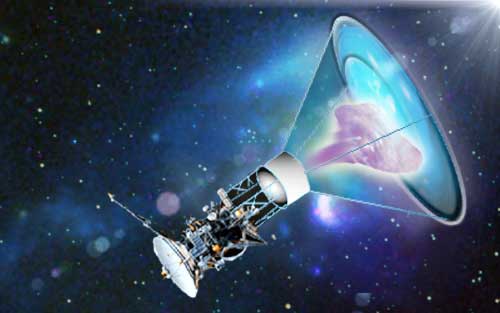
Howe\'s antimatter sail

Left: A cloud of anti-hydrogen drifts towards the uranium-infused sail. CREDIT: Hbar Technologies, LLC/Elizabeth Lagana

Sails and nuclear reactions have been paired before; in particular, in Johndale Solem’s Project Minerva, which posited setting off a nuclear explosion behind the sail to drive a spacecraft. Howe’s idea was to use nano-explosions on the sail itself. The sail would be a mixture of graphite and a new carbon-fiber material commonly known as carbon-carbon fused together, with tiny amounts of uranium impregnated in the material. And rather than a kilometers-wide sail, the energies released in this design mean that Howe can get away with a sail as small as five meters in diameter.

When I talked to Howe about the antimatter sail last year, he explained how the antimatter cloud would reach the sail surface: “The idea here is that you don’t need to give much energy, if any, to the anti-protons,” Howe said. “All they have to do is drift across and hit the sail with almost zero speed. They will find the uranium and cause it to fission. You don’t have to have accelerators to boost the antimatter pellets up to speed; you just release them and they more or less evaporate. And by the time cloud reaches the sail, it’s distributed across the diameter of the sail.”

The antimatter reacts with the uranium to produce neutrons and various secondary emissions, fission fragments that leave the sail at enormous speeds. The push is essentially a nuclear-stimulated ablation, which is what NASA’s John Cole described it as when I talked to him about Howe’s idea at Marshall Space Flight Center.

Cole sees real possibilities in Howe’s work. “The specific power there is something on the order of 2000 kilowatts per kilogram, which is the highest I’ve ever seen. If we can get ten kilowatts per kilogram, we can have human missions to the outer planets, with round trip times of two or three years. And,” Cole continued, “2000 kilowatts per kilogram is just enormous. So even if Howe is an order of magnitude off, even two orders of magnitude off, a factor of 100, he is still in the realm of where we can have human exploration of the outer planets.”

As for interstellar work, the challenge is to create and store enough antimatter. 30 milligrams of the stuff would seem to suffice for a Kuiper Belt mission, but Alpha Centauri would call for tens of grams. That’s not possible today, but high-capacity storage of antimatter is under intense study at Marshall Space Flight Center and other venues.

Howe’s continuing work on the antimatter sail has received Phase II NIAC funding. You can read more about the concept in the Hbar Technologies propulsion pages.

0 Comments

Trackbacks/Pingbacks

  1. Centauri Dreams » Blog Archive » Harvesting Antimatter in Space - [...] Jackson’s is a familiar name. He and Steve Howe at Hbar are well known in the antimatter community as…
  2. Centauri Dreams » Blog Archive » Hunting Antimatter High Above Antarctica - [...] Centauri Dreams‘ take: the more we learn about antimatter, whether from primeval black holes or accelerators, the closer we’ll…
  3. Centauri Dreams » Blog Archive » Antimatter’s Advantages (and the Catch) - [...] Now we’re getting somewhere — $10 million per milligram is more cost effective than chemical propulsion given the huge…
  4. Centauri Dreams » Blog Archive » The Positronium Surprise - [...] We’re a long way from knowing how to put antimatter to work in starship engines, but developments in this…
  5. Centauri Dreams » Blog Archive » Nudging Antimatter Toward Practicality - [...] a layer of uranium-235. Howe talks about velocities of well over 100 kilometers per second (see An Antimatter-Driven Sail…
  6. Centauri Dreams » Blog Archive » Harvesting Antimatter in Space - [...] concept that would be energized by minute amounts of antihydrogen (see this earlier Centauri Dreams story). Jackson’s new work…
  7. Centauri Dreams » Blog Archive » The Interstellar Conundrum Reconsidered - [...] of the stuff for some time to come. Even so, interesting mission concepts, like Steve Howe’s antimatter-energized sail, have…
  8. Centauri Dreams » Blog Archive » Earth-mass Exoplanets and Their Uses - [...] look into the possibilities of antimatter through near-term technologies like Steve Howe’s antimatter catalyzed sail. And, of course, we…
  9. Centauri Dreams » Blog Archive » Notes & Queries 2/23/09 - [...] on antimatter harvesting in space and, along with Steve Howe, has been a proponent of the hybrid antimatter/fission sail…
  10. Centauri Dreams » Blog Archive » Enceladus Plumes Recall Project Orion - [...] but we can hope that research in areas like antimatter-initiated microfusion or Steve Howe’s antimatter sail may eventually get…
  11. Relativistic Rockets, Antimatter and More - [...] of antimatter, though, tiny quantities could be put to work in projects like Steven Howe’s antimatter sail, which would…
  12. Antimatter Source Near the Earth - [...] question is whether there may be enough antimatter here for hybrid missions like Steven Howe’s antimatter sail, which uses…

Now Reading

Charter

In Centauri Dreams, Paul Gilster looks at peer-reviewed research on deep space exploration, with an eye toward interstellar possibilities. For many years this site coordinated its efforts with the Tau Zero Foundation. It now serves as an independent forum for deep space news and ideas. In the logo above, the leftmost star is Alpha Centauri, a triple system closer than any other star, and a primary target for early interstellar probes. To its right is Beta Centauri (not a part of the Alpha Centauri system), with Beta, Gamma, Delta and Epsilon Crucis, stars in the Southern Cross, visible at the far right (image courtesy of Marco Lorenzi).

Recent Posts

On Comments

If you'd like to submit a comment for possible publication on Centauri Dreams, I will be glad to consider it. The primary criterion is that comments contribute meaningfully to the debate. Among other criteria for selection: Comments must be on topic, directly related to the post in question, must use appropriate language, and must not be abusive to others. Civility counts. In addition, a valid email address is required for a comment to be considered. Centauri Dreams is emphatically not a soapbox for political or religious views submitted by individuals or organizations. Human comments only, please -- cut and paste from AI will not be acceptable. A long form of the policy can be viewed on the Administrative page. The short form is this: If your comment is not on topic and respectful to others, I'm probably not going to run it.


Advanced Propulsion Research

Beginning and End

Archives