
It’s a pleasure to see that Cosmic Search is now accessible on the Internet. Appearing first in 1979, this magazine devoted solely to SETI was well ahead of its time, trying to generate interest in a popular audience that had not yet become familiar with the concepts driving the search for life in the universe. In those days long before SETI@Home, I learned about Cosmic Search through the Society of Amateur Radio Astronomers, a group I had joined in the mistaken belief that I had could create my own receiving station and do interesting science.
That hope was never realized, a victim of my clumsiness with hardware, and I contented myself with reading and learning. Cosmic Search was a true gift, covering the range of SETI investigations and stuffed with reading from the likes of Philip Morrison, Frank Drake, Ronald Bracewell and many other familiar names. Go to the site, where you can scroll through the listings and see for yourself how SETI looked 25 years ago.
Cosmic Search will always be linked with the name of John Kraus, who designed and built Ohio State’s University Radio Observatory, known by the nickname ‘Big Ear.’ Kraus was able to supply the needed funds to get the magazine launched but the hoped for sales never materialized, and his creation expired after only thirteen issues. My own set is here in the office, tucked behind a run of late 1930s issues of Astounding, but now that the originals are so hard to find, I hope this archive will open the magazine to new readers who will benefit from its still timely thinking.
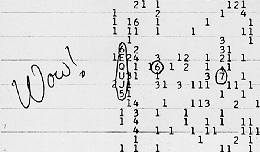
And a special word of thanks to Jerry Ehman, the Big Ear volunteer who put together the data files from scans of the originals. SETI buffs will recognize Ehman as the man who scribbled ‘Wow!’ on a printout from the Big Ear’s August 15, 1977 observations. The ‘Wow!’ signal was never repeated, and today Ehman believes that it was probably the result of terrestrial interference, but for just a while researchers pondered the possibility of an extraterrestrial signal from the direction of Sagittarius — that’s toward the galactic core — and at Ohio State’s pioneering observatory, all things seemed possible.

That must have been an incredible experience. I can only imagine the excitement at that university when they fought they discovered intelligent alien life.
You can read more about the ‘Wow!’ signal here:
http://www.seti.net/SETINet/Archive/RA19/WOW/wow.htm
Radio amateur James Brown has set up a new SETI search in the same region of Sagittarius.
I would like to correct the link to my web site. It is:
http://www.seti.net/html/SETINet/Archive/RA19/WOW/wow.htm
SETI Net is now operating 7 X 24 (or as much as I can manage) and is currently scanning the Habitable Stars at the Waterhole frequencies.
Regards…… Jim