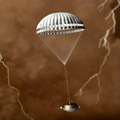
 The European Space Agency offers an outstanding animation showing the stages of Huygens’ descent to Titan’s surface tomorrow. Also available is an animation of the view from Cassini during the Huygens’ descent. Some interesting facts about the event:
Huygens’ atmospheric entry angle is a whopping 65° at a velocity of six kilometers per second, with touchdown planned for the daylight side in the southern hemisphere. The probe will pull 14g during deceleration.
The thermal shield will slow the probe to 400 meters per second within three minutes. Next comes deployment of a 2.6-meter pilot chute at 160 kilometers altitude. Within seconds, the pilot chute will pull off the probe’s aft cover; the main parachute (8.3 meters) will then deploy before the front shield is released.
At 110 kilometers, the main chute will be jettisoned; a smaller, 3-meter chute will then be deployed.
The DISR instrument (Descent Imager/Spectral Radiometer) will switch on its lamp for surface illumination and spectral analysis at several hundred meters altitude. Landing speed is 5 meters per second.
We are 20 hours away from Huygens descent as this is posted. A Huygens timeline is here (times listed are Central European — think UTC plus 1). ESA also offers a live Webcam covering Huygens and Cassini events from the European Space Agency Operations Center (ESOC) in Darmstadt. And you can take a virtual tour of ESOC that gives a glimpse of where the action will be during the Cassini/Huygens events tomorrow.
Image Credit: European Space Agency.


0 Comments