
When you hear the word ‘baryon,’ you can think of neutrons and protons, though the term really covers any subatomic particles that use the strong nuclear force for their interactions. We know a surprising amount about baryons in the early universe, including the fact that a large fraction of their number — almost half — cannot be accounted for by current theory. What happened to the missing baryons?
A paper in the February 2005 issue of Nature may shed some light on the matter. Using computer simulations of galaxy formation, Fabrizio Nicastro of the Harvard-Smithsonian Center for Astrophysics and colleagues write that the baryons could well be contained in ‘warm-hot intergalactic matter’ (WHIM), clouds of gas out of which galaxies and galactic clusters first formed.
This work was based on observations made by the Chandra X-ray satellite on the quasar Markarian 421 (located in Ursa Major, the Big Dipper). A key player in these investigations was Ohio State associate professor of astronomy Smita Mathur, who gathered the first evidence about the composition of the gas. Markarian 421 was the light source Mathur needed to analyze the clouds — its light shone directly through them. This allowed the team to take X-ray spectra of the gas that produced the new findings.
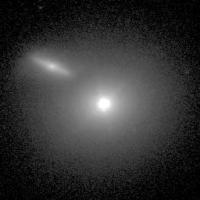 Have we really found the missing baryons? The spectrum says yes. “”This is such a wonderful spectrum that there is just no doubt about it,” Mathur said. Made of carbon, nitrogen, oxygen and neon, the clouds maintain a temperature near 1 million degrees Celsius in a band some 2 million light years thick.
Image: The active galaxy Markarian 421, one of the brightest quasars known. Credit: Aimo Sillanpaa (Nordic Optical Telescope).
Factoring such clouds into new estimates of the baryon count proves consistent with the missing baryon puzzle. So the baryons seem to be out there, only in a gas that is so hot that it shines in high-energy X-rays instead of visible light, making it impossible to see with optical telescopes. Left unanswered is the question of how the baryons got to be where they are. The current candidate: dark matter, which some believe provides a kind of gravitational structure into which normal matter flows on a galactic scale.
The Nature paper is Nicastro, Zezas, Mathur et al, “The far-ultraviolet signature of the ‘missing’ baryons in the Local Group of galaxies.” Nature 421 (13 Feb 2003) 719 – 721.

0 Comments