
What can you do with 1600 detectors spread out over 3000 kilometers surrounded by an array of 24 telescopes? If you’re in Argentina’s Mendoza Province, the answer is that you can witness the arrival of high-energy cosmic rays. The ‘Cherenkov’ detectors, each containing 3000 gallons of water, detect the passage of the particles while the telescopes examine the ultraviolet fluorescence produced by their arrival in the atmosphere. The detector array covers an area roughly the size of Rhode Island.
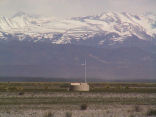 All this is occurring at the Pierre Auger Observatory, just east of the Andes on the Argentine Pampas. Auger was the first scientist to observe the interactions between Earth’s atmosphere and cosmic rays back in 1938. The observatory named for him draws on the talent of 60 institutions in 16 countries. The presentation of the first physics results from the site took place this week in the Argentine town of Malargüe.
Image: The Andes Mountains form a snow-capped backdrop to the west of the detector array. Credit: Pierre Auger Observatory.
A news release from the Particle Physics and Astronomy Research Council (UK) synopsizes the recent work. Centauri Dreams sees more questions than answers in these studies. For one thing, we still need to learn much more about ‘primaries,’ those cosmic ray particles that strike Earth’s atmosphere first. What happens afterward is a series of collisions with air molecules that produces a particle cascade. But is the primary a proton, an atomic nucleus or a photon? Learning more about primaries should help us investigate the origins of these mysterious energy outbursts.
And perhaps they’ll lead in even more intriguing directions. From the release:
These exotic theories include hypothetical objects left over from the Big Bang, called topological defects, such as “cosmic strings,” “domain walls,” and “monopoles.” If these hypothetical phenomena existed, and then collapsed, their collapses could produce enough energy to create very high-energy cosmic rays. If so, then a certain fraction of cosmic rays would consist of photons. So far, the data is not extensive enough to prove or disprove any of these phenomena. But enlarging the data set over time will help Auger scientists narrow down the many different theories of cosmic ray origin.
Usefully, low-energy cosmic rays are more affected by galactic magnetic fields than their high-energy counterparts. This sets up the possibility of using the imbalance to track back to a point source in the sky, always one of the most difficult challenges of cosmic ray research. We are a long way from resolving the enigma of cosmic rays, but the same collaboration that funded Auger is now working to establish a northern hemisphere equivalent, probably to be situated in southeastern Colorado.



Hi my name is Samantha smith and I attend Malverne high school as a freshman. I am doing a project on cosmic rays and was wondering if u could give me pointers 2 how I should go about this project. I am stuck on how I should detect cosmic rays and unsure of what my question she be. I am in a science research class which I applied for extra credit for college and right now I am not doing so well in that class, and would appreciate if u can help me with this topic.
Yours truly
Samantha smith
I hope someone with some cosmic ray expertise can help Samantha out with her project. Any thoughts on good Web sites or other sources of information would be very welcome as we bring a future astronomer online. One quick reference source that provides links to ongoing projects, Samantha, is this:
http://en.wikipedia.org/wiki/Cosmic_ray
All best wishes with your project.