
Habitable zones are always easy enough to explain when you invoke the ‘Goldilocks’ principle, but every time I talk about these matters there’s always someone who wants to know how we can speak about places being ‘not too hot, not too cold, but just right.’ After all, we’re a sample of one, and why shouldn’t there be living creatures beneath icy ocean crusts or on worlds hotter than we could tolerate? I always point out that we have to work with what we know, that water and carbon-based life are what we’re likely to be able to detect, and that we need to fund the missions to find it.
The last word on habitable zone models has for years been Kasting, Whitmire and Reynolds on “Habitable Zones around Main Sequence Stars.” Now Ravi Kopparapu (Penn State) has worked with Kasting and a team of researchers to tune-up the older model, giving us new boundaries based on more recent insights into how water and carbon dioxide absorb light. Both models work with well defined boundaries, the inner edge of the habitable zone being determined by a ‘moist greenhouse effect,’ where the stratosphere becomes saturated by water and hydrogen begins to escape into space.
The outer boundary is defined by the ‘maximum greenhouse limit,’ where the greenhouse effect fails as CO2 begins to condense out of the atmosphere and the surface becomes too cold for liquid water. When worked out for our own Solar System in terms of astronomical units, the 1993 model showed the habitable zone parameters extending from 0.95 to 1.67 AU. Earth was thus near the inner edge.
The new model improves the climate model and works out revised estimates for the habitable zones around not just Sun-like G-class stars but F, K and M stars as well. The definition uses atmospheric databases called HITRAN (high-resolution transmission molecular absorption) and HITEMP (high-temperature spectroscopic absorption parameters) that characterize planetary atmospheres in light of how both carbon dioxide and water are absorbed. The revision of these databases allows the authors to move the HZ boundaries further out from their stars than they were before.
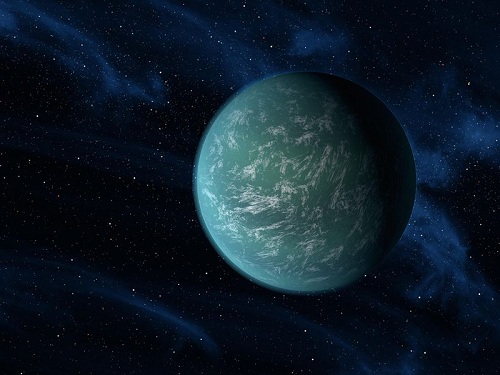
Image: An artist’s conception of Kepler-22b, once thought to be positioned in its star’s habitable zone. New work on habitable zones suggests the planet is actually too hot to be habitable. Credit: NASA/Ames/JPL-Caltech.
This looks to be an important revision, one that people like Rory Barnes (University of Washington) are already calling ‘the new gold standard for the habitable zone’ (see Earth and others lose status as Goldilocks worlds) in New Scientist. In Solar System terms, the limits now become 0.99 AU and 1.70 AU. We see that the Earth moves closer to the inner edge of the habitable zone, causing the authors to comment about an important part of their analysis, that it does not factor in the effect of clouds:
…this apparent instability is deceptive, because the calculations do not take into account the likely increase in Earth’s albedo that would be caused by water clouds on a warmer Earth. Furthermore, these calculations assume a fully saturated troposphere that maximizes the greenhouse e?ect. For both reasons, it is likely that the actual HZ inner edge is closer to the Sun than our moist greenhouse limit indicates. Note that the moist greenhouse in our model occurs at a surface temperature of 340 K. The current average surface temperature of the Earth is only 288 K. Even a modest (5-10 degree) increase in the current surface temperature could have devastating a?ects on the habitability of Earth from a human standpoint. Consequently, though we identify the moist greenhouse limit as the inner edge of the habitable zone, habitable conditions for humans could disappear well before Earth reaches this limit.
While the small change to the Earth’s position in the habitable zone is getting most of the press attention, I’m more interested in what the new numbers say about M-dwarfs. These small red stars would have habitable zones close enough to the star that the likelihood of a transit increases. The 1993 habitable zone work did not model M-dwarfs with effective temperatures lower than 3700 K whereas the new work takes effective temperatures down to 2600 K. In an article run by NBC News, Abel Mendez (University of Puerto Rico at Arecibo) mentions that Gliese 581d, thought to skirt the outer limits of its star’s habitable zone, may now move toward the habitable zone’s center, increasing the possibility of life emerging there. Other planets catalogued by the Planetary Habitability Laboratory at UPR will be affected as some thought to have been in the habitable zone may move out of it. See A New Habitable Zone for more.
There are other factors to consider about M-dwarfs, especially the fact that planets close enough to these stars to be in the habitable zone are most likely tidally locked, presenting the same face to the star at all times. Neither the 1993 model or this revised one does well at representing a tidally locked world and the authors say they have not tried to explore synchronously rotating planets in different parts of the habitable zone around M-dwarfs. The paper does note that a planet near the outer edge of the HZ with a dense CO2 atmosphere should be more effective at moving heat to the night side, perhaps increasing the chances of habitability.
The overall effect of adjusting our parameters for habitable zones around the various stellar classes will be to improve our accuracy as we look toward producing lists of targets for future space-based observatories. The authors note that the James Webb Space Telescope, for example, is thought to be marginally capable of taking a transit spectrum of an Earth-like planet orbiting an M-dwarf. We’ll need the maximum chance for success before committing resources to specific planets once we get into the business of trying to identify biomarkers on possibly habitable worlds.
The paper is Kopparapu et al., “Habitable Zones Around Main-Sequence Stars: New Estimates,” accepted at the The Astrophysical Journal (preprint). Note that a habitable zone calculator based on this work is available online. The 1993 paper is Kasting, Whitmire and Reynolds, “Habitable Zones around Main Sequence Stars,” Icarus 101 (1993), pp. 108-128 (full text).

49 Comments
Trackbacks/Pingbacks