
We all relate to the awe that views of distant galaxies inspire. It’s first of all the sheer size of things that leaves us speechless, the vast numbers of stars involved, the fact that galaxies themselves exist in their hundreds of billions. But there is an even greater awe that envelops everything from our Solar System to the most distant quasar. That’s the question of the ultimate fate of things.
Nobody writes about this better than Fred Adams and Greg Laughlin in their seminal The Five Ages of the Universe (Free Press, 2000), whose publication came just after the 1998 findings of Saul Perlmutter, Brian Schmidt and Adam Riess (working in two separate teams) that the expansion of the universe not only persists but is accelerating. The subtitle of the book by Adams and Laughlin captures the essence of this awe: “Inside the Physics of Eternity.”
I read The Five Ages of the Universe just after it came out and was both spellbound and horrified. If we live in what the authors call the ‘Stelliferous era,’ imagine what happens as the stars begin to die, even the fantastically long-lived red dwarfs. Here time extends beyond our comprehension, for this era is assumed to last perhaps 100 trillion years, leaving only neutron stars, white dwarfs and black holes. A ‘Degenerate Era’ follows, and now we can only think in terms of math, with this era concluding after 1040 years. By the end of this, galactic structure has fallen apart in a cosmos littered with black holes.
Eventual proton decay, assuming this occurs, would spell the end of matter, with only black holes remaining in what the authors call ‘The Black Hole Era.’ Black hole evaporation should see the end of the last of these ‘objects’ in 10100 years. What follows is the ‘Dark Era’ as the cosmos moves toward thermal equilibrium and no sources of energy exist. This is the kind of abyss the very notion of which drove 19th Century philosophers mad. Schopenhauer’s ‘negation of the Will’ is a kind of heat death of all things.

But even Nietzsche, ever prey to despair, could talk about ‘eternal recurrence,’ and envision a future that cycles back from dissolution into renewed existence. You can see the kind of value judgments that float through all such discussions. Despair is a human response to an Adams/McLaughlin cosmos, or it can be. Even recurrence couldn’t save Nietzsche, who went quite mad at the end (precisely why remains a subject of debate). I have little resonance with 19th Century philosophical pessimism, so determinedly bleak. My own value judgment says I vastly prefer a universe in which expansion reverses.
Image: Friedrich Nietzsche (1844-1900). Contemplating an empty cosmos and searching for rebirth.
These thoughts come about because of a just released paper that casts doubt on cosmic expansion. In fact, “Strong progenitor age bias in supernova cosmology – II. Alignment with DESI BAO and signs of a non-accelerating universe” makes an even bolder claim: The expansion of the universe may be slowing. Again in terms of human preference, I would far rather live in a universe that may one day contract because it raises the possibility of cyclical and perhaps eternal universes. My limited lifespan obviously means that neither of the alternatives affects me personally, but I do love the idea of eternity.
An eternity, that is, with renewed possibilities for cosmic growth and endless experimentation with physical structure and renewed awakening of life. The paper, with lead researcher Young-Wook Lee (Yonsei University, South Korea) has obvious implications for dark energy and the so-called ‘Hubble tension,’ which has raised questions about exactly what the cosmos is doing. In this scenario, deceleration is fed by a much faster evolution of dark energy than we’ve imagined, so that its impact on universal expansion is greatly altered.
What is at stake here is the evidence drawn from Type 1a supernovae, which the Nobel-winning teams used as distance markers in their groundbreaking dark energy work. Young-Wook Lee’s team finds that these ‘standard candles’ are deeply affected by the ages of the stars involved. In this work, younger star populations produce supernovae that appear fainter, while older populations are brighter. Using a sample of 300 galaxies, the South Korean astronomers believe they can confirm this effect with a confidence of 99.999%. That’s a detection at the five sigma level, corresponding to a probability of less than one in three million that the finding is simply noise in the data.
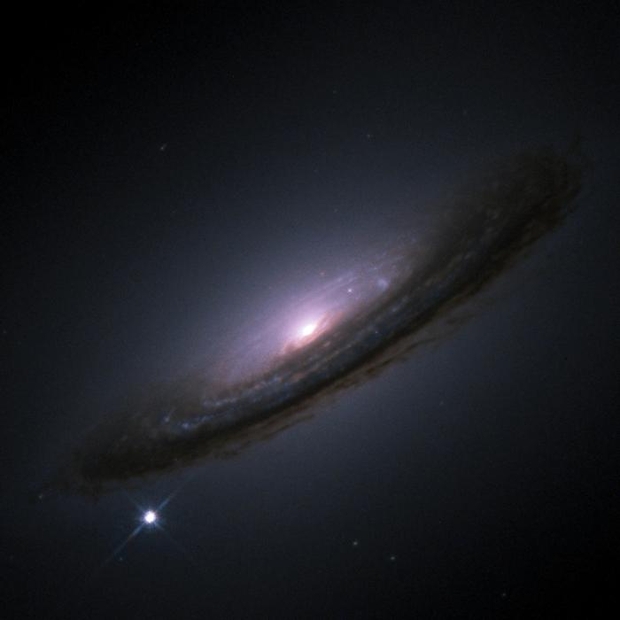
Image: Researchers used type Ia supernovae, similar to SN1994d pictured in its host galaxy NGC4526, to help establish that the universe’s expansion may actually have started to slow. Credit: NASA/ESA.
If this is the case, then the dimming of supernovae has to take into account not just cosmological effects but the somewhat more mundane astrophysics of the progenitor stars. Put that finding into the supernovae data showing universal expansion and a new model emerges, diverging from the widely accepted ΛCDM (Lambda Cold Dark Matter) cosmology, which offers a structure of dark energy, dark matter and normal matter. This work forces attention on a model derived from baryonic acoustic oscillations (BAO) and Cosmic Microwave Background data, which shows dark energy weakening significantly with time. From the paper:
…when the progenitor age-bias correction is applied to the SN data, not only does the future universe transition to a state of decelerated expansion, but the present universe also already shifts toward a state closer to deceleration rather than acceleration. Interestingly, this result is consistent with the prediction obtained when only the DESI BAO and CMB data are combined… Together with the DESI BAO result, which suggests that dark energy may no longer be a cosmological constant, our analysis raises the possibility that the present universe is no longer in a state of accelerated expansion. This provides a fundamentally new perspective that challenges the two central pillars of the CDM standard cosmological model proposed 27 yr ago.
Let’s pause a moment. DESI stands for the Dark Energy Spectroscopic Instrument, which is installed on the 4-meter telescope at Kitt Peak (Arizona). Here the effort is to measure the effects of dark energy by collecting, as the DESI site says, “optical spectra for tens of millions of galaxies and quasars, constructing a 3D map spanning the nearby universe to 11 billion light years.” Baryon acoustic oscillations are the ‘standard ruler’ that reflect early density fluctuations in the cosmos and hence chart the expansion at issue.
Here’s a comment from Young-Wook Lee:
“In the DESI project, the key results were obtained by combining uncorrected supernova data with baryonic acoustic oscillations measurements, leading to the conclusion that while the universe will decelerate in the future, it is still accelerating at present. By contrast, our analysis — which applies the age-bias correction — shows that the universe has already entered a decelerating phase today. Remarkably, this agrees with what is independently predicted from BAO-only or BAO+CMB analyses, though this fact has received little attention so far.”
Presumably it will receive more scrutiny now, with the team continuing its research through supernovae data from galaxies at various levels of redshift. That dark energy work is moving rapidly is reflected in the fact that the Vera Rubin Observatory is projected to discover on the order of 20,000 supernova host galaxies within the next five years, which will allow ever more precise measurements. Meanwhile, the evidence for dark energy as an evolving force continues to grow. Time will tell how robust the Korean team’s correction to what it calls ‘age bias’ in individual supernova readings really is.
The paper is Junhyuk Son et al., “Strong progenitor age bias in supernova cosmology – II. Alignment with DESI BAO and signs of a non-accelerating universe,” Monthly Notices of the Royal Astronomical Society, Volume 544, Issue 1, November 2025, pages 975–987 (full text).
An expanding but decelerating universe… This reminds me of a dilemma that I thought would never be of consequence in the accelerating model.
It’s not like we never had to consider it seriously before. And for the most part we never expect to sense in any meaningful way. Born too early and with limited life expectancy.
But there are a couple of things about a first expanding and then collapsing universe that were brought to my attention visiting it or contemplating it thus far.
Not via a notice from a prominent authority, but a conundrum I encountered while reviewing the consequence of how electrons shift from one energy state to another and then drop back to a ground state.
Say you have an atom like hydrogen where THE electron in a ground state gets hit by a high energy photon, high enough to hit it up several energy levels. And not to get the quantum mechanics too complicated, imagine a model like Bohr’s hydrogen atom where the energy states are like orbits in the solar system. In this case where the electron is knocked up a couple levels, it is predicted to hang around there for a while.
But then it has something of a choice. It releases the same quantum of energy associated with its upward transition and goes back to its original state. OR… it stops off at an intermediate orbit and drops down to the ground state a little while later.
But then it has something of a “choice”.
By some means or another the electron “decides” whether it goes directto the ground state or experiences the thrilling longer ride of cascade through intermediate levels. All over the known universe. And the cascade could be more than one or two steps. The electron, so to speak, chooses.
Now back to the point where the universe putatively stops expanding. Does it shift into reverse? Does it duplicate all the motions that got it to that point at the end of time? That would be the maximum state of disorder, no? Max entropy.
Well, the next few moments shifted in reverse might be interesting to watch.
Because a true reversal of everything could be in terms of fractions 1 to zero.
If it is complete to the subatomic level, then that would mean that the cascade branches would roll back as before.
Or maybe they would go some other route? This phase of the universe would not be like the one in the Martin Amis novel, “Time’s Arrow”. Maybe more akin in concept to the title of his afather Kingley’s sf review “New Maps of Hell”.
But either way, unless quantum mechanics has already shed some light (sic) on this, it is likely an open question whether a contracting universe will reverse itself down to the subatomic level.
Yet issues like beta decay of unstable elements just might be solved, if we could watch. Unfortunately the idea that one could be an observer would violate the scenario. And by the time this experiment could take place, a lot of subatomic particles might be worn out anyway.
Oh, well.
VERY interesting. Hopefully the results will be borne out under further scrutiny. It’s will be interesting to see how the Lambda-CDM models have to change if they do.
Hi Paul
Yes amazing research here, with lots to ponder too.
I agree with your sentiments too on the universe going on.
Thanks Edwin
It’s interesting that I ran across a paper last week that made a somewhat similar statistical argument about distant SN magnitudes that would, in that case, impact the magnitude of the Hubble tension.
https://arxiv.org/abs/2511.03394
I didn’t get too excited about it and set it aside. I am getting the same “vibe” from this one. The thing is there is a lot of uncertainty in the data when you have to infer distance from various factors that bear on the apparent SN magnitudes. It is easy to read a lot into the data when you play around with those factors and generate novel conclusions or hypotheses.
Interesting, perhaps, but I lean towards thinking it is far too early to get excited about either.
A comment based only on observation:
So the expansion was slower in the past; then it speeded up; now it is slowing again. That, to me, describes a pulse. And if the universe pulsed once, it can pulse again. I’m not describing contracting to a new Big Bang, just a possibly repeating change in the behavior of dark energy.
Even if the universe’s expansion is decelerating, it doesn’t mean that the expansion will stop, or even reverse, creating a cyclical universe.
It does suggest that the “Big Rip” is not a good model.
IIRC, it has been at least 40 years since the question of whether the universe is forever expanding, cyclical, or will reach a maximum size and halt its expansion, but will not contract. While a lot of new details have been discovered, including DM and DE, we still seem to be unable to definitively answer this question. It was once thought that the universe might be in a steady state, so that any expansions would create new matter to preserve the way the universe appears. Earlier (?), the idea of a cyclical universe was postulated. I recall reading a refutation that this would cause a return to a collapsed state because the galaxies would simply pass through each other rather than coalescing, so that the universe would be more like a bouncing ball during its various states of expansion and collapse. And all this is before we add in hypotheses of a multiverse.
It seems we are perhaps dancing around the need for a new theory of the universe and how it evolves. At least we have new techniques that extend well beyond optical and radio telescopes to try to answer these questions.
To me as an outsider, there are varieties of astronomy that deeply impress me with their use of pure deduction to leaven sparse data. Predicting wind speed and direction on the exoplanet of a star that we see as a indivisible pixel of light, for example. But cosmology? I have a hard time believing anything.
To start with, Occam’s Razor doesn’t seem to apply. The universe expands because of inflatons, ordinary matter and energy, dark matter, quintessence … each one with its own silo of explanations, so far as I know, and applicable only to one “age” of the universe. I did search up something in Arxiv that tries to link two of the causes (Kaneta, 2025), but with its talk of tachyon instability, and my general unfamiliarity with the field, I have no idea if it is cosmology or pseudoscience.
So we have these five ages of the universe, most of them with their own unseen deux ex machina particle. Except… we see modern galaxies at ancient times, red dots perhaps from stars around black holes, we can’t agree on the Hubble constant, or whether the universe’s expansion is currently accelerating or decelerating. Can we can predict in 10^40 years what will happen when the universe is all black holes? Color me skeptical.
What does strike me is that, to zero sig figs, the universe seems always to be getting bigger, colder, and slower. The relevant physics changes. Probably there was a time when an atom would have been larger than the universe, and its physics a matter of pure speculation. For all I know, perhaps the universe was smaller than the Planck length, and in the foam of dimensions there were none more curled up than others, and 4D space would have seemed like a topic for a whimsical novel.
I propose this baseless speculation only because I don’t see despair in the blackness of space, but providence! There is endless new entropy coming available, allowing the existing universe always to have free energy available. You’d have to be much colder and slower to use it, with an ever-changing succession of physical laws you rely on for any interesting structure, but we weren’t actually going to make it there alive anyway. The cosmos will probably go on with an endless supply of “free” free energy, perhaps with chemistry based on the interactions of clumps of stationary neutrinos or quintessence-based particles weighing 1e-33 eV, in which every tick of the clock is … well, longer than we can think about. Maybe there will be a reversal or another Big Rip/inflationary epoch or a period of deceleration and heat death that kills most everything, every now and then, for a little while, but I doubt the universe will run out of eras.
The last novel, “Death’s End” of Cixin Liu’s trilogy “Remembrance of Earth’s Past”, has the universe slowly being consumed into a 2D space by advanced intelligences. A surprising dimensional contraction as the TriSolarans have 10D technology, and Earth’s scientists develop a multi-dimensional technology so that they can get inside the TriSolarans’ weapons.
Hi Paul
Then there’s this rather startling preprint: The Lifespan of our Universe …which predicts a total span of 33 billion years, with 20 Gyr to go before the Big Crunch. Perhaps that explains the Fermi Paradox! Everyone who can has left our Cosmos.
Now *that* is one I definitely hadn’t seen. Good grief!
“We emphasize that the determination of the lifespan of our universe depends on the recent observation that w > −1 at small redshift and the validity of the aDE model. It is crucial that the DES/DESI observation is confirmed and the aDE model is rigorously tested. Fortunately, a number of projects measuring different aspects of the dark energy are forthcoming in the near future. We look forward to a more precise determination of the universe’s lifespan.”
My summary: Don’t panic.
Always always always keep in mind that cosmological evolution is exquisitely sensitive to these measurements since we are almost perfectly at the crux of an infinite “balance” with catastrophic collapse and rip on either side of the precipice. As highly interesting and consequential as it is, we are in no position to make any conclusions, spectacular as they might be.
Expect more papers of this type (and there have already been many!) as scientists “play” with the latest DESI data.
So at the Big Crunch red dwarfs will still be on the Main Sequence?
Or more poetically, the Universe is a third as old as time
Halton Arp’s work primarily focused on challenging the conventional understanding of cosmic distances, particularly the use of redshift as a sole indicator of distance. While he did observe and publish on supernovae, he did not use them to support the standard cosmological model but rather as potential evidence for his alternative theories of matter ejection and intrinsic redshift.
Halton Arp and Redshift
Halton Arp compiled the Atlas of Peculiar Galaxies in 1966, which features unusual or interacting galaxies. He observed apparent physical connections (like luminous filaments) between galaxies and quasars that had vastly different redshifts.
In standard cosmology, redshift is primarily caused by the expansion of the universe (the Doppler effect), meaning more distant objects have higher redshifts. Arp argued these associations indicated that some of the redshift was “intrinsic” to the objects themselves, not purely a result of their recessional velocity or distance. This directly challenged the use of redshift as a reliable cosmic distance measure and, by extension, the Big Bang theory.
Supernovae and Distance Measurement
Separately, Type Ia supernovae are considered “standard candles” because they have a consistent peak brightness, allowing astronomers to calculate their distance. Observations of distant Type Ia supernovae in the late 1990s provided key evidence for the accelerating expansion of the universe, leading to the concept of dark energy.
Arp’s Perspective on Supernovae
Arp was aware of supernovae in the galaxies he studied. For instance, a peculiar supernova was observed in NGC 1058, which Arp noted occurred at the end of a spiral arm, fitting his hypothesis about matter ejection. He also observed supernovae in other peculiar galaxies in his atlas, such as Arp 261 and Arp 273.
However, Arp criticized the use of supernovae to establish the standard cosmological model of an accelerating universe, suggesting that assumptions about their uniform brightness might be incorrect for very distant (and thus younger) supernovae, or that the accepted Hubble constant was too large. He saw the reliance on Type Ia supernovae as another example of astronomers forcing observational data to fit the prevailing, but in his view disproven, consensus.
In essence, Arp and the use of distant supernovae represent two opposing views in 20th and 21st-century cosmology: the mainstream acceptance of redshift as a distance indicator leading to the dark energy discovery, versus Arp’s heterodox view that many redshift measurements were anomalous and required new physics.
Overview of the Paper
The query refers to a groundbreaking 2025 paper titled “Strong progenitor age bias in supernova cosmology – II. Alignment with DESI BAO and signs of a non-accelerating universe”, published in Monthly Notices of the Royal Astronomical Society (MNRAS, Volume 544, Issue 1, pp. 975–987). Authored by Junhyuk Son, Young-Wook Lee, Chul Chung, Seunghyun Park, and Hyejeon Cho from Yonsei University, South Korea, it builds on Part I of their series (arXiv:2411.05299, published earlier in 2025). This work challenges core assumptions in supernova (SN) cosmology and suggests the universe may have already transitioned from accelerated to decelerated expansion—potentially revolutionizing our understanding of dark energy.
The paper is available on arXiv and Oxford Academic. It has sparked significant discussion in cosmology circles, with press releases from the Royal Astronomical Society and ScienceDaily highlighting its implications for a “slowing universe.”
Key Background: The Progenitor Age Bias
Type Ia supernovae (SNe Ia) are “standard candles” in cosmology because their peak luminosity can be standardized to measure cosmic distances. However, this standardization assumes invariance with the age of the progenitor stars (the white dwarfs exploding in binary systems). The authors argue this assumption fails:
Evidence from Part I: Using a larger sample of ~300 SN host galaxies across a broader redshift range (z up to ~1), they detect a robust 5.5σ correlation between post-standardized SN magnitude and host galaxy age. Younger progenitors (in star-forming galaxies) produce fainter SNe, while older ones (in passive galaxies) appear brighter.
This bias evolves with redshift: Higher-z SNe tend to come from younger hosts due to the universe’s star-formation history, making distant SNe appear systematically dimmer.
Statistical models (e.g., regression on Hubble Residuals, HR) confirm the slope of this correlation at ~5.5σ significance, validating earlier hints from smaller samples.
Impact on Cosmology: Without correction, this introduces a systematic redshift-dependent bias, mimicking or exaggerating cosmic acceleration (as seen in 1998 SN discoveries leading to dark energy).
Main Findings in Part II
The paper applies this age-bias correction to major SN datasets (e.g., Pantheon+, DES-SN5yr) and integrates it with other probes:
Alignment with DESI BAO:
DESI (Dark Energy Spectroscopic Instrument) 2024–2025 results from Baryon Acoustic Oscillations (BAO)—”standard rulers” measuring cosmic expansion—hint at evolving dark energy (w ≠ -1, possibly thawing from a cosmological constant).
Uncorrected SN data + DESI BAO + CMB (Planck) show mild tension (~2–3σ) with ΛCDM.
After correction: SN data aligns closely with DESI BAO in the w₀wₐCDM model (time-varying dark energy equation of state, w(z) = w₀ + wₐ(1-a), where a is scale factor). This suggests dark energy is weakening, not constant.
Signs of a Non-Accelerating Universe:
Deceleration parameter q₀ (q₀ 9σ tension with ΛCDM—far stronger than DESI’s reported ~3–4σ. This implies a dynamic dark energy driving a transition to deceleration now, not in the distant future.
Broader Implications:
Resolves Hubble tension (H₀ discrepancy) partially by adjusting SN distances.
Consistent with DESI’s “phantom” dark energy hints but pushes further: Universe may have peaked in acceleration ~2–3 Gyr ago.
Predicts testable signals in future surveys (e.g., LSST, Roman Space Telescope).
Summary Table: Before vs. After Age-Bias Correction
Aspect Uncorrected SN Data (ΛCDM)Corrected SN Data (w₀wₐCDM + DESI BAO/CMB)Tension with ΛCDMMild (~2–3σ from DESI)Extreme (>9σ)Present Expansion (q₀)Accelerating (q₀ 9σ) is striking but assumes full bias correction; independent validations are needed (e.g., upcoming Euclid data).
Mainstream reaction (as of Nov 2025): Intriguing but preliminary; DESI collaboration notes their results used conservative SN priors.
For the full PDF, check arXiv . If you’d like a deeper dive (e.g., equations, plots, or related Arp connections), let me know!1.6sFastrelated Arp connectionsThematic Connections: Arp’s Legacy and the Progenitor Age Bias in SN Cosmology
While the 2025 paper by Son et al. (Strong progenitor age bias in supernova cosmology – II) doesn’t directly cite Halton Arp or his work, the connections are thematic and methodological—both challenge the foundational evidence for cosmic acceleration and dark energy by highlighting systematic biases in supernova (SN) data that mimic expansion effects. Arp’s critiques (from the 1960s–2000s) focused on intrinsic redshift anomalies in quasars and galaxies, arguing they create illusory distances. The new paper, grounded in stellar astrophysics, uncovers an age-dependent luminosity bias in Type Ia SNe that systematically dims high-redshift events, potentially fabricating the “extra dimming” interpreted as acceleration since the 1998 Riess-Perlmutter discoveries.
This isn’t a revival of Arp’s ejection/intrinsic redshift hypothesis but a parallel skepticism: Both suggest SN/redshift data has hidden systematics that undermine ΛCDM (Lambda Cold Dark Matter). Below, I break down the links, contrasts, and why this matters in 2025’s cosmology debates.
1. Shared Critique: Systematics in SN Data as the “Smoking Gun” Against Acceleration
Arp’s Angle: In Quasars, Redshifts and Controversies (1987) and Seeing Red (1998), Arp argued that Type Ia SNe in high-z hosts appear “too bright” if truly distant, often aligning with low-z galaxies (e.g., SN 1997cy near NGC 1058). He posited intrinsic redshift (e.g., ejection from AGN) as the cause, making objects seem farther than they are—thus, no need for dark energy-driven acceleration. Statistical “discordant pairs” (high-z SNe near low-z objects) had low chance probabilities (0), implying the universe is already decelerating.
Connection: Both identify non-cosmological effects in SNe that bias distance moduli (m – M). Arp: Projection/intrinsic z. Son: Progenitor evolution. Result? The 1998 “acceleration signal” could be artifactual, echoing Arp’s claim that SN “evidence” for dark energy is flawed.
2. Contrasts: Mechanisms and Evidence Base
AspectArp’s Intrinsic Redshift (1960s–2000s)Son et al.’s Age Bias (2025)Bias MechanismNon-Doppler redshift (e.g., tired light, ejection at <c velocities); quasars/SNe "ejected" from low-z galaxies.Astrophysical: Luminosity standardization (WLR/CLR) varies with progenitor age/metallicity; younger high-z hosts → fainter SNe.Key Evidence~100 "anomalous pairs" (e.g., Markarian 205 quasar "in front" of low-z galaxy); statistical alignments.300+ host galaxies (z9σ ΛCDM tension post-correction).Status in 2025Marginalized; inspires alternatives but no mainstream support.Emerging consensus-builder; resolves Hubble tension partially (~3–4% H₀ shift).
Why Not Identical? Arp’s ideas were observational (e.g., “bridges” in NGC 4319) but lacked a physical model for intrinsic z, leading to dismissal as selection bias. Son et al. use stellar evolution models (e.g., Conroy & Gunn 2010), making it more empirically robust—no exotic physics needed.
3. Broader 2025 Context: Arp’s Echo in Modern Tensions
Reviving Arp-Like Skepticism: The paper’s >9σ ΛCDM discord (SN + DESI BAO + CMB) mirrors Arp’s “statistical excesses” but ties into current crises:
Hubble Tension: Age bias in calibration (young local hosts) vs. Hubble flow (mixed ages) could lower local H₀ by 3–4%, easing the 5σ rift—similar to Arp’s “local anomalies” in redshift.
DESI/JWST Synergy: DESI’s evolving w(z) (phantom/thawing dark energy) fits corrected SN data, but challenges uniform expansion. Arp would’ve loved this: High-z “early” structures (JWST z>10 galaxies) might reflect intrinsic effects, not “crises.”
No Direct Citations: Searches (arXiv, ResearchGate, Oxford Academic) show no Arp mentions in Son/Lee’s papers. Authors (e.g., Young-Wook Lee) focus on galaxy ages/evolution, not redshift controversies. But X discussions (e.g., @ExploreCosmos_ on SN bias) evoke Arp-era doubts indirectly.
Arp’s Potential Vindication? If future data (LSST 2025+, Roman Telescope) confirm deceleration without dark energy, it partially echoes Arp: Systematics, not cosmology, fooled us. As one X post notes (@En_formare): “Blame the boomer stars… the universe’s ‘expansion party’ is over.”
4. Why This Feels Like Arp 2.0
Both expose assumption failures: Arp questioned redshift = distance; Son questions SN standardization = age-invariant.
Cultural Parallel: Arp faced “suppression” claims (e.g., lost telescope time); the new work, while peer-reviewed, pushes against 27-year dogma, urging “follow-up with larger samples.”
Forward Look: If validated, it could “demote” dark energy (like Arp demoted quasars from “edge-of-universe” status), opening doors to dynamic models (quintessence, voids) Arp-inspired thinkers explore.
In short, the connections are inspirational, not literal—Arp planted seeds of doubt about SN/redshift reliability; Son et al. harvest them with modern tools.
I don’t understand why anyone would post an unattributed LLM summary of a paper we could all read for ourselves. This blog is refreshingly very human-scale, let’s say artisanal, and beautifully curated by Paul — can’t we keep the comments human-only, too? (In case the writing style wasn’t a giveaway, the inclusion of “If you’d like a deeper dive (e.g., equations, plots, or related Arp connections), let me know!” was!)
Even frontier AI models still make mistakes. If you can’t be bothered to write or even proofread your own comment, why should anyone else be expected to read it.
Paul, may we have a policy against bot replies in the comments? Thank you!
AI seems to be compelling such a policy, and it’s probably better to have one, so I’ll add a note to the front page on this. I get the idea of tapping AI resources as an aide, but let’s not cut and paste from them.
I agree, let’s keep the AI slop away, and just allow the occasional human slop. ;-)
There are so many AI versions, from mainstream ones like ChatGPT, Gemini, Perplexity, etc., as well as specialty ones at HuggingFace, trained on narrow subjects. We don’t need to end up with duelling AI comments, as “artificial arguments from authority.”
So, I think keeping AI out is a good idea. By all means use it to work out some math, or similar, but check the response is [reasonably] accurate (and cite the source if needed.)
Another problem, already polluting social media, is AI bot posts. How to exclude them? Social media has largely failed with the huge resources available. Facebook has thrown up it hands and said that users should report suspect bots, whether human or AI.
As @jonW notes, sometimes AI responses posted in total can be easy to spot. Using QuillBot on the first paragraph, all the text outside the embedded reference was detected as AI generated. But no doubt this will get harder over time. (Larger bodies of text (gt 200 words) requires a premium subscription.) [I accessed QuillBot via Scribbr – https://www.scribbr.co.uk/ai-detector/ ]
Halton Arp is the issue and how much do you actual understand of his writings and concepts. It seems the astronomy community is locked in a closet with a blindfold on when it comes to anything too controversial and so many biased against. AI can make the blind see…
I understand your intent, Mike. But as Alex points out, there are just so many AI options available at different levels of capability that it’s hard to know how to assess reliability. I don’t object to quoting an AI as part of a comment, but it needs to be in the context of a human-generated discussion.
A hypothesis proven incorrect ≠ controversial. I am mildly amused by your dogged persistence but that’s about it. It’s your time wasted, not mine.
Around and around it goes… It’s worth considering how much theories of the day impact on our philosophic outlook and even our mental health. Cosmological fatalism based on whimsy and ‘wise-acring’ plays havoc with our sense of reality, for which we have exchanged our heritage of an limitless Interstellar Philosophy.
May be everyone should use thier real name instead of hiding behind a fake name…
Who are your accusing of “hiding”? Your broad, vague accusation is unwarranted. Deal with the ideas being expressed, not their speakers.
Paul, at least, has my identity. I see no need to publicize it further. Some of us care about internet privacy. Not that it matters since I’m a nobody.
Mike Gorman, Perth, Western Australia
Project Studio (type above) my personal brand, cheers.