
The second part of Jim Benford’s examination of Breakthrough Starshot concludes our look at the numerous issues advanced by Phase I of the project. Largely discounted in recent press coverage, the Starshot effort in fact completed a successful Phase I and left behind numerous papers that illuminate the path forward for interstellar flight. This is solid work on everything from laser arrays to metamaterials and the engineering of data return at light-year distances. Read on.
by James Benford
“I have learned to use the word ‘impossible’ with great caution.”
— Wernher Von Braun, after the lunar landing
In this second report, I will describe the major results of Starshot beginning with the mission scenario and then treating each major technical area in terms of how solutions have been resolved and issues retired. In Part 1, I described Phase 1 objectives.
One of the causes of Starshot results not being well-known publicly is that the Breakthrough Foundation has not publicized its events and results during most of its duration. After its completion, substantial reports have appeared, but are not commonly available to the public. There is a final report, but it has yet to be published. There are briefings by Harry Atwater at Breakthrough Discuss and the IRG in Montreal in 2023 [1,2].
The most detailed discussions are in the book Laser Propulsion in Space edited by Claude Phipps, with a system overview by Pete Worden and others, a description of his system model by Kevin Parkin and other aspects of directed energy in space by Philip Lubin, all in the one volume [3]. The Kevin Parkin article is particularly interesting because it contains fully worked-out examples of the possibility of future voyages of humans traveling to the stars in large >100 m sailcraft in future centuries. Note that there are many journal publications produced by Breakthrough Starshot. And there are many papers that have been published since Starshot was put on hold.
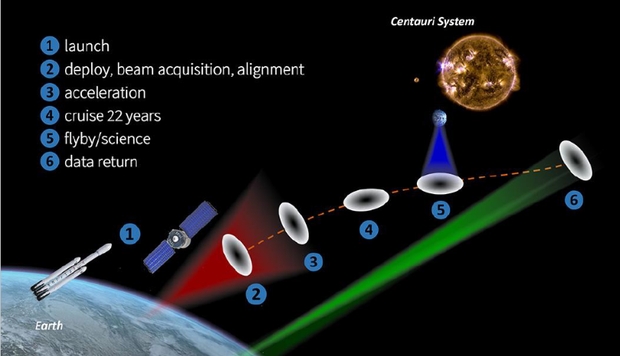
The Starshot Mission Scenario has evolved as a substantial improvement over previous beam-driven sail mission concepts. A mothership is launched which houses a fleet of membrane-like sailcraft measuring ~5 meters in diameter and less than a micron thick. The traditional standard laser guide star adaptive optic system can’t be scaled to Starshot-sized apertures to deal with the time–dependent fluctuations due to atmospheric turbulence. The system uses a satellite–based laser which is called the Beacon. It’s in an orbit at the launch time of apogee 200,000 km.
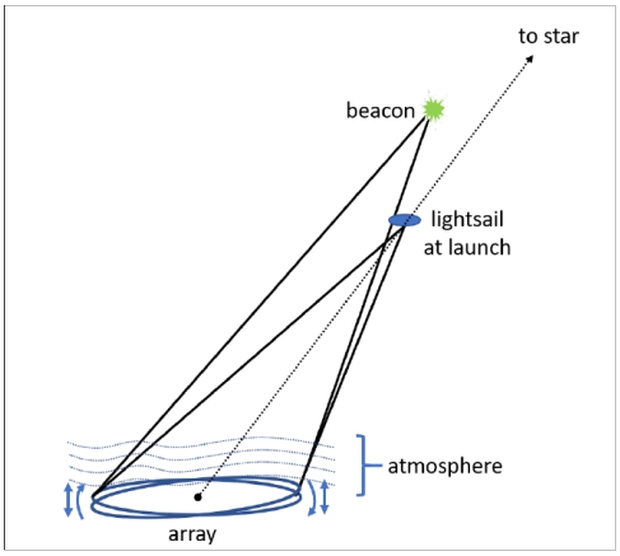
Image: Starshot system geometry. Arrows indicate that the array acquires atmospheric turbulence data from a Beacon and points the beam at the sailcraft. (Courtesy of Breakthrough Foundation.)
The sailcraft are composed of super-reflective metamaterials that stabilize the perturbations that could prevent beam-riding during the propulsion phase. The scientific instruments that are the payload are integrated into the sail. The mission begins as the mothership deploys a sailcraft into space.
Meanwhile on Earth, a phased array of 100 million small lasers turns on, generates ~100 GW of optical power and, using information from a Beacon in high orbit, digitally adjusts the phase of the emitted light to correct for atmospheric turbulence. These small lasers would be manufactured in printed sheets, following the fabrication techniques of the semiconductor industry. This is the means of lowering laser prices.
The single 100 GW beam focuses on the sail and accelerates the sail. Almost no energy is absorbed by the sail’s reflective surface, so imparting force. The sail rides the beam for ten minutes and reaches relativistic speed. It leaves the solar system in less than a week. Soon after acceleration it encounters dust and charged particles, so can be oriented edge-on to avoid such collisions. On arriving at the Alpha Centauri system, it captures images, detects dust and particles and measures fields. The sail transmits data home to an array of optical receivers on Earth, so it begins to arrive four years later. Data return may take decades because of limited data rate. Recall that complete data return from the New Horizons flyby took about a year.
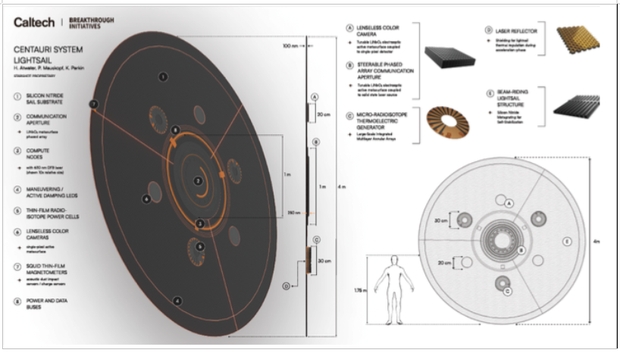
The above figure shows a concept for the sail, about 5 m in diameter. Some studies show that at the velocity under consideration the gas and dust will pass through the thin sail with virtually no damage if it travels face-on. Only the payload would need protection. The sail can also be oriented edge-on in order to avoid such collisions, giving meters of material protection to the center. The payload is around the center, protected from damage due to incoming gas and dust.
Key issues for beam-driven sail systems have been retired by high levels of Starshot research. Most are resolved at the conceptual level. Experiments are needed to verify solutions for these major issues, discussed below.
Can phase be maintained across a large aperture composed of many sources? This is well demonstrated historically for microwaves, principally for radar. For lasers, a new concept has been quantified [4, 5]. Building the hundred million laser emitters into a large array is the driving technical challenge of the project. The principle of the design is to interferometrically link multiple arrays which are phase-locked into modular tiers of larger size. That is, multiple areas which are individually phase controlled would be linked together by interferometry. This approach of linking multiple optical phased arrays is called a hierarchical array. The array design that resulted has laser dimensions and total power levels that are about five orders of magnitude beyond present state of the art capabilities. To control the phase over such a large aperture is the most significant technical challenge to Starshot.
Can a sail material be found which can meet the many constraints on sail acceleration? Most materials effort has been for laser propulsion, where the leading candidate for sail material is silicon nitride. There are no fundamental limits to optimize that material for the key parameters of mass, reflectivity, refractive index, and thermal properties. (For microwaves various types of carbon are preferred, such as microtruss and graphene.)
Can the sail ride on the beam stably? (Feedback is impossible over long ranges.) If not, sails can veer off-course on millisecond timescale. The notion of beam-riding, stable flight of a sail propelled by a beam, places considerable emphasis on the sail shape. Even for a steady beam, the sail can wander off if its shape becomes deformed or if it does not have enough spin to keep its angular momentum aligned with the beam direction in the face of perturbations. Beam pressure will keep a concave shape sail in tension, and it will resist sidewise motion if the beam moves off-center, as a sidewise restoring force restores it to its position. Early stability experiments verified that beam-riding does occur with a conical sail [6].
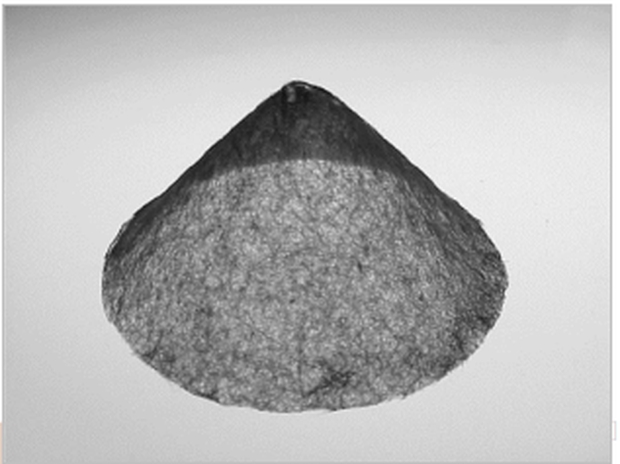
Experiments and simulations show that conical sails ride a microwave beam stably. The carbon–carbon sail diameter is 5 cm, height 2 cm, and mass 0.056 g.
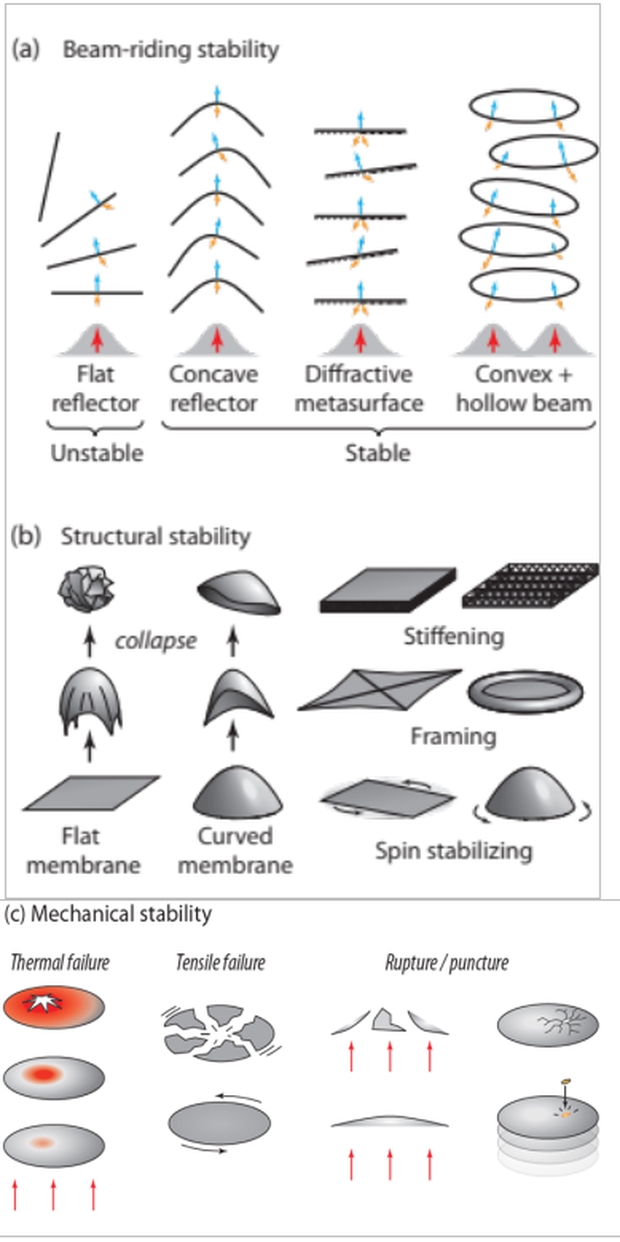
Beam riding and structural stability is difficult. (a), beam-riding stability, where bold upward arrows depict accelerating beam, light upward arrows the force of radiation pressure, downward arrows the direction of reflected light (b) structural stability methods (c) mechanical issues [7].
Meter-scale shaped sails of submicron, ~100 atomic layer thickness can ride with stability along the axis of the accelerating beam despite the many types of deformations caused by photon pressure and thermal expansion. There is also a requirement for structural stability, the ability to survive acceleration without collapse, and crumpling under acceleration, as depicted in the figure above. And there could be thermal and tensile failure as well as rupture of sail materials. Many studies of this issue have shown multiple solutions.
Stable designs exist for concave shapes and for flat flexible sails with millimeter scale photonic structures to control reflections. (Simple flat sails cannot achieve beam-riding stability because specular reflection produces forces only normal (perpendicular) to the surface.) A considerable advantage of flat sails is that curved sail shapes are more difficult to fabricate at meter scales. However, Starshot has shown that even flat sails can beam-ride by tailoring asymmetric optical properties to produce transverse restoring forces with millimeter-scale photonic structures to control reflections. So a flat sailcraft can be modified to scatter light as if it were curved. For example, the Swartzlander group, in a series of theoretical, computational, and experimental studies, has shown that a flat sail whose reflecting surface is equipped with diffractive gratings is directionally stable [8,9]. Anisotropic scattering of incident light into the grating diffraction orders manifests in optical restoring forces transverse to the membrane, redirecting incident photon momentum to produce beam-riding.
Such metagratings or metasurfaces consist of subwavelength scatterers shaped as disks, blocks, spheres, etc. shape the scattered wavefronts, redirecting incident photon momentum transversely. This provides stabilizing restoring forces and torques. However, adding metagratings makes the sail heavier than the ~0.1 gram per square meter goal. And photonic grating patterns would have to be produced over a large area. The advantage of flat sails will significantly streamline and simplify the fabrication process. The issue is whether such structures can be scaled to manufacture on the size of meters with low mass.
Spin-stabilization will likely be needed to prevent the collapse of sails while acceleration is underway. A beam can carry angular momentum and communicate it to a sail to help control it in flight. Spin can be modified remotely by circularly polarized beams from the ground [10]. It also allows ‘hands-off’ unfurling deployment through control of the sail spin at a distance [10-12]. Spinning them at ~100 Hz rates gyroscopically stabilizes sails against drift, yaw and tilting, allowing numerous shapes to retain their stability. (Circularly polarized electromagnetic fields carry both linear and angular momentum, which acts to produce a torque through an effective moment arm of a wavelength, so longer wavelengths are more efficient in producing spin.)
A final and crucial issue: Can the data be returned from distant space targets at sufficient data rates before the sail moves far beyond the star? For solar system-scale missions this is possible with existing microwave communication technologies. that were realized 50 years ago in the Deep Space Network. For interstellar missions it is possible by using laser communications. Though today’s laser communication systems are far too heavy for Starshot, which instead aims to operate part of its sail as an optical phased array. There are methods of making this likely in future decades [13]. That is because we understand essentially completely the fundamental limits on communication, and our technology today is able to operate very close to those limits.
The mission objective is to return 100 kB of data. The power requirement on board is driven primarily by the communication needs as well as pointing, tracking and computation. The energy technology is a thin film, radioisotope thermoelectric generator.
Propulsion-oriented scientists usually assume that the mission should be done at maximum speed. But information scientists’ relation to speed is different; they focus on how it affects the data return:
* Slower is better since observations are easier and there is more time in the vicinity of the target star.
* The measure of mission performance is the volume of data returned reliably vs the ‘data latency’ (defined as time from acquisition at Centauri to return to Earth of an entire observational data set).
So from this perspective speed is a secondary parameter except as it influences the data volume and data latency, which will relate to the payload mass, and in particular the communications mass.
Messerschmitt, Lubin and Morrison have studied the minimum data latency that can be achieved for a given data volume, or equivalently the maximum data volume that can be achieved for a given data latency [13, 14]. Generally, they reduce speed for high latency (with the benefit of larger data volume, so larger mass, more instrumentation, and larger data volume).
From this, the key insight that governs the difficult problem of returning data over interstellar distance is that a cost-optimized (meaning cost minimized) system scales as the relation between speed v and mass m: v~1/m1/4. That means we can have a much heavier communication system onboard. Achieving the data return is more credible. This leads to an optimum mass that maximizes data volume for a given data latency. Future communications research will deal with several probes downlinking concurrently from the same target star. Separating these downlinks (‘multiplexing’, using different formats, polarization, etc.) is very challenging,
That leads to a very significant development conclusion: We would of course develop heavier, lower velocity probes early on as the Beamer is being built out. The Beamer will be built by adding modules of power and aperture over time. It is likely what will happen is that technologies advance, such as sail materials are improved and mass is reduced. As faster solar system deep space missions occur, mass will either drop as the system performance improves or will increase for faster, better data return. That’s the natural development path, leading to faster, better missions.
The on-board pointing system of the sail is also a technical challenge. It must point in the direction of our Solar System, and the beam will be larger than Earth’s orbital diameter, 2 AU. That means a pointing accuracy of a milliarcsecond, about 10 microradians.
Phase I confirmed that short wavelength optical communications can provide the required down-link capability with limited data rate. Low-cost receiver aperture concepts were developed.
System Cost
Before I joined Starshot, I developed an analysis for cost optimization of beam-driven sail systems. In it, the trade-off was between the cost of the sources powering the array versus the cost of the array itself. That was in agreement with the cost of transmitter systems that had been built for interplanetary communications. My conclusion was that the minimum capital cost is achieved when the cost is equally divided between the array antenna and the radiated power [15].
However, Starshot requires more power than can be directly supplied by the normal electrical grid. Therefore, energy storage for the system has to be included, and becomes a substantial cost element [16, 17]. That results in a considerable change in the laser aperture, laser power, and energy storage cost. The result is that the laser cost, which is ~80% of the array cost, becomes the dominant element in the total project cost. The cost trends shown below demonstrate that cost is viable for future fiber amplifiers at ~$0.10/W, and future semiconductor lasers at ~$0.01/W.
The figure below shows that current laser fiber amplifiers and semiconductor laser costs are far too high to afford a Starshot system today. The hope is that economies of scale in the application of lasers to aspects of modern life, for example self-driving cars, will drive down the cost of lasers by economies of scale. In order to reach an affordable level for Starshot, the prices have to fall to order of cents per watt, not many dollars per watt we have today. The points at 2040 and 2050 shows what will have to occur if the cost of Starshot is to be of order 10 billion dollars. That requirement is two to three orders of magnitude cost reduction.
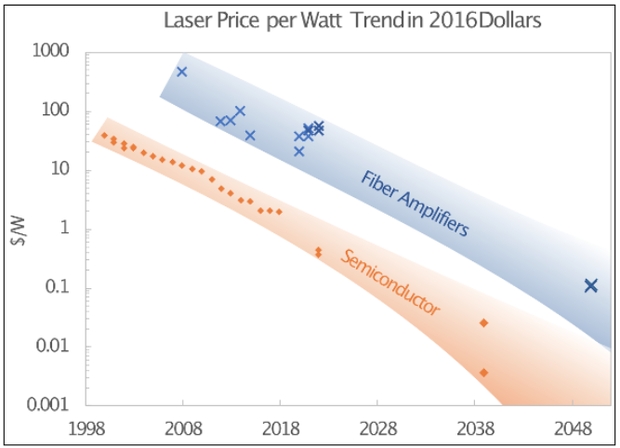
Image: Cost trends for fiber amplifiers and semiconductor lasers.
The Future of Beam-driven Sails
Phase II technical demonstrations, such as laboratory beam-riding sail flights and including orbital sail deployment and sail acceleration, would lead to a firm experimental basis for pilot production of the key sub-systems, leading to the beginning of array construction. That would later lead to precursor missions.
While the Beamer is under construction, many missions become possible that are at speeds lower than interstellar, as well as other applications. The laser driver can beam power to locations in space, such as Earth satellites and space stations. It can deorbit orbital debris. It can drive fast sail missions to the Moon, Mars and the outer planets. At Mars, it could have a second laser array to decelerate the spacecraft, or a retro reflector system, such as proposed by Forward, could reflect a beam from Earth to slow the sailcraft at Mars. And it can beam power to high-performance ion engines.
Development of fast sailcraft that can travel beyond our solar system will enable us to understand the interstellar medium and then, in the fast encounter with other star systems, acquire imaging, spectroscopy, and in situ particle and field measurements.
Beam-driven sails are the only way that probes can be sent to the stars in this century. Completion of Phase II would bring much-increased credibility to the concept by demonstrating beam-riding and operation of a Beamer module in the laboratory. Then the dream of beam-driven interstellar travel could be realized.
Kevin Parkin has even envisioned human beam-driven fast travel to the stars. Accelerating at Earth gravity to relativistic speeds, allowing us to contemplate human travel in future. He points out that human civilizations’ energy production doubled every 40 years since 1800, so that the energies needed for the simplest such missions will be attainable by the end of the century.
Acknowledgements: Figures are by permission of Breakthrough Starshot and Michael Kelzenberg. I also want to thank Kevin Parkin, Dave Messerschmitt and Al Jackson for technical discussions about Starshot.
References
1) Atwater, H. Starshot: from science to spacecraft to missions, Harry Atwater, Interstellar Research Group , Montreal 2023, https://www.youtube.com/watch?v=jV2sNOYzaFA
2) See also same title, Breakthrough Discuss, Harry Atwater, 2023 https://www.youtube.com/watch?v=IrLcllx0LpQ
3. Laser Propulsion in Space: Fundamentals, Technology, and Future Missions, Claude Phipps, ed., Elsevier., Cambridge, MA ,2024.
4. Worden S., Green, W. Schalkwyk, J., Parkin K., and Fugate R., “Progress on the Starshot Laser Propulsion System,” Applied Optics, doi: 10.1364/AO.435858, 2021.
5. Bandutunga C., Sibley P., Ireland M. J., and Ward, R., “Photonic solution to phase sensing and control for light-based interstellar propulsion”, J. Opt. Soc. of Am. B, 38, 1477-1486, 2021.
6. Benford, G., Goronostavea, O., and Benford, J., “Experimental tests of beam-riding sail dynamics” in Beamed Energy Propulsion, AIP Conference Proceedings 664, Pakhomov, A., Ed. 325, 2003.
7. Gao, R., Kelzenberg M. D., and Atwater H. A., “Dynamically Stable Radiation Pressure Propulsion of Flexible Lightsails for Interstellar Exploration”, Nature Comun, 15, 4203. https://doi.org/10.1038/s41467-024-47476-1, 2024,
8. Srivastava P., Chu Y., and Swartzlander G., “Stable diffractive beam rider,” Opt. Lett. 44, 3082-3085, 2019.
9. Chu Y., Tabiryan N. and Swartzlander G., Experimental Verification of a Bigrating Beam Rider. Phys Rev Lett. (123(24), 2024.
10. Benford, G., Goronostavea, O., and Benford, J., “Spin of microwave propelled sails,” in Beamed Energy Propulsion, AIP Conference Proceedings 664, Pakhomov, A., Ed., 313, 2003.
11. Benford, J. and Benford, G., “Elastic, electrostatic and spin deployment of ultralight sails”, JBIS 59 76, 2006.
12. Martin, P. et al., “Detection of a Spinning Object Using Light’s Orbital Angular Momentum” Science 341 537, 2013.
13. Messerschmitt D., Lubin P. and Morrison I., “Challenges in Scientific Data Communication from Low-mass Interstellar Probes”, ApJS 249,36, 2020.
14. Messerschmitt D., Lubin P. and Morrison I., “Interstellar flyby scientific data downlink design,” arXiv preprint arXiv:2306.13550, 2023.
15. Benford, J., “Starship Sails Propelled by Cost-Optimized Directed Energy”, JBIS 66, 85, 2013)
16 Parkin, K., “The Breakthrough Starshot Systems Model”, Acta Astronautica 152, 370–384, 2018.
17. Parkin, K., “Starshot System Model” in Laser Propulsion in Space: Fundamentals, Technology, and Future Missions, Claude Phipps, ed., Elsevier., Cambridge, MA ,2024.
If the sails are used in a micro disc format and alternate discs are slowed they will collide and ionise. This allows us to use magnetic fields to redirect the plasma and generate thrust. If the laser system is built on the earth it would allow us to resurface the moon to made roadways and power settlements. There are a large number of uses for the laser system even as it is being built paying for itself. Perhaps we could generate a list of uses.
I was reading about the immense power of Jovian lightning:
https://behindtheblack.com/behind-the-black/points-of-information/juno-data-suggests-lightning-on-jupiter-is-a-hundred-to-a-million-times-more-powerful-than-lightning-on-earth/#comment-1630126
–and about the Great Blue Spot….and then I saw this:
https://phys.org/news/2026-03-radio-edge-extreme-stars-surfaces.html
Might a Starwisp be designed to harvest Jupiter’s power…a long tether to induce a blue jet strike?
Thank you for this concise and very interesting precis of the Breakthrough Starshot report that shows what has been achieved and where there is still much development to do to make the project feasible sometime in the 21st century. If it doesn’t arrive until the 22nd century, then we would be pushing tiny sails at sublight speeds, whilst the fictional Enterprise under the command of Captain Archer was already a large, FTL ship. Zephram Cochrane was already building prototype warp drive ships in this century, with the first flight in 2063. sic itur ad astra
As with Phil Lubin’s original DE-STAR roadmap, I found his planetary missions within the solar system more interesting than the potential later interstellar mission[s]. I am pleased that the BS roadmap also seems to include fast flights within the solar system. Lubin allowed for slower, but heavier probes within the system. These are interesting tradeoffs depending on the available laser array size and the mission requirements.
I note that the cost reductions needed are many orders of magnitude to make the BS mission to Proxima/Alpha Centauri economically feasible. Given your expertise with microwaves, what might be economically and physically achievable for solar system probes with phased microwaves, within a shorter time frame?
For power beaming, I assume a laser receiver needs a PV array, whilst microwates need a simpler metal rectenna. For a lunar facility using terrestrial power beams, would it be easier to set up a microwave system?
One thing to remember is how to offset costs.
Solar Thermal powersats needed for Green energy will be closer to your sail needs and geoengineering.
The same with star-shades for astronomers trying to get above mega-constellations, and cooling shadows for orbital data centers.
Put yourself into discussions with these different interest groups such that your sail needs couple with their wants.
OT.
I was reading a (1950s/1960) speculation by Harlow Shapley that the galaxy would be littered with many bodies of super-Jupiter to sub- Red Dwarf (Brown Dwarf) size, in far greater numbers than visible stars. Have IR and radio telescopic observations falsified that speculative hypothesis? Such bodies exist, but in far fewer numbers than Shapley speculated about. His speculation led to the idea that some bodies with sufficient internal heat could have liquid water surfaces and potentially life. The huge numbers of such bodies would allow for easy island hopping to the stars, rather than the later suggestion of using Oort cloud icy bodies.
Hi Alex
The old idea of Brown Dwarfs out-numbering Main Sequence stars has been disproven. But smaller objects with hydrogen atmospheres should stay warm for aeons and out-number the stars. Marshall Eubanks has advocated for them to be near-term Starshot targets.
Saturn has a lopsided field, perhaps this could be used by Starwisps somehow
I think the intersection of bubbles allows for a perfectly flat plane to exist.
UV might harden that plane with some work-arounds.
On bubbles
https://www.nextbigfuture.com/2017/01/single-soap-bubble-made-on-earth-that.html
Other links
https://phys.org/news/2026-03-3d-photonic-lanterns-combine-multimode.html
https://www.nanowerk.com/spotlight/spotid=68849.php
Cost aside how significant are the advantages of launching from a vaccum location like the Moon?
Hi Jim
David Criswell’s old idea of power beaming from an in situ manufactured PV belt around the Moon might provide sufficient juice for a Moon based system. Learning to build Criswell’s PV makers on a patch of terrestrial desert could be an early project for Breakthrough.
Alex: I have written a paper with Greg Matloff on this question of near-term outer solar system missions with much cheaper commercially available microwave and millimeter wave sources, at about 1$/watt. They are at least ten times cheaper than lasers with total system capital cost roughly $1 billion. That was covered extensively in our 2019 paper in JBIS: “Intermediate Beamers for Starshot”, James Benford and Gregory Matloff, JBIS 72, pg. 51, 2019.
For power beaming, microwaves would would be captured efficiently by a metal rectenna array, which is now well developed. For sailship acceleration by photon momentum reflection, all that is needed is high reflectivity.
Ivan: The obvious advantage of launching from the Moon is there would be no atmospheric turbulence, so no Beacon needed to compensate for it. However, the disadvantages are that one would have to move so much equipment to the Moon and build the system under very difficult circumstances. The system would have to be built by people in space suits, or example. Or by robots. While there are the dust storms in the Atacama desert in Chile, where Starshot would be built, the ubiquitous lunar dust would be much more difficult to deal with. So it’s got to be at least an order magnitude, and probably several orders more expensive to put it anywhere but on Earth.
Adam: Powering Starshot on the Moon with photovoltaics would be quite a major enterprise! Providing gigawatts of power from sources of less than a kilowatt per square meter is a major piece of real estate.
@Jim Benford
Unfortunately, your paper is behind the JBIS paywall, so I cannot read it. However, I did re-read your CD article Beamer Technology for Reaching the Solar Gravity Focus Line. There, you indicate that microwave beams were 2 orders of magnitude cheaper to build, making this a potentially cheaper near-term solution. Forward’s Starwisp microwave beamed sail concept, using superconducting wires, was improved on by Matloff’s paper, indicating that carbon fiber was the solution needed to overcome heating. Your own experiments on carbon fiber sails proved the concept in the lab demos. You mentioned that desorption of a “paint” improved the performance as it acted as a propellant. IIRC, you have in teh past mentioned that such a painted CF sail could have a very high acceleration, allowing for either a shorter beam time of using a smaller, less powerful beam. The CF sail could be made to a very low 0.1g/m^2 areal density suitable for interstellar flight, but also for missions in our solar system.
2 questions.
1. While you used a CF sail, could a sail using carbon fiber in a looser mesh, more like that of Starwisp, be possible? Could it be manufactured and deployed with something like existing technology?
2. What was the reason BS went for laser beaming rather than microwaves? [I think you have answered this in the past, but I forgot the reason.]
It seems to me that while the laser light sail concept is somewhat far off, a far smaller, microwave solution might be developed quite quickly, so that the focus shifts to developing the CF sail and the needed microscale instruments for solar system missions seems more immediately interesting and useful. It could make outer system targets far more accessible and support the development of distributed instruments on separate sails. It could also make power beaming for remote instruments and facilities possible, without resorting to nuclear power, especially for high-power requirements.
There seems to be supporting literature for microwave beams for space applications, including ETO launch systems, which could make SSTO launchers possible and safer than chemical rockets. I have heard about transmitting power for various applications since at least the 1960s. Why the apparent lack of interest?
Ref: Space Applications of High Power Microwaves (Benford, 2007)
I just can’t see a 100 GW laser been built on earth, I can see a much smaller test one of say a GW or 100 MW been built though. This smaller unit could be used to haul material into space to go to the moon though and act as a test bed for the much larger design. If it can pay its way all the better.
https://phys.org/news/2026-03-laser-driven-photonic-crystals.html
Puo’ essere utile, questo articolo?
Google Translate: Could this article be useful?
Saluti da Antonio Tavani
Yes, Raffaele, “Photonic crystals” are one way of describing metasurfaces. “Gratings” are another.
Just wondering if a glass stack could be used with the spacecraft been on the last one, say if you had a large number of high quality glass panes stacked together. Laser light is reflected off the first slightly and gets a push but much of the light gets through to the rest of the panes. Laser light can then become trapped in the stack of glass panes and expand outwards. Each pane effectively becomes a multi reflector increasing the systems efficiency and allows a longer concentration of the beam, effectivity the stack acts as a collimator of the laser light. I suppose each pane could carry a probe with camera for other slower observations. This type of glass is already available in large amounts.
An important use of this technology that will be gained during the build-out phase is sending prototype probes to the sun’s gravitational focal point at ~500AU. Rather than sending one or two huge and precise instrument packages to a point that can look in only one direction, beam driven sails can be deployed in any direction to focus on one target of interest. This also provides a valid test bed for the eventual interstellar sail driven probes. Data acquisition and return at distance can be tested and refined.
The further these probes go out the more planets they will see via starlight dips from different angles.
I stuck this into AI and found it to increase the odds quite a lot, about 13 to 26 times the 1.5% for Proxima centauri for an earth sized planet.
‘what is the angle between 1 light year perpendicular and proxima centauri in degrees and how would that affect detecting transit planets if the whole line is used for detection as a percentage’
These sails just going out would provide a wealth of information about the Universe.
optics
https://phys.org/news/2026-03-miniature-laser-technology-lab-home.html
https://phys.org/news/2026-03-3d-photonic-lanterns-combine-multimode.html
https://phys.org/news/2026-03-fiber-setup-compresses-mid-infrared.html
https://phys.org/news/2026-03-compact-vacuum-ultraviolet-laser-nanotechnology.html
https://phys.org/news/2026-03-bilayer-photonic-crystals-dynamically-tune.html
https://phys.org/news/2026-03-acoustic-enables-condensation-chip.html
https://www.space.com/stargazing/skywatching-kit/how-to-clean-your-cameras-image-sensor-safely-at-home
Very interesting discussion. These are some questions I’ve long had about the Starshot concept:
– Won’t an Earthbound laser array ionize air in its path (along with unlucky birds and insects)? Can adaptive optics adequately compensate for such turbulence? Wouldn’t it generate a lot of ozone and nitrogen oxides too?
– Is it possible to find a ten-minute satellite-free beam window in this era of megaconstellations? Or can they survive briefly transiting the beam?
– A collimated laser beam greatly limits dispersion. But is there a fundamental reason a sufficiently large parabolic mirror residing at a Lagrange point couldn’t be used? Perhaps shifting its focal length as the probe accelerates away? Is monochromatic laser light a key feature that allows tuning the sail material? Might engineering a sail material that can briefly withstand concentrated sunlight be an easier task than constructing and powering a laser array?
If you dump an asteroid into the Sun, you can have a laser in its wake–first discribed in a Forgettomori story called “Laser Stars: Laser Planets”
More at this post
https://www.secretprojects.co.uk/threads/solid-state-laser-news.9380/page-36#post-858048
Bob: Air breakdown occurs at about 10 Gigawatts per square meter. The Starshot array operates at about 10 kW per square meter, which is about 10 times the power density of sunlight on the array. So no breakdown can occur.
You can’t collimate sunlight to more than about 400 kW per square meter because the sun is an incoherent source. It can’t be focused to anything greater than it’s luminosity in the sky. That’s about one 10,000 of what Starshot needs on its sail, so that won’t work by that huge factor.
Jim, thanks for your reply.
The point I missed is the laser array is focused only in high orbit, and limited to 10 kW/m^2 in the atmosphere. Even so, that seems a lot of heating that must be adapted to.
That 10kw/m^2 is distributed through a few tons of atmosphere and the laser light wavelength chosen has a smaller chance of been absorbed, so heating should be minimum.
Reading mention of 100 KB of returned data, I wondered what sort of data could be returned, and how exactly to prioritize categories of data. Characterizing planets is surely at the top of the list, which reminded me of just how difficult locating planets would be.
It’s a problem often described by Jack McDevitt (one of my favorite writers, for many reasons), who writes of the difficulty, on arriving in a new star system, of locating planets, even when they are known to exist. In his stories, our explorers have the luxury of extended loitering time; Starshot, alas, will have precious little observation time as it zips through that foreign solar system. Surely by arrival any planetary orbits will be known, but still.
How would planet-locating be approached, I wonder? And the obvious next question: how to organize sets of questions in a most-useful manner?
And, a different question: what can be said about the minimum number of our little envoys passing through the system? Would each carry an identical suite of sensors?
So many questions. And my appreciation to Dr. Benford, et.al., for stunning efforts over several decades, patiently nibbling away at the basic design questions.
Apologies in advance.
I have always worried that this sort of tech is a utopian end point, i.e. that it requires alignment of global sentiment and resource to be meaningful. It is obviously a provocative statement but there is very little chance that these sorts of missions are a near term need or option
1. There is no global alignment
2. Due to 1. there will never be the right environment for a faithful (to the spirit) mission
3. We are in a time where global stability is like a gravity well where only a couple of well developed launches are likely to to get us to the next “hope” point
4. “hope” being anywhere between 50 or 500 years away
5. “hope” being to enable near colonisation in the next 25-50 years
6. Chemical rocketry is the only game in town, i.e. the most mature tech
I am in a bit of a gloomy mood but consolidation in immediate tech should be the goal.
Local vs Broad. Are we chasing a yesterday’s/tomorrow’s navel rather than the now? I fully appreciate how funding cycles work – particularly in aerospace… It just feels horribly out of touch.
If you mean for pushing large payloads around the solar system, including crewed vehicles, then that seems to be the case. If you are also including launchers to space, that is most certainly the case.
But if you are talking about smaller payloads, then electric propulsion is reasonably mature if you can live with teh slower travel times. Ideally, we could do with a small nuclear reactor to power electric engines in the outer system where solar PV is ineffective.
Solar sails are still mostly experimental, but offer some of the best terminal velocities if sundiver maneuvers prove possible, and the areal density of the sails can be reduced further. For interstellar flight, beamed sails are our only viable method. Whether we can build sails and beamers large enough to propel biological crews to the stars is speculative. 1 tonne payloads propelled by beamed sails would require scaling beams and sail sizes 5 to 6 orders of magnitude greater than Breakthrough Starshot envisages. This would require us to reach an economic size somewhere between KI and KII status. At a sustained 3% annual GDP growth, this would take 350-450 years, and far longer if growth slows down.
However, technology following exponential growth (at least in the early phase of a logistic growth pattern) develops more slowly in the short term, and faster in the long term. My assumptions about technology and GDP may be wildly wrong.
Alex & tesh: I disagree about chemical rockets. I feel that they have just about reached their limits. When the SpaceX Starship becomes operational, it will be the largest and probably last major development in chemical rockets technology because it will be capable of very large payloads and is to be completely reusable. But if we want to move out into, settle and industrialize the solar system, we need nuclear rockets. The exhaust velocity of the best chemical propellants, liquid hydrogen and oxygen, is about five kilometers per second. That’s because their ultimate limit is set by the amount of energy in chemical bonds. Nuclear energy has far more energy than the energy stored in chemical bonds, so can double that velocity, meaning faster speeds. As my friend Geoff Landis points out, nuclear rockets are the spaceship equivalent of a pickup truck: simple, rugged, fast and high thrust, so can haul a lot of cargo (Landis, G., “The Nuclear Rocket: Workhorse of the Solar System” in Starship Century, James and Gregory Benford eds., Lucky Bat Press, 2013). They can go twice as fast as chemical rockets and can have far higher payload mass. A nuclear thermal rocket consists of a tank, a pump, a nuclear reactor, and a nozzle. That’s all. And nuclear rockets have already been developed and tested, although that was over 50 years ago. The recent cancellation by DARPA of the DRACO nuclear thermal rocket was a mistake (the usual DARPA failure mode: premature short-sighted cancellation). The Chinese are developing nuclear rockets because they think on a longer timescale than we do.
My main beef with the nuclear rocket is a shutdown, there is still huge amounts energy still in the decaying products that without cooling would melt the fuel store. I suspect beamed power via lasers to power ion drives or direct heating of hydrogen to provide thrust would be better.
https://www.sciencedirect.com/science/article/pii/S2542435121005407
Hi Jim
With respect to NTR’s, they’ll need to work better than NERVA to reach their full potential. Jeff Greason’s suggestion of an NTR using Isothermal Expansion seems to get the performance sufficiently high. Else the best use of a nuclear reactor is to make H2/O2 propellant out of water.
Of course a source of free hydrogen in a low gravity well might change those economics.
@Jim,
The point is that only chemical rockets have matured. Nuclear (NTR) has effectively ended with NERVA. Nuclear, apart from low power RTGs, nuclear use for propulsion remains paper studies.
I was just reading Dyson’s “Disturbing the Universe,” which includes a chapter on using nuclear bombs for propulsion. He was an opponent of the nuclear test ban treaty to try to keep that concept alive. This ensures that nuclear propulsion cannot be used for ETO vehicles. In space, the use of nuclear explosives is still banned, which keeps that use an idea only. High-power nuclear reactors for NEP remain a paper study, even though VASIMR needs such a power source.
Beamed energy, using solar energy from the inner system, may be the only viable hope for deep space propulsion beyond Jupiter/Saturn, unless nuclear power can be revived by ensuring the nuclear material can be sourced and manufactured off-Earth. The bogusly reasoned war in Iran is an existing proof that any terrestrial manufacture will not be tolerated by the existing [increasingly unstable] nuclear powers.
Earlier study study of chemical vs. nuclear vs. directed energy propulsion,
https://ntrs.nasa.gov/api/citations/20170009162/downloads/20170009162.pdf
led me to conclude that directed energy can ultimately outperform chemical and nuclear for ETO (page 3).
Methane propellant outperformed hydrogen under assumptions consistent with a single stage to orbit / TLI / Mars vehicle (page 28).
Given how efficient and light solar subsystems are these days, nuclear thermal/electric is heavier than solar thermal/electric until sunlight gets dimmer, and I will leave it to the audience to decide how many planets out from the Sun it is until nuclear wins on specific power.
I would update my conclusions if someone could make a nuclear thermal rocket with an order of magnitude greater specific power than Timberwind, or similar on the nuclear electric front. But if you have R&D money to throw at something, think about the relative upsides of chemical vs. nuclear vs. directed energy.
Interestingly laser power may allow us to use Lithium as the thrust mass with ISP’s of around 40 000 !
https://www.jpl.nasa.gov/site/research/media/posters/2019/SP19013p.pdf
Hi Michael
The other option is Iodine, which gets similar results.
Found this article about the power of using lithium to get to the SGL fast.
https://electricrocket.org/2019/369.pdf
@Michael
Why is Sodium not included for comparison? It is heavier than Lithium, but more easily ionized [IIRC]. Sodium is far more available as an element, whilst Lithium is already in short supply to meet battery demands. [Sodium battery R&D is being revived for static applications, such as renewable energy storage on the grid.]
Is there some mismatch between Sodium as the ionizable propellant and the means to use it effectively?
Apparently it is less aggressive on materials than sodium, but I can’t find an tests using sodium as a propellant. May be worth looking at though as you say it is plentiful in space.
I suppose with these lithium ion engines we could build an interstellar craft, the lithium itself is a building material so no tanks needed and it is very good at comic ray protection. So we put the habitable part at the centre of the lithium mass and just consume the lithium over time. Now we would need a very large but doable solar cell system at the back with the ion engines in between. Then the laser system need only get bigger to keep the beam collimated over time.
Using an Isp of 50,000s, to reach 120 km/s requires a mass ratio of propellant to dry mass of ship of 1.3.
If you want to reach 0.1c, it needs a mass ratio of 1.0E26! This is not feasible.
So you could conceivably push such a vehicle to reach the SGL in a reasonable mission time, but an interstellar probe that could reach the nearest star in less than 50 years for a flyby would not be possible, even with that Isp.
You can see why the “tyranny of the rocket equation” would require extraordinary energetic rocket engines to reach the stars, or propellantless propulsion.
One needs Isp’s comparable in seconds to 1/10th the cruise velocity in m/s, to keep the mass ratios reasonable. Fission fragment rockets with exhaust velocities about 0.03c might work, as would advanced fusion rockets, and antimatter rockets using any sort of suitable propellant. If one could dope a sail with radioactive material so that the emissions could be directed, then one might be able to dispense with the beam to propel the sail. Unfortunately, no known radioactive material fits the bill for the fractional c velocities desired.
The lithium ion engine can do better than 50 000 s as the double ionisation level start to impose limits which is around ten times higher than the single ionisation. Mind you it is probably better using a particle beam to send the lithium to bounce off the probe to push it.
https://www.aerovia.org/tools/rocket-equation
I suspect fabrication of laser and solar cells on the moon will be much aided by the vacuum there. Clearing a large area of regolith and glassfying it so these structures can be essentially sprayed on to the smooth surface on mass, in effect a huge manufacturing surface. I also suspect a beacon will be needed near the target star that will allow mass control of the components. And perhaps one day it will all be integrated into one system.
https://www.shimz.co.jp/en/topics/dream/content02/pdf/lunaring_e.pdf
That brief comment about self-driving lowering the cost of lasers piqued my interest. If that comment was based on the assumption that self driving needs several lasers per car, I will beg to differ. Eye safe lasers need to be in the infrared range and infrared reflectivity of the road environment is uncontrolled. That is not a recipe for safety.
I worked for a decade developing and testing radar and lidar for driver assistance. It a nightmare of unusual road environments. For example, a some black cars are black in the infrared and are almost invisible to lidar, others reflect IR just fine…uncontrolled, undocumented, and invisible to the naked eye.
People think laser and radar are easier to implement because they are less complex that camera video analysis. That is less and less true as processing technology and AI training advance.
I would suggest that radar is useful if you want super human performance to see targets through rain, snow, fog, smoke, dust…to avoid those 70 car pileups on I-70. But LIDAR can’t do that and really is not any better than color vision system. LIDAR has range measurement, but that is available from vision + sensing own motion.
Very interesting and informative comment. Are there any other uses that could create the scale needed to reduce unit costs?
I agree shapes offer much more information than just simple laser and lidar sensing.
The quote from von Braun seems apt for this situation. Indeed, less is impossible than we think. When we look to the great imaginative leaders of historical exploration, whose rank entitles them to the credit for the work of many hundreds or thousands of men, we often find accomplishments beyond the redrawing of lines on the map.
For example, Columbus nearly eliminated the Taino people and laid the groundwork for the great nation of Haiti. The great international scientific exploration project under the auspices of the Association Internationale du Congo is still half-remembered in movies every few years about a “Lost World”, but it deserves more credit for pioneering the doctrines of anarcho-capitalism, such as the use of severed hands as a form of currency. And von Braun was able not only to pioneer the V-2 rocket, but went on to arrange the first atmospheric detonation of a nuclear missile.
There is some irony there I suppose. If he had succeeded in his first war effort, Allgemeine-SS Sturmbannführer #185,068 might have become as faceless as the slave laborers of Mittelbau-Dora who built the V-2 under his direction. We would all learn, with a certain element of truth, that it was the iron will of our Führer alone that brought humanity into space.
Wernher von Braun’s thesis was entitled “About Combustion Tests”, and in public it did not say it was a design for a rocket terror weapon. And Breakthrough Starshot is said to be about interstellar exploration, despite the immediate military applications of powerful lasers and miniaturized surveillance transponders. If the probes are expected to explode at the alien world with a force ten times weaker or perhaps stronger than the Hiroshima bomb, that is just a colorful detail. If the results are not actually published, perhaps it is just proprietary interstellar exploration data. And if we are concerned about safety, there is always the option to place the laser array safely away in space. It worked in Diamonds are Forever (1971), after all.
I don’t mean to suggest that laser weapons are always bad, if they can stop drones from attacking civilian shipping for example. But this level of credulity is, well, just embarrassing. It seems more feasible to assassinate a thousand government officials per the plot of Real Genius (1985), or set a hundred thousand square miles of forest and grassland on fire in a night, or take down an entire wave of ICBMs from Russia per the plot of Star Wars (1983), than to send a single probe to Alpha Centauri at a tenth of the speed of light. If only one of these things is impossible, I have a guess which it will be.
‘ We would all learn, with a certain element of truth, that it was the iron will of our Führer alone that brought humanity into space.’
The madman only seen the rocket as a means to an end, he showed little interest at first.
The irony is why the unmad did not see this as a great endeavour for all of humanity but only after the destruction it brought.
Mike Serfas: Von Beraun’s 1934 thesis “About Combustion Tests” was for a rocket with at most 600 pounds thrust, hardly a basis for a “rocket terror weapon”. / Starshot probes with a mass of on a gram scale at velocity 0.2 c have a kinetic energy of order terajoules (TJ). So, such probes have energy roughly ten times weaker than the Hiroshima bomb. But asteroids with a diameter of 7 m enter the atmosphere about every 5 years with as much kinetic energy as the nuclear energy of the Hiroshima fission device. These ordinarily explode in the upper atmosphere without serious effect.
Alex:
1) Yes, making a sail using carbon fiber in a screen mesh, like that of Starwisp, is possible. I think there would be firms willing to develop the manufacture of such by scaling existing technology.
2) Starshot decided on lasers rather than microwaves partly because the Beamer area would be much larger for microwaves. But an additional reason is that the BS staff, like most people, think lasers are sexier than microwaves or millimeter waves. That’s an entirely subjective matter. The fact that present day lasers are far too expensive for this at the present is waved away by pointing out that it’ll be some decades before the full system will be built and lasers will be cheaper then. However, that makes it harder to do substantial experiments in the present, because the laser cost is quite high. So that means using small lasers on very, very small sails in the laboratory, which is what Caltech has done. Doing it with microwaves using 10-cm size sails is entirely possible with existing inexpensive microwave or even millimeter wave technology. For example, to do a flight experiment proving beam-riding in a vacuum chamber in an Earth laboratory, is entirely possible. Proposals for doing just that have been made by colleagues of mine.
I think once we are on the moon very large microwave arrays can be built, I can see no reason why they cant be sprayed onto a glassified surface many kilometres in diameter as with current solid state devices. I also suspect particle beam propulsion can be looked into further, although beam spread is more than lasers it can be mitigated by the time dilation effect. For instance the OMG cosmic ray particle was going so fast that time slowed by around 160 million times which would reduce the divergence enormously.