
‘First light’ from any new telescope is an exciting moment, but never more so than with the Kepler instrument. Dust cover off, the space-based telescope is now looking at its target, a starfield in the Cygnus-Lyra region of the Milky Way. Kepler’s full field of view covers a 100-degree swath of sky, containing scenery like NGC 6791, an eight-billion year old cluster some 13,000 light years from us, as seen in the image below.
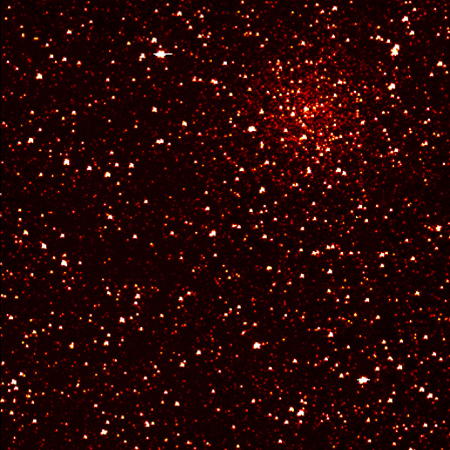
Image: The area pictured is 0.2 percent of Kepler’s full field of view, and shows hundreds of stars in the constellation Lyra. The image has been color-coded so that brighter stars appear white, and fainter stars, red. It is a 60-second exposure, taken on April 8, 2009, one day after the spacecraft’s dust cover was jettisoned. Credit: NASA/JPL-Caltech.
Loosely bound, the stars in NGC 6791 have begun to spread out from each other, the signature of what is called an ‘open cluster.’ The view is impressive but also blurry, an intentional effect that is being used, as this NASA news release points out, to keep the brightest stars from overloading the individual pixels in the spacecraft’s detectors. You’ll see the same blurry effect in the second image, which centers on a star known to have at least one planet orbiting around it. TrES-2 is a ‘hot Jupiter’ that makes its way around its host every 2.5 days.
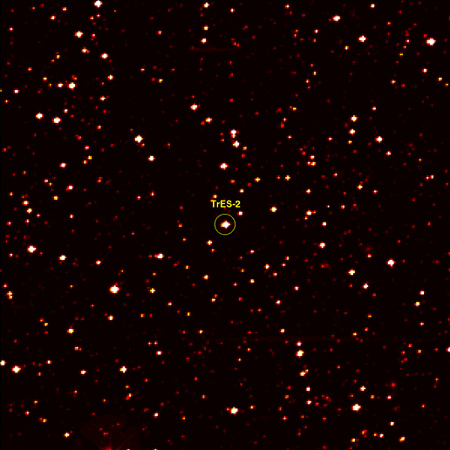
Image: Here we see an area one-thousandth of Kepler’s full field of view, showing hundreds of stars at the very edge of the constellation Cygnus. The image has been color-coded like the one above. Note the star orbited by TrES-2 in the center of the image. Credit: NASA/JPL-Caltech.
It’s interesting how our methods have come together in this second image. TrES-2 was detected by the Trans-Atlantic Exoplanet Survey, which uses 4-inch Schmidt telescopes equipped with CCD cameras (located at Palomar, Lowell Observatory and the Canary Islands) to run automated search routines. This humble instrumentation was able to snare the transit of a Jupiter-like planet across a star some 750 light years from Earth. The Keck Observatory confirmed the discovery, which will now be examined by a space telescope capable of seeing much smaller worlds.
TrES-2 thus offers an early tune-up for Kepler’s instrumentation as well as an early target for further science. We’re about to embark on a three and a half year project to sample light from 100,000 stars, a study that will vastly expand our existing catalog of exoplanets and give us our earliest sense of how common small worlds in the habitable zone of their stars are. With a 95-megapixel camera able to detect changes in brightness of 20 parts per million, Kepler will be ready to go as soon as the necessary calibration of its photometer and subsequent alignment is completed. Figure just a few more weeks before Kepler’s hunt begins in earnest.

The overall first light image is stunning — looks like you’re looking through the front window of the bridge of a scifi spaceship.
I wonder how long it will take to confirm the presence of TrES-2. With a period of 2.5 days, and the requirement of three transits to confirm a discovery, it shouldn’t be more than 7-10 days from the time they begin continuous observations. Depending on how commonplace Hot Jupiters are, we could have a whole passel of light curves to look at by the end of the year.
Exciting times indeed.
The SETI Institute has a video seminar given by one of the Kepler Mission scientists:
http://archive.seti.org/videos/Jeffrey%20Van%20Cleve.mov
It’s a RealPlayer movie and takes a while to download, but worth the wait.
Oops, my mistake. The link uses QuickTime. Sorry.
A SETI Institute link to an Adobe Reader slideshow for the above seminar:
http://archive.seti.org/pdfs/csc-lecture-vancleve.pdf
Any of y’all want to pick a star in the Kepler betting pool? Entry if free, rewards are imaginary:
http://lablemminglounge.blogspot.com/2009/04/my-god-its-full-of-stars.html
There is also a recent informative lecture from one of the researchers about how they deal with all the data Kepler will generate:
Sounding the Stars with Genetic Algorithms
http://www.youtube.com/watch?v=r4O10PSp7Dc
“In February 2009 NASA will launch the Kepler satellite, a mission designed to discover habitable Earth-like planets around distant Sun-like stars. The method that Kepler will use to detect distant worlds will only reveal the size of the planet relative to the size of the host star, so part of the mission is devoted to characterizing distant Suns using a technique known as “asteroseismology”. I have developed an automated approach to matching computer models of stars to such observations, based primarily on a parallel genetic algorithm. I will give a broad overview of how we can probe the insides of stars using seismology, and I will provide a general background on the operation of our model-fitting application. I will conclude with our first results on a nearby star: the Sun.
Speaker: Travis Metcalfe
Travis Metcalfe is an astronomer at the National Center for Atmospheric Research in Boulder, Colorado. He started his career in the backyard of his childhood home in rural Oregon, and continued it in such places as Tucson, Austin, and Boston before landing in Boulder four years ago.”
Thanks for the link, inquire. The SETI Institute seminar mentions this project in passing but didn’t go into much detail. These links complement each other nicely!
I’m having some computer problems of my own and not sure if my last comment was posted, but wanted to thank inquire for the link to the astroseismology project report. The SETI Institute Kepler seminar mentioned this project in passing but didn’t give much detail.