
Is Proxima Centauri really the closest star? Possibly not, a fact that was driven home just last year with the discovery of the red dwarf SO25300.5+165258 (a catchier name would have helped). At 7.8 light years, this tiny neighbor is the third closest to the Sun, but M-class stars are cool and dim, making them hard to detect. Even harder to find are the cool, failed stars known as brown dwarfs.
A new NASA mission called the Wide-field Infrared Survey Explorer will scan the sky in infrared looking for such objects, its detectors half a million times more sensitive than previous survey missions. “Approximately two-thirds of nearby stars are too cool to be detected with visible light,” said Principal Investigator Dr. Edward Wright of the University of California, Los Angeles, who proposed the new mission to NASA. “The Wide-field Infrared Survey Explorer will see most of them.”
Another bonus: WISE should be able to spot planet-formation in the making by depicting the dust discs around nearby stars.
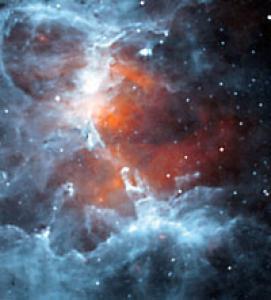 Image:: An infrared image of M16, the Eagle Nebula, taken by the ESA/ISO satellite. The false-color image was constructed from a 7.7 micron infrared exposure (shown as blue), and a 14.5 micron infrared exposure (shown as red). This nebula is the site of active star formation in the Milky Way Galaxy. WISE will observe the region in similar wavelengths of light to see the dust that often enshrouds star forming regions. Credit: European Space Agency – Infrared Space Observatory.
For more, see this JPL news release. The WISE home page is here.

0 Comments