
Exciting news on the antimatter front with the launch of PAMELA, a probe designed to detect antimatter in space. Standing for Payload for Antimatter Matter Exploration and Light-nuclei Astrophysics, the PAMELA spacecraft lifted off from Baikonur on June 15. The mission should be a significant upgrade to previous balloon-borne attempts to survey antimatter inflows in the cosmic rays falling on Earth.
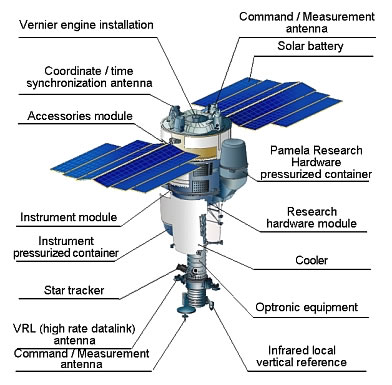
Image: A look at PAMELA, a dedicated mission to study antimatter. Credit: Firenze/INFN.
“It’s the first serious, dedicated space experiment to detect cosmic rays,” says Felix Aharonian, an astrophysicist from the Max Planck Institute in Heidelberg, Germany, in a news story by Mark Peplow on Nature.com. Which makes PAMELA an intriguing thing indeed, and worth considering in light of other studies of antimatter in space, such as James Bickford’s recent work on antimatter collection in the Solar System, and the long-term prospect of antimatter factories working around a gas giant like Jupiter, where naturally-forming amounts of the stuff may be surprisingly abundant and collectable.
But Centauri Dreams also likes the dark matter angle, which goes like this: particle collisions with the type of dark matter candidate called WIMPs (Weakly Interacting Massive Particle) may produce an excess of antimatter with a distinctive signature. That could be one more observational clue to the nature of dark matter, which remains, like dark energy, one of the biggest mysteries in the cosmological catalog.
It may seem unusual to see a particle physics slant to a space mission, but that’s the result of that community’s involvement with this concept from the start, as opposed to the traditional space science community at NASA and ESA. The mission is, in fact, a collaboration between Russia, Italy, Germany and Sweden, and the betting here is that it will prove unusually productive. In addition to Nature.com, New Scientist is also covering PAMELA’s three-year flight in a story by Maggie McKee that is not yet sequestered behind the magazine’s firewall.

Astrophysics, abstract
astro-ph/0702350
From: Cosimo Bambi [view email]
Date: Tue, 13 Feb 2007 20:32:35 GMT (15kb)
Antimatter in the Milky Way
Authors: C. Bambi, A.D. Dolgov
Comments: 13 pages, no figures
Observational signatures of existence of antimatter objects in the Galaxy are discussed. We focus on point-like sources of gamma radiation, diffuse galactic gamma ray background and anti-nuclei in cosmic rays.
http://arxiv.org/abs/astro-ph/0702350
thank you ljk i was just reading and writting long comments under the antimatter section of this site under a practical positron rocket. this seems to fit right in i am glad you brought it to everybodies attention! i appreciate it.respectfully your friend george
Two years of flight of the Pamela experiment: results and perspectives
Authors: M. Casolino, Pamela Collaboration
(Submitted on 28 Oct 2008)
Abstract: PAMELA is a satellite borne experiment designed to study with great accuracy cosmic rays of galactic, solar, and trapped nature in a wide energy range (protons: 80 MeV-700 GeV, electrons 50 MeV-400 GeV). Main objective is the study of the antimatter component: antiprotons (80 MeV-190 GeV), positrons (50 MeV-270 GeV) and search for antinuclei with a precision of the order of $10^{-8}$).
The experiment, housed on board the Russian Resurs-DK1 satellite, was launched on June, $15^{th}$ 2006 in a $350\times 600 km$ orbit with an inclination of 70 degrees.
In this work we describe the scientific objectives and the performance of PAMELA in its first two years of operation. Data on protons of trapped, secondary and galactic nature – as well as measurements of the December $13^{th}$ 2006 Solar Particle Event – are also provided.
Comments: To appear on J. Phys. Soc. Jpn. as part of the proceedings of the International Workshop on Advances in Cosmic Ray Science March, 17-19, 2008 Waseda University, Shinjuku, Tokyo, Japan
Subjects: Astrophysics (astro-ph)
Cite as: arXiv:0810.4980v1 [astro-ph]
Submission history
From: Marco Casolino [view email]
[v1] Tue, 28 Oct 2008 18:18:18 GMT (2989kb)
http://arxiv.org/abs/0810.4980
November 5, 2008
PAMELA Results Mean Only One Thing: Please Trust the Scientific Process
Written by Nancy Atkinson
Scientists from the PAMELA (Payload for Antimatter/Matter Exploration and Light-nuclei Astrophysics) orbiting spacecraft have published preliminary results, putting an end to months of speculation about the first direct detection of dark matter.
The science team was, in essence, “forced” to publish before they had conclusive results because other scientists “pirated” data from the team.
“We wanted to make our final results available to the scientific community once the data analysis was finalised,” PAMELA member Mirko Boezio said in an article in Physicsworld.com. “Given that our preliminary conference data are starting to be used by people, we felt this was a necessary step — not least because it provides a proper reference that correctly acknowledges the whole PAMELA collaboration and is available to the scientific community at large.”
This is not the way the PAMELA team wanted to present their results, but really, they had no choice.
Full article here:
http://www.universetoday.com/2008/11/05/pamela-results-mean-only-one-thing-please-trust-the-scientific-process/