
The Hubble Space Telescope cost far more to build and launch than the twin telescopes of Hawaii’s W.M. Keck Observatory, but Keck gathers twenty times the light and offers four to five times better resolution. Assuming, of course, that we can find a way to cancel out the effects of atmospheric blurring on its images. That’s where the science of adaptive optics comes in. By using a bright reference beacon nearby, an observatory like Keck can analyze atmospheric effects even as its observations are being made.
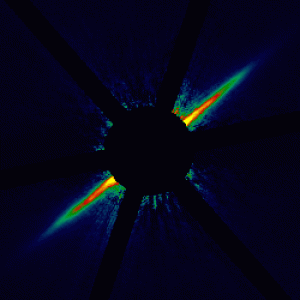 That this technique can be used in the hunt for extrasolar planets is clear. The infrared image to the right (credit: Michael Liu, IFA-Hawaii/W. M. Keck Observatory) shows a dust disk surrounding the star AU Microscopii. The image is 100 AU wide, roughly the size of our Solar System; Keck’s images are the sharpest ever obtained of a circumstellar disk, with an angular resolution of 1/25 of an arcsecond, about 1/500,000 the diameter of the full moon.
But adaptive optics has a catch: the small number of sufficiently bright nearby stars limits these methods to about one percent of the sky. Now, according to Keck scientists at the Mauna Kea site, a way around this problem has been discovered. Called the Laser Guide Star Adaptive Optics system, the new method removes the bright star limitation by placing a laser guide star as a reference in front of any target. The result: wide-field imaging with adaptive optic techniques, and unprecedented resolution for an Earth-based telescope.
From the observatory’s news release on the laser system:
By using a laser to create a “virtual star,” astronomers can study any object in the vicinity of much fainter (up to 19th magnitude) objects with adaptive optics and reduce its dependence on bright, naturally occurring guide stars. Doing so will increase sky coverage for the Keck adaptive optics system from an estimated one percent of all objects in the sky, to more than 80 percent.
“This new capability of using a laser guide star with a large telescope has invited astronomers to start exploring the night sky in a much more comprehensive manner,” said Adam Contos, optics engineer at the W.M. Keck Observatory.”In the future, I would expect most major observatories to be installing similar systems to take advantage of this incredible enhancement to their AO capabilities.”
Keck has already been a major player in the hunt for extraterrestrial planets; witness its involvement in the recent discoveries around 55 Cancri, which used Keck data. The new laser methods promise even more remarkable results. For more on the whole field of adaptive optics, check the Center for Adaptive Optics Web site.

0 Comments